Get DVDs From Amazon

http://www.flkcinema.com/Forum.asp

http://www.flkcinema.com/Forum.asp
The Place to Chat about Rare Kung Fu and More!

HK FLIX Latest Additions

Wednesday, May 30, 2007

Dragon Dynasty Shanghai Express DVD Review

Video: Brian White and the team at Dragon Dynasty have delivered an excellent transfer of this Fortune Star re-mastered print. The colours are extremely strong and vibrant, and yet at the same time do not suffer from any form of over-saturation (ie no heavy pink tones, although they pop up during the interview clip montages, maybe from an earlier transfer, but not in the main picture). The detail and clarity of the print are excellent (if you want a comparison to how the film used to look check out the un-restored deleted scenes) and allow for a great ease in picking up a lot of the cameos in this film. The transfer is 2:35:1 and of course enhanced for 16X9 televisions. The picture quality makes Shanghai Express and its spaghetti-western influences a real beauty to behold.

Audio: The primary track we listened to was the Cantonese mono track (which I can confirm is just that mono, thankfully Dragon Dynasty has never suffered the problem of receiving fake mono mixes). It sounds a tiny bit harsh, but that has more to do with the recording techniques in Hong Kong at the time, more so than anything else.The classic sound effects are present and make the film all the more enjoyable. The are also English and Cantonese 5.1 mixes available and both sound fine nothing having any dropout or sound problems. There is also a audio commentary track with Bey Logan.

Extras: Brian White, Bey Logan, and the team at Dragon Dynasty have given us a bevy of extras to enjoy for their special edition of Shanghai Express. First, we have the standard (and by standard, I mean excellent) Bey Logan commentary which does an excellent job at pointing at the various cameos in the film, the different versions, and even the role of Yusaki Kurata in cherographing some of the fights. All in all a great track for a great film. There is in informative 14:46 long video interview with Sammo Hung which discusses the production of the filming. Then we get a 24 minute interview with Cynthia Rothrock talking about her introduction to the martial arts and her career, specifically Shanghai Express and also tells you why working in the United States is a lot easier than being in Hong Kong. We also get a great 20 minute interview with Yuen Biao talking about the film and the dangers of shooting some of the stunts. We then get a special treat for US fans as Dragon Dynasty gives fans an exclusive that was not even on the UK or HK discs of Shanghai Express: deleted scenes. There are four scenes of varying running time in un-remastered condition. Paragons of Virtue runs nearly 6:47 minutes long, Roof Rage runs 19 seconds, Close, but No Cigar runs 47 seconds and RestroomRretreat runs 31 seconds.

Final Thought: With a great transfer and sound setup completed with unique extras that won't appear anywhere else in the world makes Dragon Dynasty's Shanghai Express a EASY buy.

Tuesday, May 29, 2007

Shaw Brother's release schedule for the second half of 2007 is up!


Shaw Bros release schedule second half of 2007 is up!

Not much else to say, thanks to Donnie 1974 for finding this. Just click on the link and you'll find a link to the list or just read it here :)

BBC Dracula coming to R1

BBC Dracula finally hitting US stores!

On September 25 Warner/BBC Video are going to release the 1977 miniseries Count Dracula on DVD for $14.98


Thanks to thebrainfollower, check the link above for the discussion about it at CHFB

New DVD Sets Coming in Time for Halloween!

New DVD Sets Coming in Time for Halloween!
Link above to CHFB for the full story!

At the CinEvent Film Conference in Columbus I ran into reps from studios that are releasing some classics for the Halloween season this year (Thank you Michael, Jessica and friends). Three classic horror box sets are coming to DVD this fall. One from Columbia and one from Fox. The Columbia set will include THE WEREWOLF (1956 with Steven Rich), CREATURE WITH THE ATOM BRAIN (1955 with Richard Denning), ZOMBIES OF MORA TAU (1957), THE GIANT CLAW (1957) and one other title to yet announced. The suggested retail price will be around 24.95. They will not be released separtately. The Fox set will include CHANDU THE MAGICIAN (1932 with Bela Lugosi as Roxor), THE UNDYING MONSTER (1942, Fox's answer to THE WOLF MAN), THE LODGER (1944 with Laird Cregar), HANGOVER SQAURE (1945, also with Cregar) and MAN HUNT (1941 with Walter Pidgeon, Joan Bennett, George Sanders, John Carradine and Roddy McDowell). Finally Kino will be packaging some of their horrors in a new box set (all previously released on single discs).

Special thanks to Jim Clatterbaugh

Monday, May 28, 2007

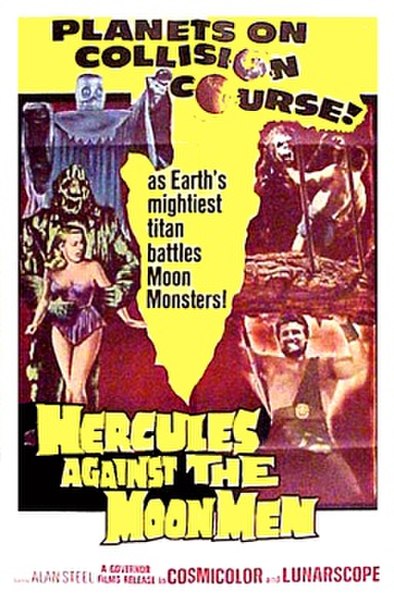
Hercules Against the Moon Men (1964) Review


Hercules Against the Moon Men

I first came across HATMM when I was watching Mystery Science Theater 3000 a year or two ago. I had stumbled across a very funny little film full of action, bright (well their faded now) colors, and crazy rock men. I had figured I would never see it again outside of the MST3K episode, but much to my surprise it was on a 50 pack Sci-Fi DVD set from Mill Creek Entertainment, which was likely taken from a copy put out by Retromedia (which looks just like the print on MST3K).

So I put the film film in yesterday not sure what to expect, but much to my surprise, besides the infamous sandstorm thrid act which really slows the picture down, I found a really fun sword and sandal film. It succeeds generally in being a briskly paced (once again ignoring the sandstorm) Italian epic with nice costumes and sets and some really out there villains in regards to the rock people of the moon. Hercules must help liberate a kingdom ruled by a Queen of pure evil, who makes the villagers scrafice their children in order to please her cruel moon men overlords (nice, huh?).The action is generally pretty good too as Alan Steel (aka Sergio Cian) (as Hercules plays a really upstanding guy full of energy and also blessed with a decent dubber), finds creative ways to dispatch his enemies. This is instead of the simple, toss a guy across the room school of ass-kicking. While I like the voices on the dubbers the lip-syncs are really off (not as a tech error, just poor syncing in the script), but once you get into the swing of things you no longer mind it as I said the voices are generally good. The costumes like on most Italian epics are gorgeous and a pleasure to look at.

This title can be found easily on numerous PD sets or from Retromedia (it is the same print through). I highly recommend you give this great Italian sword and sandal film a try.

Here is a little fun fact from wikipedia:

In the original Italian language version, the hero was not Hercules but Maciste, and its original Italian title was Maciste e la regina di Samar (Maciste and the Queen of Samar). Its French title was Maciste contre les hommes de pierre (a rough translation would be Maciste vs. the Stone Men), but the English distributors dubbed him to be Hercules, because Maciste, originally a hero in silent Italian cinema, was not well-known to American audiences.


Join the discussion of the film at Classic Horror Film Board:
Hercules Against the Moon Men

Friday, May 25, 2007

UFC 71 Preview and Predictions: By Keith Shillan

It is about time. It feels like ages since we had a UFC main event that I got this excited for. It was probable UFC 65 when Matt Hughes fought Georges St. Pierre for the second time, that made me this excited. On Saturday night, the UFC's posterboy Chuck "the Iceman" Liddell tries to avenge his only lost in his career that hasn't been avenged. The man standing in his way is the charismatic body slamming machine called Quinton "Rampage" Jackson. Lets take a closer look at the UFC's PPV card.

Chris "the Crippler" Leben vs Kalib Starnes

Both these fighters became popular by their stints on the Ultimate Fighter reality show. Leben on the debut season and Starnes on the third seaon. Both fighters are coming of disappointing loses. Leben known for his confidence (almost cocky) personality became a household name and his hands also made him a fan favorite. Leben was a disappointing on the show. Losing a decision to the then inexperienced Josh Koscheck and then losing on a cut to Kenny Florian (a fight that Leben was easily winning). Since the show Leben has had his ups and downs. He first beat Jason Thacker by first round TKO and then won a split decision slugfest against Patrick Cote. His wins would get even more impressive with first round submission (armbar) victory over Edwin Dewees, first round TKO victory over Jorge Rivera, and a unamious decision over Luigi Fiorvanti. Yet as of late times have been different. First, Leben was given a Muay Thai Kickboxing 101 lesson from current middleweight champion Anderson Silva, which made Leben look like an amateur. Leben would recover with a second round KO over Jorge Santiago, but was submitted by Jason MacDonald in their matchup.

As for Starnes, he also was disappointing on his stint on the reality show. He was the early favorite on the show. He made short work of boxer Mike Stine but lost to the show champion Kendell Grove when the fight was stopped due to Starnes receiving a rib injury. Starnes would make his actually debut in the UFC by making short work of Danny Abbadi by first round submission. He would then lose a uninspring third round TKO lost to Yushin Okami.

The key to Starnes victory is to take Leben down, where he holds an advantage in the submission game. I just don't see this happening. I believe Leben has a good enough take down defense (due to having trained in the past with top wrestlers like Randy Couture, Matt Lindland, and Dan Henderson). Leben clearly has the advantage in the hands. Every throw he makes has knockout written all over it. Leben has a head made off cement (Yes, Anderson Silva breaks cememt) and can take a beaten. This fight is probable due or die for both fighters, with their future with the UFC in jeopardy. I expect Kalib to try to take it to the ground but being unsuccessful, and see Leben landing a huge shot late in the first round. Leben by KO.

"The Dean of Mean" Keith Jardine vs Houston Alexander

The TUF alumni continues when season 2 member Jardine faces off against UFC newcomer Alexander. Jardine is currently a top contender in the UFC Light Heavyweight Division. Jardine could arguable be undefeated in the UFC. He lost to fellow Greg Jackson submission academy teamate Rashad Evans on the show but has been on a tear since. Beating fellow castmates Kerry Schall and Mike Whitehead in his first two UFC matches but then lost a very controversial decision to Stephan Bonnar (I gave it to Jardine). He would redeem himself with a come from behind decision win against Wilson Gouveia. His success would continue, when he notched the biggest win of his career when he demolished fan favorite Forrest Griffin. Jardine looks to make a bid for the next title shot by using Alexander as his victim.

I can't really comment on Alexander, because I have not actually seen him fight before. He is really attempting to tackle a huge obstacle when he takes on top contender Jardine. Jardine has KO power in his hands, crisp leg kicks, and a good gas tank (which comes from training with team Jackson). I expect Jardine's experience alone to carry him to an easy victory. Expect to see Jardine showcase his hands with a first round TKO win.

Ivan Salaverry vs Terry Martin

It has been a long time since Ivan Salaverry has graced the UFC. He was last seen in the UFC losing a lackluster fight to Nate Marquardt back in August 2005. Salaverry first bursted onto the UFC seen by dismantling AndreiSemenov back in 2002. He would then lose a decision to top Middleweight contender Matt Lindland. He would get back on the winning path with back to back submission wins. He first beat Tony Fryklund by body triangle (possible the only one I have seen end a match), and then by triangle choke (led by an awesome kick from the bottom position) over the always tough Joe Riggs. Salaverry was then matched up on the very first main event of the UFC Fight Night card against Nate Marquardt. To the UFC disaproval Salaverry and Marquardt danced around the octagon with little action. Marquardt won the fight, and Salaverry was booted from the UFC. Only to have fought once since.

Martin has also had his share of ups and downs during his time in the UFC. Martin first came to the UFC as a Light Heavyweight. In his debut, he fought the heavy handed James Irvin. Martin known for his wrestling, toke Irvin down and controlled him for the first round. It was the opening of the second round that will always be in the UFC highlight reel history. Irvin threw one of the best flying knees in MMA history, KOing Martin in a flash. Martin would be invited back to the UFC matching him against Jason Lambert. The fight was pretty competitive until Martin's gas tank ran empty and Lambert would eventually win a TKO victory in the second round. Martin would then move down to the middleweight and have a highlight reel win off his own with a 14 seconds KO over Jorge Rivera.

This matchup matches Martin's size and wrestling ability against Salaverry's submission game. I expect Martin to come out with the early lead. Taking Salaverry down and controlling him on the ground. Expect to see Salaverry transition from submission attempt to submission attempt. I expect Martin to neutralize his attempts early but to eventually gas out late in the fight. I see Salaverry catching Martin in a submission in the early third round.

Karo "The Heat" Parisyan vs "The People's Warrior" Josh Burkman

This fight has fight of the night written all over it. Karo Parisyan has been a top UFC welterweight contender for a while. He has exciting victories of Nick Diaz, Chris Lytle, and Drew Fickett to name a few. Losing close decisions to former welterweight champ Geoges St. Pierre and also to top contender Diego Sanchez. Karo has unbelievable Judo throws and is awesome at the submission game. His Kimura against Dave Strasser is amazing. Karo has been know for having been in wars. He also a smart vet with a victory over current UFC welterweight champ Matt Serra.

Burkman is another former TUF 2 cast mate. He won a decision win over Melvin Guillard on the show. He would suffer an injury during that fight which would cause him to not be able to continue on the show. Burkman would make his first two UFC fights electrifying ones. Making short work of both Sam Morgan and Drew Fickett. He would lose by rear naked choke to welterweight contender Jon Fitch but would rebound with back to back decision victories over the always tough Josh Neer and the UFC debuting Chad Reiner.

This fight is going to be exciting. Both fighters bring fire works to the table. Burkman is very well rounded. He has great wrestling slams like his KO slam of Sam Morgan and a very underated submission game (Ask Drew Fickett). Burkman probable has the edge in the hands. I truly belive that Burkman could win a boring decision by staying away and pop shotting Karo to a three round victory ala Koscheck vs Sanchez. Yet, I don't think Burkman is that style of fighter. He loves to be aggresive and always come forward. Karo on the other hand, has world class Judo skills. His throws are highlight reel material. He also has the advantage on the ground. When on his back, he is always attempting submission attempts. I expect to see everything in this fight. Both guys throwing haymakers, Burkman slamminh Karo, Karo throwing Burkman, Burkman ground and pounding, Karo making submission attempt after attempt. This will be a closer fight then some expect. I see Karo using is experience in big fights to propel him into winning a split decision.

Chuck "the Iceman Liddell vs Quinton "Rampage" Jackson

To many casual fans, this is a no-brainer. Chuck will win. Chuck always wins. To the hardcore fans, they know it is not always true. Jackson is the last fighter to beat Chuck. He is the only fighter to hold a win over Chuck that he has not avenged. These two fighers last fought almost 4 years ago. Quinton, as he would say himself, "whooped Chuck's ass". He won the standup, and toke Chuck down with one of his slams. He then stamped Chuck with a tremendous ground and pound display. Yet, since then both fighters have taken different paths.

Rampage has gone 7-3 since. He was brutally Kod twice by Wanderlei Silva. He also did not have one second of offense when he lost by 1rd TKO to Maurice "Shogun" Rua. He also won two controversial decisions over Murilo Ninja and Matt Lindland (I gave him the win over Ninja, and I am in the minority but the lost to Lindland). He did have a spectacular KO over Ricardo Arona (Best slam in the history of MMA) and his TKO win over Marvin Eastman.

Chuck on the other hand has been amazing. He has been on a 7 KO/TKO win streak. He avenged loses to UFC Heavyweight champ and Hall of Famer Randy Couture (twice) and Jeremy Horn, while beaten rivals Tito Ortiz (twice), Vernon White, and Renato Sobral (twice, once before he fought Quinton and once after).

This is a fight that Chuck and fans have been asking for a long time. These two match up great in so many ways. On the feet, Chuck is a counter puncher that throws pin point accurate bombs that have put the best of the best to sleep. While Rampage has an aggresive straight ahead, crisp punching style,has an awesome double leg takedown that is finished with a huge slam. Chuck on the other hand has one of the best takedown defense in the game. Wrestlers like Randy Couture (not their first fight) and Tito Ortiz have had awful times trying to take him down. If it hits the ground, Rampage has breath taking ground and pound (and we haven't even seen him throw elbows yet) yet Chuck is know for simply just getting back to his feet as quickly as he has been taking down. In their first fight, Quinton held Chuck down but was helped by knees to the ground which is illegal in the US.

This fight is great. I have changed my mind tons of times already. Yet, if I have to go on the record. I am taking Chuck by 4th round TKO. Though Rampage and his camp has sounded so confident, Rampage has had a bad history in title fights. If Chuck does win this fight, his legacy might make him the greatest UFC fighter in history and leave him second on the list to Fedor Emelianenko as greatest on the MMA list.

BTW-

Prelims predictions:

Din Thomas vs Jeremy Stephens - Din by UD
Sean Salmon vs Alan Belcher - Salmon by dec
James Irvin vs Thiago Silva - Silva by 1rd TKO
Wilson Gouveia vs Carmelo Marrero - Gouveia by 3rd sub

Email ShilltheThrill2000@yahoo.com for any questions or comments

K1 World Max Card Set for June 28th

On June 28th K1 will hold its third and final K1 Max event of the year at the Nippon Budokan in Tokyo Japan. The K1 Max division features the sports top competitors in the 90kg (154lbs) weight class in very competitive action packed match ups. This card features a tournament format along with an intriguing selection of “Super Fight” bouts. The tournament bracket has not been finalized but we will have a full report closer to the date of the event.

K1 World Max 2007, Nippon Budokan – Tokyo Japan

K-1Rules / 3min. x 3R Ex1R
Masato vs J.Z. Calvan
Buakaw Por. Pramuk vs Nicky Holtzken
Andy Souwer vs Ian Schaffa
Drago vs Mike Zambidis
Yoshihiro Sato vs Denis Schneidmiller
Albert Kraus vs Virgil Kalakoda
Artur Kyshenko vs Soo-Hwan Lee

Super Fight / K-1Rules / 3min. x 3R Ex1R
Takayuki Kohiruimaki vs Tsogto "SHINOBU" Amara
TATSUJI vs Andy Ologun


Mike Squier

Wednesday, May 23, 2007

Update on ABOVE THE LAW and SHANGHAI EXPRESS Specs

Review DVDs came today for the two above titles and Above the Law does feature an Alternate Ending as a feature and there are also Deleted Scenes on the Shanghai Express disc. Expect full details in our upcoming reviews.

Tuesday, May 22, 2007

Cover's for Hard Boiled and More DD Shaws


Thanks to Ricky at asiandvdguide.com's forums for finding HB and Morgoth for finding the Shaws on Amazon.

Final Specs for SHANGHAI EXPRESS and ABOVE THE LAW.

Before you ask. I don't know about the deleted scenes or alternate ending, this is only what was listed on the specs given to me. I should have a review copy of both discs tomorrow and hopefully that should clear up any questions about the content. Those features (deleted scenes and an alternate ending) are listed on the Dragon Dynasty website, so it may just be nothing. I'll post some cover pics later.

“Shanghai Express” (starring Action Legend Yuen Biao)

Running Time: 96 minutes

MPAA Rating: PG-13

Languages: English and Cantonese

Subtitles: English and Spanish

Sound: English 5.1, Cantonese Mono and 5.1

Synopsis:

Hilarious escapades and breathtaking action collide in this stunt-filled thrill ride from the director of Jet Li’s Once Upon a Time in China and America.

Before Hollywood produced Shanghai Noon, Hong Kong created Shanghai Express: a fun-filled adventure where the Far East meets The Old West. Featuring an all-star cast of Sammo Hung (Kill Zone), Yuen Biao (Once Upon a Time in China ), and Cythia Rothrock (Above the Law), this action-packed caper follows a band of unlikely heroes who team up to protect their hometown from ruthless bandits. With one of the greatest action finales, the movie culminates in an all-out showdown of martial arts icons.

DVD Special Features:

· Feature commentary with Hong Kong cinema expert Bey Logan

· Way Out West: an interview with Yuen Biao

· Trailblazer featurette with Cynthia Rothrock

· Express Delivery: an interview with director and star, Sammo Hung

· Hong Kong promotional trailer

· US promotional trailer


“Above the Law” (a film by Corey Yuen)

Running Time: 96 minutes

MPAA Rating: Unrated

Languages: English and Cantonese

Subtitles: English and Spanish

Sound: English 5.1, Cantonese Mono and 5.1

Synopsis:

When a corrupt judicial system frees the crime bosses who killed an innocent family, a renegade prosecutor (Yuen Biao, Once Upon a Time in China ) takes justice into his own hands. Packed with full-contact martial arts action, hi-octane car chases, and death-defying stunt sequences, this explosive thriller from action-director Corey Yuen (The Transporter) delivers non-stop excitement from beginning to end!

DVD Special Features:

· Feature commentary with Hong Kong cinema expert Bey Logan

· The Vigilante: an interview with producer and star, Yuen Biao

· Action Overload featurette with Cynthia Rothrock

· From The Ring to The Silver Screen featurette with Peter Cunningham

· Hong Kong promotional trailer

· US promotional trailer

Sly is back as JOHN RAMBO! Insane Violence Returns Too!

Most of you will have already seen this clip provided by AICN of JOHN RAMBO, the new Rambo film. Still, if you haven't you missing out on some insane violence and as a public service HKFCN wants to make sure you not missing a thing! Still we were asking ourselves where is the classic Jerry Goldsmith theme!?!?!

Enjoy!

Bruno Mattei Passes Away at 75.

Bruno Mattei Dies at 75

Bruno Mattei, a cult director known for some insane films including one that featured gobs of stocked nature footage (Hell of the Living Dead), his own version of Predator (Robowar), and a post-apocalyptic epic (Rats) passed away recently while in coma brought on by stomach complications. While his films were not art by any means one could never say that a Bruno Mattei film was anything (for better or worse), but a unique experience to watch. More details at the link above at CHFB.

Monday, May 21, 2007

The Wolf Man (1941) Audio Review/Discussion


We did a review/discussion for The Wolf Man (1941) that we hope you will enjoy. This film is one of the great classic horror/monster films of its time and is certainly worth a look at.

We hope you enjoy it. Here is the download link:

http://www.megaupload.com/?d=6Q7D9EBP


Note: You may have to turn the volume up a little bit as the recording volume was low.

Wednesday, May 16, 2007

Dragon Dynasty Shaw Specs

From Chopsocky over at Kung Fu Fandom

http://p081.ezboard.com/fkungfufandomfrm24.showMessage
?topicID=5071.topic

these are the features on king boxer

Feature Commentary by Film Scholars David Chute
Elvis Mitchell, and Filmmaker Quentin Tarantino
Interview with Director Chang-Hwa Jeong
Interview with Director Lau Kar Weung
Interview with Film Scholars David Chute and Andy Klein
Commentator Biographies
Poster/Stills Gallery
Trailer Gallery


My young Auntie

Feature Commentary by Film Scholars David Chute and Andy Klein
Interview with Star Kara Hui Ying Hung
Interview with Film Scholars David Chute and Andy Klein
Commentator Biographies
Poster/Stills Gallery
Trailer Gallery


One armed swordsman

Feature Commentary with Film Scholars David Chute, Andy Klein and Filmmaker Quentin Tarantino
Interview with Star Jimmy Wang Yu
Interview with Film Scholars David Chute and Andy Klein
The Master: Cheng Cheh
Commentator Biographies
Posters/Still Gallery
Trailer Gallery

Feature Commentary by Film Scholar Andy Klein and the RZA
Interview with Star Gordon Liu
"Shaolin: A Hero Birthplace"
Interview with Film Scholars David Chute and Andy Klein
Commentator Biographies
Posters/Stills Gallery
Trailer Gallery
US Promotional Trailer
Music Video for Wu-Tang Clan's "Gravel Pit"

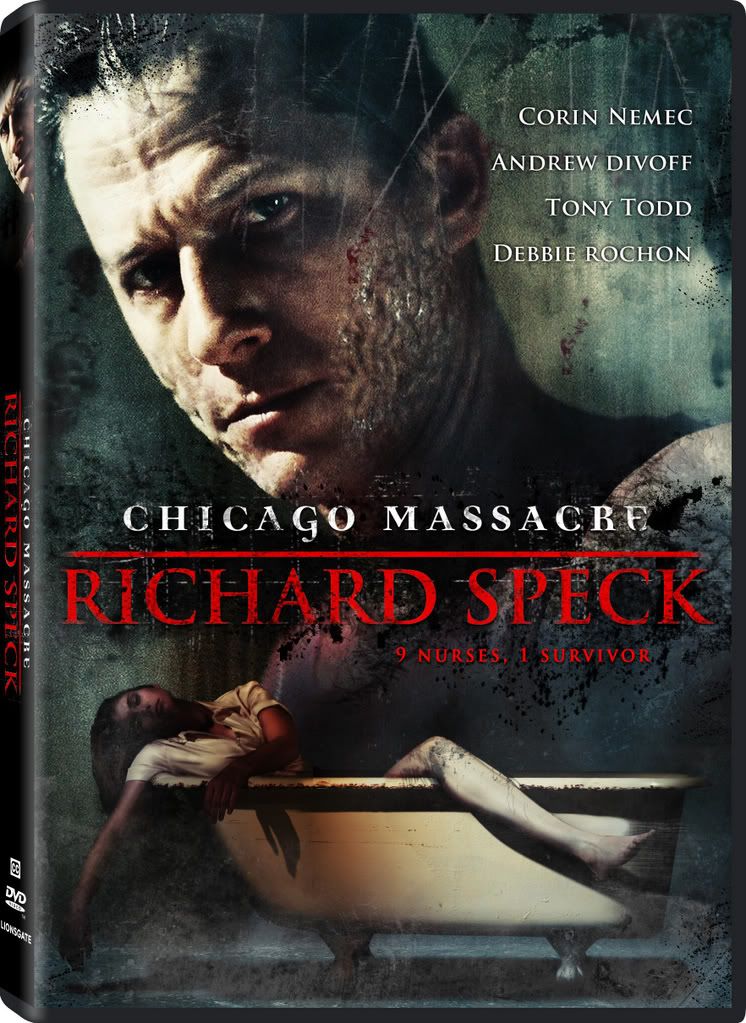
Chicago Massacre: Richard Speck DVD Preview


Here is the upcoming info on this new true crime film from Lionsgate. Thanks to Matt from Specops for the press release and cover info. We also plan to have a trailer up soon.


CHICAGO MASSACRE: RICHARD SPECK


Street Date: 6/5/07

Order Date: 5/9/07
DVD SRP: $26.98
PROGRAM DESCRIPTION

On July 14th, 1966, Richard Speck broke into a South Chicago townhouse and took 9 student nurses hostage. There he methodically beat, raped, and stabbed the young women to death in one of the bloodiest mass murders in American history. Brought to life by television’s Corin Nemec and a celebrated horror cast including, Andrew Divoff, Tony Todd and Scream Queen Debbie Rochon, this terrifying thriller is a must-see for every fan of true-crime.

DVD SPECIAL FEATURES

· Audio Commentary Featuring Director Michael Feifer and Actor Corin Nemec

· Stills gallery

CAST

Corin Nemec

TV’s “Parker Lewis Can’t Lose,” TV’s “Stargate SG-1,” TV’s “Stephen King’s The Stand”

Andrew Divoff

Wishmaster, Air Force One, Wishmaster 2: Evil Never Dies, TV’s “Lost”

Tony Todd

Candyman, Final Destination, Night of the Living Dead, The Rock

Debbie Rochon

Terror Firmer, Tromeo and Juliet, famed Fangoria radio hostess

PROGRAM INFORMATION

Year of Production: 2007
Title Copyright: © 2007 North American Entertainment Inc, All Rights Reserved.
Type: Home Entertainment Premiere
Rating: R for disturbing sadistic violence including rape, terror, sexuality, language and some drug content
Genre: Horror
Closed Captioned: English Closed Captioned
Subtitles: English and Spanish
Format: Widescreen
Feature Running Time: 91 minutes
DVD Audio Status: 5.1 Surround and 2.0 Stereo

Circle of Iron screencaps

Here our screencaps for Blue Underground's new 2-disc special edition of Circle of Iron. Thanks to Specops.

Expect a full review in the next couple of days.


MMA Consortium Plan to Make Waves in UFC Monopoly

Calls on MMA Legends to Lead Way

On June 2, 2007 the MMA cartel of K1, Bodog, EliteXC, Cage Rage and Spirit MC will hold a colossal fight card in California at the storied Los Angeles Coliseum.

This event will mark the first time K1 Dynamite, the mixed martial arts wing of FEG’s K1 promotion, has attempted to make inroads into the UFC dominated North American market. K1 Dynamite has built a massive fan base in Asia with their extravagant production values and a roster filled with names like Sakuraba, Yamamoto, Gracie and Hong Man-Choi. FEG hopes that their efforts within Asia will translate into a favorable reception by “hardcore” and casual MMA fans alike when they break ground in the United States.

Although FEG has built the K1 brand into a juggernaut promotion in Oceania, Asia and many other countries many industry observers feel the K1 Dynamite secret to success will not transfer over to North America. Anyone who has witnessed a K1 Dynamite event can attest that the organization uses a “bizarre mix” of freak matches, challenge matches and Broadway showmanship to fill out each fight card. Many North American MMA fans have a hard time accepting this “bizarre mix” as it makes the sport resemble professional wrestling, something which the sport has been trying to distance itself from since its North American inception. FEG hopes that the entertainment value they offer will bring a record number of fans to this event despite what most people see as a lack of marketing on the side of FEG.

When it comes to marketing FEG has taken a “build it and they will come” approach to their first show on U.S. soil. Clearly FEG hopes that the big name athletes they have brought to the table will transfer into big attendance numbers and pay per view buys. Not until recently has this co-op of MMA promotional organizations begun to heavily promote this event, but with just over two weeks to the event it may be a case of too little too late. Only time will tell if this strategy is the best approach to be taken when attempting to attract North American MMA fans. MMA fans on this continent are used to being the victim of an all out media bombardment before each monthly UFC event and that is from a brand that people recognize, will the response be the same for a company that is fairly unknown to the casual fan ? One thing is for sure, you can not underestimate the drawing power of a company that once attracted over 90,000 MMA fans to ONE EVENT!

K1 Banks On Big Names from the Past for Future Success

K1 Dynamite has scheduled a long overdue rematch between two MMA legends to highlight their June 2nd card. Royce Gracie and Kazushi Sakuraba will again do battle in a repeat match of their epic Pride 2000 Grand Prix war. Sakuraba defeated Gracie in the first match when, after 90 minutes, Royce was forced to throw in the towel. Gracie has stated in many interviews leading up to the June 2nd fight that it is not personal and he is not looking for revenge. That being said, one has to think that Royce will be looking to restore his family name when he enters the ring to face “The Gracie Hunter” Sakuraba.

The rest of the card, which is really three MMA events in one, will be rounded out with solid bouts between current MMA / K1 stars, professional wrestling superstars and former professional athletes. This show will be one of the biggest MMA spectacles North American fans have seen to date.

The fight card will be broken down is greater detail as we get closer to June 2nd. The following is the current tentative fight card.

Prelim Fights (Will not air on Showtime or PPV)

Gesias “JZ” Calvancanti vs. Nam Phan
Hideo Tokoro vs. Brad “One Punch” Pickett
Javier Vasquez vs. Katsuhiko Nagata

Fights that will air on Showtime from 9:00pm – 10:00 pm EST

Jake Shields vs. Ido Pariente
Gina Carano vs. Jan Finney
Antonio Silva vs. Jonathan Wiezorak

Fights that will air on pay per view from 10:00pm – 1:00am EST

Brock Lesnar vs. Hang Man-Choi
Royce Gracie vs. Kazushi Sakuraba (Pending Sakuraba’s medical clearance)
Melvin Manhoef vs. Yoon Dong Sik
Ray Sefo vs. Marvin Eastman
Mighty Mo Siliga vs. Choi Mu Bae
Johnnie Morton vs. Bernard Ackah

Suggested pay per view price is $34.95

Meet our newest writter: Mike Squier

Bio

Name : Mike Squier
Age : 28
Profession : Marketing

I am a life long boxing fan and I have been a fan of K1 and MMA since I watched my first event some fifteen years ago. I have trained in everything from boxing to Jiu Jitsu and I continue to lace up the mitts every chance I get.

I hope to bring clear and concise K1 news to the site which will help the readers of the page stay up to date with the happenings of this great organization. Thank you very much and I look forward to bringing you more exciting K1 news

Tuesday, May 15, 2007

Duel with the Devil Screencaps


Thanks to Laura and Fusian

Monday, May 14, 2007

Fight for the Agreement Screencaps

Thanks to Laura and Fusian. Looks like another solid release.


Saturday, May 12, 2007

First Dragon Drynasty Shaw Brothers Covers Displayed!


Thanks to LorenzoL at the DVD Talk Forums for posting these covers. Both DVDs are scheduled to come out in June.

Upcoming Lineup for June 2nd K-1 Dynamite USA Show

K-1 is going to be running a show with ProElite and also Showtime on June 2nd in Los Angeles. The nice thing about them hooking up with Showtime is that you will get some free previews for the show via Showtime. You can already TIVO them now, actually. The other thing is that the PPV airdate will be the same day as the show as opposed to the normally taped ones that sometimes take a month to appear on US PPV, if they appear at all.

The cost, I think, will be the same if less than a regular UFC PPV. The features being touted are the debut of Brock Lesnar vs Hong-Man Choi and Royce Gracie vs Kazushi Sakuraba. Each is scheduled to go 5 rounds for 5 minutes.

At the moment the only matches scheduled are HERO's Rules MMA matches with no K-1 Kickboxing one, perhaps in an attempt to compete with UFC. Personally, I think it's a bit of a shame, as traditional Dynamite shows often mix the two with, in my opinion, great success. Still, the card looks solid.

Tickets are still available, with information on how to get them at the bottom of the post.

Here is the full card (which has links to fighter bios)

http://www.k-1.co.jp/k-1gp/top775.htm


Dynamite!!
SoftBank presents Dynamite!! USA in association with ProElite
Date : Saturday, 02nd, June 2007
Gates Open : 3:30p.m. Start : 5:00p.m.
Place : Los Angeles Memorial Coliseum, Los Angels , U.S.A.
(3939 South Figueroa Street, Los Angeles, CA 90037)

HERO'S RULES / 5Min. 5R
Brock Lesnar
U.S.A. / Minnesota Martial Aers Academy

VS

Hong-Man Choi
Republic of Korea / Freelance

HERO'S RULES / 5Min. 5R
Kazushi Sakuraba
Japan / Freelance
VS

Royce Gracie
Brazil / Gracie Jiu-jitsu

HERO'S RULES / 5Min. 3R
Mighty Mo
U.S.A. / Freelance

VS

Mubae Choi
Republic of Korea / TMG

HERO'S RULES / 5Min. 3R
Melvin Manhoef
Holland / Show Time

VS

Dong Sik Yoon
Republic of Korea / Freelance

HERO'S RULES / 5Min. 3R

Javier Vazquez
U.S.A. / Millenia Jiu-Jitsu

VS

Katsuhiko Nagata
Japan / New Japan Pro-Wrestling Masato

HERO'S RULES / 5Min. 3R

Brad Pickett
U.K. / Elite Fighting Systems

VS

Hideo Tokoro
Japan / Team ZST

ProElite & SHOWTIME Presents Match / HERO'S RULES / 5Min. 3R

Jake Shields
U.S.A.

VS

Ido Pariente
ISRAEL

ProElite & SHOWTIME Presents Match / HERO'S RULES / 5Min. 3R

Gina Carano
U.S.A.

VS
Jan Finney
U.S.A.

Participants:

Ray Sefo
New Zealand / Ray Sefo Fight Academy

Jonnie Morton
U.S.A.

J.Z. Calvan Brazil / American Top Team Jonnie Morton

Antonio Silva
Brazil / FIGHT.CO

Presented by:
FEG USA Inc.
Main Sponsor:
SOFTBANK CORP.

Tickets (All tickets include tax)
Floor Seats (All reserve tickets):
$1000
$250
$100

General Admission Tickets:
$60
$30
$10

Tickets available by :
Ticketmaster
Internet : http://www.ticketmaster.com

LA Coliseum Box Office Contract Info:
3911 South Figueroa Street
Los Angeles, CA 90037
E-Mail: boxoffice@lacoliseum.com
Tel: 213-747-7111


Thursday, May 10, 2007

Now We're Covering MMA: Miami Herald reporter living in combat world past.

From our newest reporter Keith Shillan. Today we're kicking off our coverage of mixed martial arts news and reviews in addition to our normal site content.

Miami Herald reporter living in combat world past by Keith Shillan.


Miami herald sports reporter Lyle Fitzsimmons watched one UFC fight on Spike TV and now he is an expert. He claims he tried to be a MMA fan in his recent article (http://www.miamiherald.com/597/story/102266.html) showing his complete ignorance towards the world’s fastest growing sport called Mixed Martial Arts. He watches one fight that showed ground technique and compares it to “gay hotel porn”. Being that Lyle is a reporter, one would think he would do some investigating instead of forming an uninformed conclusion. Perhaps watch more fights, maybe go to the public library and study Brazilian Jiu-Jitsu, or even take a class. No instead he pokes fun at MMA and crowns “Boxing the NFL and MMA the XFL”. There are so many misconceptions here.

First MMA is currently more popular then boxing. The XFL was never more popular then the NFL. Second, the XFL was around for 1 year. The Ultimate Fighting Championship has been around since 1993. The UFC is the “next big thing” even if Lyle won’t acknowledge it.
Just a few years ago, the UFC was banned from both free television and pay per view. It was solely supported by live attendance (even though it wasn’t sanctioned in many states) and Internet viewers. Since then the UFC has changed many things. They have added weight classes, rounds, and more rules (like no kicks to the head of a downed opponent). MMA has now been sanctioned in many states. Yet it didn’t explode until the first season of the Ultimate Fighter reality show was aired on Spike TV in early 2005. Since then MMA has been like a virus spreading that nobody could stop. Pay Per View buys have over taken both Boxing and professional wrestling. Spike tv has added many more MMA related programs, including highlighted fights and even live events. Other stations (HBO, Showtime, ION, FOX, Versus, and others) have jumped on the MMA bandwagon, showing other MMA organizations as well (IFL, Elite XC, Bodog, Cage Rage, etc). The mainstream media has been forced to cover it. You can now see the recent UFC results on ESPN, NBC.com, and AOL to name a few.

MMA fighters have now become household name. They are on the cover of popular magazines, appearing in movies and televisions shows, and doing endless radio and television interviews. Go to any high school in America and mention names like Chuck Liddell or Randy Couture and you will notice that everybody knows who they are. Then mention boxing champions like Wladimir Klitschko or Manny Pacquiao (2 popular boxing champs, not even the no name champs) and see how many people recognize the name. You will hear a lot of people standing around the water cooler talking about the Chuck Liddell vs Quinton Jackson fight but not the Jermaine Taylor vs Cory Spinks fight.

Boxing was a great sport. There has been classic battles like Ali vs Frazier and Leonard vs Hagler but those days are in the past. In today's society, we demand new and improved technology, and sports are no different. MMA is the new and improved combat sports. So maybe Lyle didn't like his one viewing of MMA, I challenge Lyle and anybody to view fights like Nick Diaz vs Takanori Gomi, Frank Edgar vs Tyson Griffin, or Roger Huerta vs Leonard Garcia and see if you still think MMA is nothing but “gay hotel porn”.

I once watched a soccer match and the final score was 1-0 on a shootout. Though soccer is not my sport, I do know that most matches won't end the same way. Maybe soon the Lyle will learn the same lesson.

Keith “Shill the Thrill” Shillan
Send comments to ShilltheThrill2000@yahoo.com

Sunday, May 6, 2007

Final Thoughts on Frankenstein Meets the Space Monster

Final Thoughts on Frankenstein Meets the Space Monster.

I have to say I really enjoyed the second half of the film as it was a nice way to unwind after a day of work. The movie in the end did not disappoint as I thought it may. Too often do films have great starts and then limp towards the end. The story evolved in a natural and actually pretty logical manner. The story once again has some really neat plot threads that could easily be overlooked such as the returning of Frank Saunders from being a simple monster, giving him more of a character than most movie monsters seem to get. Frank Saunders could easily have just remained a mindless killing machine.

I have to say also that the make-up for a supposed low budget film looks great, as it really reminds the audience of the violence that Frank Saunders has gone through and is a nice match of flesh and machinery. The costume and make-up for Mull the titular Space Monster also looks great, conjuring up images of a yeti, mutant, and a Cthulhu mythos creature. In short, it manages to be a creative in design, and yet still functional in its execution and use. The helps to allow for some excellent combat between the two participants. While some maybe argue that the final battle is short and the end extremely abrupt, I only ask the reader to think back to Frankenstein Meets the Wolf Man and the pacing of the end. It also avoids one of the great sins of b-movie of letting an exciting situation bog down and become boring.

One other plot thread that I found interesting was the rejection and killing (as ordered by Nadir) of certain captive women for being unacceptable for breeding purposes. Nadir displays a kind of sick enjoyment in the process, signaling his decision for death with the motions of breaking something small in half. It’s quite creepy as it gives the alien invasion a direct parallel to eugenic applications as practiced by the Nazi’s and other governments. The movie takes a scene which in theory would normally just be an excuse to show off attractive women into one with callbacks to Nazi Germany or at the very least the abuses of the eugenic movements around the world.

Still the film moves at a decent clip as I mentioned earlier to an erratic and frantic battle at the end of the film with all parties involved. Some may criticize the use of stock footage, but I personally don’t mind it partially due to its common use in other films. By and large it never cuts (as some films do) between scenes of a large stock footage army to a half a dozen actors. In the end I greatly enjoyed this sci-fi monster romp and would highly recommend it. I’ll add a DVD reviewer a little later when I can take some screencaps of the film.

Hope you enjoyed this review!

Saturday, May 5, 2007

The Most Awesome Piece of Film EVER is coming out!!

This is a long time favorite of mine. I must have watched it a dozen times at least and that was only when I was a kid. The cover art shown is actually the same cover art that was on the VHS tape I would rent all the time as a kid despite what Foy would indicate.

More on this awesome news from the Foywonder


Attack of the Super Monsters on DVDIf ever there was proof that everything and anything is getting released to DVD these days, the announcement that Attack of the Super Monsters will soon be permanently enshrined on digital media is surefire proof of it. If you've never even heard of Attack of the Super Monsters, then this DVD is a must-see for you, especially if you like Japanese monster movies and Inframan-level insanity.

Attack of the Super Monsters, originally released in 1982, is actually a badly English dubbed movie compilation of the first four episodes of a low budget Japanese TV show from 1977 called "Dinosaur Wars Aizenborg" that was produced by Tsuburaya, the folks responsible for "Ultraman". This was not one of their prouder productions.

....


For the full article

http://tinyurl.com/yq34l5

Frankenstein Meets The Space Monster at Classic Horror Film Board

Frankenstein Meets The Space Monster

Classic Horror Film Board is always a great place for discussion of Sci-Fi and Horror of yesteryear. In the case of Frankenstein Meets The Space Monster, its just as great (with pics of rare stills). The link above will take you to that discussion.

With the new ability to blog thread links directly from the post (at any ezboard), you're going to see a lot more links to threads that contain cool discussion, news blips, and more. I hope you like it!

Frankenstein Meets the Space Monster!


I got Frankenstein vs. the Space Monster in via Blockbuster Online yesterday and had a chance to watch about 40 minutes, before I had to leave for work today. Now I should add a preface to this, ever since I saw a trailer for this film on a Frankenstein "doc" 2 tape VHS set (which I suspect was put out by some pre runner to ALL DAY, as most of the same content appears on the disc, except for times when stills where used for films or a few other films are added) I have always wanted to see it as it looked like an amazing blend of Alien Invasion and Creature Feature. The trailer made it look like an interesting and fun romp. Later, I read more and more about the film and didn't expect too (as most coverage of it is negative) much when the disc came yesterday. Happily, I've been enjoying the living daylights out of the film so far. For reference, I stopped the DVD at the point where Frank Saunders is discovered in the cave by the scientists also my rental did not come with the liner notes.

For me FmtSM reminds me of the dime-store epic of Invisible Invaders, It Conquered the World, and others. It has a very ambitious plot of Alien Invasion, Cyborgs on the loose, Space Exploration (that doesn't get too far), plus the plot thread of passing off a cyborg as a human (with a funny if for the wrong reasons (the idea is not bad, just the still), press conference). I don't even mind the stock footage as it mostly makes sense, say as opposed to a herd of water buffalo that appeared in one film I know of. I really enjoyed the take-off sequence (it worked really) with the surf punk in the background (which along with other surf punk and stock scores actually create a decent soundtrack so far.

I think the story so far is quite enjoyable, it is simple in its execution, but grand its plotting. While I can imagine some scoff at the creature being treated as a Frankenstein creature, I would say to combat this that as the dialogue suggests he is made from human parts. In a sense it is actually advances the concept of Frankenstein into a new age fusing the concept with robotics. The aliens are generally interesting (even with the less than stellar make-up, but hey that happens with Kung Fu movies and wigs all the time). The cast is enjoyable too, with some wonderfully goofy aliens and the scientists are interesting, if a little sedated (that and Karen is really being played poorly in terms of line delivery). The Frank Saunders character is interesting because of the fact that he is played both as a human being at times and monster at others (giving it an unpredictable Dr. Jekyll and Mr. Hyde dynamic. I really cannot wait to get home and finish the film. I suspect some readers maybe thinking that I’m insane, but so far Frankenstein Meets the Space Monster is a really good flick. Stay tuned for my final thoughts later and a Mini-DVD review of the Dark Sky Disc.

Fist of the North Star Week Finale!

Thanks again to Russ for such a great week!

Part 5 – Hokuto no Ken Will Never Die


Appreciating the Classic: How to see the 1986 Fist of the North Star Movie

As I’ll make no attempt to hide, I sincerely believe the 1986 Toei animated feature to be the single most amazing piece of Hokuto no Ken entertainment in the near 25 years of the franchise. Unfortunately the title has been out of print for years in many countries the world over, so I’ll go over the available editions of both the 1986, and 2003 OVA’s – as well as some interesting facts concerning their release.

The 1986 Movie was released before the end of the first TV series in Japan (sometime between 1986-1987), on VHS, BETA and Laserdisc. The tape format releases were in fullscreen, the Laserdisc in widescreen. The LD also had an original theatrical trailer for the feature as an extra.

There are some misconceptions about this feature (and most other Toei movies from the 1980’s and 90’s), the most notable being the “proper” aspect ratio for Hokuto no Ken. Truth be told, almost all animation – short of it having the budget of a Ghibli film – was shot on silent 16mm film, which has a native aspect ratio of 1.48:1. This ratio is somewhat wider than a standard 4:3 TV set, though it’s notably less wide than a widescreen 1.78:1 HTDV set, which is in turn just slightly less wide than a standard 1.85:1 Japanese theater screen. While films are shot in a wide variety of aspect ratios, the most common for America and Japan are 1.85:1 and 2.35:1 (the latter of which is “scope”, often given to ‘epic’ or ‘action’ films). Toei animated virtually all of their theatrical features at 1.48:1, and then either cropped the top and bottom for Japanese theaters, or cropped the sides for video. All of the action would be framed in the center of the screen, to be sure that nothing important (like the top of someone’s head) would be lost on the big screen. Meanwhile the video version would have more information, though a hand full of Toei features have since revealed unfinished animation that, on the big screen, would have been cropped right out.

Even more interesting/frustrating is the fact that the Toei LD is cropped to 1.56:1, a ratio slightly wider than the negative, but not nearly as wide as a 1.85:1 theatrical print would be. As such, it’s not the “original” aspect ratio… and as various 4:3 versions have proven, it’s not the most opened up ratio either. Simply put, the LD is matted to make it “feel” more theatrical rather than to hide any flaws or fix any awkward framing. The feature looks fine in either ratio, and unless you’re watching it in scope via a PC’s DVD player cropping 50% of the picture out or something, it really isn’t worth worrying about.

While I’m on the subject of the feature film, I might as well try and fix one niggling little misconception: it’s been rumored for years that after the theatrical release, Japanese parents threw a fit and demanded that the film be censored for video. This is meant to explain why there’s a strange purple “blur” over many of the Hokuto Shinken and Nanto Suichou Ken scenes (such as when Kenshirou kills Z, the big thug with 666 tattooed on his forehead). If the censorship was really there due to concerns of censorship, it would most likely have been applied at the video editing stage, when the different reels of film were converted to video. Well, the US release through Streamline Pictures was mastered from a film print, and used an “earlier” production print of the feature, as there were no optical credits in Japanese over the opening or ending sequences. What this implies is that the blurry “censorship” was actually there on the film negative, rather than an effect applied at the last minute. Based on this, I have to assume that the theatrical versions were just as censored as the actual release. This was a feature for middle school children after all, and for comparison remember KITAMURA Ryuhei’s ultra-violent-ultra-cool action movie Versus (2000) got a PG-12 rating in Japan (12+), but still had to be edited by about a minute for a Restricted rating in the United States (17+). I think these rumors have persisted in part because of some unfinished, but uncensored footage found on the original theatrical trailer included on the 1987 Laserdisc release. But really – if the movie was ever censored, why would Toei bother editing the feature and not the original trailer?

Sorry to burst any bubbles with this theory, but I think the only way we’ll see an “uncensored” print of this movie is if somebody kept a workprint of the finished gore animation before the optical filtering.

In North America, Fist of the North Star was released on VHS in 1992, with a Laserdisc release through Image Entertainment bearing the copyright “1986”, with no mention of when the LD itself came out. The print used for these transfers has a very different color balance than the Japanese version, with a much warmer, more “red” tint to the feature. Flesh tones look a bit too orange, but they no longer look washed out or pale either. The print used was the US version of the feature, with English credits and a dub-only soundtrack, even on the LD port released on DVD in 1998. This title went out of print soon after, and both the LD and DVD are highly prized among collectors.

In France, a “Collector’s Edition” of Ken Le Survivant: Le Film was released in 2001 featuring HARA Tetsuo cover artwork. This PAL, R2 DVD was re-released in 2003, dropping the “Collectors” banner and featuring TV series artwork as the cover, despite the same disc being inside the case. This version features the 4:3 Japanese transfer of the film, and the option of watching the film in either French or Japanese with French subtitles. I’ve heard rumors that there is only French audio during the ending of the film and French credits, though not having seen the disc in action I’m honestly not certain. A Laserdisc was also released in 1996.

Fist of the North Star arrived on VHS (and VCD!) courtesy of Manga Entertainment in the UK circa 1992. It featured a sticker sheet, as well as the kanji title on the box. No LD or DVD versions were ever released in the UK, though the BBFC 18 rated version was identical to the US unrated version anyway.

In Germany, both VHS and LD versions of the theatrical film were available through Manga Entertainment, a company that soon learned it was far easier and more profitable to just buy the rights to whatever title they wanted for Europe as a whole, and then sub-license it off to local licensors. The German dubbed version of Fist of the North Star has never been made available on DVD. The Laserdisc was released through Laser Paradise, as was an uncut German dubbed version of AKIRA and Wicked City (Youjuu Toshi). It was granted an FSK-18 rating, and released uncut.

A VHS release of Ken Il Gurriero – Il Film was released in Italy. It has yet to be released on DVD, and I’m not aware of any LD release either.

In Korea, the Hokuto no Ken movie was released on DVD by Hongdangmoo, and fascinatingly there was an effort to remaster the video. Unfortunately, Korea was given the same 4:3 video master that was provided to France, which was made in the late 1980’s and features composite video artifacts, like cross coloration (“rainbows”) and dot crawl. A comb filter was applied to the video before encoding, which got rid of much of the visible artifacts at a slight softening of the general video. The loss is no worse than the gain, and as it stands the Korean R3 DVD remains the best version of the 1986 movie available on DVD today. The colors are very similar to the Toei LD, though the LD had a strange issue with boosted contrast, which is not an issue here. Sadly, no Korean dub was made (though both Korean and Japanese subtitles are included), and the only extras include some Korean text pieces, including an explanation of various Hokuto and Nanto styles played over clips from the feature itself. This is also the only DVD release to feature the “International” ending in Japanese. It comes packaged in a clear keepcase and a nice glossy slipcover, with the Japanese and Korean titles featured prominently, and the English title “HOKUTO NO KEN, Ken the Great Bear Fist”, and even an English quite from Amazon.com! Most odd is that the technical details and menus are all in English, and they even say the disc is a single-layer DVD when it’s actually a dual-layer disc. One of the few times I don’t mind my package being inaccurate, I must say.

Various pirate versions also exist on DVD, including a somewhat decent English subtitled version from “Manga International”, which recorded the Toei LD to a single layer DVD and put on slightly mis-timed but otherwise decent English subtitles. Unfortunately, the print is also watermarked with the “MI” logo once per chapter or so. There’s another shoddy release that features both the English dubbed version, and the Japanese version (taken from a VHS tape) with burned-in Chinese subtitles on a single-layer DVD. This version is utterly worthless, and looks even worse than the now difficult to find version with only the Chinese subtitled print taking up a single-layer disc.

There was a legit (I think…?) Thai dubbed VideoCD release a few years ago of the 1986 feature, and while I wouldn’t doubt that more legit media exists, this is the extent of them that I’m aware of. Of the still available DVD releases now, the Korean version seems to be the best of the lot: it uses a dual-layer DVD-9, doesn’t have any forced subtitles, and at around $20 USD retail it won’t make you go broke like the Image DVD or Toei LD will on eBay. If you need a subtitled version, that the Japanese language/English subtitled pirate DVD is the only option to buy, but as Heart of Madness subtitled that same DVD master, just download it from them instead.


The New Legend of the Savior

Starting in 2006, North Star Films began a brand new series of feature films, with a planned 3 theatrical films and 2 OVAs. The role they fill is one of half remake, half re-envisioning of the franchise from the ground up. As of this writing the first theatrical film and OVA are available on DVD in Japan, and the second theatrical feature has premiered, but as of yet hasn’t been released on DVD. This new series is known as Shin Kyuuseishuu Densetsu (The New Savior Legend), and insofar takes place during the original storyline, adding new characters and scenes to existing storylines, as well as streamlining some characters completely. These films stand alone, but will also appeal to life long fans of Hokuto no Ken.

In the spring of 2006, Raou Den: Junai no Shou (Raou Legend: The Chapter of Martyred Love) was released into Japanese theaters as a PG-12 action feature which, despite the title, features Souther as the central villain. This new film introduces a 21st century aesthetic to the world of Hokuto no Ken, with the war of 199X playing like pixilated night vision footage we’ve all seen on the news from recent Middle Eastern conflicts, sawn off shotguns are now in the possession of random punks who roam the wastelands, the gray skies now leak dreary rain across the desert sands, and most impressively, Toki and Raou can carry on a conversation without immediately trying to take one another’s lives.

While the cast is once again new, we’re mercifully spared pop stars and pro wrestlers, and while I’m not personally a fan of UKAJI Takashi’s Raou, I’m fairly impressed by ABE Hiroshi’s Kenshirou, and while I can’t believe it myself I think I prefer OUTSUKA Akio’s Souther. The action set pieces, while far removed from the spaghetti westerns that inspired Ashida, now bring with them the careful composition of lighting, color, and emotion more comparable to the candy-colored horror films of Dario Argento, or even the martial arts epics of Zhang Yimou. Having only seen the DVD version (marketed as a Director’s Cut), I don’t know what footage was removed from the theatrical version… but assuming it had the scene an hour in, in which Kenshirou revives underground and smashes through Souther’s soldiers set to the 2006 version of Ai wo Torimodose!!, all is well. If you can watch this sequence and not excited, you really have absolutely no reason to watch any Hokuto no Ken. Or anything good, for that matter.

With a second Raou film currently in theaters, and a Yuria Den OVA currently available on DVD, this represents only 3 out of 5 of the expected New Savior Legend material: this fall a Toki Den OVA is expected, and the cinematic trilogy will end with a Kenshirou Den next Spring. While Shin Hokuto no Ken went a long way in introducing new fans to Hokuto no Ken, I don’t think it truly brought Hokuto no Ken to a new level of cinematic greatness. While I have some issues with Raou Den: Junai no Shou, I’d be lying if I didn’t say the epic and artistic qualities, coupled with the best of modern animation techniques, didn’t make for an immensely satisfying vision that Ashida and Toei could have only dreamed of in the series’ heyday of 20 years ago.

As Raou, Rei, and Yuria-centric manga appear in weekly and monthly magazines, merchandising continues to flourish, ranging from T-shirts to pachisolo slot machine and arcade style fighting games to action figures and everything else in between. While Hokuto no Ken may not be as big now as it was 2 decades prior, both its place in modern Japanese pop culture, and the nostalgia from those who watched the show as a child originally, have brought the series to what 5 years ago I would have assumed would be nothing short of ridiculous heights. Hokuto no Ken may not compare to the voracious fandom of more modern and specifically otaku-oriented titles (just say “Haruhi” around certain people and watch the fun unfold…), but to those who remember, or just want to experience it for the first time, Hokuto no Ken is an unsurpassed and epic piece of entertainment.


They Say That Imitation…

As I noted above, Hokuto no Ken inspired a whole generation of animation, not the least of which was the start of notably violent shounen (young male) animation in Japan. Saint Seiya, Dragonball, and several other titles collectively seen as “fighting anime” flourished in the years following the debut of Hokuto no Ken, and with the OVA now a viable way to release titles directors were free to bring the aesthetic of Hokuto no Ken beyond what TV censors would allow, leading to titles that seemed poised to out-offend the latest competition. The sentai hero was revived in the guise of a ceaselessly violent slayer of rubber suit monsters in Bio-Boosted Armor Guyver: Out of Control, the western was once again re-envisioned – but this time as an action packed horror film in the form of Vampire Hunter D, machismo was squared and then combined with aliens in Battle Royal High School, a Rambo look-alike was sent on a mission to recover a cure for AIDS in Dog Soldier, violence and sexuality were pushed to the utmost brink in the never ending Urotsukidoji: Legend of the Overfiend saga, and literal adaptations of Go Nagai manga, among them Shutendouji, Devilman, Violence Jack, and the early works of controversial KAWAJIRI Yoshiaki, like Goku: Midnight Eye and Wicked City may not have ever appeared, had Hokuto no Ken not proven to producers that there was a market hungry for violent animation that broke all boundaries before it. I can’t give Hokuto no Ken all the credit for 80’s anime, though: let us not forget that Kinnikuman (M.U.S.C.L.E.), a macho comedy about professional wrestling, started a year before Hokuto no Ken and also lasted for 5 years.

Perhaps the one title that owes more to Hokuto no Ken than any other is RIKI-OH, a manga that, having started in the mid 1980’s, brought Hokuto no Ken’s love for violence and hard bodies to ridiculous new heights. With flaming homosexuals, one-eyed one-handed perverts, bloated cannibals, and drooling yakuza inmates peddling drugs from inside prison, Riki-Oh, a just student who allowed himself to be caught after slaughtering a pusher in the streets of Tokyo. Punching through his opponents and breaking their heads (quite literally), Riki-Oh would growl that he had come to deliver these villains their Karma before delivering their just deserts. If there was any doubt that this title was completely insane, it can be put to bed the moment the crooked warden turns into a hulking, snarling monster. RIKI-OH is the most blatant Hokuto no Ken knockoff the world has ever seen, yet it has a dumb charm of its own, particularly in the live action Hong Kong adaptation Story of Ricky, which wasn’t afraid to keep all the wanton violence, and even stole some plot points (such as the loss of his lover) from Hokuto no Ken directly. A pair of OVA’s were created in 1989 and 1990, and while the first episode is a decent production that never goes nearly as over the top as the source material, the second episode was an under-funded literal adaptation of the manga, which has been called “the worst anime ever made” by AnimeNation.com’s resident expert John.

It’s a hard call to argue.

Hokuto no Ken has also been lovingly ripped off in the art of the spoof, among them a girl student in Project A-Ko who looks like Ken in a skirt, an episode in which the title character GTO: Great Teacher Onizuka is incognito as Kenshirou (and Doraemon!?), and even an entire episode of Excel Saga dedicated to the post-apocalyptic world of Hokuto no Ken, complete with the ACROSS style of martial arts, which makes thugs explode and turn in to… Di Gi Charat style mascots. Even the episode of South Park, Fun With Weapons, features a general spoof of action anime with character designs not too far off from Hokuto no Ken and the various titles it helped to create.

While modern day anime might seem to not have anything to do with Hokuto no Ken’s glory years, let us not forget that the ultra-violent Sci-Fi title GANTZ includes a flashback with two lead characters as children, saying “you’re just like Kenshirou, and I can be Gokuu!” It becomes harder to connect Hokuto no Ken to much later titles, but tie parallels between Hokuto no Ken and other more modern TV shows like Baki the Grappler and Berserk become almost too easy. More than anything, Hokuto no Ken created an aesthetic that led to more mature anime, an aesthetic that would mature and grow without it. Animation is now produced for seinen audiences (young adults) directly, and with Japanese audiences having mostly gravitated towards moe shows, cutesy and oft endlessly suggestive titles with fluff storylines and cute female protagonists, brutal and manly anime is a less profitable venture than it once was. (Though even moe can become incredibly dark and twisted if only as a vicious irony of the genre, if Elfen Lied and Higurashi: When They Cry are any measure.) Still, Hokuto no Ken continuing to have OVA’s and features produced into 2008 proves that the market for such material hasn’t vanished yet, and I can only hope that in the coming months that international markets will be able to buy officially translated versions of the New Savior Legend saga.


Don’t Kill the Fight

While Hokuto no Ken has never been more than a cult favorite in America (and now nostalgia for European audiences), it’s a sorely overlooked title in my eyes. Not everyone in the world can fully appreciate 152 episodes of head-popping manliness, but for those with a thirst for iconic justice dealt by the strongest man to survive the nuclear war, Hokuto no Ken is a no brainer.

I’ve been a fan of Hokuto no Ken since I first watched Carl Macek’s dub of the movie about a decade ago, and seeing an accurate translation of the Japanese script in English was one of the many things that convinced me I should start seeking out unedited foreign films. I owned a pirate copy of the Hokuto no Ken movie before I owned a DVD player, and my prized 27 volume tankou book version of Buronson and Hara’s original manga was what convinced me to start learning Japanese. This has led me to a part-time career with a niche film distributor, timing and editing – and more recently translating – foreign films for US distribution. It’s not the most glamorous or profitable career, but it’s one that I really enjoy, and one that I don’t think I would have ended up in without having learned the word “Hokuto Shinken”.

Hokuto no Ken has never been a huge success in North America, and there’s a multitude of reasons for that, not the least of which is that it’s fundamentally a violent martial arts title for children. With less graphic anime like One Piece and Dragonball Z still heavily edited to comply with FCC regulations, marketing Hokuto no Ken as entertainment for middle school kids – which is what the title was, in Japan and the rest of the world – simply isn’t an option. Meanwhile, marketing the show to adults who have been jaded by later and works that are more mature, both thematically and more graphic in terms of violence and sex, hasn’t yet been profitable or well received. Certainly Hokuto no Ken has more understanding and respect in the fairly small but vocal fan community in the US, but “respect” doesn’t necessarily equate “fans”. Hokuto no Ken isn’t very easy to run across in the US, and if you’ve even had a taste tracking down more of it can be so frustrating or expensive that it’ll turn off potential fans from putting in the effort to begin with. Hokuto no Ken is a title that requires a little patience and dedication, with amazing rewards for those with an appreciation for it.

I’ve spoken several times of aesthetic, and I think what I’m speaking of requires a little clarification. Certainly the gaudy images of shirtless men standing in crumbling cities covered in gore and staring down their opponent set to a combination of 70’s funk and 80’s rock is an aesthetic into itself the likes of which the world had never seen before. But more than that is the sense of justice, and hope that Hokuto Shinken carries with it beyond the battles. Kenshirou wasn’t a selfish individual: every blow he struck in the story was to save those around him, without fear of his own death. In even the first story, Kenshirou was willing to rot in a village prison, and didn’t bother breaking out of his cell until he was certain that Rin, the only person to have been kind to him since his arrival, would be doomed if he didn’t. Kenshirou’s justice extends beyond those who have been kind to him however, and not long after he saves a farmer from meeting the god of death who clutches a bag of rice seed to his breast as he’s filled with arrows by an arrogant punk who thinks the world belongs to the strong. Kenshirou hears the man speak of ‘tomorrow, not today’ and says that for the first time since he can remember, he feels like he’s met someone human. Hokuto no Ken’s aesthetic is about far more than bronzed fighters beating the bloody hell out of each other. Hokuto no Ken is a tale of justice, a story in which every action is either right and wrong not in what a man does, but why a man does it. Heroes kill just as many men as villains, and what separates them is why they kill. In a world where there is no law, no future, and no justice, what can he do?

He can fight. He can fight to protect the people that he loves, and the morals and values that he thinks are right. Some men, like Ryuuga, fought for what they thought was right even if it meant fighting along those they knew in their heart were wrong. Others, like Shin, fought for what was wrong only because he was convinced that performing acts of evil would do good for the woman he loved. Kenshirou considered both of these men who tried to take his life friends. Kenshirou, and every other true hero in Hokuto no Ken, are men who valued others over themselves, and fought not for fame or power, but to protect the small things that make life worth living. If Hokuto no Ken is truly about anything, it isn’t about gore or wild characters or even martial arts. It’s about the endless struggle of creating a better world, and a better life, no matter how hopeless the world may seem.

“Ore wa ima tatakau.”

I’m fighting. Are you?

- Russell “Kentai” Smith


P.S. – To clarify a few spellings used in this article:

Yuria – Macek went with “Julia”, as ‘Yuria’ is a very archaic katakana spelling of the English name Julia (just as ‘Yuda’ is also an archaic Japanese spelling of Judas). Manga Entertainment went with “Yulia”, a German name. Buronson and Hara have since stated they intended for the name to simply be exotic and not of any particular origin, and thus ‘Yuria’ is the official spelling.

Rin – Similarly, the translation “Lynn” and other spellings have been common in English, but when we consider that A) ‘Rin’ is a Japanese name, and B) that she has a sister named Rui (and “Lui” would be very similar to the name ‘Louie’ in Japanese), I think ‘Rin’ is perfectly appropriate.

Bat – I’m… not sure where the hell “Bart” came from. The name is written as ‘Batto’, not ‘Baato’, which would be “Bart” in katakana. Manga Entertainment was just crazy.

Mind that even “official” translations can get pretty strange. The recent arcade game, for instance, has Souther (spelled ‘Souzaa’ in katakana) spelled as Thouther in English characters. Yes, Thouther. Japan can be silly like that.

This article is © 2007, Russell “Kentai” Smith, and written exclusively for HK and Cult Film DVD News for Fist of the North Star Week. Hokuto no Ken is © Buronson/Tetsuo HARA/Shueisha Corporation, 1983. Hokuto no Ken animation is © Toei Films 1984. All rights reserved.

Friday, May 4, 2007

Fist of the North Star Week Part 4

Part 4 of 5 – Discovering Hokuto no Ken First Hand


So how can I enjoy the world of Hokuto?

Don’t speak Japanese? Can’t afford a grand to buy import DVDs? Still want in on this party? There’s still hope.

Heart of Madness, a pack of saints if you ask me (or perhaps Saint Emperors?) decided long ago that more Hokuto no Ken needed to be made available to English speaking individuals. So they set out on a mission to fansub the entire TV series and all of the movies – then just the original 1986 feature and “Shin” OVA’s, though as of 2006, the Hokuto no Ken franchise has grown some…

Currently episodes 1 to 116 out of 152 have been made available via the Bittorrent client, a program that lets you download large files by sharing chunks of the file with others as you also download it from someone else. It’s nothing like old file sharing software in that anything on your PC could be taken – just the file and bandwidth that you want, from a “wrapper” file you download first. It’s pretty easy to share the love with Bittorrent, and if you want more info on these releases and just what it is they do, just go to HeartofMadness.com and check it out for yourself.

For the benefit of those who don’t know, a “fansub” was a fairly novel concept that started in the early 1980’s, when anime clubs would consist of a bunch of people who literally spent hundreds of dollars importing Japanese videos, and used a primitive computer and expensive video hardware to superimpose English subtitles onto VHS tapes. They would, after this labor of love, share the tapes for free with other clubs, and with the advent of the internet, fansubs would often be offered for non-profit distribution, with each tape being at-cost (or sometimes just bootlegged outright, of course). The quality was usually pretty crappy, the translations questionable… but for a long time, this was the only way to see plenty of hard to find anime titles, Hokuto no Ken included. I watched all 152 episodes this way, and let me tell you, staring at a jittering, fuzzy tape with illegible translations is not the ideal way to watch anything. Still, these were the good old days, and nothing can beat enthusiasm for keeping at it.

Nowadays, fansubs are usually made entirely on computers, compressed to small sizes using advanced video codecs (like XVID or WMV) and then distributed for download instead of on VHS. It’s a much easier method for everyone involved, and it means – in cases of popular titles like Naruto or Bleach – that you can literally watch a new episode the day it comes out in Japan, no matter where you live. The concept of fansubs since the early 1990’s has been to expose more people to any given show, and to get them to talk about it – review it, request it at anime conventions, whatever it takes to see a better version of the show readily available.

Nowadays, anime is generally shopped around for license before it even airs in Japan, and fansubs – while still often a good measure as to what shows will be popular when they reach America – have little effect in the title being released officially. To this end, fansubbers like the Heart of Madness are now much more about preserving titles that wouldn’t be particularly profitable, and allowing those few thousand (or few hundred… sometimes only a few dozen) fans who want to watch the show in English the chance that they need. If you’re interested in seeing all of Hokuto no Ken, by all means check out the Heart of Madness fansubs. They’re actually better quality than the bootleg DVDs in every way – translation and video quality, and you can fit about 15 episodes on a DVD-R as data files, too.

Mind, I’m not suggesting that you ever stop buying the movies and TV shows that you like. The “niche” DVD market is getting pretty stagnant these days, with a lot of competing licensors, increased costs, and a lot of business practices and unfortunate conditions that have slowly and quietly shattered any long term stability that the distributors of cult entertainment – like anime, foreign horror and martial arts movies – may have once had a chance at. But in the case of Hokuto no Ken, legit English media is in short supply, and what is out there is long out of print, so buying those won’t actually support anyone but whoever is actually selling it. I’m as guilty of buying bootlegs as anyone, but I always try to put my money where my mouth is and support legit niche releases of what I like.


Fisted by the North Star? Hokuto no Ken in Live Action

Without a doubt, one of the most fascinating aspects of Hokuto no Ken have been the numerous live action adaptations of the original manga. The anime, while a fairly accurate and exciting adaptation of the manga, is really just that; the original story with some new characters and color, set to a soundtrack. The 6 – that’s right, six – live action Hokuto no Ken titles to appear have all differed drastically from their source material for different reasons, and while I’ve yet to see all of them, what I have is some of the most unfortunately hilarious stuff imaginable.

First up, naturally, is the Tony Randel directed Fist of the North Star, a Hollywood, Japanese and Hong Kong co-production released in 1995, after the anime release had become widely available via Streamline Pictures. Randel, probably best known for his stylish and gross yet wholly incomprehensible sequel Hellbound: Hellraiser II, the live action version includes an unlikely international cast, with British martial arts star Gary Daniels in the role of Kenshirou, Malcom McDowell slumming as his father Ryuuken, Costas Mandylor as the flaming Lord Shin, the beautiful Isako Washio as Julia, former heavyweight WWF superstar Vader as Goliath, Downtown Julie Brown (I swear to god…) as the village leader, and the late Chris Penn as Jackal.

Right away, we’ve got some big, big problems. Malcom McDowell, while a splendid actor as proved in films like A Clockwork Orange and even Caligula, is painfully out of place in a role that… well, probably was tailor made Pat Morita, if anyone. He clearly doesn’t show up on set with any other cast member, and his inclusion – while classy enough – kind of sets up how painfully misguided this whole affair is.

Gary Daniels, similarly, seems horribly mis-cast, though his impressive physique is certainly put to good use in his shirtless leather vest, and his real life training in various forms of martial arts give even the appearance of the Hokuto Hyakurekken – this time a flurry of outstretched fingers and chops to the torso – a certain sense of realism and purpose. The problems begin whenever he has to speak. Not only is he desperately trying to hide his British accent (with mixed results), but his forte is in being a tough guy, not a soulful leading man with a tormented past. He wasn’t a bad choice, just a slightly imperfect one.

The rest of the cast is slightly less interesting: the supporting cast (including Dante Basco as Bat, and Nalona Herron as a blind and singing version of Rin/Lynne) is always competent, but rarely impressive. When Julie Brown, a former MTV Video Jockey is a headliner… well, really, need I say more? Far worse trouble arrives in the form of Costas Mandylor, formerly known for romantic leads. His performance as Shin comes off as utterly homosexual – and not in the roaring, blood soaked, tight leather wearing butch way that Hokuto no Ken demands. More the screaming, sparkling eyed, fluffy haired bitch sort of gay one would associate with Saint Seiya. The only member of the cast otherwise that stands out in any way is Chris Penn, who’s ultra sleazy and wise cracking performance of a character that’s equal parts Jackal and Jagi steals the show in every shot he’s in.

Other aspects of the production are horribly flawed, including… among others… the very fact that the entire movie was shot on a sound stage, with painted background. (Yes, you can see the canvas backgrounds flap, too.) While this does allow Randal impressive use of overcast lighting, it starts to look very cheap about 10 minutes in. The gore – what little the film has to offer – is unimpressive, and with the drastic changes made to the story comes across as almost unnecessary. Watching Daniels perform complex katas in slow motion ends up being far more impressive than seeing Chris Penn’s head bubble over like a pot of water (and Yuria/Julia being the one to make it happen is just… *sigh*). And if proof is needed that Randal’s directorial skills were perhaps wasted on the endeavor, one needs only to seek out the Hong Kong Legends (UK) DVD of the film, with the feature length Japanese produced making-of, featuring alternate takes of the major fight sequences that, due to the documentary directors’ better eye for composition, look a lot more realistic and painful that the angles chosen for the actual film.

The only real positives I can give it are the soundtrack composed by Christopher Stone (which was released on CD along with the original pieces for the Horror movie “Ticks” – presumably Stone re-used some of the pieces in that), which is decidedly epic and beautiful with occasional bouts of metal and carefully balanced sorrow. Along with McDowell, it gives the film a sense of high class and maturity, even if it otherwise doesn’t deserve it. Similarly, the set designs inspired by Soviet Russia, and the costumes made up largely of trench coats and mismatched military uniform pieces, though nothing like the source materials, are at least interesting and visually appealing. It’s clear that everyone involved in the films’ technical and artistic design were taking things seriously, but the finished product is so uneven and segmented that it’s pretty hard to appreciate how meticulously wasted each of these positive attributes were. And – if you’ve seen it – what’s up with the final shot? Seriously, what the hell?

Unfortunately, what makes for a fascinating experience in B-movie Sci-Fi/Martial Arts equates to a lousy and insulting adaptation of Hara and Buronson’s original masterpiece. But could it get any worse? Well, in the late 1980’s, a Korean film studio decided to adapt Hokuto no Ken into a pair of direct to VHS features, in which Hokuto no Ken is played out with cheap 1980’s music video special effects and punks attack Kenshirou in generic looking warehouses and construction sites. Having seen only the original trailer for the first film, I can say that while it looks pretty god-awful… at least I recognize that it’s supposed to be Shin, Kenshirou and Hokuto no Ken in some low-tech way. Sadly, these videos have become scarce since the late 1990’s, when Toei caught wind of their very existence. The Korean film studios never paid for the use of the story or characters, and as such, the very existence of these two movies is considered illegal. A similar situation happened in the late 1990’s, when a Chinese comic book publisher was sued by Shueisha for “Hokuto Ou Ken” – the Hokuto King Fist – an unauthorized sequel to Hokuto no Ken. Finally, a Hong Kong film studio also created a pair of Hokuto no Ken movies (with battles by the beach, no less!), which were released on VHS in Korea… by the same distributors who got in trouble for the Korean productions. I don’t know if these films were a licensed adaptation or not, but considering Hong Kong’s infamy in adapting Japanese properties without buying the rights first (Dragon from Russia was an unlicensed Crying Freeman movie, and Avenging Fist started out as a Tekken adaptation, dropped the story and characters… but kept the outfits), the likelihood that this pair of films wasn’t 100% legit is pretty high.

The only other live action Hokuto no Ken film was a 6 minute long TV special aired in 1987, shortly before the premier of Hokuto no Ken 2. It featured a live action Kenshirou and Raou battling, though the production values in that make even the illegitimate Korean videos look pretty impressive.

All in all, avoid Hokuto no Ken in non-manga or anime form where at all applicable, unless you really, really dig cheesy B-movies. Or as an added bonus, buy the Japanese DVD of the Randal film – it features a Japanese language dub using the original anime cast. Now, I don’t know that hearing Gary Daniels growling “Omae wa mou, shindeiru!” in KAMIYA Akira’s awkwardly synched voice will make the film any ‘better’ in the traditional, academic sense… but I’m positive it would make the film far more amusing in some ways regardless.


New Fist of the North Star: Hara and Buronson’s Last Stand

Hokuto no Ken would gain new life starting in 2003, with the release of the Shin Hokuto no Ken (or New Fist of the North Star) OVA series. Using the mid 1990’s novel Hokuto no Ken: Jubaku no Machi (The Cursed City) as the basis, this sequel starts several years after the end of Hokuto no Ken 2, in which Kenshirou ends up defending a frail and broken down village who’s last hope rested in the hands of a fellow Hokuto practitioner, the kind and lovely Saara. Sanga, the tyrant leader of Last Land – a massive city built upon a reservoir of clean water – kidnaps Saara to be used as a tool to convince the people that he owns a Goddess. While Kenshirou leaves to aide a dying child, the “demi-god” Vista, Sanga’s son Seiji returns to claim his birthright: Last Land, and every soul inside of it. Despite Vista’s brother Tobi putting up a resistance force of the enraged Last Land serfs, they are no match for Seiji’s strange Hokuto based fighting style or army of defending soldiers, and if Ken doesn’t return in time from finding the medicine he needs to save Vista there may be no Last Land for him to save.

With 3 individual hour-long episodes to tell a complex story, I’m afraid that director WATABE Takeshi just doesn’t get deep enough into the new concepts of these fledgling societies, or the idea that there is a new form of Hokuto being practiced in the mountains to protect the world from a second nuclear war. The OVA’s come across as filling for time, with Kenshriou barely present in the last 2 episodes and the new supporting characters not having the depth and spark that made former sub-heroes and villains in Hokuto no Ken so interesting. The animation is equally a mixed bag, featuring generally great 2D animation, but occasional lapses in the CG material, where a massive stone palace will look more like a paper model than something genuinely substantial. The soundtrack composed by TAKANASHI Yasuharu and performed by the band yaiba, however, crossed 1980’s metal with Japanese taikou festival drums, for a constantly impressive score that crossed the traditional with the modern in typical Hokuto no Ken fashion. Kenshirou’s theme in particularly brings the Shin Hokuto no Ken aesthetic to life perfectly.

The biggest problem in this OVA series is really the casting. For reasons unknown, Kenshirou was re-cast for the first time in nearly 20 years with KAMIYA Akira being usurped in the role by KOYASU Takehito. I’ve enjoyed Koyasu in various other roles, like as Ilpalazzo in Excel Saga and Luke Valentine in the Hellsing Ultimate. Unfortunately, as Kenshirou his performance is flat and forced, sounding completely fake and lacking anything resembling the strength or conviction needed to bring this now-iconic hero to life. Ironically, the J-Rock star Gackt, a singer who also did the theme song for the sequel to the popular Final Fantasy VII franchise, not only performs the closing theme (an okay piece that is put to shame by the instrumental opening), but also performs as the lead villain Seiji. Similarly, he’s wholly mis-cast, with his smooth and almost syrupy voice trying like mad to reach the booming and fearful heights reached by UTSUMI Kenji (Raou), GINGA Banjou (Souther), or GOURI Daisuke (Uiger), he ends up with an almost amusingly tiny emulation of those men before him. Frustratingly enough, his actual acting skills aren’t half bad, proving if he were a voice actor in a less “manly” title he’d probably have a bright career in the business. Magnum Tokyo, a Japanese pro wrestler, also puts in a cameo (effectively as himself) but the role is so inconsequential that it’s only a big deal if you believe the hyperbole on the DVD extras.

For the first time in this series, the English dubbed version might be the better choice with all this crazy celebrity musical chairs casting. Robert Kraft puts more conviction into his role than any other English speaking performer in the role of Ken ever has, and while Adam Dudley’s Seiji has been compared to a Dragonball Z villain, I really fail to see how that’s a problem compared to sounding like a girly pop star. The only notable disappointments on the English version are Joseph Paul Sheppard as Sanga and Katie Gilette as Saara, who’s roles are eclipsed almost completely in the original Japanese version by IZHIZUKA Unshou and HINO Yurika, respectively. They both have a certain lack of understanding for the characters they’re playing, with Sheppard’s Sanga being more like a confused madman than a ruthless tyrant, and Gilette simply lacking any emotion in the role, be it excitement or sorrow or… well, much of anything beyond the line itself.

Shin Hokuto no Ken is still a well produced and exciting revival project that coincided with Hokuto no Ken’s 20th anniversary, and for being what it is – an attempt to bring the title to a new audience, it did well enough. The modern animation, revamped soundtrack and… *cough* creative casting brought an audience that would have looked at the classic series as “too old” or even “lame”, and the violence – though ironically, the best gore in the whole series wasn’t carried out by a Hokuto or Nanto master! – is heaped on heavily in the first and third episodes, giving life long fans the violence entertainment we’ve been lacking for so long. The title also brings a new level of sexuality to the title that, despite some brief nudity and mature (read: creepy) situations the original contained, bring sexual desire and assault to the formerly “child friendly” world of Hokuto no Ken. It doesn’t make the title inherently any better or worse, though after 20+ years of Hara drawing unimpressive and forehead-heavy women, it was nice to see SOTOZAKI Haruo, Shin Hokuto no Ken’s character designer, bring a more feminine and elegant touch to the women who have always supported the lead male characters.

There are a multitude of officially licensed DVD editions, and I’ll go over the pro’s and con’s of each for a moment:

The US rights are held by ADV Films, who released Fist of the North Star in two versions: a “single” release in which every hour long OVA was its’ own dual-layer DVD with special features, including original press conferences, dubbing sessions with Gackt and Tokyo Magnum, an interview with the composer, behind the scenes of the English dub, interviews with actual martial artists who comment on how Hokuto Shinken relates to real life fighting styles, and an English language commentary on episode 3. Each volume was available for $30, with Vol. 1 offering a cardboard box to house the whole show in for an additional $10. Less than a year later, ADV offered all 3 episodes on a single dual-layer DVD with no special features of any sort and new cover art for $30. Both versions feature a letterboxed widescreen presentation and 5.1 Dolby Digital Japanese and English audio with optional English subtitles, and fairly clunky looking English episode titles placed over the original kanji titles.

In France OB Planning bought the rights, and released Shin Hokuto no Ken in a fairly unimpressive set of single DVDs which included a 5.1 and 2.0 audio track, with optional French subtitles and only a still gallery as a special feature. The discs are letterboxed PAL and Region 2, and each volume sells for 15 Euros, or a complete box set for 30 Euros. Interestingly, two editions were made available, one being in Japanese only, and the second substituting the Japanese stereo track for a stereo French dub. Both contain French subtitles though, and the packages used different artwork for each version.

In Italy, “Ken Il Gurrerrio – La Trilogia” was released through an Italian distributor Mondo. Each disc featured 2.0 Italian and Japanese audio, and was 4:3 letterboxed PAL and coded for Region 2 playback. Extras included a collection of original Italian trailers (some of which would serve as special features on the ADV release), and booklets talking about the series’ origins in Italian. The price per volume was 25 Euros. These basic editions were later usurped in price by a series of Italian-dubbed only budget DVDs for 12 Euros each, and a deluxe box set that included full bitrate DTS 96KHz/24 bit encoding, Dolby Digital EX 6.1, the 2.0 Italian version played on Italian TV along with the original 5.1 Japanese track, all housed in a handsome art box. Last, and perhaps least, all 3 episodes were also released on CD’s encoded in the DIVX MPEG-4 video codec through EXA Cinema, at 6 Euros per episode or 10 Euros for all 3 in a box set.

In Germany, OVA Films released the series on 3 separate DVD’s for 25 Euros per volume. Each episode came in a cardboard Digipack with a “laser cel” as a bonus, and contained the same extras as the Japanese DVDs – basically the ADV extras, minus the American interviews and Italian previews. Japanese 5.1 Dolby and German 5.1 Dolby and DTS audio were available, as was optional German subtitles. The most striking feature of the German version was the fact that the DVDs were 16:9 anamorphic PAL, unlike all NTSC versions (including the Japanese DVD release) which were letterboxed 4:3. The transfer, despite the increased resolution, is still an NTSC-PAL standards conversion, so how much better it looks has yet to be confirmed with a side by side comparison. While it’s likely the show was animated in high definition, all the DVD releases (aside from this and the next) have been non-anamorphic, and I’ve yet to see any proof that these DVDs didn’t just upscale the non-anamorphic master, which will actually harm the master more than it will improve it.

The last version I know of was the Thai release, which has been fascinatingly mis-translated on several sites selling it as “Fist of the North Star: Theatrical Version Vol. 1-3”. The technical specs indicate that the disc is 16:9 Anamorphic and includes both a 5.1 Thai track and 2.0 Japanese, with Thai, English and Chinese subtitles. Thailand is a PAL country, and the disc is restricted to Region 3 playback. I can only assume the same master as the German DVD was used, and if you can find it (and don’t mind the lack of special features) the price is a fraction of what the German edition usually costs, and includes English subtitles too. A VCD version was also released by the Thai distributor (who’s name I don’t know), which is only in Thai and has no subtitles.

Shin Hokuto no Ken is a somewhat flawed series, though this can be said of the original macho-marinated and sometimes cheaply animated TV series as well. Fans of Hokuto no Ken will enjoy it, and people who couldn’t get into the TV series due to its vintage might find themselves enjoying this modern day sequel instead. Besides, without it we’d probably have never seen the 2006 revival effort…

Thursday, May 3, 2007

Fist of the North Star Part 3

Part 3 of 5 – Hokuto Shinken is invincible! Well, except in America.


Viz Media: The Legend Dies Early

Viz Media, in and of itself a subsidiary of “Shopro”, a conglomerate of Japanese entertainment companies (including Shueisha, the guys who publish and co-own Hokuto no Ken) decided to release the Hokuto no Ken manga in North America back in 1989, believe it or not. Unfortunately, the concept of releasing manga in tankou book form – that is, a smaller sized graphic novel in the Japanese right-to-left reading format as is pretty much typical today – didn’t exist at the time, and instead the translated version of Hokuto no Ken, similarly released as “Fist of the North Star”, was released in the “Prestige format” – in other words, it looked like a typical American comic book, though it’s generally longer and has better quality paper. This was basically done to work as a tie-in to the release of the Nintendo game (actually, it was the second NES game, the first was never released outside), and lasted for 16 chapters, including the King and Golan story arcs. It didn’t break any records, and as was pretty common in those days, the title was quietly canceled due to lack of interest.
Fast forward to 1995, and the Streamline release of Fist of the North Star had reached its’ peak in terms of distribution, thanks in part to Streamline being bought up by a new distributor, Orin Home Video. (Ironically, Orion would fold 4 years later, prompting most of Streamlines titles to slowly disappear from the market place – including Fist of the North Star.) Viz released several more volumes of the manga until 1997, this time completing both the Jackal and Jagi story arcs, but alas, the title was canceled a second time, and all of the Viz media chapters were published in four American sized graphic novels.
The Viz translation was closer to the original dialogue than the Carl Macek dub, though certain inaccuracies – particularly Nanto Seiken being translated as “Fist of the Southern Cross” – remained all the same. One of the things I was most confused by was Rei’s sister, Aili, being called “Iris”. (Huh?) Due to the fact that Americans were then used to reading comics left to right, the artwork was flipped, leading to a world where every fighter was left-handed, and plenty of awkward attempts of “fixing” Ken’s wounds in the days before photoshop were made. Viz’ release was at least unedited, and presented Hokuto no Ken in a format no more or less a faithful than almost any other manga title at the time.

Hard Work and Gutsoon!

Viz wasn’t the only company to think releasing the Hokuto no Ken manga in the US was a good idea, though… they also weren’t the last to cancel it.

In 2003, Gutsoon! Entertainment made a loud splash in the US marketplace by offering the very first weekly manga anthology in English. The prices were fair – about $7 for a 200+ page magazine – and the titles included Bomber Girl, Fist of the Blue Sky (Souten no Ken – Hokuto no Ken’s official prequel), Baki the Grappler, City Hunter, and plenty of other titles intended to market directly to America’s love for action packed and often violent manga titles. Unfortunately, Gutsoon like so many other Japanese companies, overestimated the American marketplace, and soon realized that publishing a weekly magazine that, despite being incredibly cheap page-per-page in the American marketplace, simply wasn’t nearly as profitable in America as it was in Japan. Soon after the magazine publication began, some of their titles were released in the now-standard tankou format, but not Fist of the North Star redux… they had something special for that.

2003 being the 20th anniversary of the original manga, Shounen Jump came out with the “Master Edition” manga printing in Japan, an oversized square-bound deluxe magazine printing that, for the first time ever, featured Hokuto no Ken in full and bloody color. Various manga have been colorized outside of Japan before, with varying results: the Marvel Comics printing of Akira was oft considered appropriate and natural looking by fans, while the colorized Devilman featured in Verotik Comics look like a dark crayon smudge over the original artwork. Gutsoon! released released this deluxe, full color version and made it all the way to volume 9 of 27 – the Master Editions matched the Japanese release perfectly, with a brand new (and more accurate) translation than the Viz Media comic format release. Unfortunately, Gutsoon! as a whole folded in 2004, with it went what could have been the last hope for seeing all of Hokuto no Ken legitly available in English.

Raijin comics released the Master Edition of Hokuto no Ken back to Japan (in Japanese of course) and packaged the first volume with a mini figure, even. Sadly, this was canceled after just 4 volumes.

Souten no Ken, a title which recently got a 26 episode TV adaptation, was canceled in the Raijin collapse after 3 tankou volumes. The title is published in Weekly Comics Bunch to this day in Japan, and shows no signs of stopping at 16 tankou volumes thus far. Set in 1930’s Shanghai, Souten no Ken is a title that will appeal to fans of Hokuto no Ken’s martial arts and character drama fans, but lacking some of the ultra-violence and the Sci-Fi inspired post apocalyptic setting it lacks some of the other worldly flair that attracts some people to Hokuto no Ken in the first place.

Fascinatingly, the horrific and wanton violence was retained in all Gustoon! printings, but all nipples – nearly all of which were male in Hokuto no Ken – got the axe. Yep’. You can blow someone’s brain and eyeballs out of their skull, so long as we don’t see his man nipple. Neither Viz nor Shueisha ever had issues with this, and the majority of Hokuto no Ken features such smooth and chiseled chests that Hara didn’t bother to draw most of the nipples to begin with.

God bless America.


DVD Killed the VHS Star

Another notable disappointment for English speaking Hokuto no Ken fans was the Manga Entertainment release of the Fist of the North Star anime, a release which turned out to be roughly as unorthodox as you could get… yet in the grand scheme of Manga Entertainment releases, it was just business as usual.

Starting in March of 1999, Manga Entertainment started releasing subtitled and English dubbed versions of the Fist of the North Star TV series on VHS. This release had 3 episodes per tape, once a month, and was a planned 12 volume series. This would bring the total of episodes in English up to 36, a mere portion of the original 109 episode series, to say nothing of the 43 episode Hokuto no Ken 2. Still, any Hokuto no Ken in the US is better than none… or so we’d hope. The English dub, while generally more accurate (and more professionally acted) than either the Viz or Streamline translations before it, used a completely new soundtrack provided by Reinforced Records, a company owned by the same parent company that then owned Manga Entertainment. The original score was replaced with generally non-fitting and poorly synched techno, right down to the opening animation being completely replaced and given a new and not particularly fitting theme song. The subtitled version still had the original score, though anyone hoping to hear “YOU ÇÕSHOCK!” in the opening would be disappointed: the opening and ending themes were gone as well, as was the original “In the Year 199X…” pre-credits sequence. Manga Entertainment did include a dubbed prelude, at least.

Making matters even worse is the fact that, once more due to poor sales, Manga Entertainment canceled the VHS release after volume 8, effectively killing the series off in English the moment it started to improve in Chapter 2. Considering that anime to this day generally doesn’t sell 5,000-10,000 copies per DVD, I’d shudder to think how awful the sales on this title must have been for Manga Entertainment to pull the plug so early. Also worthy of note, each tape opened with information on a contest (with a “Fist full of prizes!”), in which the grand prize would be a chance to be in the last English episode of Fist of the North Star as a guest voice actor. To the best of my knowledge that contest was quietly canceled over time.

Poor VHS sales didn’t keep the show from airing on Showtime Beyond, however, and the English dubbed version was played in full (all 36 episodes worth) – twice! - on late-night cable. In 2003, Manga Entertainment began to release a bi-lingual DVD series, with the entire 36 episode English run spread across 5 DVDs. Having bought all 8 of the English dubbed tapes and fansubbed/raw Japanese videos besides, I never bothered with this release personally, though I know the techno riddled English dub and changed openings and endings remain. Sadly, cramming 7 to 8 volumes on a dual-layer DVD can also lead to compression problems, with macroblocks and other issues relating to MPEG video are reportedly visible on all 5 of the discs. At least these were dual layer DVD’s... as you’ll soon see, things can always get worse.


New Life in Shattered Fists: DVD Restoration

Speaking as a person who watched old 4th generation (and beyond) VHS copies of the entire Hokuto no Ken series over the course of about 3 years, my mind was finally set at ease when in 2002 Toei Animation announced that it would release the ultimate Hokuto no Ken TV collection.

For those well off or dedicated (or just… insane) enough to have pre-ordered one when it first came out, it looks like it didn’t disappoint. The entire 152 episode saga was split across 26 DVDs, packaged in a set of 4 gate-fold boxes with brand new artwork. Also included was a 100 page booklet, mostly filled with Hara artwork (and probably liner notes, knowing Toei) as well as an exclusive repaint of the first 200X Kenshirou “Violence Action Figure” released by Kaiyodo in a unique all-plastic package and an alternate paint job. The price for this titanic box set? 100,000 yen, which in todays exchange rate is about $850 USD before taxes and shipping. Should you be of a frightening dedication to Toei’s amazing box set, it was re-released in 2006, and is still available in Japan for the same price – the only difference this time is the exclusion of the action figure.

For those of us who can’t take out a second mortgage just to buy DVD box sets (and hell, I can’t buy ramen noodles after buying a couple American DVDs!), Toei Animation also started releasing the same content as DVD singles in 2003, with the last disc released in 2006. Each DVD is identical to the disc included in the massive box set, with 5-6 DVD’s per DVD, in Japanese with a Dolby Digital mono track as the only language option. At 98,800 yen for the singles and 100,000 yen for the box set, the price difference is basically negligible, so the difference really comes down to whither or not you prefer the standard keepcase or gatefold packaging, how much you want the collector’s box and booklet, or if you feel spending $850 (and then some) all at once, or over the course of several orders, is more worthwhile.

For those of us Americans, it’s worth pointing out that the Toei Japan DVD’s are only in Japanese (no English subtitles or dubbing), and are Region 2 only, meaning they won’t play on a standard American Region 1 DVD player unless the region has been cracked somehow. All the same, if you’re spending $850 on these DVD’s, another $100 or so for a region free (or even a high quality Region 2 only Japanese) DVD player should be a drop in the bucket.

The Toei R2 DVD’s – though sadly I’ve never watched them personally – have been confirmed as the ultimate Hokuto no Ken release the world over. For one thing, keeping only 5 to 6 episodes on a dual-layer DVD is near optimal compression standards on DVD, meaning that there’s virtually no issues with over-compressed video files, like macroblocking or banding or pixilation during the high-motion scenes (of which Hokuto no Ken is full of). Another positive is that all 152 episodes were remastered from the original Toei film masters, and were given a frame by frame restoration to remove print damage and restore both the colors and level of detail to how the film masters looked back in the 1980’s. Hokuto no Ken really can’t look any better on DVD than the Toei release does, with the entire TV series (and the movie) having been shot on cheap silent 16 millimeter film stock some 20 years ago, the slightly dull and grainy look is simply the way the series has – and will – always look. Increasing the color vibrancy or contrast would only lead to bleeding and unnatural images, and removing the grain would only serve to soften the picture, removing actual detail along with it. For a look at to how not to remaster traditional anime, just rent a volume of FUNimation’s new Dragonball Z Season One box set: it’s not pretty, and is a blatant travesty when compared against even the edited US DVD’s from 1999, let alone the Toei imports.

Toei also released a trio of “Best Of” Hokuto no Ken DVDs with 7 episodes a disc, selling at 3800 yen each. These discs are typical high Toei quality, and the limited edition of the first volume also included a collector’s box to keep all 3 DVDs together. With 21 episodes collected, it’s hardly a complete set, but for the price it’s the best Hokuto no Ken collection from Toei one can build. These however aren’t the same as the pair of VHS tapes Toei released in the late 80’s, which also collected the best fight scenes from various parts of the TV series.

For those of you looking for a bargain release of Hokuto no Ken, one may always consider the Catalyst Logic Region 3 DVD box sets from Taiwan. At a retail price of 2,000 Taiwan dollars each (for 3 sets), that’s about $60 each… though with some diligent searching, I know for a fact that all 3 sets can be had – shipped! – for about $50. Each box set contains 4 DVDs in 2 keepcases, for a total of 57 episodes, or the first 2 chapters of the original TV series. Each set was noted as “To be continued”, with the third set having come out in October of 2006. I don’t know for sure if we’ll get the rest of the show from them, but it’s a nice cheap way to get a part of the series. Also, along with the original Japanese dialogue a Mandarin dub is included, an addition which may liken Hokuto no Ken to an old school Hong Kong martial arts more than ever.

Sadly, I don’t know for sure if the Catalyst DVDs are single or double layer. Taiwan DVDs – yes, even the legit ones – tend to just copy and paste the Japanese video and audio masters, adding Mandarin dialogue and/or Chinese subtitles with new menus and packages. Sometimes new DTS or PCM tracks, too. With fewer episodes per disc, these may be new, lower bitrate encodes. They might not look quite as good as the Toei imports because of it, though I imagine the differences would be minimal.

France continues to release Ken le Survivant on R2 PAL DVD, with vol. 14 being the latest release as of this writing and containing episodes 69-72. Each French DVD contains 4-6 episodes, retails for 20 Euros, and (unfortunately) only has French audio. It’s probably an NTSC-PAL conversion, which would lead to ghosting and a softer image, though I don’t know for certain. There is currently a box set of volumes 1-8 for 100 Euros, and I imagine as more single DVDs are available more box sets will come out as well. There was also a “Ken 2 – Fist of the North Star” DVD released in both in singles (retailing for 28 Euros each) and a 5 DVD box set (for 105 Euros) in France, which is also PAL and has only Japanese audio with French subtitles, leading me to assume Hokuto no Ken 2 was never aired on French TV. I can’t vouch for the quality of these DVDs personally, but at at 8-9 episodes per DVD they might suffer from heavy MPEG compression artifacts.

Despite Ken il Gurriero’s popularity in Italy during the 1980’s, the Italian version has so far never been released on DVD.


Pirates of the Carribe-er, of the Pacific

“But what about all those cheap box sets on eBay with the whole series with English subtitles?” I can hear some of you thinking.

Don’t buy them. Seriously, just don’t bother.

Before you misunderstand, I’ll say that I have no problem with people buying illegitimate media, but just when there’s no local alternative available. If an anime series you’re interested in is available at Best Buy for $20 a volume (times 6 or 7) and you opt to get the whole 26 episode series on 3 DVD’s for $30… well, that’s not cool. The anime industry in America is a widely noted niche market, and every dollar you spend on them is a dollar keeping them alive to release more titles in the future. Most anime DVDs struggle to sell 5,000 copies for a title that isn’t on mainstream cable, and between the cost of $20,000-30,000 to license a single episode and another $10,000-20,000 to dub it into English, the profit margins are almost non-existent, unless the studio releasing shows was lucky enough to have even one “big” title that has either nostalgia attached to it, or is just a plain ol’ marketing powerhouse. But not every anime is Dragonball Z or Pokemon, and the majority of titles in the market today are struggling to make a profit, and some – even sequels to well established and popular titles from yesteryear – struggle just to break even.

Every dollar you give to pirated “HK DVDs” – a term that isn’t really fair, since not only does Hong Kong produce thousands of legit DVDs with English subtitles, but also because most of the pirate DVDs are made in Taiwan these days (a country that also produces legit DVDs, though most of those lack English subtitles and a region code) – not only are you not supporting the anime industry in any way, but the trafficking of bootleg products in Chinese speaking countries is primarily done by organized crime. That’s right, every time you buy a “HK DVD bootleg” you’re supporting the villain of a Triad movie, which is exactly why many Hong Kong DVDs have a short, but often fairly amusing “Thank you for not supporting organized crime” message in front of legit media. Sorta’ beats the guilt tactics used by the MPAA telling us the lighting guy doesn’t get paid if you steal a Hollywood feature, even though his work is union based, and he got paid regardless of wither or not the big stars, producers and directors get the royalties they’re hoping for.

But the real reason to avoid them is simple. Bootleg DVDs made in Taiwan, Russia and other countries where bootleg media is just as (if not more) common than legit media have absolutely no quality checks or basic standards to uphold. In the case of the most common Hokuto no Ken bootlegs available now – the 24 disc box set containing the movie, the Shin Hokuto no ken OVAs, and the TV series on 20 discs housed in a shiny silver box – the quality is in every way just plain awful. For one thing, two out of 3 of my DVD players refuse to read over half of the discs. Even those that will start to play on my computer will die about half way through, so the likelihood of them even working is low. Another issue is that 7 to 8 episodes are packed on a single-layer DVD, meaning that they honestly don’t look much better than the average VCD from a decade ago. Every single scene of motion is soft and blocky, and the end credits during the song “Dry Your Tears” are so awful you can’t even tell it’s supposed to be raining. The biggest strike against them, however, is the incomprehensible “Chinglish” subtitles.

For those who have never seen a bootleg of Hokuto no Ken, let me quite, word for word, what one of them has to say:

“Let’s wait until you recover Never take action right now”

“It’s a great urgent if we can get miken…”

“We can be loyal to them but we are no dogs!”

Truth be told, these bootlegs have come a LONG way since reading crap like “If can’t didnt’ go we be suspected” on bootlegs of Amon: Apocalypse of Devilman, or the burned-in subtitles on old VHS taken from cropped theatrical prints where half the translation is quite literally gone, but as most of these translations are accomplished by hiring someone to translate the Japanese into Mandarin, and then feeding the Chinese subtitles into a Chinese-English translation program… well, one of the easier to understand rambling subtitles you wind up with might be “I’m preoccupied with sin I wanna destroy the Hokuto family”. You’re lucky if they keep the names in Japanese and don’t change “Ryu” to “Shaolong”.

Most of these pirate copies are from a studio called “Manga” – not to be confused with Manga Entertainment, a studio that legally released Hokuto no Ken in the US, UK and Germany. The Manga bootlegs are available either in a box set with the movie and the “Shin Hokuto no Ken” OVA’s, or in a set of 4 gatefold box sets. The gatefolds use 17 dual-layer DVDs, while the single “complete box” uses 20 single-layer DVDs. The gatefolds are a bit more watchable, fitting about 5 episodes per layer instead of 8, but they use identical subtitles, and the dual-layer versions also have a burned-in subtitle saying “This DVD was made by Anime Cartoon! You can eMail us at…”, so any “increase” in quality is sorta’ nixed right there.

Wednesday, May 2, 2007

Ring of Honor Inks PPV Deal!

Now people can expect more then simply WWE and TNA PPVs!

http://www.rohwrestling.com/news/article.aspx?id=1314


INTERNATIONAL WRESTLING PHENOMENON RING OF HONOR INKS STATESIDE TELEVISION DEALS
Wednesday, May 02, 2007

INTERNATIONAL WRESTLING PHENOMENON RING OF HONOR INKS STATESIDE TELEVISION DEALS

WITH iN DEMAND, TVN AND ECHOSTAR

PPV/VOD Distribution Deals Bring ROH into 50 Million Households

New York, May 3, 2007 - Ring Of Honor Wrestling (ROH), in association with G-Funk Sports & Entertainment, has concluded programming and distribution deals for PPV and VOD wrestling cards with iN DEMAND Networks, TVN and EchoStar Communications Corporation’s DISH NetworkTM, making the critically-acclaimed ROH brand available for the first time ever to approximately 50 million American households. The agreement calls for a card every 60 days from shows both stateside and abroad, and will premiere July 1. A total of six cards are planned throughout ‘07/’08. ROH owner Cary Silkin made the announcement today with G-Funk’s President Ken Gelman. The debut event, entitled “Respect Is Earned,” will be taped May 12 in New York City from the Grand Ballroom of the Manhattan Center, and will feature a glistening array of talent from Japan, England, the U.S. and Mexico.

Long revered by a loyal underground fan base, the Philadelphia-based ROH—currently seen on Canadian, British and Japanese TV—appeals to the disenfranchised wrestling fan fed up with storylines which seem to take precedence over the kind of powerful ring competition that ROH specializes in. ROH, in fact, is seen to have the highest level of athleticism in its field today, which recently culminated in a sweep of the 2006 Wrestling Observer awards for “Most Outstanding Wrestler,” “Best Brawler,” “Best Major Wrestling Show” (ROH took four of its Top 10) and “Best Booker.”

“Fans around the world now know that our brand of action is, indeed, the highest-flying, hardest-hitting most daring and acrobatic action presented today,” says Mr. Silkin. “We are thrilled that we can finally show a televised audience what our crowds have known for the last six years…that ROH harkens back to an earlier era of wrestling where authenticity still counted for something. There’s a magic at our shows that I, as a wrestling fan, had all but given up on.”

G-Funk Sports and Entertainment will be handling all marketing and promotion for the wrestling programs, including creation and launch of an affiliate website on May 15, www.rohaffiliates.com, which will contain easy-to-implement marketing materials and all event information. Each show will also be supported by a range of targeted national consumer advertising and promotion.

According to Mr. Gelman, “Ring Of Honor already has the respect and enthusiastic following of legions of fans around the world through their live events, but represents a fresh new entry into the world of televised wrestling. These distinctive programs will prove a welcome change-of-pace for audiences and a popular new option for cable operators and satellite providers as they expand their transactional offerings.”

About iN DEMAND Networks

iN DEMAND Networks is the pioneer and world leader in providing exciting entertainment delivered through television’s most innovative technologies. iN DEMAND delivers programming through four distinct areas of business: Pay-Per-View (PPV), Video-On-Demand (VOD), Subscription Video-On-Demand (SVOD) and high-definition (HD) programming. Howard TV (SVOD) is now the exclusive TV home of Howard Stern. PPV programming includes first-run movies, mega events and the digital out-of-market subscription sports packages. VOD includes blockbuster movies and boxing, mixed martial arts and concert events. The company also operates the MOJO network, formerly INHD, a pioneer in HD. The company's shareholders are Comcast iN DEMAND Holdings, Inc., Cox Communications Holdings, Inc., and Time Warner Entertainment - Advance/Newhouse Partnership. Further information about the company can be found at www.indemand.com.

About TVN Entertainment Corporation
TVN Entertainment Corporation, the leading television on-demand company, works with every major studio, network and telecommunications video provider in North America. TVN is the preferred provider of original on-demand programs and networks. TVN supports an open, advanced technology platform, and offers the most comprehensive, end-to-end solution for licensing, managing, distributing and marketing on-demand content to virtually any platform. For more information about TVN’s products and services, please visit www.TVN.com.

About Echostar Communications Corporation
EchoStar Communications Corporation (NASDAQ: DISH) has been a leader for more than 26 years in satellite TV equipment sales and support worldwide. The Company's DISH Network(TM) is the fastest-growing pay-TV provider in the country since 2000 and currently serves more than 13.1 million satellite TV customers. DISH Network offers a premier line of industry-leading Digital Video Recorders (DVRs) and hundreds of video and audio channels as well as the most national HD and International channels in the U.S., Interactive TV, Latino and sports programming. DISH Network also provides a variety of package and price options including the lowest all-digital price in America and the DishDVR Advantage Package. EchoStar is included in the Nasdaq-100 Index (NDX) and is a Fortune 300 company. Visit www.echostar.com or call 1-800-333-DISH (3474) for more information.

New Information on Blue Underground's Upcoming Special Edition of Circle of Iron

We're going to be reviewing this disc in the near future, but knowing that its coming from Blue Underground we shouldn't expect anything but a quality disc. Thanks to Rachel at Spec Ops.

Synopsis:

The Adventure Epic Written By Bruce Lee – His Dream Project He Would Never Live To See!

At the height of his international fame, the legendary Bruce Lee – along with his friend and student James Coburn and Oscar® -winning screenwriter Stirling Silliphant – began to write what he believed would be the greatest achievement of his film career. Five years after his mysterious death, Lee’s vision would finally be realized. David Carradine (KILL BILL), Christopher Lee (THE LORD OF THE RINGS), Roddy McDowall (PLANET OF THE APES) and Eli Wallach (THE GOOD, THE BAD AND THE UGLY) star in this acclaimed cult hit that brings Lee’s personal philosophy to the screen with a still-potent combination of mysticism, humor and martial arts mayhem.

CIRCLE OF IRON – also know as THE SILENT FLUTE – has now been remastered in stunning High Definition and remixed in bone-crunching 6.1 DTS-ES and 5.1 Dolby Digital Surround EX. Extras in this new 2-Disc “Kick Ass” Edition include startling interviews with David Carradine, Co-Producer Paul Maslansky, Martial Arts Coordinator Joe Lewis, Co-Writer Stirling Silliphant and much more.

DVD Special Features:

Disc 1:

  • Audio Commentary with Director Richard Moore
  • Theatrical Trailers
  • TV Spots

Disc 2:

  • Playing the Silent Flute – Interview with Star David Carradine
  • The Producer – Interview with Co-Producer Paul Maslansky
  • Karate Master – Interview with Martial Arts Coordinator Joe Lewis
  • Audio Interview with Co-Writer Stirling Silliphant
  • Bruce Lee’s The Silent Flute: A History By Davis Miller & Klae Moore
  • Poster & Still Galleries
  • First Draft Script By Bruce Lee, James Coburn & Stirling Silliphant (DVD-ROM)

News from Asia by Paul S.

Paul gave us this neat little tidbit on what The Weinstein Company is up too.

Weinsteins Investing In Asian Films

Setting their sights on Asia, Bob and Harvey Weinstein are setting up
a $285 million fund, with the help of Goldman Sachs, to invest in
movies with Asian themes and elements.

Including -

"a remake of the Hong Kong martial arts movie "Come Drink With Me,"
directed by Quentin Tarantino."

Source -
http://www.hollywoodreporter.com/hr/content_display/film/news
/e3ia76075fe469ef9a4ae39677b33634639

Fans might also remember that TWC acquired the movie and stage rights
to the entire Crane Iron Pentalogy by Wang Dulu. Crouching Tiger
Hidden Dragon rights were also included in that deal which started a
legal battle with Sony/Columbia/Tristar who claimed they had secured
the rights previously.

Fist of the North Star Week Part 2

Russ continues his in-depth and amazing look at FoTNS

Part 2 of 5 – The Manliest Action Around


The History of Hokuto Shinken

The TV series was broken up into 4 separate story arcs, each one of them given a new pre-credits sequence, and in the final story, a new set of opening and ending themes. The story arcs and episodes they reside in broke down as follows:


Chapter 1: The Bloody Cross (Episodes 01-22)

This first storyline covers the introduction of the lead characters in Rin’s village, the struggle against the GOLAN Red Beret squadron and their tower of illusions, Jackal destroying Bat’s childhood home and summoning Devil Rebirth from Villainy Prison, and ends with Kenshirou’s battle with Shin, King of Southern Cross and of Nanto Souchuu Ken (Nanto Eagle Fist), a madman who gave Kenshirou his signature seven scars and stole his fiancé Yuria.

This portion of the TV series is the most unlike the original manga, and features a lot of silly one-shot stories and events that, given the world the manga created, are simply not logical. Still, it was the start of it all, and is at the very least a well animated and produced TV series for its era.

Theme songs from now to Chapter 3 were provided by Crystal King, a pair of singers who are equally famous for singing the Lupin III theme in the early 70’s. They would return to sing a brand new version of Ai wo Torimodose!! in 2006 for the Raou Den: Junai no Shou movie.


Chapter 2: Wind and Cloud, Dragon and Tiger (Episode 23-57)

Starting at Kenshirou’s meeting with Rei, the Nanto Suichou Ken (Nanto Waterfowl Fist) master seeking a wicked man with Seven Scars, the two of them join forces to protect Mamiya’s village and rescue Rei’s sister Aili from the wild and probably inbred Kiba Ichizoku (Fang Family). After dealing with the Great Fang King, Kenshirou goes off to punish his brother Jagi, a madman who’s mutilated himself to sully Ken’s good name. After dealing with Jagi, Ken learns the whereabouts of his other two brothers: Toki, who has gone from a Christ like healer to experimenting with innocent sickly villagers like a mad scientist, and Raou, who has since dubbed himself Ken-Ou (Fist King) and is slowly conquering the remains of society. Learning Toki was an imposter, Kensirou leads an assault on Cassandra prison to free his kind hearted but radiation sickness riddled sibling*, while Rei fends off Raou’s front line from Mamiya’s village. The saga ends with Rei, wounded from his battle with Raou, using what little time he has left to avenge the Mamiya against the Nanto Koukaku Ken (Nanto Flamingo Fist) master Yuda, a mad transvestite who slaughtered her parents on her 16th birthday and violated her out of jealousy for her remarkable beauty.

Without a doubt, this is the storyline that will be most familiar to those who have seen the movie, since though Toki, Mamiya and Yuda are nowhere to be found, the storylines are basically the same otherwise. The animation budget increased notably from this point, and the violence – though still overly stylish as opposed to detailed – came more to the forefront of the story.


Chapter 3: Order and Chaos (Episode 58-82)

After the death of Rei, Kenshirou begins to wander anew, and finds himself locked in mortal combat with Shuu, the blind Nanto Hakurou Ken (Nanto White Heron Fist) master who sacrificed his own eyes for Ken’s life long before the war. Shuu, a just and kindly man, is waging a war on the Saint Emperor Souther, a cruel and seemingly heartless man who kidnaps children and forces them to work, knowing that more children have less of a chance of revolting against his wishes than fewer adults. Kenshirou joins in the battle, but finds that Hokuto Shinken is useless against Souther’s ancient bloodline. Defeated and imprisoned, Shuu’s own son sacrifices himself to save Kenshirou, knowing in his heart that without him the fight is already lost. Shuu himself becomes a martyr for the cause of protecting tomorrow’s heroes – the children of his village – and Kenshirou, revitalized and with a new strategy, faces off with Souther – master of Nanto Houou Ken (Nanto Phoenix Fist). With Souther finally out of the way, Kenshirou must face off with Yuria’s brother, who claims to have killed Toki. Kenshirou bests Ryuuga’s Taizan Tenrou Ken (Taishan Heaven Wolf Fist), yet Ken soon learns that Ryuuga – now a general in Raou’s army, working towards what he believes is the good of the people – injured himself in the hopes that Kenshirou would be the one to restore order in this savage new world.

Adding new animation techniques to the series, including impressive optical effects for the legendary battle between Kenshirou and Souther atop his master’s pyramid, chapter 3 brought both the technical and storytelling qualities to new levels, once more playing heavy handed morality along with the never ending wave of action and blood. Souther becomes at once the most evil and inevitably sympathetic villain in the series’ long run, and – frustratingly – it ends on a painful note of 5 back to back episodes of remembering the 5 Nanto Grand Masters we’ve been introduced to… two of which were not only from this chapter, but were both present at the exact same time! Ah well, at least it leads us directly to…


Chapter 4: The Final Chapter (Episode 83-109)

Starting with the appearance of Fudou, a massive but kindly Nanto Seiken practitioner, the final stretch of the original Hokuto no Ken TV series introduces the Nanto Goshasei, sworn protectors of the last Nanto Star – the last fighter who’s birthright it is to be considered a Nanto Grand Master. The five warrior Goshasei – Hyui of the Wind, Fudou of the Mountains, Jyuza of the Clouds, Shuren of the Flame, and their general Rihaku of the Sea, protect the final star from harm as Raou’s reformed army slowly approaches the last notable front of the world. While the first two Goshasei – Hyui and Shuren – sacrifice themselves without fail, it isn’t until the normally apathetic Jyuza is willing to sacrifice his own life at the cost of one of Raou’s fists that the prize at hand becomes clear. The final Goshasei, the one warrior to have not fought on the front lines, is none other than Yuria.

Fudou having revealed their well guarded secret to, he and Raou meet in the Goshasei’s fortress, with Raou gaining the upper hand in its’ collapse and taking Yuria. Kenshirou blinded in the battle, Raou cursed himself for nearly dying in a fit of fear at Kenshirou’s ultimate Hokuto technique, the Musou Tensei – a technique mastered by understanding the depths of sorrow, the mastery of which hadn’t been seen in a thousand years. Raou decides to face his fear head on and kill the first man to have ever made him show cowardice: Fudou, the Oni. As a youth, Fudou was a cruel and wicked man who rampaged on and pillaged from the wealthy Nanto families, until Yuria taught him how precious life was. Having given up his devilish ways (the Oni are a mythical Japanese beast not unlike an ogre), Fudou dons his armor once more and faces off with Raou. With Kenshirou rushing to locate both Raou and Yuria through his blindness, he learns that Raou has taken Yuria to the Hokuto’s holy land, the Hokuto Renkitouza. There, blood having washed his eyes clean anew, Kenshirou will face his greatest opponent yet, for his most worthy reward; the hand of his beloved Yuria.

Despite more “filler” villains this chapter, the handling of the saga is overall on par with the third, and features great animation, several vocal songs in the episodes, and a climax that put anything before it the series could offer to shame. Kenshirou and Raou’s struggle remains one of the most impressive parts of the series, and could have served as a perfectly acceptable climax… but Buronson and Hara had far more up their cut off leather sleeves.

Theme songs for this final stretch of episodes were provided by Kodomo Band, including the stoic Silent Survivor in the opening and the strangely romantic Dry Your Tears as the ending. Kodomo Band also provided the original songs for the Hokuto no Ken movie, including the insert “music video” song Heart of Madness, and the bittersweet ending theme Purple Eyes.


Hokuto no Ken 2 (Episode 110-152)

A decade after Kenshirou rode off on Raou’s horse with Yuria, the world is once again a society torn asunder by violence and chaos. The villainous Jakkou has turned the once glorious Gentou Empire into a den of chaos and violence, offering bounties for the capture of radicals of the Hokuto Army, a gang of freedom fighters who fight against the oppressive forces of the Gentou Empire for the miserable people it exploits. When times have reached their darkest, and a grown Bat and Rin have taken to leading the Hokuto army, their savior appears once more. Despite the bounty hunter Ain on Kenshirou’s tail, and Jakkou having the Gentou Kou Ken (Origin Dipper Emperor Fist) master Falco begrudgingly at his disposal, it takes all Ken and the Hokuto Army has got to free the Gentou Empire with his fists.

Having freed the rightful Gentou Empress (Rin’s sister Rui… yeah, you heard me), Kenshirou must journey to the island of Shura, a legendary place of madmen to save his former loli sidekick. Falco accompanies him, and is bested on the beach by one of the many assassins that protect this ancient and brutal land. Kenshirou soon learns that the most dangerous foes he’ll ever face are here, among them the “World King” Kaiou, master of Hokuto Ryuu Ken (Hokuto Lapis Lazuli Fist), and his student Hyou… a man that Kenshirou once called brother.

Without a doubt, Hokuto no Ken 2 is the wildest and most insane part of Hokuto no Ken, introducing characters who are blood brothers to character we’ve known the whole time. Add in a bounty hunter who thinks he’s Elvis, a pair of kind hearted pro wrestlers encased in concrete, a martial arts style based on Persian legend, an Island of Deadly Men, a kindly aborigine demon-servant, a plot to impregnate a character we’ve known since childhood by force, and a climactic battle along the side of a volcano and you’ll begin to understand why Hokuto no Ken 2 is, quite literally, the most awesome anime “evah”. It doesn’t make any sense, and you have CHIBA Shigeru screaming like a coke fiend as narrator, but it’s a small price to pay to get to watch Kenshirou put on a pair of Cobra sunglasses and then go beat up pirates. I’d say I was kidding… but I’m not.

Theme songs for the final Hokuto no Ken TV series were provided by TOM*CAT, a band with primarily female vocals, who’s presence didn’t keep the opening Tough Boy from being hands down the most rowdy song Hokuto no Ken had in it’s musical arsenal. This was, however, evened out by the seemingly throw-away ending theme… Love Song. “I don’t like love, ‘cause I love you.” Huh…?

Hokuto no Ken 2 similarly had 2 story arcs, the Holy Capital and Shura arcs, each with a slightly different opening. These arcs were never given specific start and end points, however.

Ashida would continue directing the series right to the end of Hokuto no Ken 2, including the 1986 theatrical movie, which gave him a chance to revisit much of the material he had completed with bigger budgets and better visual techniques. While the TV series gained quite a bit of popularity in France (as “Ken le Survivant”, Ken the Survivor) and Italy (as “Ken il Gurriero”, Ken the Warrior), America just wasn’t ready for a macho hero that blew up heads in the mid 1980’s, no matter how just he was. At that time Saturday Mornings were dominated generally by fairly awful, predictable tripe like He-Man and the Masters of the Universe, Thundercats, and (god forbid) The Smurfs. It wasn’t until the end of the 1980’s that Americans turned to the Far East to get a taste of mature, violent animation… all it took was a little company called Streamline Entertainment, and one movie (then released as “Video Comics”) called AKIRA, to bring anime into America’s hungry pop culture.


Carl Macek: God or Devil?

Perhaps the biggest mistake made in the United States was introducing most Hokuto no Ken fans to the animated movie before much of the original manga or any of the TV series to help give it some context. The movie is amazing, don’t get me wrong, but make no mistake – it was released in March of 1986, perhaps the height of Hokuto no Ken’s popularity. It was intended to be a big, loud, bloody spectacle the likes of which due limited budgets, network censors, and tight schedules the TV series could never quite bring to life the way they had been in the original manga. As such, the feature film, Seikimatsu Kyuseishu Densetsu HOKUTO NO KEN Gekijouban (End of the Century Savior Legend – HOKUTO NO KEN The Movie) was never really meant to be a stand alone feature film (despite adapting the material in a clever way that sums up a lot of the original story without detailing everything), rather it was meant to play as more of a “greatest hits” collection showing off familiar characters and fights with far better animation and no TV centric censorship. This strategy became fairly common in the mid 1980’s, when OVA’s – Original Video Animation (ie: direct to video episodes and movies) – started to appear en masse, and would often take as much of the original manga or novel or, whatever it was based on, and try to cram in as many great scenes as it could while still trying to tell a coherent story. Even AKIRA, the film that started America’s interest in anime as a piece of imported culture rather than as just a funny looking poorly dubbed cartoon, tried vainly to compress far more story than the 2 hour long feature could possibly contain. As such, the Hokuto no Ken movie was exactly what it was supposed to be: a lot of flash, but not as much substance. Viewers in Japan already had the original manga and TV series to fill that need, after all.

For better or worse, Streamline Pictures – Carl Macek’s dubbing studio created to release unaltered Japanese animation directly to the masses, after several years often heavily re-written and notably edited anime releases like Robotech – purchased the rights for, and dubbed, the 1986 movie into English and released it as a stand alone feature film, later licensing the film for release in Europe through Manga Entertainment. Streamline Pictures, for the record, was the very first company specifically created in the West to release anime, and also the first studio to offer Japanese animation in Japanese on home video. For all the atrocities they committed in the name of profit, without Macek there probably wouldn’t be an anime industry in the US… and you probably wouldn’t be reading this now.

Fist of the North Star, as it was now known in the US, had the high quality animation and seemingly mature storytelling that Americans interested in the art form wanted to see. Akira had, without any question, paved the way for more mature titles in the Western world, and Streamline did their beast to cater to this audience with Vampire Hunter D and Fist of the North Star in 1992. While the violence and animation was left intact, the story took an unexpected hit in the English localization, with all mentions of Hokuto Shinken and Nanto Seiken having been deleted, and plenty of helpful dialog that propelled the story forward having been substituted for bad puns and corny performances that, I can only assume, were meant to mock some of the less than impressive English dubs of 1970’s martial arts movies. Some sound elements – particularly the music during the fight with Heart – are almost impossible to hear, and most surprisingly the American version used a completely different version of the films’ ending.

There’s been a lot of contention about which ending was “right”, and while all Japanese VHS, BETA and LD versions have used a poorly edited version of the ending in which Ken and Raou fight to a draw (as they did in the manga version of the story), the US, French and Korean versions have all used an alternate version of the scene in which Raou… y’know, if you’re one of those “OMG spoilers!” people, skip the rest of this paragraph, and the one right after it. Now! *Ahem* The Japanese video version uses the scene in which Raou actually wins the fight, but decides against killing Kenshirou off when Rin walks onto the battle field and talks him out of it. The “Raou Wins” ending was used in the color ‘Anime Comic’ adaptation of the feature film (stills from the film with dialog and sound effects), and having never seen a Japanese 35mm print I can’t be sure what ending Japan actually saw on the big screen. What I do know is that the animation on the Japanese video ending is fairly poor quality, and there are several shots in which Ken has literally been pasted in as an optical effect. As Buronson and Hara wrote the screenplay for the 1986 movie, what gives?

My guess is the “Draw” ending exists solely for the sake of home video, which would explain why the new animation literally looks like it was cribbed from one of the final TV episodes. After all, the VHS and LD releases would have been released shortly before the climax of the original Hokuto no Ken TV series, and playing an ending that sets up Ken and Raou’s final conflict at home would only further point towards a need to see the rest of the weekly series. For whatever reason, Toei has never released the “Draw” ending outside of Japan, and never released the “Raou” ending inside of it.

Between the poor English dub, the general lack of any explanations, and the fact that it could best be described as a “splatter movie for kids” (and it was, make no mistake) Fist of the North Star soon became a cult classic in the US and UK, though it would never even begin to approach the level of respect given to some titles also released by Streamline, among them the aforementioned controversial Sci-Fi thriller AKIRA, the stylish and erotically charged Wicked City, or various MIYAZAKI Hayao pictures (Nadia, Laputa, Castle of Cagliostro, My Neighbor Totoro and Kiki’s Delivery Service – years before Disney decided to promote his name around as they saw fit). Fist of the North Star just wasn’t a story that could be summed up in 110 minutes with the focus on the visuals the movie afforded… so when the manga or TV series was released in America, it would have to be a hit, right? …right?

…clearly, you see where I’m going with this.

School is DONE!

Well at least all the papers are in and such. I still have an oral comp on Friday. What does this mean for you the reader? More and more content. Fist of the North Star Week will continue today. Just a day off schedule, sorry for the minor delay. But I assure you with grad school done, there is going to be a ton more content.

Take care while I get some sleep and watch Japanese Pro Wrestling on my TV via my computer. :)