HK and Cult Film News's Fan Box

Thursday, August 31, 2023

HOWARDS END -- Blu-ray Review by Porfle


Originally posted on 11/29/16


I've always had an unreasoning fear of Merchant Ivory movies.  I was afraid that if I watched one, I would slowly sink into a murky mire of stiff drawing room drama that would bore me into submission and entomb me in a calcified shell of stilted dialogue and labored social entanglements. 

Having just watched my first one, however, I must say that I may have misjudged the genre.  For HOWARDS END (1992, Cohen Film Collection), probably the crown jewel in the celebrated oeuvre of distinguished producer Ismail Merchant and director James Ivory, is not only solidly engaging on a literary basis but also about as impeccably rendered a period piece as one might ever hope to enjoy. 

The film does invite repeat viewings in order to peel away its various layers and to pick up on what I find to be a rich vein of visual symbolism akin to the days of silent cinema.  (Much of which, admittedly, was pointed out to me while listening to the engaging commentary track.)


The story, which takes place in England shortly after the turn of the 20th century, is all about that country's rigid class system and how people from the different strata of society were expected to interact in relation to one another.

In this case, that includes the wealthy, upperclass Wilcox family, their middleclass acquaintances the Schlegels, and a young lowerclass couple, Leonard Bast and his blowsy, disreputable "wife" Jacky (they're actually living in sin, so to speak), whose inadventent contact with the above will lead to tragedy as well as general interpersonal crises for everyone involved.

It all revolves around a quaint old country house called Howards End which is owned by Mrs. Ruth Wilcox (Vanessa Redgrave), who holds her old family estate in deeply fond esteem.  Stiff, unimaginative husband Henry (Anthony Hopkins) is the opposite of his warm, emotionally open wife, and sees the house only as a bit of real estate.  Their children, on the other hand--sons Charles and Paul, and daughter Evie--eye it with jealous envy.


All are shocked when a deep friendship between Mrs. Wilcox and the oldest Schlegel sister, Margaret (Emma Thompson), results in Mrs. Wilcox leaving Howards End to Margaret upon her death.  While the Wilcoxes secretly burn the scribbled will, an awkward romance between Henry and Margaret threatens to give her ownership of the house after all. 

Meanwhile, Margaret's younger sister Helen (Helena Bonham Carter), a free-thinker with a rebellious streak, is enraged when Henry inadvertently causes Leonard to lose his precious job and then stubbornly refuses to admit fault or help the penniless man.  This causes a deep divide between the two sisters and exacerbates tensions between the families which will eventually result in heated conflict and, finally, a violent incident. 

HOWARDS END is (very) high-end soap opera in a way, with Margaret marrying Henry mainly because the Schlegels--including ne'er-do-well brother Tibby--are about to lose the lease on their own house.  This compels her to reluctantly adopt the stuffy ways of the upper class even as Henry's lofty disregard for the Basts enrages Helen to the point where she flees to Germany and refuses to return home.


On a deeper level, the film is a fascinating examination of the implacable and largely inexplicable social mores which existed in England at that time and kept the poor in their place with little hope of advancement while the privileged class enjoyed an infinitely superior lifestyle.

Despite a relatively modest budget, there's nothing even remotely flimsy or cheapjack about this production.  The film is gorgeous in every aspect, a dazzling evocation of the period with a wealth of ideal locations that are consistently pleasing to the eye. 

James Ivory directs with great taste, subtlety, and skill, with a style that doesn't draw attention to itself.  The screenplay by Ivory and co-writer Ruth Prawer Jhabvala, adapted from the original novel by E. M. Forster, maintains a high literary standard throughout and is filled with choice dialogue including a fair amount of pointed humor.


Anthony Hopkins and Emma Thompson are first-rate and work beautifully together as the charmingly awkward couple Henry and Margaret.  The young Helena Bonham Carter is utterly captivating as Helen--when I see her, I'm reminded of the Old Hollywood saying "They had faces in those days."  She would've been a natural for silent films and brings immeasurable presence to a period piece such as this.  In her brief role as the first Mrs. Wilcox, the great Vanessa Redgrave is disarmingly warm and as memorable as always. 

Other supporting roles are ideally cast, such as Samuel West and Nicola Duffett as the unfortunate Basts.  James Wilby does a fine job as Henry's dull older son Charles, whose clumsy efforts to gain his father's approval while trying to wrest Howard's End away from his new stepmother often border on the pathetic. 

As Charles' flighty and rather flaky wife Dolly, Susie Lindeman adds a touch of comedy to the story, as does Prunella Scales, whom most will remember as Sybil Fawlty in the BBC classic "Fawlty Towers", as the Schlegels' Aunt Juley.


The 2-disc Blu-ray from Cohen Film Collection comes in an attractive slipcase which includes an illustrated 26-page booklet containing film credits and essays by James Ivory, John Pym, and production designer Luciana Arrighi.   

Disc 1 contains the 16x9 widescreen feature film (looking fine with a new 4K restoration) with an exhaustive commentary by critics Wade Major and Lael Lowenstein. English subtitles are available. (The subtitles have an annoying PC tendency to replace the word "Miss" with the more modern term "Ms." which was coined several decades after the story takes place. This happens in a lot of subtitles these days and is a pet peeve of mine.)

Disc 2 contains the original and re-release trailers and the following featurettes:

--2016 conversation with James Ivory and Laurence Kardish, former Senior Curator of Film, MoMA
--2016 Cannes Film Festival interview with James Ivory and Vanessa Redgrave
--2016 Film Society of Lincoln Center Q & A with James Ivory
--Building Howards End
--The Design of Howards End
--1992 Behind-the-Scenes short featurette with comments by cast and crew
--James Ivory remembers Ismail Merchant
 
HOWARDS END is British drawing room drama with all the windows thrown open and the fresh air and sunshine allowed to come in, making it both an edifying intellectual experience and a refreshment for the senses.  In trying to describe it, I keep coming back to the word "impeccable", a quality that's in pretty short supply these days.




Share/Save/Bookmark

Wednesday, August 30, 2023

NEVER -- Movie Review by Porfle


Originally posted on 9/20/16


I figure if a chick-flick doesn't have me wanting to tear my own face off after 15-20 minutes, it's not so bad.  And as dull and sometimes irritating as NEVER (2014) can be, it isn't totally horrible.  From me, that's a pretty good recommendation for a chick-flick--"not totally horrible."

Aside from that, though, this boy-meets-girl-meets-other-girl yarn is bland by any standards.  It starts out in the usual murky, wobbly-camerawork style of the "modern" low-budget indy pic with a very tearful phone breakup between Nikki (Robin Williams' daughter Zelda Williams, GIRL IN THE BOX, HOUSE OF D) and her girlfriend.  This leaves Nikki vulnerable and depressed for the rest of the movie, which is just perfect for this kind of movie.

Enter a chipper young fellow with the irritatingly cute name of Denim (Zachary Booth, THE BEAVER) who works as a T-shirt designer and is on the lookout for a significant other.  Trouble is, he meets the intriguingly offbeat Nikki, who is an aspiring singer-songwriter performing her own songs in a club, at the same time that he's also becoming slightly infatuated with perky co-worker Meghan (Nicole Gale Anderson, "Beauty and the Beast", "Ravenswood", REDLINE), a more conventional and somewhat quacky Miss Perfect type who's also perpetually chipper.


Denim and Nikki meet-cute in a kitchen during one of those awful booming-bass house parties and then decide to platonically date-cute for awhile.  Their growing attachment to each other is so gradual and uneventful that the montage of their first day out together tends to drag, as do most of their scenes together.  This is partly because most of the interactions between characters in NEVER are like what you might hear if you were keeping people under surveillance and waiting patiently for them to say something interesting. 

In one brief vignette, a reflective Denim walks around town and stops at a bicycle store to look at a bicycle.  For a brief, exciting moment, we think that he might actually buy it.  But it's just a false alarm.

In another scene, Denim and Nikki are sitting on the grass at the park having a nice moment, when suddenly Denim's phone rings.  He gets up to take the call, walking out of hearing range from Nikki so he can talk furtively with Meghan.  Is this normal now? Have people actually become this horrible?


Later Nikki runs into her old girlfriend and has a painful reunion with her in a diner that's interrupted when the girlfriend's phone buzzes and she starts texting someone while Nikki sits there like a lump.  This is just as annoying in a movie as it is in real life. 

Nikki confides in Denim about her musical aspirations and he helps her get another nightclub gig during which she's totally ignored by the boorish patrons.  And in another scene that's painfully awkward, their attempt at having sex turns into a tearful mess. 

All of this would be better, of course, if it were leading up to something.  But the ending just sort of peters out, as though the story couldn't muster the energy to resolve itself in an interesting way.


While not a great actor, Zachary Booth is ideal for convincingly playing a wimpy metrosexual like Denim.  Zelda Williams' Nikki is so anti-cute in her deliberate "me so plain" kind of way that I became rather fond of her after awhile.  Nicole Gale Anderson as Meghan is...well, chipper. 

Placed together in this tepid tale, the three characters don't exactly generate a firestorm of drama.  But this is writer/director Brett Allen Smith's feature debut, so hopefully he has nowhere to go from here but up.

NEVER is the kind of movie my sisters used to bring home from the video store and make me watch with them because in those days I was the only one who knew how to run my VCR.  In fact, these were the only times I actually regretted having one. But if you love chick-flicks so much that you derive some mysterious sustenance from even the lesser ones which I don't understand, you may want to check this one out.

Runtime: 85mins
Format: 1:85 Flat (35mm)
Sound: Dolby SR
Rating: R
Country: USA
Language: English
Website: www.IndicanPictures.com
Genre: Drama/ Romance
Share/Save/Bookmark

Tuesday, August 29, 2023

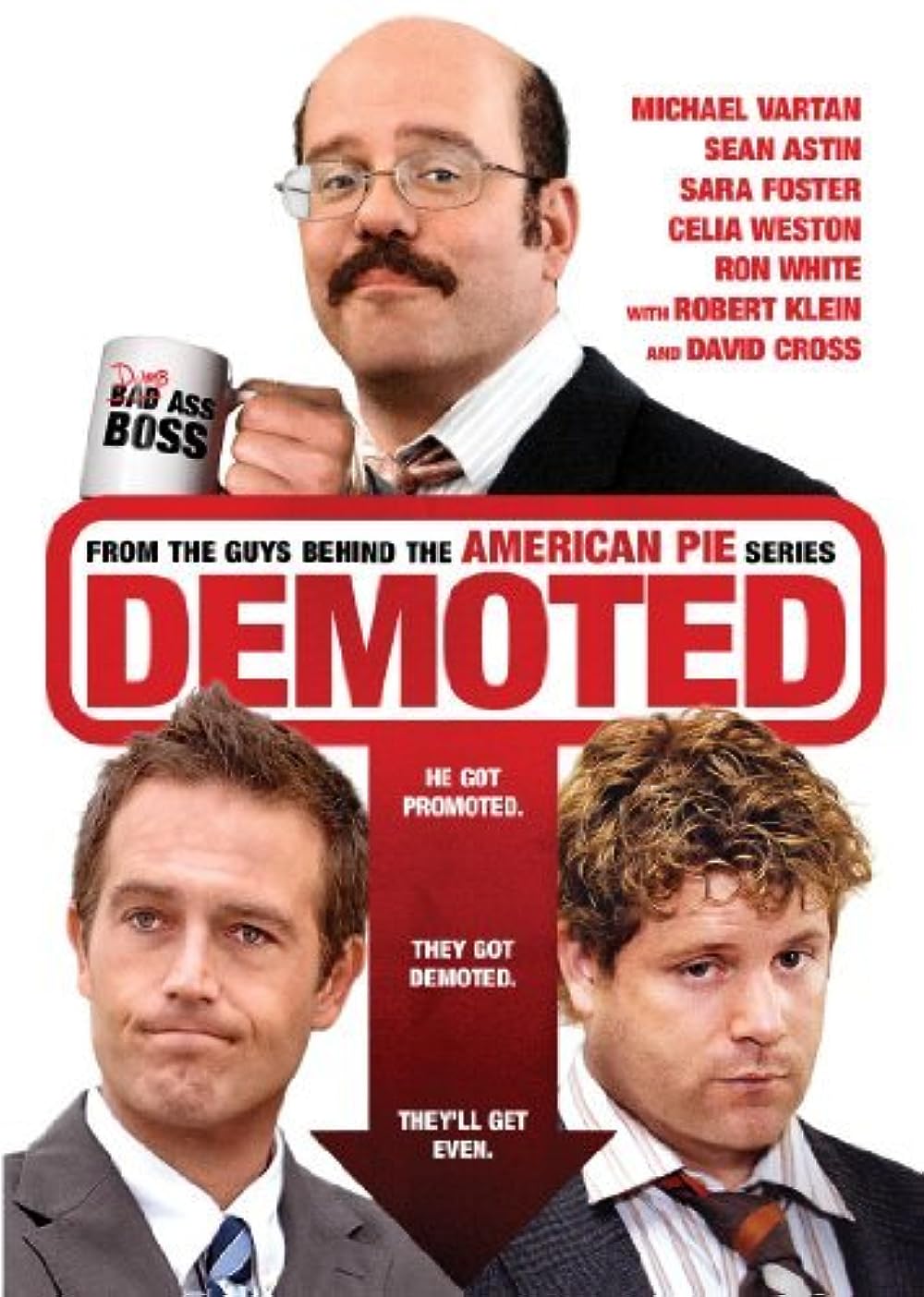
DEMOTED -- DVD review by Porfle


Watching DEMOTED (2011) labor overtime to be like an irreverent combination of OFFICE SPACE, ANIMAL HOUSE, M*A*S*H, and 9-TO-5 is almost as tiring as putting in a full day's work yourself.  Especially since this lame comedy has none of the wit and imagination of the films it's emulating.

Seeing David Cross' big head on the DVD box had me anticipating a lot more from this one, being a devoted fan of the great HBO series "Mr. Show with Bob [Odenkirk] and David."  Indeed, Cross gets to play one of his nerdy-yet-overbearing characters to the hilt here, giving DEMOTED just about its only entertainment value.  But even Dave can't overcome a script that doesn't actually give him much to do or say that's actually funny. 

He plays office drone Ken Castro, a salesman for Treadline Tire Company who is forever being mocked and belittled by bully boys Rodney (Michael Vartan) and Mike (Sean Astin).  Rodney and Mike are the company's best salesmen, but when head honcho Bob Farrell (Robert Klein) kicks the bucket and a gloating Ken lands his position as boss, the two hotshots are demoted from salesmen to secretaries. 

I liked and identified with Ken right away, but we're not supposed to--we're meant to hate him and side with Rodney and Mike, the "cool" guys (think Hawkeye and Trapper vs. Frank Burns), instead of the other way around.  So as the story trudges along, Ken's character gets progressively more irritating, inept, and bigoted while Rodney and Mike develop a new Ghandi-like empathy and respect for their fellow secretaries whom they once treated like chattel.  (I still liked Ken better.)

When Ken has their modest breakroom-slash-storage closet demolished (during which a scene straight out of ANIMAL HOUSE is reenacted), it's last-straw time with the former bully boys leading their new female comrades in a revolt that includes a scene straight out of M*A*S*H in which Ken's trip to the bathroom results in public humiliation.  The trouble is, the bland direction achieves no build-up and payoff to elicit M*A*S*H-level laughs--it just happens, and Cross is forced to flop around on a wet floor with his pants down while we're expected to finally give up and laugh.  And that's the film's comedy highlight.

The dialogue is equally unfunny, as when Rodney reels off this one-liner to Ken:  "Good morning, Kenny.  How's your ass?  Was your boyfriend gentle on you last night?"  Michael Vartan's lack of appeal as the lead doesn't help, including a lengthy subplot concerning his impending marriage to Jennifer (Sara Foster), who doesn't know he's been demoted, and his abrasive relationship with her overbearing father, J.R. (Patrick St. Esprit), who, in another comedy highlight, forces Michael to gaze at his pecker in the men's room to prove he's the alpha male of the two. 

Sean Astin can be likably funny with the right material, but he doesn't get it here.  Not even when he's advising a fellow secretary that a blowjob is the perfect anniversary gift for her boyfriend.  As Bob Farrell, Robert Klein proves once again that whatever appeal he has as a stand-up comedian doesn't carry over well to movie roles, particularly when he's pole-dancing drunk in his underwear.  Celia Weston does her best as head secretary Jane, who exists mainly to appreciate how wonderful Rodney and Mike are when they acknowledge the other secretaries as human beings.

A series of boring song montages clutter the already thin plot and seem to be trying to make the story heartwarming at times, which, needless to say, doesn't work.  An equally fruitless attempt at "cute" comes when Mike starts scoring romantic points with a female executive (Constance Zimmer) that leads to a bowling date and lots of smiling.  Direction and editing often appear to be done by people who have never seen a comedy before but have had one described to them. 

The DVD from Anchor Bay is in 1.78:1 anamorphic widescreen with Dolby 5.1 sound and subtitles in English and Spanish.  There are no extras.

It's hard to screw up a comedy in which David Cross plays a major role as an egotistical dweeb, but DEMOTED tries its best to do so and succeeds.  The most suitable tagline I can think of for this failed effort would be: "If you liked OFFICE SPACE...just watch it again." 


Share/Save/Bookmark

Monday, August 28, 2023

DEAD END -- Movie Review by Porfle


Originally posted on 1/19/16


Director William Wyler's 1937 drama DEAD END opens with a beautiful model vista of the city and its tenements and then dissolves to a vast soundstage set in which most of the story will unfold.  It takes place on the edge of the East River, where (as the opening text tells us) every street in New York ends, and where the rich live in lofty apartments whose terraces overlook the poverty and hopelessness of the slum dwellers below.

These include the famed "Dead End Kids", led by Billy Halop, Leo Gorcey, and Huntz Hall when they were barely in their teens but already first-rate actors.  They would go on to various incarnations as the East Side Kids and the Bowery Boys, but here, they're just a bunch of impressionable neighborhood punks who think they want to be big-time thugs like "Baby Face" Martin (Humphrey Bogart), a former Dead-Ender on the lam who has returned to see his mother and former girlfriend. 

The kids are pretty much the main attraction here as they strut and act tough, huddled around a fire in an old barrel or swimming in the filthy water of the East River.  They come from broken homes, often bragging about their stints in reform school or the beatings they got from the old man the night before.  They're funny--especially Gorcey as "Spit" and Hall as "Dippy"--but are vicious when they prey on the pampered rich kid who must pass by them every day with his fine clothes and superior air.


Their leader, Tommy (Halop), lives with his older sister Drina (a luminous Sylvia Sidney) who struggles to support them even as she and her coworkers strike for higher wages.  Drina loves local boy Dave (Joel McCrea), a struggling architect getting by painting signs, but his eyes are drawn to the wealthy playgirl Kay (Wendy Barrie), who likes him while finding his lifestyle distasteful. 

Throughout DEAD END we see the gap between rich and poor as the rich are portrayed as pampered and privileged, the poor as downtrodden and exploited.  Even Drina sports a bruise on her forehead which she got from a cop on the picket line.  The more noble and strong-willed, like Dave (whom we know will eventually realize Drina's true worth in the end), hold on to their scruples while the weak turn to crime. 

Meanwhile, a younger Bogart, still getting "with" billing after McCrae and Sidney, hones his tough-guy persona while also managing to bring some sympathy to his character when he's coldly rejected by his despairing mother (Marjorie Main) and finds that Francey (Claire Trevor), the neighborhood girl he was always sweet on, has fallen into prostitution.  Main is light years from her "Ma Kettle" character here, while Trevor, always stunningly talented, gives a brief but heartbreaking performance.


These various factions naturally clash when forced to inhabit the same concrete jungle day after day, leading to a dramatic finale that sees Bogart and McCrae trading hot lead while Drina tries to keep her brother Tommy from being arrested after one of the gang squeals on him.  The story ends as it began, with the Dead End Kids resolving their own external and internal conflicts the only way they know how, while hopefully learning something positive from it all. 

Wyler's inventive direction explores that awesome soundstage in inventive ways while making the most of his actors' faces in tight, dramatic closeups.  Gregg Toland's lush black-and-white cinematography is shadowy and noirish, especially in the climactic scenes with Bogart and McCrae stalking each other through back alleys and across the rooftops.  The supporting cast includes Allen Jenkins as Martin's crony "Hunk" and Ward Bond as a burly doorman who doesn't get along with the gang.  

While the message may get a bit heavy-handed at times, DEAD END is a treat for lovers of classic film drama and the great actors and filmmakers of yesteryear.  And the Dead End Kids themselves have never been more fascinating, natural, and bursting with energy and talent.


Share/Save/Bookmark

Sunday, August 27, 2023

THE MALTESE FALCON (1941) -- Movie Review by Porfle


Originally posted on 1/30/16


The first great "film noir", 1941's THE MALTESE FALCON, set the standard both storywise and in its impeccably exquisite visuals.  First-time director John Huston does a masterful job orchestrating his actors and crew to create a visual experience which is consistently involving and often dazzling. 

The film, shot mostly on interior sets, was brought in on budget and ahead of schedule despite Huston requesting an extra day of rehearsal for the film's climactic sequence, which takes place entirely within a single hotel room with almost all members of the main cast.  The complex character interactions and the way the tangled plot is meticulously resolved during this scene makes for some of the most breathlessly riveting cinema ever filmed.

Huston uses clever direction and camera movements to keep things from getting claustrophobic, and never once lets the pace drag.  His screenplay follows Dashiell Hammett's novel almost to the letter (the two earlier, inferior adaptations, 1931's "Dangerous Female" and the comedic "Satan Met a Lady" in 1936, didn't), and crackles with scintillating dialogue, intriguing plot twists, and relentlessly building suspense. 


Hammett's celebrated anti-hero Sam Spade is the perfect noir detective--brash, resourceful, self-assured, keenly intelligent, streetwise, tough but not infallible, and opportunistic.  He does have a moral code, one not easily compromised, and a motto that is rigidly enforced: "Never play the sap for anyone." 

The first person to try and use him is quintessential femme fatale Brigid O'Shaughnessy (exquisitely  played by Mary Astor), who hires San Francisco private detective Spade and his partner Miles Archer (Jerome Cowan) to locate her missing sister along with a mystery man named Floyd Thursby.  When both Archer and Thursby turn up dead, it appears there's more to Brigid's story than she's letting on. 

Before long Spade discovers that she's after a priceless treasure known as the Maltese Falcon, for which she's in fierce competition against  "the Fat Man" Kaspar Gutman (Sydney Greenstreet) and the wily, effeminate Joel Cairo (Peter Lorre).  Spade must spar with these conniving characters while fending off police detectives Dundy and Polhaus (Barton MacLane, Ward Bond), who suspect him in the murders although the more genial Polhaus tends to side with Sam.  All in all, these actors comprise one of the finest casts ever assembled for a film.  (Look for John Huston's father Walter in a quick cameo as a fatally wounded ship's captain.)


Huston delights in working with these masterful performers as any artist deftly employs his chosen medium.  The dialogue scenes between Bogart and Greenstreet are a verbal delight (Gutman constantly admits his glowing admiration for the crafty Spade), while the utter dishonesty underlying Spade's love affair with Brigid gives it an air of perversion. 

Lorre's Joel Cairo, both dangerously scheming and amusingly fussy, is always fun to watch.  I love the scene in which Spade disarms and manhandles Cairo, whose main concern is expressed with the heated accusation: "Look what you did to my shirt!"

Even young character actor Elisha Cook, Jr. gets to shine in the plum role of Gutman's "gunsel" Wilmer Cook, a callow trench-coated hood hiding his cowardice behind guns and tough talk.  (Dwight Frye played the part in the 1931 version.)  The ever-sharper Spade delights in yanking Wilmer's chain, and in one incredible closeup we see fat, glistening tears suspended in each of the young killer's eyes as he's overcome with burning frustration and impotent rage (another bravura touch by Huston).


But it's Bogart's show, and his performance is a pure delight.  We know Spade's a stand-up guy, yet the moment his partner's murdered he has the signs around the office changed from "Spade and Archer" to "Samuel Spade."  He's even having an affair with Archer's wife, Iva (Gladys George), but loses interest once he meets Miss O'Shaughnessy.  Yet we know he's an okay guy as long as his faithful gal Friday, Effie (Lee Patrick), still secretly loves him. 

In one delightful moment, after storming out of a tense encounter with Gutman and Wilmer in the Fat Man's swanky hotel room, Spade smiles when he realizes that his hand is shaking and his palms sweating.  Spade may be brave, but he still gets scared, a fact which both amuses and excites him.

This vintage detective yarn sizzles with suspense and excitement for viewers who are able to plug themselves into its high-voltage current.  For me, it took several viewings before I finally began to appreciate just what a finely-rendered thing of beauty it truly is.  Others (as some IMDb comments would indicate) seem to take a strange kind of pride in remaining immune to its charms, believing that such classics are revered by many simply because they're "old." 

But if it doesn't hit you right away, just keep watching and remain open to it.  Chances are that sooner or later, THE MALTESE FALCON will weave its magic spell over you.  Like the rare and unique artifact of the title, it's "the stuff dreams are made of.

Read our review of the BEST OF BOGART COLLECTION


Share/Save/Bookmark

Saturday, August 26, 2023

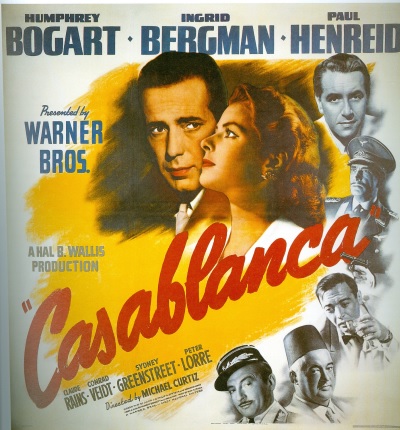
CASABLANCA -- Movie Review by Porfle


Originally posted on 1/22/16


CASABLANCA (1942) is one of those films which we can now look back on as an undisputed classic in which everything seems to come together perfectly.  At the time, however, it was regarded by the studio as just another production, whose script, based on the unproduced play "Everyone Comes to Rick's", was being written on the fly and didn't even have a proper ending worked out until shortly before it was shot.

 The story takes place in 1942 in the Vichy-controlled Moroccan city of Casablanca, which overflows with refugees desperately struggling to gain passage to America and elsewhere in the free world to escape Nazi encroachment in Europe .  Exiled American (and ex-freedom fighter) Rick Blaine, played to perfection by Bogart , runs a nightclub called "Rick's Café Américain" in which many of these people meet to buy and sell the hope for freedom. 

 Also on hand is Rick's friend, Captain Louis Renault (THE INVISIBLE MAN's Claude Rains in one of his best performances), the head of the local police and an opportunist of the first order whose greatest pleasure is accepting bribes both monetary and sexual.  Renault openly admires Rick's similarly self-serving qualities and even displays a platonic crush on him ("If I were a woman, and I were not around, I should be in love with Rick," he admits). 


We wonder how Renault would react if Rick started reverting back to his old, noble self, especially in the presence of the vile German officer Major Heinrich Strasser (Conrad Veidt, THE CABINET OF DR. CALIGARI,  THE MAN WHO LAUGHS), newly-arrived and on the trail of famed Czech resistance leader Victor Laszlo (Paul Henried). 

 While Rick starts out as an anti-hero, he gradually and without really meaning to becomes more heroic as the story progresses.  Early on, Peter Lorre's oily Ugarte--who recently killed some German soldiers to attain two letters of transit to sell in Casablanca--begs Rick for help before he's captured ("Hide me, Rick!  Hide me!").  Rick's terse response: "I stick my neck out for nobody." 

And indeed, Rick seems grudgingly content to sit out the current world war as manager of his bustling nightclub until one night, when an old flame named Ilsa (the utterly radiant Ingrid Bergman) comes through the front door with her husband, none other than Victor Laszlo.  Rick, once an idealistic crusader himself but now cynical and disillusioned, has never forgiven Ilsa for inexplicably running out on him during the fall of Paris, at the height of their love affair--not knowing that Laszlo, whom they both thought dead, had turned up alive.


 When Rick obtains the two letters of transit from Ugarte, he has the means of whisking Ilsa back to America with him and resuming their love affair while leaving Laszlo behind to carry on alone and devastated.  But will he do something so selfish and immoral?  Or regain his soul and commit the supreme act of sacrifice for the sake not only of Ilsa and her husband but of the free world itself?

 This is the dilemma which gives CASABLANCA much of its power to effect us emotionally while simmering with a growing suspense.  As a film, everything clicks-- Michael Curtiz' sharp direction, the gorgeous black-and-white photography, great performances by a stellar cast, a powerful musical score by Max Steiner, and a story that's always totally engaging. 

 Action and romance are perfectly balanced and compliment each other, while comedic touches abound, especially from the delightfully corruptible Renault,  the antics of Rick's eccentric staff (including S.Z. Sakall), and a fez-topped Sydney Greenstreet (again) as a competing club owner who wants to acquire Rick's place along with his loyal piano-playing band leader Sam (Dooley Wilson, who croons the classic "As Time Goes By").


But when Laszlo exhorts Sam and his band to strike up a stirring rendition of "La Marseillaise" in response to Strasser and his fellow German officers belting out "Die Wacht am Rhein", the move (which Rick okays with a subtle nod of his head) not only stirs the patriotic fervor of everyone else in the club but may bring the viewer to tears as well.  (Steiner uses this same anthem as a fanfare for his own musical credit during the main titles.)

The climax of the film takes place at the airport, a focal point for dreams of freedom throughout the story.  Rick now literally holds the ticket to a new life with Ilsa, who will join him if he asks her to.  Yet his newly reawakened sense of duty to humanity now fights for precedence.  Meanwhile Renault, his own duty to Strasser  putting him at odds with his friend, awaits Rick's decision. 

 When the plane fires up its engines, Steiner's music swells, and there comes a stunning, perfectly-edited series of  closeups of Bogart,  Bergman, and Henried which generate a dramatic tension few films could ever attain.  It's pure, undiluted Hollywood magic at its most sublime, and the resolution which follows couldn't be more perfect.  CASABLANCA is an intricate jigsaw puzzle of seemingly disparate pieces which fit together to form a beautiful picture.

Read our review of THE BEST OF BOGART COLLECTION


Share/Save/Bookmark

Friday, August 25, 2023

THE TREASURE OF THE SIERRA MADRE -- Movie Review by Porfle


Originally posted on 1/31/16


With the epic outdoor action-drama THE TREASURE OF THE SIERRA MADRE (1948), based on a novel by enigmatic writer B. Traven, Humphrey Bogart once again joined with director John Huston and his father Walter (after THE MALTESE FALCON) for a grueling tale of the devastating effects of greed on average men.  And during the film's arduous shoot in the wilds of Mexico, any hint of Hollywood glamour would soon become a distant memory. 

As Fred C. Dobbs, Bogart loses himself in one of his grittiest and least sympathetic roles.  Dobbs is an American stuck in a small Mexican town with no job or money, wandering the streets and begging for pesos.  (The younger Huston has a funny cameo as a well-to-do man Dobbs keeps hitting up for change.)  Dobbs will fling his glass of water in the face of a small boy (Robert Blake) pestering him to buy a lottery ticket, yet we sense a modicum of decency somewhere beneath his gruff exterior.

This early sequence of him trudging his way through life, getting bad haircuts, chasing after prostitutes, etc. lets us sit back and watch Bogart at work creating one of his finest characters.  Dobbs hooks up with a fellow American named Curtin (Tim Holt) for a job in which they're cheated out of their pay by a crooked foreman (Barton MacLane of THE MALTESE FALCON) whom they beat senseless after he attacks them in a bar.  (This well-choreographed fight scene is brutally effective.)  Then, after meeting grizzled old prospector Howard (Walter Huston) in a flophouse, they take his advice and set out with him to find gold in the mountains of the Mexican desert. 


Walter Huston enjoyed recounting the story of how he told his son John that if he ever became a filmmaker to "write me a good part."   The old gold-hunter Howard is that part, a role the elder Huston,  sans dentures, inhabits so fully that he almost manages to steal the picture right out from under Bogart.  (He would go on to win an Oscar for it.)  Howard is a goodnatured, level-headed old man, and we believe him when he warns of the evil effects gold can have on weak-willed men.
  
Dobbs blusters against such talk, thinking himself above any negative influences.  Yet without missing a beat, he will fulfill each of Howard's admonitions one by one as the lure of gold transforms him into a paranoid,  resentful,  and ultimately dangerous man.  By the time he's gone over the deep end, he's a frightening character, convinced in his mindless desperation that everyone's out to get him and that he's justified in whatever heinous act he may commit to protect himself and his newfound fortune.

When Dobbs and Curtin finally find themselves locked in a life-or-death battle of wills in the middle of the desert, the film almost takes on the eerie inevitability of a horror movie.  The only thing that undercuts it, along with much of the rest of the film, is one of Max Steiner's worst musical themes--a loping, folksy motif that I find jarringly out of place.


In addition to being a fascinating character study,  TREASURE is a terrific action-adventure.  Alfonso Bedoya is unforgettable as the ruthless Mexican bandit Gold Hat,  whose gang attacks our heroes' train during their trip into the mountains and then later stumbles upon their mining camp, leading to a blazing gunfight.  Gold Hat may be a monster, but Bedoya manages to make him funny, especially with his immortal response to Dobbs' question "If you're federales, where are your badges?"

"Badges? We ain’t got no badges...we don’t need no badges...I don’t have to show you any stinking badges!"

Tim Holt is solid in the less flashy role  of sturdy, dependable Curtin, who shares Howard's dismay at Dobbs' growing instability.  Walter Huston is a delight in a truly wonderful performance--he even gets to break the fourth wall and give us a sly look during one sequence in which he's being given the royal treatment by a tribe of Indians after doing them a good turn.  We don't even hold it against Howard when he votes along with the others to execute another man, Cody (Bruce Bennett), who tries to horn in on their find. 

But it's Bogart, as a man susceptible to bouts of pure, wild-eyed insanity, who makes the film as truly memorable as it is.  No matter how low he sinks and what horrible things he does, we always remember the relatively decent guy he was before gold changed him, and feel some remorse for what he's become.  And just like Dobbs, I'd like to think gold wouldn't make me act that way--but who knows?

Read our review of the BEST OF BOGART COLLECTION


Share/Save/Bookmark

Thursday, August 24, 2023

THE AFRICAN QUEEN -- Movie Review by Porfle


Originally posted on 2/4/16


THE AFRICAN QUEEN (1951) is the story of two people you'll want to get  to know very much--Humphrey Bogart as Charlie Allnut, a goodnaturedly uncouth little man who runs a tiny supply boat up and down the river in German East Africa in 1914, and Katharine Hepburn as Miss Rose Sayer, a Christian missionary who, along with her brother Reverend Samuel Sayer (Robert Morley), brings God's word to the natives until German soldiers burn down the church and village, kill her brother, and leave her all alone in the jungle.

Director John Huston deftly blends comedy with tragedy in the opening scenes.  Shortly before their horrific encounter with the German military, the Sayers invite Charlie to tea during a supply stop.  He hasn't eaten in awhile, so his stomach starts making the most impolite growling noises to which Rose and her brother react with growing dismay until finally Charlie explains brightly, "Ain't a thing I can do about it!" 

Charlie returns later to bury the brother and take Rose away in his boat, the "African Queen".  But her first thought is to somehow aid in her country's war effort by whatever means available.  Hearing of a German gunboat, the "Louisa", which is terrorizing the countryside from a large lake somewhere downriver, she hatches a scheme in which Charlie will devise a couple of torpedos out of compressed gas bottles, with which they will then ram the Louisa with the torpedos sticking out of the African Queen's bow. 


Humoring her for the time being--and not realizing that he has begun something he won't be able to back out of--he later mocks Miss Sayer's request in a grumbling approximation of her prim accent: "Can you make a torpedo?  Then do so, Mr. Allnut." 

This belly-laugh moment, courtesy of Bogart's irresistibly natural, likable performance as the ragtag river rat, is just the beginning of what will be a rip-roaring adventure, a tender romance, and a gut-busting comedy.  The independent production, filmed mostly on location in Africa in lush Technicolor, is one of John Huston's warmest and most heartfelt films.  This is due in large part to the chemistry between the two stars and Huston's ability as a master director to showcase them at their best.

Miss Rose Sayer is naturally brave and resourceful, which helps make up for her naivete' and inexperience with life in general.  She adapts quickly and becomes instantly addicted to the thrill of adventure as a substitute for sexual intimacy (her first excursion down the rapids leaves her as though she'd just had her first sexual release). 


Learning to handle Allnut's boat is symbolic of her growing familiarity with the man himself while he, in turn, finds himself suddenly yearning to bring out the inner woman behind the straight-laced exterior. 

Allnut is one of Bogart's funniest and most uninhibited characters--his emotional honesty and expressiveness are at their peak here.  Often a single look on his face will convey more thought and emotion than many actors can manage with an entire speech. 

Hepburn is ideally cast as the initially very proper, timid spinster who gradually lets her hair down (literally) and begins to appreciate the more sensual and even carnal aspects of life as her love for Charlie Allnut blossoms toward fruition.


Their journey down the river is a series of funny and romantic vignettes interspersed with moments of harrowing danger which are excitingly staged.  The rapids are a major obstacle, as are mosquitoes, leeches, and, in one suspenseful sequence, German bullets.  Through it all, Rose's indefatigable attitude brings out the best in Charlie, and together they give each other something to live for even when things are at their worst.

Huston's technical skills are dazzling throughout the film.  The location photography is not only stunning but often amazing as well, as when we see a number of large alligators diving off the bank into the water right after Bogart has moved out of the frame--all in a single shot.   The process shots are as well integrated into the action as possible for the time and, for me at least, proved little distraction.  Allan Gray's musical score is another of the film's many pleasures. 

The story reaches its triumphant conclusion aboard the German gunboat, where our unlikely hero and heroine reach the end of their journey in fine style.  Like SHANE, which is tied with KING KONG (1933) as my favorite movie of all time, there are scenes throughout THE AFRICAN QUEEN which bring me to the verge of tears.   Not because these scenes are particularly sad, or particularly happy, but simply because they're quite disarmingly beautiful. 

Read our review of the BEST OF BOGART COLLECTION


Share/Save/Bookmark

Wednesday, August 23, 2023

All The She-Monster Scenes From "The Astounding She-Monster" (1957) (video)


The She-Monster is played by Shirley Kilpatrick...

..rumored to have later changed her named to Shirley Stoler of "The Deer Hunter" and "Seven Beauties" fame.

Exterior shooting took place in various parks around Los Angeles.
Interiors were shot at Larchmont Studios in Hollywood.

Much of the music was later reused in "The Beast of Yucca Flats" (1961).

Kenne Duncan was an Ed Wood regular, appearing in five of his productions including "Night of the Ghouls."
Often cast as a bad guy, he was known as "The Meanest Man in Movies."

Robert Clarke would star as "The Hideous Sun Demon" in 1958.
Marilyn Harvey's only other movie role was an uncredited bit part in "Rosemary's Baby" (1968).
Bit player Jeanne Tatum (left) had but one other credited role, in "Ghost of Dragstrip Hollow" (1959).

Director Ronald V. Ashcroft hired his own wife Lorraine as Shirley Kilpatrick's stunt double.
Ashcroft was an assistant director on Ed Wood's "Night of the Ghouls."

The Official Razzie Movie Guide lists this as one of the top 100 most amusingly bad movies ever made.

Shirley Kilpatrick rarely turns her back during her scenes because the zipper on her costume broke during filming.

The film was released in the UK under the title "Mysterious Invader."

The film was made in four days with a cost of $18,000...
...and was sold to American International Pictures for $60,000.


Originally posted on 10/3/18

I neither own nor claim any rights to this material.  Just having some fun with it.  Thanks for watching!


Share/Save/Bookmark

Tuesday, August 22, 2023

"Dragnet": The Two Times Joe Friday Had To Shoot To Kill (video)


In both decades of "Dragnet", Joe Friday (Jack Webb) only had to shoot to kill twice.

("The Big Thief", 1953)
("The Shooting Board", 1967) 


The first time he was forced to kill an armed suspect, it hit Friday hard.
He was wracked with guilt and regret afterward.

The second time occurred when Friday interrupted a robbery in progress.

This time, Friday's main concern was clearing his name...
...after his story was called into question.


Originally posted on 11/19/18
I neither own nor claim any rights to this material.  Just having some fun with it.  Thanks for watching!


Share/Save/Bookmark

Monday, August 21, 2023

Three Extras Killed Filming "Noah's Ark" (1928) (video)


During the key flood sequence, safety was ignored in favor of spectacle.

Extras were not warned of the severity of the water that would engulf them.
These included a young Marion "Duke" Morrison (John Wayne).

While the stars were doing their closeups...
...the unwary extras were being deluged by deadly torrents of water.

Their fear is real as they scramble for their lives.

Several extras were seriously injured.
Three of them were killed. 


Originally posted on 8/31/18
I neither own nor claim any rights to this material.  Just having some fun with it.  Thanks for watching!


Share/Save/Bookmark

Sunday, August 20, 2023

THE GREATEST SHOW ON EARTH (1952) -- Movie Review by Porfle


Originally posted on 7/26/21


Currently watching: I usually don't care that much for circus movies, but producer/director Cecil B. DeMille's blustery, bloated, bombastic, and at times downright monstrous THE GREATEST SHOW ON EARTH (1952) eventually won me over.

DeMille clearly did care for circus movies--enough, at least, to make this the most spectacular big top epic ever, with the full participation of the Ringling Brothers-Barnum & Bailey Circus, the best outfit of its kind ever to tread the sawdust.

It's also packed with dozens, perhaps hundreds of actual circus performers (including Emmett Kelly), making it a three-ring extravaganza that barely lets up for its entire two-and-a-half hour running time. Even Hopalong Cassidy makes an early appearance.


The director's sentimental streak for the circus life is expressed in all the cutaways of wide-eyed kids, wonderstruck by the spectacle before them as they gorge themselves on cotton candy and other treats even as their adult companions can be seen reliving their own childhood joy.

What really drives this film, however, is the behind-the-scenes drama. Charlton Heston is awesome as the no-nonsense boss, Brad, who dresses like Indiana Jones and drives the performers and roustabouts to always push themselves to produce the best show possible despite all odds.

The absolutely indefatigable Betty Hutton has one of her most energetic roles as trapeze star Holly, driven to risk her life nightly when another trapeze master, roguish French superstar Sebastian (Cornel Wilde), joins the show and competes with her for the center ring. Both perform their increasingly dangerous stunts without a net, with inevitably tragic results.


Also filling out a wonderful cast are Gloria Grahame as elephant trainer Angel, Holly's rival for Brad's affections; exotic Dorothy Lamour as an emotionally unpredictable glamour girl; and Lyle Bettger and Lawrence Tierney as criminal types whose dastardly schemes threaten both the circus and the very lives of its people. (Keep a sharp eye out for a great dual cameo appearance by two very familiar stars.)

Last but not least is Jimmy Stewart, a clown who hides his identity beneath layers of greasepaint due to a dark secret in his past that will return to haunt him at a crucial moment. His character stays in the background for most of the film but comes to the forefront in a big way during the finale.

This occurs when a spectacular train wreck spells instant disaster for the circus as DeMille pulls out all the stops. The miniature special effects are great fun here, and so are the full-scale practical effects and stunts, replete with escaping wild animals and a number of grievous injuries among the tightly-knit circus family.


Till then, however, DeMille himself does an impressive juggling act as he keeps all the various subplots up in the air. Some are of the romantic variety, while others focus on the performers' egos as well as the evil forces that are conspiring to bring ruin to the show.

It's all a dizzying mish-mash of melodrama, with plenty of corny dialogue and gushing sentiment, and somehow it all works when the viewer settles in and becomes acclimated to the atmosphere DeMille has so feverishly created in what was evidently one of his most heartfelt productions (which he himself narrates in solemn tones just as he did his later epic THE TEN COMMANDMENTS).

Sprawling, colorful, eye-pleasing, and delightfully old-fashioned, THE GREATEST SHOW ON EARTH is pure pleasure for anyone who wants to put their minds on hold and let one of Hollywood's greatest showmen entertain them for a few hours.


Share/Save/Bookmark

Friday, August 18, 2023

"Star Trek III: The Search For Spock" With A "CHiPs" Ending (video)


 Here's another Star Trek "Foolie" with a humorous "what if." Or something like that.


Video by Porfle Popnecker. I neither own nor claim any rights to this material. Just having some fun with it. Thanks for watching!


Share/Save/Bookmark

Thursday, August 17, 2023

The Movie That Inspired Jack Webb To Create "Dragnet" ("He Walked By Night", 1948) (video)


"He Walked By Night" is a tough, terse police procedural...

...with a soon-to-be-familiar opening.

We witness a shocking crime.
We meet the realistic, no-nonsense police detectives.

Their investigation is methodical and by the book.
Eventually their "dragnet" closes around the wily suspect.

In the film, a young Jack Webb plays one of the "lab boys."

It would inspire him in creating the radio and TV classic "Dragnet"...
...in which he starred as realistic, no-nonsense Detective Joe Friday.


READ OUR REVIEW OF "HE WALKED BY NIGHT"

Originally posted on 4/29/19
I neither own nor claim any rights to this material.  Just having some fun with it.  Thanks for watching!


Share/Save/Bookmark

Wednesday, August 16, 2023

"Dragnet" At Its Sappiest (video)


 "Dragnet" is one of my favorite cop shows, but when it went sappy, it went all the way.


Video by Porfle Popnecker. I neither own nor claim any rights to this material. Just having some fun with it. Thanks for watching!


Share/Save/Bookmark

Tuesday, August 15, 2023

Amazing World-Class Bad Acting! ("Blood Feast", 1963) (video)


Herschell Gordon Lewis' "Blood Feast" was the first major "gore" film.

Although Bill Kerwin is the only decent actor...

...the other actors are encouraged to emote wildly.

Thus giving us some truly, impressively bad performances...

...including that of Playboy Playmate of the Month (June 1963) Connie Mason.


I neither own nor claim any rights to this material.  Just having some fun with it.  Thanks for watching!


Share/Save/Bookmark

Monday, August 14, 2023

The Infamous Tap-Dancing Scene From "Exorcist II: The Heretic" (video)


This may be the scariest scene in the whole "Exorcist" series, but for all the wrong reasons.


Video by Porfle Popnecker. I neither own nor claim any rights to this material. Just having some fun with it. Thanks for watching!


Share/Save/Bookmark

Sunday, August 13, 2023

Christopher Walken's Name Is Misspelled In The End Credits For "Annie Hall" (video)


What, Woody Allen couldn't afford to hire a proofreader?


Video by Porfle Popnecker. I neither own nor claim any rights to this material. Just having some fun with it. Thanks for watching!


Share/Save/Bookmark

Thursday, August 10, 2023

RWBY: VOLUME 3 -- Blu-ray/DVD Review by Porfle


Originally posted on 5/2/16


I was a bit lost at first, coming in after two seasons as I did, but it doesn't take long to get caught up in what's going on in Rooster Teeth's American anime epic RWBY: VOLUME 3 (2016), a 2-disc Blu-Ray+DVD Combo Pack from Cinedigm. 

Once I picked up the threads of this sweeping tale of a futuristic world called "Remnant" in which super-powered teens train at academies to become hunters and huntresses in order to protect the world from evil, it was easy to get addicted and begin to dread the inevitable cliffhanger ending to the season (the bane of so many season DVD sets). 

The main team of wannabe huntresses is known as RWBY (pronounced "ruby") whose color-coded members consist of Ruby Red (red), Weiss Schnee (white), Blake Belladonna (black), and Yang Xiao Long (yellow).  At first they seem to be the usual girly-girls we find in such series as "K-On"--they're funny and sometimes a little ditzy in addition to being great athlete-warriors--but as the events of the story progress they and others around them reveal many levels of depth to their characters.


The script features a good mix of comedy and drama with very appealing character interplay.  This includes scenes of both the teens and their teachers, older siblings and relatives, guardians, etc. with plotlines growing increasingly complex with each episode until at last the fate of humanity hangs in the balance. 

The initial focus of the season is on a grand tournament involving teams from all academies, one which symbolizes the lasting peace achieved among the once-warring continents.  Team RWBY competes against other groups with acronyms such as SSSN ("sun"), JNPR ("juniper"), and CRDL ("cardinal").  Whenever the story gets a little slow, it's back to the arena for more adrenaline-fueled game play.

These sequences are loaded with frenetic fight action that's creatively directed and animated, with editing that is lightning quick but easy to follow.  The various characters and their individual powers and backstories come together in interesting ways during this segment as they either band together to face their foes or team up in different combinations.


By now we've come to like and identify with several of the good guys while the bad ones reveal hidden machinations that will set the stage for the season's spectacular final battle, which takes up much of the story's running time. 

When this begins, we get to see all those fighting skills we've been watching in the arena get put to practical use, and the result is a lengthy series of spectacular encounters between the teen heroes and an attacking army of deadly beast-creatures known as the Grimms.  In addition to them, one team of teen warriors will emerge as the villains and their leader will acquire a power that threatens massive death and destruction.

This entire sequence is enormously entertaining and pays off in all sorts of satisfying ways for anyone who likes PROJECT A-KO or similar types of anime.  Just when you think things couldn't get any more intense, we're assailed by still more visual wonders and wicked plot twists.


The creative people at Rooster's Teeth, headed by the late Monty Oum who was the show's creator and lead animator, have stocked this series with beautifully-designed settings and characters brought to life using 3D Poser technology and motion capture. 

This, along with great voice talent (and some really catchy songs) creates an eye-pleasing hybrid of old-school cel animation and computer generated cartoons which allows the characters considerable expression while freeing the writers to let their imaginations run wild.

The 2-disc Blu-ray/DVD combo pack from Rooster Teeth and Cinedigm contains two commentary tracks (directors and cast) and trailers along with five featurettes detailing the creative process behind the series ("Legacy of RWBY") and the World of Remnant itself ("The Tournament", "Huntsmen", "The CCT (Cross-Continental Transmit System)", "The Four Maidens").  The latter is especially moving and supplies backstory for one of the season's major plotlines. 

I don't often see a story escalate from colorful action-filled fun to catastrophic disaster epic the way RWBY: VOLUME 3 effortlessly does in its fast-moving and involving 176 minutes.  This is great anime entertainment that left me wanting more.


Share/Save/Bookmark

Tuesday, August 8, 2023

RED VS. BLUE: SEASON 14 -- Blu-ray/DVD Review by Porfle


Originally posted on 11/15/16


If geek heaven is a place on Earth, then I'd guess that place is Rooster Teeth Studios in Austin, Texas. That's where a gaggle of creative young fans of anime, videogames, and other fun stuff get together and actually make a living indulging in all the things they love.

One of the creations to come out of all this (besides the beautiful "RWBY") is the web series "Red vs. Blue", which takes the characters and visuals from the HALO videogames and uses them in conjunction with outstanding new voice work and storylines to come up with wildly funny and exciting variations on the game's original premise.  (Sort of like a high-tech version of Woody Allen's "What's Up, Tiger Lily?")

Seasons 11-13 of the series were covered in our previous review of the 3-disc steelbook Blu-ray set "Red vs. Blue: The Chorus Trilogy", a sprawling saga that combines the series' almost non-stop wacky humor with an exciting, suspenseful story which built to a spectacular climax.


But the gang at Rooster Teeth are anything but predictable, so RED VS. BLUE: SEASON 14 turns out to be pretty much the exact opposite: an episodic collection of short films that not only lean more heavily on our funny bones but are unrelated storywise.  And since each one is done in a different way, using different media, the variety seems endless.

(Just to recap the premise: two opposing military factions, the Reds and the Blues, are stuck on a desert planet together in a place known as "Blood Gulch."  War is constant in this "1984 meets Starship Troopers"-type future although the power-suited warriors have no idea why the Reds and Blues are at odds.  In fact, they often make friends and join forces, with their common stupidity serving as a unifying factor.)

A "Twilight Zone" theme runs through the season with artificial intelligence entity "V.I.C." introducing each segment as a window floats through space.  "Room Zero" starts things off right in the middle of a frantic mission.  The next couple of segments show us some early basic training tomfoolery highlighted by an overly gung-ho Sarge proudly killing off his fellow trainees.


We get a grainy black-and-white recruitment film, a musical sequence, and even a rap battle.  Rejects from Project Freelancer (which predated the Red and Blue teams) are exiled into the desert and end up at war with each other. 

Agents are sent on a mission so top secret that even they don't know what it is.  Private Caboose tells a story in coloring-book pictures, in what resembles a sci-fi episode of "Elmo's World.  "And two groups of warriors all happen to be colorblind, making it impossible for them to tell who's on which team.

A three-part epic about present-day urban mercenaries/bounty hunters vs. a crime kingpin whose son they've kidnapped for ransom departs wildly from the formula with some choice computer cartoon animation.  There's also a delightful segment consisting of honest-to-goodness stop-motion with the main characters as Lego figures being manipulated by a geeky kid.  Old school animation fans will plotz.


To top it all off, the Rooster Teeth crew actually pull off some impressive live-action stuff with explosions and gun battles and some really cool power-suit costumes.  One live-action segment involves a desert battle, and the other one has the Reds and Blues accidentally transported into the Rooster Teeth studio building itself. 

All our favorite characters are here--Sarge, Tucker, Church, Grif, Carolina, Epsilon, Locus, Felix, and of course, the ever-moronic Caboose--my favorite--who reminds me of Space Ghost's former nemesis Brak. All of the various editions of HALO are represented, from the most primitive early ones to some really advanced stuff that yields really eye-pleasing visuals. 

Dialogue is rapid-fire and way off-the-wall--between bursts of action these characters stand around yakking at each other a mile a minute (sometimes I have to go back and play the captions in slow motion just to keep up) and the ridiculousness of these power-suited warriors pitting their severely limited intellects against each other is a giddy delight.


The 2-disc set from Rooster Teeth consists of a Blu-ray disc with extras and a DVD disc with creator credits only.  Feature is in widescreen with Dolby Digital 5.1 surround sound and English subtitles.  Extras consist of the entertaining featurettes "Deus Ex Machinima", "The Building Blocks of RvB", "Making a Mercenary", "Immersion", and "Rocket Jump BTS", which cover several of the more fascinating creative aspects of the making of these short segments.  Trailers are also included. 

The keepcase contains four cool playing cards from the mercenary story and a "Blood Gulch Activity Book" in which it appears Private Caboose has already done all the puzzles.

I'll look forward to more of the standard long-form action adventure along with the comedy in future "Red vs. Blue" stories, but until then, the sheer variety and creativity of RED VS. BLUE: SEASON 14 make it a constant delight for "machinima" fans and anyone else who enjoys a colorful futuristic romp in a ditzy dystopia.


Share/Save/Bookmark