HK and Cult Film News's Fan Box

Friday, August 7, 2026

AGATHA CHRISTIE POIROT: SERIES 1/ AGATHA CHRISTIE POIROT: SERIES 2 -- DVD Reviews by Porfle


Originally posted on 1/26/12


Having been introduced to the British ITV series "Agatha Christie Poirot" through some of the later feature-length episodes, I was surprised to find the earlier seasons (circa 1989-90) of this long-running show to be faster-paced, funnier, and much lighter in tone--in general, more fun.  Not to disparage the more darkly dramatic ambience of the post-2000 ones, which are superb entertainment in their own right, but I like this lighthearted and mischievously sly side of Poirot much better.

The first ten one-hour episodes are collected in AGATHA CHRISTIE POIROT: SERIES 1, beginning with "The Adventure of the Clapham Cook" (which features a brief appearance by a young Danny Webb of ALIEN 3 fame).  Here, we're first introduced to Poirot's associate Captain Hastings (Hugh Fraser), a hale fellow with a boyish enthusiasm for things like automobiles and cricket.  Hastings isn't too quick on the uptake, at least not alongside a genius like Poirot, but he's good at following people, tackling escaping suspects, and serving as an appreciative audience for the vain Poirot's feats of deduction. 

Also on hand is Poirot's prim and efficient secretary Miss Lemon.  As played by Pauline Moran, she's made up to look just plain enough to render her strangely sexy, despite the fact that her character is as properly straitlaced as can be.  In Poirot's office-apartment in a magnificent old hotel complex, the three frequently engage in breezy banter that's often more fun than the mystery plots themselves.  This early incarnation of Poirot, unlike his later self, delights in playfully teasing his associates and exercising his exquisitely dry wit at their expense.

David Suchet's portrayal of the title character is, as always, absolutely impeccable.  His Poirot is an unwavering obsessive-compulsive who's fastidious, fussy, finicky, and mortified at anything that's out of place in his well-ordered world.  This, along with the sheer joy he derives from solving puzzles using his beloved "little gray cells", is what compels him to make right the wrongs that he encounters through his often desperate clients.  Another impetus is his friendly rivalry with Chief Inspector James Japp (Philip Jackson, also seen only in the early seasons of the show), a doggedly by-the-book cop who is continually baffled by Poirot's unconventional deductive skills.

"Murder in the Mews" begins with Poirot's infuriating battle with a Chinese laundry over the amount of starch in his collars and progresses to include a puzzling locked room murder made to look like a suicide.  In "The Adventure of Johnnie Waverly", the parents of a small boy are warned in advance that their son is going to be kidnapped at a particular time and place, which happens despite the presence of several police and Poirot himself.  "Four and Twenty Blackbirds" concerns the suspicious deaths of two estranged brothers within a short time of each other.

"The Third Floor Flat" finds Poirot's little gray cells atrophying during a long stretch between cases, until a murder in his own hotel has him sizing up all the various suspects as only he can.  "Triangle at Rhodes" benefits from gorgeous location photography with a vacationing Poirot getting drawn into the murder by poisoning of a woman whose husband is infuriated by her infidelity with another guest.  Another vacation, this time on board a cruise ship, is marred by a "Problem at Sea" when a wealthy but thoroughly unlikable woman is found stabbed in her cabin with the door locked.  Everyone including the woman's henpecked husband seems to have a strong alibi, giving Poirot a particularly challenging mental workout. 

"The Incredible Theft" is steeped in pre-WWII intrigue as a woman suspected of being a Nazi sympathiser is accused of stealing the plans for a new fighter plane in order to pass them along to German agents.  Old movie fans should get a kick out of "The King of Clubs", as a tyrannical studio boss is murdered in his mansion and the main suspect is a popular actress with whom he's been known to be at odds.  One of the perks of this episode is the use of an old-style glass shot during a soundstage scene, while another is the appearance of a young Sean Pertwee as the brother of the accused actress (Niamh Cusack). 

Finally, "The Dream" has something of an "Avengers" vibe as a crotchety old meat-pie tycoon complains to Poirot that he keeps having a recurring dream of committing suicide in his office at a particular time.  When he actually does just that, and at the precise time of his dream, Poirot finds himself with a real puzzler.  Joely Richardson guests as the man's daughter, while Alan Howard delivers a marvelously theatrical performance as the abrasive old coot.

Each story is bathed in the nostalgic glow of an old magazine illustration, with finely-rendered production design (art deco fans will be in hog heaven) and ideal locations lending an exquisite period atmosphere to every scene.  Direction is first-rate as are the uniformly excellent guest performances.  Unlike the denser and sometimes meandering plots of the later "Poirot", these episodes are briskly uncomplicated and easy to follow in addition to featuring much delightful character interplay that will be missing (and missed) when Poirot becomes a more solitary and stern character later on.  Captain Hastings and Chief Inspector Japp in particular are the perfect uncomprehending foils for Suchet's brilliant Poirot.

The three-disc DVD set from Acorn Media is in 4:3 full screen with Dolby Digital sound and English subtitles, with the titles newly remastered and in the original UK broadcast order.  There are no extras.  (Also available in a two-disc Blu-Ray version.)

Continuing right where season one left off is AGATHA CHRISTIE POIROT: SERIES 2, with nine more mysteries on three discs.  "Peril at End House" guest stars Polly Walker (PATRIOT GAMES, CLASH OF THE TITANS) as a beautiful heiress whom Poirot meets while staying at a Cornish resort.  The young woman's stories of a rash of recent life-threatening mishaps leads Poirot to believe that someone is trying to kill her, especially when a stray bullet zips through her bonnet as they're chatting by the seaside.  This story boasts some really nice twists and turns along with an appearance by Paul Geoffrey (EXCALIBUR, WUTHERING HEIGHTS). 

"The Veiled Lady" finds the portly detective helping another enchanting young lady, this time a blackmail victim imploring him to recover an incriminating letter.  A highlight of this adventure is Poirot and Hastings becoming cat burglars as they break into the blackmailer's house to conduct a search which results in their being arrested by none other than Chief Inspector Japp.  An imposing Terence Harvey of FROM HELL and PRIME SUSPECT 3 plays the formidable cad here, which seems to be his specialty. 

A foray into Chinatown to solve the murder of a Chinese businessman and the theft of his map to "The Lost Mine" leads Poirot into a winding maze of mystery.  In "The Cornish Mystery", the Belgian detective has a rude awakening when he's too late to save a woman who suspects her husband of trying to poison her.  Her tragic death fires him up big time, and woe to the killer when a fired-up Poirot aims his razor-sharp intellect at him (or her).  Freda Stanton, who played the hapless Princess Elspeth in DRAGONSLAYER, guest stars. 

Kenneth Colley, a familiar face to fans of THE EMPIRE STRIKES BACK, plays a banker who steps out of his house into the fog one day and is never seen again in "The Disappearance of Mr. Davenheim."  Sharp-eyed viewers will guess the secret behind this one pretty quick but it's still fun watching it play out.  "Double Sin" is a real twister with the delivery of some priceless antiques to a potential buyer ending in theft during a bus trip.  Here, Chief Inspector Japp bets the boastful Poirot that he can't solve the mystery without leaving his house, giving Hastings a rare opportunity for some solo detective work. 

"The Adventure of the Cheap Flat" finds a lucky young couple getting a lovely apartment for a steal, unaware that they're being set up for murder.  (The wife is played by Samantha Bond, who was Moneypenny to Pierce Brosnan's 007.)  Poirot and Hastings do a little more cat burglary in this one with similarly unfortunate results, while the search for some stolen submarine plans brings in William Hootkins (Porkins in STAR WARS, Eckhardt in BATMAN) as a visiting FBI agent played in stereotypical blustery "American" style.

A crackerjack mystery ensues surrounding "The Kidnapped Prime Minister" as Poirot infuriates police with his methodical and seemingly nonsensical approach to solving the crime as the seconds tick away before a crucial international arms summit.  Finally, "The Adventure of the Western Star" is the intriguing tale of a pair of priceless diamonds owned by two women who receive letters informing them that the gems are to be stolen in order to return them to the mystical idol from which they were taken.  Sure enough, this occurs--seemingly--but Poirot suspects that there's more to the case than meets the eye, and, as usual, he's right.

The three-disc DVD set from Acorn Media is in 4:3 full screen with Dolby Digital sound and English subtitles, with the titles newly remastered and in the original UK broadcast order.  There are no extras.  (Also available in a two-disc Blu-Ray version.)

As with the first set, AGATHA CHRISTIE POIROT: SERIES 2 is the kind of cozy entertainment you can snuggle up with as you would a volume of engrossing short stories on a rainy evening.  With their endlessly appealing blend of sumptuous production design, intriguing stories, and fascinating characters--not the least of which being David Suchet's masterful portrayal of the dazzling and strangely endearing Belgian detective himself--the adventures of Hercule Poirot are a feast for mystery fans. 



Share/Save/Bookmark

Thursday, August 6, 2026

CHROMESKULL: LAID TO REST 2 -- DVD review by porfle


(NOTE: This review is based on the unrated director's cut. Originally posted on 9/11/11.)


The tall, skinny, bald guy with the chrome skull-mask, the wicked knife, and the video camera perched on his shoulder like a parrot is back in CHROMESKULL: LAID TO REST 2 (2011) and this time, he's got back-up. 

The last we saw of Ol' Chrome-Dome (Nick Principe) back in the first LAID TO REST (2009), he was lying on the floor of a rural convenience store with his face ripped off and his skull smashed in.  Well, you can't keep a good monster down, so when this sequel picks up right where the last one left off, we see his crew sweep in, dispatch the investigating police, clean up the crime scene, and whisk their boss to an operating room where surgeons labor to save his life and what's left of his face.

It turns out that he's one of those multi-millionaires who can afford to do whatever the heck he pleases and pay people to willingly help him do it, even if that includes setting up an elaborate torture chamber for him (in his chrome-plating factory, naturally) and stocking it with kidnapped young girls.  His right-hand woman, Spann (the ever-popular Danielle Harris) even seems to enjoy her job, as does his main fixer, Preston, who is very well played by Brian Austin Greene. 


Green seems to revel in the Preston role, portraying a borderline psycho who wants to follow in his boss' footsteps by adopting the chromeskull mask and performing his first kills with an almost sexual ardor.  Not only do we get a shocking pre-titles sequence that harkens back to FRIDAY THE 13TH PART 2, but we get a little of PART 5 as well with an imitator going around making like the main man.  This not only gives Green a chance to stretch his acting muscles but also gives gore fans a double dose of carnage.

Like a cross between Jason Voorhees and Mason Verger of HANNIBAL, Chromeskull, now sporting a hideous patchwork face, spends his recovery time stalking a new girl to obsess on now that Princess, his previous object of interest, is out of the picture.  Her replacement is Jess (Mimi Michaels), who has an eye disease that's slowly making her go blind.  In one of the film's first startling kill scenes, Jess' best friend is dispatched in imaginatively gruesome fashion and Jess is abucted, waking up in a casket while being taunted by Preston.  Mimi Michaels plays the role to the hilt, screaming very convincingly and emoting her buns off.

Thomas Dekker returns as Tommy (last seen driving away with Princess in the last film) and gets caught up in the whole mess again, this time coming to the aid of Jess.  They both end up in Chromeskull's factory where they witness some of the film's more elaborate kills, including a virtuoso decapitation and a thing with a spring-loaded blade cluster (a chrome-plated custom job designed by Preston) giving another character a really big smile. 

Other death scenes of interest include a nasty disembowelment (with the victim being portrayed by twins in order to achieve a tricky single take), a head sliced vertically in half like a cantelope, the impromptu chrome-plating of somebody else's head, and another impressive single take in which Chromeskull wipes out a number of cops one after the other in gruesome ways.  The gore effects are achieved, as in the previous film, by combining excellent practical effects with some subtle CGI enhancements. 


Speaking of cops, they're a pretty ineffectual bunch here.  Owain Yeoman plays Detective King, who looks a little young to be heading the precinct, and Christopher Allen Nelson (Beatrix' almost-husband Tommy in KILL BILL) is Max, his best detective.  "Best" being a relative term, since the whole squad amounts to little more than kill fodder for Chromeskull.  When they bust into the chrome-plating factory to rescue Jess and Detective King yells, "You're safe now!", I thought, "Yeah, right."  Hot female detective Holland (Angelina Armani) fares no better.

Gail O'Grady appears as Jess' mother and a grown-up Eric Lloyd (of the SANTA CLAUSE series) is billed as "Geeky Lackey."  The actress who played Princess in the first LAID TO REST, Bobbi Sue Luther, is neither seen here (her flashback scenes were reshot with Allison Kyler replacing her) nor mentioned by name (unless I missed it).  

The DVD from Image Entertainment is in 1.78:1 widescreen with Dolby 5.1 surround sound.  Subtitles are in English and Spanish.  Extras include a commentary with director Robert Hall, co-writer Kevin Bocarde, and actor Brian Austin Green, along with a making-of featurette, deleted scenes, bloopers, and a trailer.  There's also a feature which allows viewers to jump to any one of the various kill scenes.  (Stick around through the closing credits for a two-minute epilogue.)

While the film is pretty fast-paced and the additions to the Chromeskull mythology fairly interesting, I prefer the first film with its creepier settings, more enigmatic killer, more likable characters, and more involving story.  This one has none of its dry humor (Sean Whalen and Kevin Gage are especially missed) and the main girl, Jess, is winsome but not really all that interesting.  Still, CHROMESKULL: LAID TO REST 2 is head and shoulders above most of the cheap slasher flicks being churned out lately, continuing the first film's "cavalcade of cool kills" approach with a little style and a lot of enthusiasm.  And Chromeskull is definitely one of the major movie monsters of the last few decades.


Share/Save/Bookmark

Wednesday, August 5, 2026

LAID TO REST -- DVD Review by Porfle


Originally posted in 2009


"A guy in a mask chasing a girl...that usually works," thought writer/director Robert Hall while thinking up ideas for a follow-up to his '04 debut feature, LIGHTNING BUG. And what a mask--a grinning chrome skull, which fits over the face of tall, lanky, cueball-bald actor Nick Principe. With his imposing stature and graceful, deliberate movements, in addition to being nattily-dressed in a tastefully tailored black outfit, Chrome Skull is one of the most interesting slasher anti-heroes since the 80s. And LAID TO REST (2009) is a glossy, blood-drenched, pedal-to-the-metal throwback to that era.

The chilling titles sequence gives us jagged glimpses of Chrome Skull nastily doing away with several young women. Then we meet our heroine, The Girl (Hall's wife Bobbi Sue Luther in a lively performance), as she wakes up in a closed casket in a funeral home, with no memory of who she is or how she got there. After witnessing the gruesome death of an old mortician (the venerable Richard Lynch) at the hands of Chrome Skull, she flees down the highway until she's picked up by a kindly redneck named Tucker (Kevin Gage, best-known by me as the vile "Waingro" in Michael Mann's HEAT), who takes her home. Tucker's wife Cindy (Lena Headey, "Terminator: The Sarah Connor Chronicles", 300) isn't too pleased at first, but soon warms up to the poor frightened woman. Then Chrome Skull shows up and pins Cindy's head to a wall with his knife.

We should probably talk about Chrome Skull's knife for a minute. It's a real doozy--in fact, it makes those things carried by guys like Jim Bowie and Crocodile Dundee look like toothpicks. Razor-sharp on one side, with jagged spikes on the other, the massive chrome blade is perfect not only for slicing and jabbing but also for sawing people's heads off. Which seems to be one of the many hobbies that keep Chrome Skull occupied. We never learn much about what happened to screw this guy up, but with a phallic extension like this, he definitely has a sexual hang-up or two rattling around in his shiny skull.

Anyway, Tucker is now on the run with Princess (his nickname for the mysterious girl) and along the way they pick up a geeky nerd named Stephen, who's played by the very familiar and funny Sean Whalen (THE PEOPLE UNDER THE STAIRS, TWISTER). They take refuge in the funeral home, which is troublesome for Stephen since his mother just died, and even more troublesome when he sees her head floating toward him in the dark. After a lot of running around from place to place, and a lot of doing stupid stuff that people in slasher movies always do, the three finally end up barricaded in a small grocery store with a couple of rave-bound party boys named Tommy and Johnny (Thomas Dekker, Johnathon Schaech). But they can't keep Chrome Skull out for long, and before you know it he's in there making mincemeat out of anything with a heartbeat.

This is the kind of eye-popping, knuckle-baring slasher flick I was looking for back in the old days whenever I'd trudge to the latest FRIDAY THE 13TH crapfest or rent yet another piece of dreck like THE BURNING or THE PROWLER, ever hopeful that the next one would actually turn out to be worth watching. With LAID TO REST, Robert Hall has taken the old formula and done it up with all the bells and whistles--state-of-the-art gore effects from his own renowned makeup studio Almost Human, a sharp script that lovingly reprises all the old cliches while giving us a few new twists, a top-notch cast, and a cool monster who videotapes his kills with a shoulder-mounted camera (an element which will later provide clues to Princess' mysterious origins). Hall proves himself a very capable director, and the cinematography, done with a Panasonic HPX-3000 high-definition 1080p camera in the AVC Intra Mode (I don't know what any of that means, but it sounds awesome), makes this one of the best-looking indy slasher flicks you'll ever see. Hall's own band Deadbox contributes to the exciting heavy metal musical score.

Extras include an enthusiastic audio commentary from husband-wife team Hall and Luther and the half-hour "Postmortem: The Making of Laid to Rest", a very entertaining and well-produced documentary. There's also a look at "The SFX of Laid to Rest", a few deleted scenes, some funny bloopers, and a trailer.

This isn't "torture porn" as much as an homage to the classic stalker-slasher era with suspense sequences punctuated by sudden, flabbergasting death scenes. It's the kind of gore effects that you used to see featured in big full-color spreads in Fangoria magazine, but when you went to see the movie you'd find they'd all been snipped into almost subliminal split-second flashes to avoid an "X" rating. Not in this unrated director's cut, however--everything's as horribly graphic as the most avid gorehound could hope for. Almost Human studios specializes in realistic-looking dead bodies, which are abundant in the aftermath of Chrome Skull's homicidal activities, and they also give us some of the most shocking kill scenes ever created. These are done with good old-fashioned makeup FX (one death scene even uses bladders) which are augmented by CGI to create some pretty convincing carnage. The most jaw-dropping (literally!) effect comes fairly early as one guy gets Chrome Skull's blade right through his cheeks, which our whimsical hero removes by taking the top of the guy's head off. Yikes! If that sounds intriguing to you, then you really should check out LAID TO REST. If not, then I would advise you to stay as far away from this movie as possible.


Share/Save/Bookmark

Tuesday, August 4, 2026

THE DISAPPEARANCE OF ALICE CREED -- DVD Review by Porfle


Originally posted on 11/11/10


A good old-fashioned nailbiter that keeps you on the edge of your seat, THE DISAPPEARANCE OF ALICE CREED (2009) is one of the most suspenseful and unpredictable thrillers I've seen in quite a while.

The film opens with a brisk montage of former cellmates Danny (Martin Compston) and Vic (Eddie Marsan) working industriously to lay the groundwork for a kidnapping.  Then comes the abduction, with poor Alice Creed (Gemma Arterton, QUANTUM OF SOLICE) wrested from her life as a millionaire's daughter and gagged, hooded, and handcuffed to a bed in a soundproofed room. 

After getting her all trembling and teary-eyed with threats of death, the kidnappers videotape her pleas to pay the ransom and use the message as a persuader for her rich father to come across with the cash.  All that remains after that is for the deal to go through so Vic and Danny can start a new life elsewhere with money to burn.

But you just know that something's going to go wrong with this seemingly foolproof plan somewhere along the way.  The inevitable glitch comes from out of nowhere and is a genuine surprise, setting the whole scheme unraveling in all sorts of interesting ways.  Danny, the inexperienced one who seems to be developing some sympathy toward Alice, can barely keep it together while the intimidating and at times overbearing Vic is unnervingly businesslike.  They're bound to clash sooner or later, especially when Danny screws up so badly that at one point he allows their captive to get the upper hand.

Strangely enough, in fact, I found that much of the suspense comes from worrying about what will happen to Danny if Vic discovers the mess he's made of things.  Added to that is the knowledge that Alice's fate hinges upon the success of their kidnapping scheme, since Vic is clearly prepared to do away with her at the slightest sign of trouble.  And as things get more and more complicated, with suspicions mounting in all directions, we're never sure what either of them is capable of.


Alice, meanwhile, keeps us guessing as well.  Frightened and docile one moment, she acts swiftly and decisively the first time she gets a chance.  Will she manage to escape, or simply give coldblooded Vic a reason to kill her?  And what, exactly, does Vic plan to do once he does get all that money?

That's all I'm going to say about the story, because surprise is the key to enjoying all the twists and turns that unfold during this often riveting tale.  Each character gains the advantage over the others at one time or another, so the final outcome remains a toss-up until the very end.  Suffice it to say that I was caught up in it from start to finish, and would be hard-pressed to recall a single dull spot. 

Writer-director J Blakeson's uncluttered, straightforward style is ideal for this material, especially since the story is so good that any added visual spice would be superfluous.  Since it's strictly a three-character film, a vital element in its success is the excellence of the performances, most notably Gemma Arterton in a gruelingly emotional role.  Martin Compston and Eddie Marsan also do a great job and are utterly convincing throughout.


The DVD from Anchor Bay is in 2.40:1 anamorphic widescreen with Dolby Digital 5.1 sound.  Subtitles are in English and Spanish.  Extras include a director's commentary, a deleted scene, an extended scene, some outtakes, some storyboard-to-film comparisons, and a trailer.

THE DISAPPEARANCE OF ALICE CREED isn't a blockbuster or a rollercoaster ride, and it won't blow you through the back wall of the theater (or livingroom).  It's just a smart, solid, well-crafted little thriller that's a lot of fun to watch. 


Share/Save/Bookmark

Monday, August 3, 2026

HOUSEWIVES FROM ANOTHER WORLD -- DVD Review by Porfle


Originally posted on 3/2/10
 
 
Fred Olen Ray's Retromedia does it again with HOUSEWIVES FROM ANOTHER WORLD, another lighthearted soft-porn romp in the vein of BIKINI FRANKENSTEIN and TWILIGHT VAMPS. This time, the story which serves as a connective tissue for the numerous sex scenes is flimsier than ever, but ultimately that doesn't really matter all that much, does it? 
 
The movie opens, unsurprisingly enough, in the bedroom of Max (Frankie Cullen) and Karen (Heather Vandeven), but that's not Karen whom Max is having furious simulated sex with--it's their ditzy neighbor, Rita (Rebecca Love). 
 
Nicely intercut with this are shots of a meteor headed for a fiery rendezvous with Earth--the simple CGI looks pretty good--which might serve as a metaphor for the fact that Karen is coming home early from a business trip. When she discovers Max and Rita in bed together, she's furious. Rita, we find, was told that Karen had been killed in a freak skateboard accident and that Max needed to be held. 
 
Karen grabs a bottle of Jack and angrily stomps out into the desert behind their house, where she finds the pieces of the fallen meteor. One of the shards shoots a jolt of energy into her head, transferring an alien entity into her body. 
 
Seemingly morphed into a Stepford wife, Karen cheerfully forgives Max and Rita. But she secretly has a new mission--find the plans for a top-secret galaxy-probing satellite that Max is working on for the government and destroy them before Earth discovers her home planet, which will lead to an intergalactic war. (How? It doesn't matter.) 
 
Meanwhile, Max's competitors at work, Tom (Tony Marino) and Carla (Christine Nguyen), are busy trying to steal the plans themselves so they can take credit for them. Using meteor shards in the form of necklaces, Karen zaps Carla and Rita with more alien entities. Their mission, however, is put on hold when the intoxicating carnal sensations of their new human bodies drive them to engage in lots and lots of sex. Betcha didn't see that coming. 
 
 
As in the rest of these Retromedia sex farces, HOUSEWIVES is capably directed and looks really good for its low budget, with a pleasant musical score. Best of all, however, is the fact that the lead castmembers not only look terrific but aren't bad actors, either. Frankie Cullen and Tony Marino continue to display a deft comic sense that sets them apart from the average leering stud muffin, while Christine Nguyen's sex appeal is matched by her own skills in this area. Too bad this particular script doesn't give them much of a chance to be funny. 
 
Heather Vandeven looks about as good as you'd expect a Penthouse Pet of the Year to look and is quite enthusiastic in her sex scenes. (It appears as though she's using the famous Stanislavski method in her shower scene.) My favorite, though, is the adorable and delightfully buxom Rebecca Love, who has now joined my list of future wives which will go into effect just as soon as I become a billionaire playboy and bigamy is decriminalized. 
 
Rounding out the supporting cast are Ted Newsom as Max's boss Mr. Roberts--Ted plays a normal person for a change, and is surprisingly adept at it--and Ron Ford as the shady foreign-type (he wears a fez) who schemes to purchase the satellite blueprints from a debt-plagued Tom. Both actors bring a certain substance to their roles which adds a little weight to this otherwise paper-thin story.
The DVD from Retromedia and Infinity is widescreen with Dolby Digital sound. Extras consist of trailers for this and several other Retromedia releases. 
 
As an entry in Retromedia's growing list of sci-fi and horror-tinged softcore sex comedies, HOUSEWIVES FROM ANOTHER WORLD is extremely light on the comedy and story elements (though it does have a slight ZONTAR vibe at times). But with acres of bare skin on display and a cast that performs like Energizer bunnies at the drop of a hat, it's definitely fun to look at.


Share/Save/Bookmark

Sunday, August 2, 2026

DADDY-LONG-LEGS (1919) -- Movie Review by Porfle


Originally posted on 12/12/21


Currently rewatching: My favorite Mary Pickford movie and one of my favorite silent films ever, DADDY-LONG-LEGS (1919), which I haven't seen since it was on PBS back in the 80s.

Mary is radiant and utterly disarming in this classic film that's filled with laughs and pathos.

As usual, Mary's fascinating facial expressions and physical acting are a delight and her slight stature enables her to play the plucky orphan character from pre-teen to young woman. 


The story maintains a light tone most of the time despite some dark elements, such as Mary's character, Jerusha Abbott, being abandoned in a trash can as an infant and winding up in an orphange run by a cruel woman and her spiteful toady.

"Judy", as the children call her, is a rambunctious rebel and full of mischief, which Mary Pickford plays to the hilt. 

We see her in lots of frantic action of this nature (the sequence in which she and a younger boy inadvertently get drunk is particularly funny) until the years pass and Judy, now a young woman, is sponsored by a mysterious benefactor--whom she knows only as "Daddy-Long-Legs"--and sent to college.


Mary handles the transition between pre-teen and young lady flawlessly, as two different upper-class boys vie for her affection while her benefactor, "John Smith", remains in the background.

In addition to struggling with romantic matters, she also must deal with the prejudice her classmates and acquaintances have for her "common" status. 

While much of the story leans toward sentiment, it never becomes maudlin or descends into bathos even when Judy serves as a surrogate mother for a terminally-ill orphan.


All of the story elements are deftly interwoven and augmented by cleverly-written and rather witty intertitles and art. Direction, cinematography, and performances are uniformly fine.

I got a used copy of this rare DVD which, thank goodness, is in very good condition and features a great print of the film.

It even has a good musical score that was written for it and performed by a chamber orchestra.

This title along with TESS OF THE STORM COUNTRY and SPARROWS are my favorite Mary Pickford films. DADDY-LONG-LEGS in particular is one of the most delightfully entertaining silent films I've ever seen.


Share/Save/Bookmark

Saturday, August 1, 2026

THE LAST HOUSE -- DVD Review by Porfle


Originally posted on 11/23/15


Described as a "psycho-sexual thriller", THE LAST HOUSE, a.k.a. "Breath of Hate" (2015) wants to be deep and maybe even a little avant-garde--in addition to being violent and perversely sexy--but doesn't quite have the finesse to pull it off.

CLERKS' Jason Mewes (ZOMBIE HAMLET, SILENT BUT DEADLY) is Ned, a lovesick schlub trying to convince his hooker heartthrob Love (Lauren Walsh, MEET THE SPARTANS) to quit the business and be his one-guy gal.  But when Love finally goes to her pimp to serve notice, Sonny (Jack Forcinito, SILENT NIGHT, ZOMBIE NIGHT) strongly insists that she go on one final job with two other hookers to a swanky mansion where a wild sex party is to be held.  Reluctantly, Love agrees.

Bad idea, since we've already seen the three psychotic squatters occupying the mansion do away with a lady realtor (SLEEPAWAY CAMP's Felissa Rose in a brief, thankless cameo), and it's obvious their idea of "party" will prove unpleasant for the three unsuspecting working girls.


There's Cleb (Ricardo Gray), an excitable young black dude whose "crazy happy" mood, we're told, must be seen to be believed; Selma (Monique Parent, THE PERFECT HOUSE), a wickedly dominant sex bomb; and "Hate" (Ezra Buzzington), the oily, enigmatic, and endlessly verbose ringleader of the tawdry trio.  Once this dubious situation gets into full swing, THE LAST HOUSE becomes a round-robin series of sexual trainwrecks. 

Cleb, we discover, likes cheerleaders.  In fact, he thinks they look good enough to eat--literally.  He's also partial to heating up half a canteloupe in the microwave and then making love to it AMERICAN PIE-style, and when these two scenarios are edited together the confusion is compounded when Love suddenly shows up and starts hacking away at him with a butcher knife.  Or does she?

Meanwhile, some of the film's kinkier deeds are performed in the upstairs bedroom when Selma has her way with the other hooker in a mistress-slave scenario that includes spanking, toe-sucking, and other sleazy sex stuff that skirts the boundaries of "softcore" before turning baseball-bat violent and, for me anyway, baffling.


But the most perplexing part comes when we watch our heroine Love in an increasingly troublesome tryst with "Hate", which starts out creepy and just gets worse, until he starts to live up to his name and she finds herself in grave peril. 

Which sounds straightforward enough, but is anything but because this film, remember, wants to be some kind of sleazy art film with its jumbled timelines and rambling monologues. 

Despite his on-the-nose moniker, Hate reminds me mainly of an evil David Spade--not very menacing, even when his true nature starts to bleed through.  The story gets progressively strange as characters die, live again, kill, get killed, etc. and we see a variety of flashbacks, flash-forwards, dreams that foretell the future, alternate outcomes, and other timeline-fiddling. While all this is going on, Ned is busy trying to track down Love by haunting the strip club where she works and going head to head with Sonny.


Jason Mewes handles his role well enough but it's Lauren Walsh as Love who's the real standout here.  Monique Parent is meant to be wickedly sexy, which is something she could do without breaking a sweat.  As Hate, Ezra Buzzington gets an "A" for effort although I never found the character as intriguing or mysterious as intended.  Jack Forcinito is sleaze personified as the pimp Sonny, whose main concern is his miniature pet turtle. 

The DVD from WildEye Releasing is widescreen with Dolby Digital sound.  No subtitles.  Bonus features consist of a writer and director commentary, deleted scenes, a Cinemayhem Film Festival director interview, and the film's London premiere at the Gorezone Film Festival.

While some members of the cast double as prolific porn stars, THE LAST HOUSE is more thriller and less sleaze than the synopsis might lead you to believe. I didn't find it all that thrilling, either, but I must give the filmmakers credit for trying something different. 


Share/Save/Bookmark

Friday, July 31, 2026

The Deer Hunter (1978): "This Is This" (video)


This is this! This is this! This is this this this!


Video by Porfle Popnecker. I neither own nor claim any rights to this material. Just having some fun with it. Thanks for watching!


Share/Save/Bookmark

Thursday, July 30, 2026

JACK BROWN GENIUS -- Movie Review by Porfle


Originally posted in 2009


Do you miss the good old days when Yahoo Serious was a cinematic force to be reckoned with? Then you may enjoy JACK BROWN, GENIUS, a 1994 comedy from New Zealand, because it plays as though producer Peter Jackson, director Tony Hiles, and co-writer Fran Walsh had him in mind for the title role when they penned the script for Wingnut Films.

The farcical nature of the story emerges during the prologue, with a 10th century English monk named Elmer (Stuart Devenie) jumping off a cliff to test his newly-invented wings only to fall to his death and be wrongly banished to Purgatory for committing "suicide." Nearly 1000 years later, but only days before Elmer is to be consigned to Hell for all time, he enters the brain of a struggling inventor named Jack Brown (Timothy Balme, BRAINDEAD) and nags him into trying to succeed where he failed, thus convincing God that Elmer didn't really intend to commit suicide after all. (Wait--isn't God supposed to be omniscient? Oh, never mind.)

I've seen "Scooby-Doo" episodes that made more sense, but this movie just blithely sails along as though the story weren't completely out to lunch. Like a weird medieval variation of INNERSPACE (with a dash of HUDSON HAWK thrown in, God help us), we see Elmer bopping around inside Jack's brain and poking at his nerves and blood vessels to get attention whenever Jack starts to work on his current project (hydraulic leaping shoes) for his demanding boss (Edward Campbell). "Thou canst not silence me, Jack! Thy brainpan is my permanent place of abode!" Elmer insists.

After spending some time in a "Regional Centre for the Deeply Disturbed", Jack actually does invent a working pair of wings, only to have the power source stolen by The Boss and his evil dominatrix girlfriend, Sylvia (Lisa Chappell), to sell to an Asian businessman. Meanwhile, Jack's best friend Dennis (Marton Csokas, LORD OF THE RINGS, THE BOURNE SUPREMACY), who runs a mobile hot dog stand, is seduced into helping Sylvia while his bride-to-be Eileen (Nicola Murphy) starts to fall for Jack, whom she thinks is crazy. Okay, where did I lose you?

JACK BROWN GENIUS features some nicely garish set design and is directed like a cartoon, full of hyperkinetic action and ridiculous plot developments that just barrel along like a circus wagon with no brakes. Some potentially funny situations are set up and then just sailed through without any elaboration--this movie could've been twice as funny if the writers had just taken the time to insert some comedy into the comedy scenes. This is especially true during Jack's stay in the nuthouse, although the part where he tries to silence Elmer by subjecting himself to shock treatment is nicely done.

Then again, the movie sometimes manages to pull off some almost dazzling sequences out of the blue. Angry with Jack for messing up their leaping-shoes deal with the Asians, The Boss takes after him in a car with the intent of running him down. This leads to some incredible stunt/effects scenes involving a car and two speeding trains as Jack leaps for his life. Another chase in a garbage dump has Jack and Eileen being pursued by a livid Sylvia in a demolition-derby style smash-up with an exhilarating finale. And the climactic flying effects are well-done.

I enjoyed some of the dialogue, such as this simple exchange:

JACK: "There's a monk in my head, Eileen."
EILEEN: "Pardon?"

Timothy Balme is appropriately cartoonlike in the title role, a perplexed wacky-inventor type who depends on his imagination to get him out of a scrape. Nicola Murphy is likable in her debut as Eileen, although her sudden infatuation with Jack, who throws up on her shoes and seems insane enough for her to have him committed to an asylum, seems a bit of a stretch. As The Boss, Edward Campbell has a gruff Vinnie Jones-like thing going. Marton Csokas, who would go on to have quite a successful career, does what he can with the role of Dennis, which is just all over the map.

Likewise, Stuart Devenie makes the best of his wacky monk character, Elmer, which consists mainly of being irritating and bouncing around inside a big rubber brain. My favorite supporting character has to be Lisa Chappell as bad girl Sylvia, for reasons which I will leave to your conjecture. She has the one graphic gore scene in the film, but, unfortunately, neither of the two bare behinds on display belong to her. (You don't wanna know who they do belong to.)

I watched a barebones screener so I can only say that the final DVD extras should include a stills gallery. The 16 x 9 anamorphic widescreen image and 2.0 Dolby Digital audio are good. The film has a nice pop music score and I especially liked the song "Not an Ordinary Life" by the Brainchilds.

JACK BROWN GENIUS gets by on a certain amount of inventiveness, some appealing actors, and lots of energy--which adds up to a decent amount of fun. It isn't one of the best comedies ever made, but it's one of the best comedies that Yahoo Serious never made.


Share/Save/Bookmark

Wednesday, July 29, 2026

Coopers' Christmas (2008): "I Kill Poppy!" (video)


This scene from the 2008 comedy "Coopers' Christmas" teaches a valuable lesson: if you're Poppy, you should never let your guard down around Dougie.

(Caution: something violent happens)

Video by Porfle Popnecker. I neither own nor claim any rights to this material. Just having some fun with it. Thanks for watching!


Share/Save/Bookmark

Tuesday, July 28, 2026

GHOSTS OF GOLDFIELD -- DVD Review by Porfle


Originally posted on 4/10/09


I didn't like the film version of THE SHINING, so any horror movie about ghosts in a big old hotel is going to have to outdo Kubrick in order to win me over. (Okay, that may be a slight exaggeration.) And like the little engine that could, GHOSTS OF GOLDFIELD (2009) huffs and puffs its little heart out trying to do just that. But despite the best efforts of all involved, it never really builds up much steam.

Julie (Marnette Patterson of "Charmed") is a psych major who's doing a thesis on ghosts, so she rounds up some college friends to help her shoot a film inside the haunted Goldfield Hotel, situated in a ghost town in the middle of the Nevada desert. The main reason the place is haunted is because long ago, the rich bastard who built it tortured his mistress Elizabeth (Ashly Rae) to death in one of the rooms after finding out she was cheating on him with the hotel's bartender. He also tossed the couple's illegitimate baby down a mine shaft (what a sweet guy!), so now Elizabeth's ghost roams the corridors wailing "Where's my baby?" (And no, dingos are not involved.)

There's some other stuff mentioned about the hotel being a portal between the worlds of the living and the dead, but nothing much ever comes of this. And the fact that Elizabeth (who resembles Juliette Lewis after a bad weekend) seems to be the only ghost in the whole place for much of the movie really cuts down on the haunt factor. First-time director Ed Winfield displays little skill at building suspense or putting together effective scare sequences, while the cast seem unable to convincingly convey extreme emotions when necessary. Even their casual banter often seems awkwardly improvised, though much of the blame for this is probably due to the writers not giving them much to work with.

Besides Julie, there's her straitlaced boyfriend Dean (Scott Whyte), nice-guy cameraman Chad (TWILIGHT's Kellan Lutz), obligatory jackass Mike (Richie Chance), who stays drunk most of the time and likes to jump out and scare people, and Keri (Mandy Amano), the whiner who's constantly griping about being hungry or tired when she isn't swiping stuff from the hotel to sell on eBay. You know your cast isn't too impressive when the best performance comes from "Rowdy" Roddy Piper, who plays Elizabeth's secret lover Jackson Smith (in flashback) with something resembling two strips of beef jerky glued to his jowls to represent old-timey sideburns.


As expected, members of the group begin to wander off by themselves down dark, spooky corridors as soon as they enter the hotel. Director Winfield relies heavily on shots of mysterious figures flitting past the camera, clutching hands, and other familiar stuff to keep us on edge. The ghostly image of Elizabeth wandering around with her blazing red eyes, flowing white gown, and crazed expression are somewhat effective at times. Late in the story we begin to get a few gory kill scenes, but nothing very elaborate. Also as expected, nobody is able to get a signal on their cell phones! It's inevitable nowadays that horror movies must deal with this issue, and lately it seems more and more as though scriptwriters are simply saying "Screw it--the cell phones don't work."

The DVD is in 16x9 widescreen with 2.0 stereo sound. Direction and photography are average at best, and at times not very good. I viewed a screener with the movie only, but the release version promises a director's commentary, stills gallery, and trailers.

During the story, Julie begins to have visions of herself in the hotel during a past life, and her possible connection with Elizabeth's tragic demise leads to a downbeat and somewhat surprising finale that sends the movie off on a high note. GHOSTS OF GOLDFIELD is an okay time-waster if you're not in a very demanding mood; otherwise, chances are you'll find it more tame and tedious than scary.


Share/Save/Bookmark

Monday, July 27, 2026

B.T.K. -- DVD Review by Porfle


Originally posted on 4/12/09


The same tall, imposing figure, dressed in coveralls, relentlessly stalking his next hapless victim--Kane Hodder remains as intimidating a screen presence now as he did as Jason Voorhees in the FRIDAY THE 13TH films. But there's no hockey mask here, only the face of a normal, everyday guy. Yet there's something about it that isn't quite right, something a little off...just enough to give you the creeps. Because this isn't the face of a mindless killing machine. It's the guy next door.

Which is one of the reasons B.T.K. (2008) is so effective. Hodder plays Dennis L. Rader, a devoted husband and father of two grown daughters, a man active in his church, a man with a fairly responsible position--he's what's called a "compliance officer", which means he gets to wear an official-looking uniform and drive around his sleepy Kansas town in a white van, looking for infractions of various city ordinances. Rader takes this job seriously, perhaps a bit too seriously, to the point of being anally obsessive and at times downright hostile toward people who let their poodles run loose or don't keep their lawns trimmed (he actually measures the grass). Not only does this feed his voracious ego and help bolster his feelings of inadequacy, but it also gives him an opportunity to scope out potential victims--the women who will be his next targets for home invasion and brutal murder.

B.T.K. isn't your usual colorfully-inane slasher flick for teenagers to hoot and throw popcorn at. It's closer to the somber, uncomfortably realistic feel of HENRY: PORTRAIT OF A SERIAL KILLER, although Dennis isn't quite the remote, solitary cold fish that Henry was. He revels in his family life and his community and church activities, as long as he has brutal murder as a release valve for his pent-up rage and an outlet for his sexual frustrations. Hodder is great at portraying the two sides of Dennis--he's all smiles and banal cordiality until the little psycho-dial in his head inches into the red and he starts turning into a monster. And with his hulking physique, bull neck, and big, powerful hands, he's someone you wouldn't want coming after you.

Writer-director Michael Feifer doesn't go in for the flashy, elaborate kills that require the services of guys like Tom Savini or the inventiveness of Rube Goldberg. The real thing is scary enough when presented in a realistic way, as he does here. The performances in B.T.K. are generally good (Hodder himself is excellent) and natural enough that we feel for these everyday people whom Dennis strangles, stomps to death, smothers with plastic bags, or simply shoots in the head. The fear we all feel of having a vicious killer stalking us in our own homes is vividly portrayed. Feifer uses a hand-held camera to good effect and deftly stages the terror sequences so that they're both unnerving and emotionally disturbing. Direction and editing are above average throughout. Not every scene works, of course, and some of the later ones with Rader's family discovering the truth about him as police investigators move in are less than successful.

As the film goes on, we're taken deeper and deeper into Dennis' whacked-out mind while also getting disquieting glimpses from the victims' POV as well. One rather shocking scene shows him tracking down and getting revenge on a hooker who ran out on him earlier in the film--he decorates the wall with her husband's brains and begins to strangle her, which we see through her eyes as her vision dims, then returns, over and over again as Dennis sadistically brings her to the point of death several times before the kill. Then, he suddenly sees his own daughter in her place and freaks out. His mental state becomes even more unstable later on until ultimately we're just as unsure as he is of what's real and what isn't. Which leads to one of the film's most disturbing moments--a final twist that ends the story on a disorienting, dispiriting note.

Picture and sound quality are good--the DVD image is 16 x 9 widescreen with 5.1 surround audio. My screener contained no extras but the final release should boast a commentary track featuring director Feifer and Kane Hodder, a stills gallery, trailers, and Spanish subtitles.

B.T.K. (the title stands for "bind, torture, kill" after the infamous B.T.K. Killer, who inspired this fictional account) isn't a "fun" movie by any means. But it is often harrowing, disturbing, and effective. Mainly because the killer isn't a faceless automaton in a mask, or a grossly disfigured monster, but just some guy you might pass by on the street. Or glimpse out of the corner of your eye while sitting at home alone at night, right before he whips the plastic bag over your head.


Share/Save/Bookmark

Sunday, July 26, 2026

NIGHT STALKER -- DVD Review by Porfle


Originally posted on 7/28/09


A specialist in serial killer films as of late, prolific director Ulli Lommel adds to his screen bios of Son of Sam, the D.C. Sniper, the B.T.K. Killer, the Zodiac Killer, and others with 2007's NIGHTSTALKER, which is being given a new DVD release on Sept. 8 by North American Motion Pictures (under the slightly different title NIGHT STALKER). This weak and ponderous effort makes the recent serial killer films of director Michael Feifer look like "Masterpiece Theater" by comparison.

After a brief flashback of Richard Ramirez as a child witnessing his crazy war-veteran uncle shooting his crabby aunt in the head, the film is virtually plotless. Just about the only other thing that doesn't involve Ramirez skulking around the streets of Los Angeles looking for his next victim is the part where he follows an attractive young woman to a party and is introduced to drugs and Satan worshipping. Her supposed influence on him is manifested by several flashbacks during the murder scenes, consisting of quick closeups of her eyes as she chants "Hail Satan!"

Ramirez hates women, we're told early on, and is intent on putting them in their place. Thus, several of his victims in the movie are bitchy women in the process of bawling out some mousey guy, which seems to set off his "stalker sense" and lead him straight to the scene where he starts blasting away. This is repeated several times ad nauseum during the movie--scenes of couples arguing intercut with shots of Ramirez shuffling down the sidewalk sucking on his ever-present Charms Blow Pop until he arrives on the scene. Bad acting ensues, squibs go off, and star Adolph Cortez is directed to play around with the fake blood that's all over the place while director Lommel fiddles with artsy camera angles and editing.

I've always considered Richard Ramirez to be one of the scariest and most menacing of the famous serial killers, but Cortez plays him like a weaselly high-school dropout looking to score some weed for the big Phish concert. He does a voiceover with a lot of talk about evil and "darkness" and all that stuff, and keeps telling us "God is dead", etc., but there's no real connection between these ominous words and the smirking Richard Grieco wannabe who skulks around endlessly sucking on Blow Pops. Cortez goes through so many bags of Blow Pops during the course of this movie that his stomach lining must have developed an impenetrable candy shell.

Unfortunately, this is just about the only unique trait the character has, so Cortez works those damn things like he was doing a softcore porn tease. Besides that, all the script gives him to do is one walking-around sequence after another topped by yet another splattery bang-bang. After awhile the film becomes mainly a showcase for some decent head-shot squib effects.

NIGHT STALKER has that shot-on-video look and a wildly-inappropriate synth score that often works against the desired effect. The DVD image is 16 x 9 anamorphic widescreen with 2.0 stereo sound. I watched a screener with no extras, but the DVD release is supposed to include a stills gallery and closed captioning.

The film rambles along until the boredom finally ends with Ramirez' capture, which is depicted in a cursory but somewhat accurate manner. Then we're shown the following actual quote: "You don't understand me. You are not expected to. You are not capable of it. I am beyond your experience. I am beyond good and evil." These words are more chilling than anything depicted in NIGHT STALKER. Painting a convincing portrait of Richard Ramirez and giving us an inkling of what it must have been like to live in Los Angeles during his reign of terror or to experience one of his attacks are beyond this film.


Share/Save/Bookmark

Saturday, July 25, 2026

DRIFTER: HENRY LEE LUCAS -- DVD Review by Porfle


Originally posted in 2009


Director Michael Feifer seems intent on chronicling the lives of every vile, lowlife bastard who comes to mind when you think of the term "serial killer." Now, in addition to "B.T.K.", "Boston Strangler: The Untold Story", "Bundy: A Legacy of Evil", "Chicago Massacre: Richard Speck", and "Ed Gein: The Butcher of Plainfield", comes DRIFTER: HENRY LEE LUCAS (2009), a well-made and fairly engaging account of one of the most notorious killers who ever stalked the countryside.

Most of us know at least the basics of Lucas' story--abused physically and mentally by a sadistic mother, he grew up to be a prolific serial killer who traveled with his equally-demented buddy Ottis Toole and Toole's 12-year-old niece Becky, with whom Henry had a romantic affair. After his capture, he confessed to hundreds of murders but later recanted, making it unclear just how many he was actually guilty of.

The screenplay by Feifer and Wood Dickinson generally sticks pretty closely to the facts. The story of Henry's nightmarish childhood proves most affecting, with Ezra Averill as an 8-year-old Henry and Caia Coley giving a frightening performance as his prostitute mother Viola. In addition to making him watch as she has sex with strange men, the monstrous Viola beats Henry brutally, once putting him into a coma with a wooden board, and also abuses her legless husband. When a teenaged Henry (Nicolas Canel) finally kills Viola in what he claims was self-defense, it's pretty much a fist-in-the-air moment.

We see the adult Henry (Antonio Sabato Jr., "The Bold & The Beautiful") commit the first of his serial murders and his fateful meeting with fellow drifter Ottis Toole, played artlessly but with a lot of energy by "Deuce Bigalow: European Gigolo"'s Kostas Sommer. (The fact that grungy, homely Lucas and Toole are portrayed by a couple of relatively hunky actors is a little disconcerting.) Kelly Curran is good in her debut role as Becky, whose eventual murder by Henry is shown near the beginning of the film and revisited later.

The very familiar John Diehl of such films as "Jurassic Park III" and "Pearl Harbor" plays Sheriff Larabie, a fictionalized version of the actual sheriff who was accused of using Lucas as a "confession machine" in order to clear up hundreds of unsolved murders. Farino, the skeptical D.A. is portrayed by John Burke, whom I know mainly as the co-host of "Personal FX: The Collectibles Show." While there really isn't much of an ending to Lucas' story, the final scenes with him being interviewed by Farino do tie things up rather well and bring the film to a satisfactory conclusion.

Despite several opportunites to do so, director Feifer refrains from filling the screen with excessive blood and gore. One of the more lurid death scenes has Henry forcing his way into a woman's kitchen, knifing her in the back, and then strangling her from behind as she crawls away. Another sequence features the strangulation of a hitchhiker and Henry's subsequent necrophilic violation of her body. A movie theater patron gets his throat cut for daring to "shush" Henry and Ottis, and there are several knifings.

For the most part, however, the violence is quick and Feifer doesn't linger over it, preferring to concentrate on the story. The only drawback to this is that the sheer horror of Lucas' crimes is rarely adequately conveyed by this matter-of-fact approach. Direction and photography are consistently good, displaying a fair amount of style and imagination that helps keep things interesting even though there's not really that much of a plot.

The film is presented in 16 x 9 anamorphic widescreen with 5.1 surround and 2.0 stereo audio. My screener contained no bonus features, but the DVD should include a commentary with Feifer and Sabato, stills gallery, and Spanish subtitles.

DRIFTER: HENRY LEE LUCAS does a pretty good job of showing us, in effect, "How to Make a Monster." The scenes of Lucas' childhood are harrowing and sad, yet Antonio Sabato Jr. manages to convey the idea that there's just something inherently evil about Henry (albeit an infinitely banal evil) regardless of his upbringing. While "Henry: Portrait of a Serial Killer" and the lesser-known gem "Confessions of a Serial Killer" remain the last word on the subject as far as I'm concerned, Michael Feifer's version of the story is both visually interesting and perhaps somewhat closer to the real facts than its predecessors.


Share/Save/Bookmark

Friday, July 24, 2026

BUNDY: A LEGACY OF EVIL -- DVD Review by Porfle


Originally posted in 2009


Back in 1990, Corin Nemec starred in a "Ferris Bueller"-inspired TV series called "Parker Lewis Can't Lose." Later, he went against type to play the repellent Harold Lauder in the ABC miniseries "The Stand", based on Stephen King's book. Now, with BUNDY: A LEGACY OF EVIL (2008), Nemec seems intent on exorcising all traces of his nice-guy image by portraying one of the most cold-blooded serial killers of all time, Ted Bundy.

It's hard to say how successful he is at this because at times I couldn't tell if I was supposed to think his Ted Bundy was scary or funny. This is especially true of the scene in which Ted, after murdering a young woman in some isolated location, gets down on all fours and starts howling like a coyote. Sometimes he seems to be still playing perennial loser Harold Lauder, striking out romantically while trying to pass himself off as a normal, dynamic guy. Nemec's theatrical portrayal is occasionally interesting, but rarely convincing.

Some effort is made by writer-director Michael Feifer to show some of the possible reasons for Bundy's warped personality. He had a troubled childhood during which he thought his grandparents were his parents and his mother was his sister (his father's identity being the subject of some dubious speculation). He grew up reading violent horror comics. And he was devastated when his college sweetheart dumped him after she realized that the socially-stunted young man would never grow up. Immediately after this, however, we're shown a montage of brutal abduction-murders with the now totally bonkers Ted having suddenly morphed into a savage, bloodthirsty animal. None of it really comes together to show the evolution of Bundy from troubled youth to psycho.

I read Wikipedia's page on Ted Bundy and found that much of the film's story is fairly accurate, although we still don't get an idea of the sheer number of victims he managed to do away with. The murder sequences themselves are disturbing mainly because the actresses are so convincing--their screams and pleas for mercy are heartrending. Nemec does his best to convey the unhinged monstrousness required, yet his emoting seems overly calculated. He's at his best in the quieter scenes, such as the ones between Bundy and the warden (Kane Hodder) who's about to lead him to the electric chair in the film's bookending segments, or the gripping courtroom sequence in which Bundy serves as his own defense lawyer and makes a mockery of the proceedings.

Michael Feifer, who directed Hodder that same year in B.T.K. and has made a number of other fact-based serial killer films, gives this one the look of an above-average made-for-TV movie. Interestingly, he shoots the early 70s stuff in a way that makes it seem to actually have come from that era, right down to the film stock and cheesy soundtrack songs. This segment of the movie looks as though it could've come right out of a Joe Sarno flick. Artistically, that's the most noteworthy thing about BUNDY: A LEGACY OF EVIL--otherwise, it's capably done but relatively unremarkable.

Other details of Bundy's story are sketched in, including an impromptu jailbreak, a brush with political activism, a stint manning a suicide hotline (where the real Bundy would meet future true-crime author Ann Rule), and a reunion with his college flame Stephanie (the very cute Jen Nikolaisen) which, though fictionalized, results in one of the film's most effective moments. Bundy's infamous rampage through a girls' dormitory is documented in predictably bloody fashion. The final act, of course, consists of Bundy's execution in the electric chair. Feifer, I suspect, was trying for some of the impact of the last minutes of IN COLD BLOOD here. The results are much less effective, yet the sequence does come off pretty well.

How much of Bundy's behavior was simply a deliberate choice to do evil as opposed to the actions of someone incapable of controlling his warped impulses? In the film, a Ted Bundy still hoping for a reprieve puts much of the blame on pornography and other outside influences. Hodder's warden doesn't buy it: "You're not mental. You're not deranged. You're the most normal, intelligent man I've ever had on death row." I think Corin Nemec's performance would have been more effective if he'd played Bundy more like that instead of always trying to make it obvious to us that the guy's a total loon, because we already know that.


Share/Save/Bookmark

Thursday, July 23, 2026

GHOST CAT -- DVD Review by Porfle


Originally posted on 7/30/09


This 2003 Canadian made-for-TV film was originally known as "Mrs. Ashboro's Cat" and has appeared as an Animal Planet original movie. Now, North American Motion Pictures is giving it a Sept. 22 DVD release as the somewhat more intriguingly-titled GHOST CAT, with special emphasis in the ads on Oscar-nominated Ellen Page (HARD CANDY, JUNO, X3) in an early starring role.

At first I thought this was going to be a zany combination of THAT DARN CAT and CASPER, but it's actually a pretty serious movie. Michael Ontkean ("Twin Peaks", "The Rookies") plays Wes Merritt, a recently-widowed writer moving to his deceased wife's New England hometown with his young daughter Natalie (Page). While house-hunting they meet a nice elderly woman named Mrs. Ashboro (Shirley Knight) whose weaselly banker nephew Boyd (Tom Barnett) is trying to get her to sell her house so he can replace the money he's been embezzeling before the bank examiners find out.

Mrs. Ashboro withdraws her savings from the bank with the intention of helping her friend Brenda (Lori Hallier, MY BLOODY VALENTINE, MONTE WALSH) who's being pressured to sell her animal shelter to a crooked land developer named Riker (Nigel Bennett). But soon after stashing the money in her house, Mrs. Ashboro dies suddenly and her loyal cat Margaret expires soon after out of grief. Wes and Natalie move into Mrs. Ashboro's now-vacated house and soon become involved in Brenda's struggle to keep her animal shelter as the increasingly ruthless Boyd and Riker join forces against her. Meanwhile, the good guys discover they have an unexpected ally--the ghost of Mrs. Ashboro's cat, Margaret.

Low-key and thoughtful, GHOST CAT has a subtle charm and warmth that sets it apart from the Disney Channel-type film you might expect. The characters, for the most part, behave in a realistic manner. This is especially true of Wes and Natalie, who still display a wistful melancholy after having lost wife and mother respectively, and Brenda, whose lifelong dream of operating her animal shelter is being wrested away from her. Tom Barnett's "Boyd" comes closest to stepping over the line as the stereotypical villain, but even he has an air of clumsy desperation not unlike that of William H. Macy's "Jerry Lundergaard" in FARGO, which keeps him believable.

I liked Lori Hallier as the "hardware widow" in 2003's MONTE WALSH and her down-to-earth performance here is very good. Ontkean does a nice job as the understanding single dad (who you just know is going to get romantic with Brenda sooner or later), and Ellen Page manages to portray a teenage girl without being flighty or precious or insufferable, which is no small feat. Of course, Shirley Knight is wonderful as Mrs. Ashboro and it's a shame her character disappears so soon. The rest of the cast is up to par, particularly Shawn Roberts as Natalie's budding love interest Kurt, whose troubled past makes him a suspect in some of the vandalism that takes place at the animal shelter.

I can't recall any scenes that are supposed to be out and out funny--in fact, the funniest thing about GHOST CAT is that it could've gotten along as a fairly serious drama without having a ghost cat in it at all. Not that I'd want that, since I'm a cat lover and Margaret is a very sweet and likable character. But she isn't really necessary to the plot at all and exists mainly to either lighten things up or to give the filmmakers an excuse to include some mildly spooky stuff like a seance, or a scene where Natalie is awakened in the middle of the night to find the piano playing itself.

In addition to that, Margaret's other functions are to wake people up when the barn's on fire or to lead them to the hidden stash of money, or to attack the bad guys when they're escaping in their car. And with all of that stuff going on, the last third of the movie manages to build a fair amount of suspense.

Direction by "Road to Avonlea" vet Don McBrearty is good; cinematography has that "Canadian made-for-TV" look. The DVD is 16 x 9 widescreen with 2.0 stereo audio. I watched a screener with no bonus features, but the official disc should include a stills gallery and closed captioning.

GHOST CAT is a fine choice for family viewing since the story is interesting, suspenseful, and heartfelt enough for adults, and since it has a ghost cat in it for the kids. Although they're liable to be disappointed that the movie isn't as kooky or as spooky as they might expect a movie called GHOST CAT to be.


Share/Save/Bookmark

Wednesday, July 22, 2026

THE SACKETTS -- Movie Review by Porfle


Originally posted on 11/26/09
 
 
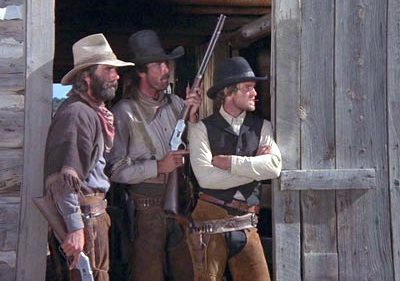
There were other made-for-TV Westerns before it, but THE SACKETTS (1979) is the first big multi-part cowboy epic that I can think of. It came out a full ten years before the LONESOME DOVE series and, though it isn't nearly as good, it does lay the groundwork for this type of sweeping TV Western.

The story follows the adventures of the three Sackett brothers, Tell, Orrin, and Tyrell. Tell (Sam Elliott) is the loner of the bunch, and we're introduced to him as he is forced to flee his mining job after gunning down a crooked card dealer (James Gammon) who happens to be one of the dreaded Bigelow brothers.

Knowing that the other Bigelows will be after him for revenge, Tell disappears into the mountains, where he stumbles onto a rich vein of gold and starts his own one-man mining operation. When he totes a large bagful of the shiny stuff into the aptly-named town of Purgatorie to trade for cash, it doesn't take long for some of the less scrupulous denizens to try and surgically remove him from his new-found riches.


Meanwhile, his brothers Orrin (Tom Selleck) and Tyrell (Jeff Osterhage) have left their Tennessee homeplace to avoid a bloody feud between the Sacketts and another clan, and are headed West with a cattle drive. When they reach Abilene, Orrin falls for the golden-haired daughter of an ambitious politician named Pritts (John Vernon), who aims to drive all the Mexicans out of Sante Fe.

Tyrell, of course, falls in love with a lovely Mexican lass (Ana Alicia) whose father, Don Luis (Gilbert Roland), is the main stumbling block in Pritts' plans. When they all get together in Santa Fe, the situation soon turns deadly and guns start a-blazin'.

The script is a combination of two Louis L'Amour novels, "Sackett" and "The Daybreakers", and it isn't a very smooth blend, crosscutting between the two barely-related stories the way you might switch channels back-and-forth between two movies that are on at the same time.


The stories overlap only twice--once near the end of the first segment when the three Sacketts run into each other in Purgatorie, and again for the big finale as the Bigelow brothers finally catch up to Tell and he's reunited with Orrin and Tyrell to fight them off.

This awkward overlapping of the two stories bothered me the first time I watched THE SACKETTS, along with some jarring hand-held camerawork (no Steadicam here), an endlessly irritating and inept musical score by Jerrold Immel, and a strange performance by Mercedes McCambridge that makes Ma Sackett look like she's either perpetually tipsy or tetched in the head.

But further viewings have helped me to get over the various minus points and begin to appreciate all the good things about this movie. Despite its somewhat rough-hewn quality, THE SACKETTS is an engaging Western with lots of authentic atmosphere, good characters, and a terrific cast.


For starters, there's Sam Elliott and Tom Selleck, who I think are the two best Western actors of the past twenty or thirty years (with the exception of Clint Eastwood, of course), and Jeff Osterhage, a lesser-known actor who does a fine job here. Glenn Ford plays Tom Sunday, the ramrod of the cattle drive who later joins Orrin and Tyrell in their own cattle venture and eventually ends up as their enemy, and his intense, masterful performance (watch his face twitch in those close-ups!) is a joy to behold.

This can also be said for the great Ben Johnson as Cap Roundtree, who becomes Tell's gold-mining partner. Paul Koslo is a hoot as the blowhard would-be gunslinger Kid Newton. The Bigelow brothers are played by Jack Elam, Slim Pickens, Gene Evans, and James Gammon, and also appearing in the cast are the likes of L.Q. Jones, Ruth Roman, Pat Buttram, Shug Fisher, and Buck Taylor, in addition to the aforementioned John Vernon and Gilbert Roland. (Louis L'Amour himself does the opening narration.) If you're like me and you love great character actors as much as A-list stars, this is the kind of "all-star" cast that will put a smile on your face.

I can't give THE SACKETTS a super high score due to its various deficiencies, and the fact that it's not the polished effort that later TV Westerns like LONESOME DOVE would be, but it has enough going for it to get a solid three-and-a-half out of five spurs. The final shoot-out alone is worth waiting for--it's almost as much fun as the bullet-riddled free-for-all that ended OPEN RANGE. And that cast--awesome. There's one scene which features Sam Elliott, Tom Selleck, Glenn Ford, and Ben Johnson sitting around a campfire, and I thought "Damn...I wish I was sitting around that campfire, too."


Share/Save/Bookmark

Tuesday, July 21, 2026

ALL THE COLORS OF THE DARK -- Blu-ray/CD Review by Porfle


Originally posted on 1/27/19


I'm not all that familiar with the Italian "Giallo" genre (save for some Dario Argento classics such as TENEBRE) which consists of warped, horror-tinged murder stories with lots of bloody violence and other lurid elements. 

So it's always nice to catch a really good one like the Italian/Spanish co-production ALL THE COLORS OF THE DARK, aka "Tutti i colori del buio" (Severin Films, 1972) from Sergio Martino, the director who also gave us TORSO, SLAVE OF THE CANNIBAL GOD, and SCREAMERS.

This one is nowhere near as formally-shot and polished-looking as the usual Argento effort, but Martino has a loose, imaginative style that fits the "anything goes" nature of the material, as well as a talent for staging suspense scenes in interesting ways. 


Our heroine, Jane (cult star Edwige Fenech), has been plagued by horrible nightmares ever since the traumatic loss of her unborn baby following a car crash.  Her lover, Richard (George Hilton), is devoted but unable to help, especially since his job keeps him away for days at a time. 

Jane's sister Barbara (Susan Scott) advises her to visit Dr. Burton, the seemingly kindly psychiatrist she works for.  But Jane finds more solace with a new friend, Mary (Marina Malfatti), a mysterious woman who inducts her into a black magic cult filled with arcane rituals that take place in a creepy old castle in the country.

While the mentally and emotionally frazzled Jane may be a bit slow on the uptake, we can tell right away that being forced to drink fresh dog blood and then getting gang-banged by a bunch of stabby, whacked-out weirdos in a cult from which there is no escape probably isn't going to help her as much as a few quiet sessions with Dr. Burton.  Especially since one of the cult members is a creepy trench-coated stalker with neon blue eyes (Ivan Rassimov) who keeps following her everywhere and trying to kill her.


We're never quite sure if we're seeing something real or just one of Jane's waking nightmares, but this lively film keeps us on our toes by constantly alternating the talkier scenes with sudden bursts of action and sometimes shocking violence. 

Much of the suspense is effectively staged around the creaky, open elevator and winding staircase in Jane's shadowy apartment building, and there's a terrific sequence inside Dr. Burton's country estate where Jane discovers a grisly scene involving the elderly caretakers who've been charged with watching over her.

I noticed a few similarities here and there with ROSEMARY'S BABY, which had me suspecting Jane's lover Richard, her sister Barbara, her friend Mary, her shrink Dr. Burton--oh heck, practically everybody--of secretly being part of the cult and their sinister plans for Jane.  Director Martino does like to keep us guessing, all the way up to a nifty fake-out ending in which fantasy and reality clash with deadly results.


The 2-disc Blu-ray from Severin Films is widescreen 1080p full HD resolution with a new 4k scan from the original negative.  Audio is 2.0 English and Italian with English subtitles.  Bonus features include a very learned and thoughtful commentary with Kat Ellinger (author of "All the Colors of Sergio Martino"), interviews with Sergio Martino, screenwriter Ernesto Gastaldi, actor George Hilton & horror expert Antonio Tentori, trailers, and the unrestored alternate US cut of the film entitled "They're Coming to Get You." Also included is a CD of the film's musical score by Bruno Nicolai.

With a fine cast (Edwige Fenech fans will be extra happy), great use of scenic London locations, and a scintillating story full of colorful characters and sinister goings-on, ALL THE COLORS OF THE DARK is pure nerve-wracking fun all the way.


Special Features:
They’re Coming To Get You: Alternate US Cut (88 mins.)
Color My Nightmare: Interview with Director Sergio Martino
Last Of The Mohicans: Interview with Screenwriter Ernesto Gastaldi
Giallo is the Color: Interviews with Actor George Hilton & Italian Horror Expert Antonio Tentori
Audio Commentary with Kat Ellinger, Author of All The Colors of Sergio Martino
Trailers
BONUS Disc: CD Soundtrack 


Share/Save/Bookmark