Jess Franco's immediate follow-up to his relatively well-made VAMPYROS LESBOS is another dark, death-shrouded vehicle for the lovely and exotic Soledad Miranda (again billed as "Susann Korda") featuring some of the same castmembers including Paul Müller, Ewa Strömberg, and Franco himself.
The result, SHE KILLED IN ECSTASY (1971), is a slasher/revenge thriller which stands with his previous effort as one of my two favorite Franco films so far.
The storyline this time is lean and simple--genetic research scientist Dr. Johnson (Fred Williams) commits suicide after his maverick work with human embryos is viciously derided as inhumane by his peers, who suggest he be not only imprisoned but even executed for such atrocious ideas.
Devastated, his devoted wife (Soledad Miranda, known only as "Mrs. Johnson" throughout the film) vows revenge against the four scientists she holds responsible for her husband's death. These are Prof. Jonathan Walker (Howard Vernon), Dr. Franklin Houston (Paul Müller), Dr. Crawford (Ewa Strömberg), and, last but not least, Jesús Franco as the understandably nervous Dr. Donen.
Even before the murders begin, we get an idea of how casually perverse SHE KILLED IN ECSTASY is when we learn that Mrs. Johnson is keeping her husband's death a secret in order to have necrophilic relations with his corpse. While this may sound romantic on paper, it comes off as a bit strange in practice.
Soledad Miranda handles these scenes as she does all her others, with a smoldering intensity that is always enhanced by her dark, exquisite physical beauty. When she becomes a seductive femme fatale, donning various guises to stalk her male and female prey before brutally killing them, her presence always fascinates.
As Franco's muse for all-too-short a time, she seems to inspire him to do some of his best work. For example, the death of Dr. Crawford (Strömberg, who played Countess Carody's lover in VAMPYROS LESBOS) is artfully choreographed and shot, with the added visual flair of having the hapless woman suffocated with a clear plastic pillow through which we can still see her anguished face.
The murders of the male victims are more brutal and violent, although much of this is suggested rather than graphically depicted. Still, it's shocking enough to see Mrs. Johnson going through the motions of castration and aggravated genital mutilation (Franco's unfortunate shlub of a character gets special attention) on a level usually reserved for the most agregious rape-revenge plots.
This emphasizes just how deranged she is and to what extent she must sadistically torture and degrade the objects of her wrath as punishment for driving her husband to suicide. These scenes are heavily sado-masochistic as well.
A limited collector's edition, the handsome 2-disc Blu-ray+CD set from Severin Films is in 16 x 9 widescreen with 2.0 sound. The soundtrack is German with English subtitles. Extras consist of a 20-minute Franco interview, an interview with Soledad Miranda historian Amy Brown (the same one found in Severin's VAMPYROS LESBOS set), an interview with "Murderous Passions: The Delirious Cinema of Jess Franco" author Stephen Thrower, a brief interview with actor Paul Müller, and the original German trailer.
Disc two is actually a music CD entitled "3 Films by Jess Franco" containing tracks from VAMPYROS LESBOS, SHE KILLED IN ECSTASY, and THE DEVIL CAME FROM AKASAVA. These 24 musical tracks by Manfred Hübler and Siegfried Schwab are offbeat and enjoyable--much more so, in fact, when isolated in this way than when heard as backing for scenes which, in my opinion, they're often wildly inappropriate. I found much of this music to be terrifically listenable.
Although still displaying that unpolished quality characteristic of Franco's work, SHE KILLED IN ECSTASY is more crisply wrought and thematically unfettered than his other films I've seen. And as a companion piece to VAMPYROS LESBOS, it stands as a fitting testament to the talent and appeal of Soledad Miranda, whose promising career was so tragically cut short by a fatal car accident soon after filming was completed.
So far, I've seen five films by cult director Jesús "Jess" Franco, including THE HOT NIGHTS OF LINDA, THE SINISTER EYES OF DR. ORLOFF, BLOODY MOON, and PAULA-PAULA. Not enough to call myself an expert on the prolific filmmaker, but enough to conclude that I'll probably never become a devoted Francophile since I find little of his work particularly compelling unto itself.
That said, I do find most of it fun to watch even if it's often in a "so bad it's good" kind of way. My fifth Franco film, VAMPYROS LESBOS (1971), is the best one I've seen so far and definitely worth watching, although I wouldn't call it a must-see unless you're already a fan.
This sun-blanched, 70s-tacky vampire yarn is like a distaff version of "Dracula", with Ewa Stroemberg (SHE KILLED IN ECSTASY) as Linda and Soledad Miranda (here billed as "Susann Korda") as Countess Nadine Carody filling in for Jonathan Harker and Count Dracula. Linda arrives at the Countess' sunny island in Istanbul to help expedite a legal matter--namely, the inheritance by Nadine of the late Count Dracula's estate--and ends up mired in a nightmarish lesbian affair with the undead beauty in which she unwillingly supplies both emotional and physical sustenance, i.e. blood.
Linda has already been having dreams about Nadine before meeting her, so the attraction is mutual. After some skinny-dipping and nude sunbathing, Nadine drugs Linda's drink (this vampire DOES drink wine) and has her "vampyros lesbos" way with her, giving Franco the first of several chances to enhance his film with some "Cinemax After Dark"-style softcore sex before the lady vamp goes for the jugular.
After waking up with confused memories of the encounter, Linda and her boyfriend Omar (Viktor Feldmann) seek the help of Dr. Seward (Dennis Price, VENUS IN FURS), a specialist in the supernatural whose sanitarium is home to a madwoman named Agra (Heidrun Kussin), also a victim of Countess Carody. Of course, the troubled inmate in the thrall of the vampire, the occult-savvy Dr. Seward, and the sanitarium setting itself are all further references to the original Dracula story.
The plot proceeds at a snail's pace most of the way and not a whole lot exciting happens with the exception of a few key scenes such as the showdown between the Countess and Dr. Seward and Linda's capture and near-murder by a demented hotel employee played by Franco himself. Things come to a rather sedate climax that builds little suspense and goes more for tragedy than horror as the Countess spins her web of forbidden desire for the hapless Linda.
Visually, VAMPYROS LESBOS often resembles a Doris Wishman film with its rough-hewn production values and garish, often kitschy design, all in distinctive Eastmancolor. As expected, the camerawork is clumsy at times but Franco shows some style as well as his usual inborn zest for filmmaking. A strangely inappropriate score by Manfred Hubler, Siegfried Schwab, and Jess Franco is a mish-mash of noodly jazz, twangy sitar notes, and what sounds like someone mumbling robotically through a distorted speaker.
Performances are mostly wooden save for Heidrun Kussin's frantic portrayal of Agra, while Soledad Miranda's dark beauty and charisma as the Countess (she reminds me of Victoria Vetri) lend the film much of its appeal. Also appearing are Paul Muller (NIGHTMARE CASTLE) and J. Martinez Blanco as the Countess' loyal servant Morpho.
A limited collector's edition, the attractively packaged 2-disc Blu-ray+DVD set from Severin Films is in 16 x 9 widescreen with 2.0 sound. The soundtrack is German with English subtitles. Extras consist of a 20-minute Franco interview, an interview with Soledad Miranda historian Amy Brown, an interview with "Murderous Passions: The Delirious Cinema of Jess Franco" author Stephen Thrower, a brief clip in which Franco explains how he was the inspiration for the "Star Wars" character Yoda, trailers, and the alternate German opening titles sequence.
While disc one contains the German-language HD-remastered Blu-ray version of the film, disc two is the "bootleg" Spanish-dubbed DVD version. The print has that "grindhouse" look (which I like because of the nostalgia value) and is a shorter edit with several trims and all of the nudity deleted. (This includes two lengthy sequences in which Soledad Miranda's character does an erotic dance in a local nightclub.) Another big difference is an alternate organ-based musical score which sounds much more like a traditional creepy score for a horror movie.
Slow-moving and dry, VAMPYROS LESBOS nevertheless has that indefinable Jess Franco quality that should appeal to his fans. For others, this very sunny and not all that horrific vampire tale will either be a bore or a pleasant diversion.
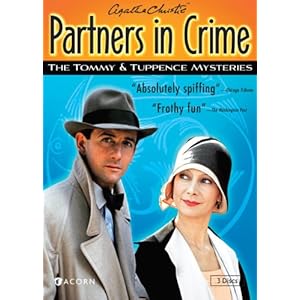
While I was aware of Agatha Christie's keen sense of humor from watching the delightful "Poirot" and "Marple" television adaptations of recent years, it wasn't until I met Tommy and Tuppence Beresford that I encountered Dame Agatha's downright silly side. Their one-season, 11-episode TV series from 1983 can now be found in Acorn Media's 3-disc DVD set AGATHA CHRISTIE'S PARTNERS IN CRIME: THE TOMMY & TUPPENCE MYSTERIES, but how much you appreciate them depends on your tolerance for screwball detective shenanigans of a distinctly lightweight nature.
James Warwick, almost a dead ringer for a young Michael Palin of "Monty Python", plays wounded World War I vet Thomas Beresford. In the feature-length pilot "The Secret Adversary", Tommy returns to London after his military discharge and is reunited with Prudence "Tuppence" Crowley (Francesca Annis, "Lillie", "Cranford"), the beautiful, vivacious army nurse who helped him recover from his injuries. Naturally, they fall in love, but are both desperate to find work.
After a few improbable contrivances, the soon-to-be-married couple find themselves working undercover for the British government in an adventure that feels more like a low-rent espionage yarn than a mystery story. While there's a McGuffin of some sort that I can barely recall, this is simply an excuse to put our hero and heroine in and out of mildly dangerous situations for an hour and a half while dealing with guest stars George Baker ("I, Claudius"), Honor Blackman (of "The Avengers" and GOLDFINGER fame), and Gavan O'Herlihy (Richie Cunningham's phantom older brother on "Happy Days") as Julius P. Hersheimmer, an American millionaire who may or may not be in cahoots with the bad guys.
"The Secret Adversary" has that dreary, overcast look typical of filmed British teleplays of the era, which I actually regard with much nostalgia. The story is more serious than the later series, with more gravitas and character depth. Period trappings do a good enough job evoking the atmosphere of the post-WWI "flapper" era, especially in the rather lavish costuming. All in all, it comes off as something Agatha Christie might've written to give her brain a rest from its usual rigorous literary workouts.
The first episode of the series proper, "The Affair of the Pink Pearl", comes as something of a shock since it features that odd-looking tendency of early British television to mix gloomy filmed exteriors with brightly-lit videotaped interiors, which never fails to look jarring and artificial. Tommy and Tuppence have taken over a detective agency despite their having no experience in the field whatsoever--they rely mainly on sheer luck and pluck to get by--with their movie-obsessed young butler Albert (Reece Dinsdale) serving as receptionist and general comedy relief buffoon.
The series has the look of a sitcom with everyone playing their roles in a broad, theatrical manner. The mysteries Tommy and Tuppence are called upon to solve are quickly and easily dealt with for the most part--anything more complicated, in fact, would be beyond their limited capabilities--leaving plenty of time for frivilously romantic banter between the charming but sometimes sickly-sweet lovebirds.
"Pink Pearl" is a simple, even paper-thin drawing room mystery involving the theft of the title item amidst an upperclass household of eccentrics. Francesca Annis' Tuppence is flightier and sillier than ever, yet she's more naturally clever at solving puzzles than Tommy, a sturdy, reliable chap who enjoys letting his playful side show through in her presence. Guests include William Hootkins of STAR WARS, BATMAN, and HARDWARE, and Graham Crowden of BRITANNIA HOSPITAL.
"The House of Lurking Death" is more like it, living up to its lurid title quite nicely with a better balance of seriousness and humor. Half the characters we're introduced to in the first scene are killed off by poison, putting Tommy and Tuppence into a situation that's much grimmer and more genuinely involving than usual. (Joan Sanderson, the crabby old deaf lady from "Fawlty Towers", guests.) After this, "The Sunningdale Mystery" is positively inert, with our leads wandering around a golf course discussing a murder mystery and poking around for clues until they figure things out and go home.
"The Clergyman's Daughter" is a fun one about a supposed mansion haunting with the usual "Scooby-Doo" plot enhanced by Tuppence's masquerade as a spiritualist. "Finessing the King" gives Tommy and Tuppence a chance to dress up as Holmes and Watson for a costume ball and revisit some old romantic haunts from their past, one of which becomes the setting for the inevitable murder. After that, "The Ambassador's Boots" is about as bland as the title suggests.
There's some nice foggy atmosphere in "The Man in the Mist" but it gives way to tedium as Tommy's longwinded re-enactment of yet another murder goes on too long. The episode is saved by a chuckle-inducing ending. "The Unbreakable Alibi" is an interesting tale of a woman who claims to have been in two places at once, with a solid alibi in each instance. Fairly intriguing, until the most obvious solution to the mystery turns out to be the right one.
In "The Case of the Missing Lady", Tommy and Tuppence infiltrate a country asylum where an Arctic explorer's missing fiance' is thought to be held captive. This is one of the most comedy-heavy episodes, with Tuppence, disguised as a famous Russian ballerina, keeping staff and inmates occupied with a prolonged shaggy-dog version of "Swan Lake" while Tommy searches the place disguised as a scraggly old gardener. A last-minute revelation makes the story even more lightweight than previously thought, but with amusing results. "The Crackler" sends the series off with a pretty interesting tale of counterfeit bank notes floating around an illicit gambling club.
The 3-disc DVD set from Acorn Media is in 4:3 full screen with Dolby Digital sound and English subtitles. There are no extras.
If you're up for this sort of frothy, lightweight entertainment, then there's no reason why you shouldn't enjoy AGATHA CHRISTIE'S PARTNERS IN CRIME: THE TOMMY & TUPPENCE MYSTERIES to some extent. Just as long as you're not expecting something with the same rich atmosphere and emotional resonance as Christie's more substantial filmed works.
When we first got cable TV back in the late 70s, one of my newfound delights was getting to watch British telly on PBS. In addition to "Monty Python", "Fawlty Towers", and all the other usual stuff, this included a 13-episode "Masterpiece Theatre" serial about Lillie Langtry which, for some reason, had me glued to the screen for its entire run.
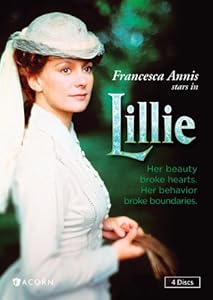
Why was I hooked on what amounted to a lavishly-mounted, delightfully decadent soap opera that consisted of little more than the interpersonal relationships and illicit affairs of a bunch of idle upperclass twits? I'm not quite sure, but watching Acorn Media's 4-disc DVD set LILLIE (1978) has given me a chance to relive the whole thing and get addicted to this nineteenth-century version of "The Rich and the Restless" all over again.
Lillie Langtry, as we all know (or not), started life as poor Jersey island girl Emilie Le Breton, a tomboy with six brothers who escaped her rural life by marrying the leisure-class yachtsman and trout fisherman Edward Langtry. After moving to London, Lillie discovered that her new husband was near destitute and dependant on a small allowance from his family. Fortunately, her great beauty and social confidence quickly earned her a place as the most sought-after woman in British society.
Francesca Annis (AGATHA CHRISTIE'S PARTNERS IN CRIME: THE TOMMY & TUPPENCE MYSTERIES, DUNE) is not only radiantly beautiful in the title role, but gives a bravura performance that captures every nuance of Lillie's personality from her most brazen and rebellious to her most insecure. She inhabits the role just as convincingly as a naive fifteen-year-old first attracting the attention of the opposite sex (her first suitor is shocked to learn her true age while requesting her hand in marriage) as she will be in Lillie's wistful twilight years (despite some rather iffy old-age makeup).
Lillie's loveless relationship with the dullard Edward gives the series its most gripping moments, with Anton Rodgers superb as the increasingly pathetic and irrelevant husband who detests Lillie's way of life but must dutifully play along or risk both his family's displeasure and withdrawal of financial support. It's to the credit of both Rodgers and main scriptwriter David Butler that the character isn't entirely vilified but shown in an almost sympathetic light as he spirals ever downward into alcoholism and finally madness.
Despite the fact that Edward will continually deny Lillie the divorce she badly wants, this will do nothing to deter her from engaging in numerous torrid affairs with everyone from the Prince of Wales (Denis Lill as a robust "Bertie") to rich American tycoons, with even Wild West frontiersman Judge Roy Bean seeking her attention. There's a certain vicarious thrill to watching her scramble up the social ladder while challenging the stiff conformity of her new peers at every turn, even though her life amounts to little more than one meaningless party or empty love affair after another.
When financial ruin forces her to seek employment as an actress, this only leads to greater success and fame that will extend to America as well. The series follows her exploits on both continents as her various theatrical tours cut a swath of notoriety wherever she goes, each scandal seemingly making her more popular than before.
All the while, her entourage of fervent admirers grows to include famous artists such as James Whistler (Don Fellows) and her lifelong friend and confidant Oscar Wilde (the excellent Peter Egan), whose sharp-witted presence gives LILLIE a scintillating sparkle. Jennie Linden is likable as Lillie's relatively down-to-earth high society pal Patsy Cornwallis-West. Joanna David plays her illegitimate daughter Jeanne Marie, who, in some of the series most heartfelt moments, ultimately rejects her mother after discovering the true identity of her father. (Look quick for 007's Desmond "Q" Llewelyn as Lord Dudley.)
Following the usual practice of the era, the show's exteriors are filmed while the interiors are shot on videotape. Thanks mainly to some skillful lighting, however, the effect is less jarring than in many British TV shows of the time. Overall, the production is solid on both sides of the camera--the sort of compelling period drama, done with taste and subtlety, that only British television seems capable of rendering to such a fine turn.
The 4-disc DVD set from Acorn Media is in 4:3 full screen with Dolby Digital sound. No subtitles, but closed-captioning is available. Extras consist of cast filmographies and an insert featuring an essay on Lillie Langtry's lasting impact on pop culture.
While many will undoubtedly regard it as rather pointless and boring, I find LILLIE both nostalgic and compelling, and, for those who enjoy this sort of thing, first-class stuff all the way. It's soap opera of the most sophisticated and decadently delicious kind--like a box of extremely rich chocolates, it almost feels fattening to watch.
For those with a taste for the unusual, SUFFERING OF NINKO (2016) should prove a delectable, perhaps even sumptous treat. While hardly the nuttiest Asian supernatural film set in ancient Japan that I've ever seen, it easily ranks as one of my more keenly unusual movie-watching experiences.
The establishing shots alone let us know that we're in for a beautifully rendered film by first time feature director (and writer and producer and editor) Norihiro Niwatsukino, whose credits on the project mark it as an intensely personal vision.
Set in Japan's Edo period (around the 16th century or so), the story begins in a monastery where young monk Ninko (Masato Tsujioka) is the most ardent and hardworking of all his peers. But for all his virtue and spiritual purity, he suffers from a terrible burden--he is incredibly, insanely irresistible to every woman he comes into contact with.
At first this is depicted with subtle hints of lighthearted comedy despite the film's solemn tone, with Ninko's excursions into a nearby village with his brothers to beg for alms descending into chaos as all the women in the area converge upon the group to grab, grope, drool over, and attempt to seduce the hapless Ninko with every feminine trick in their book and a few that are clearly made up on the spot.
Ninko's ordeal is deftly portrayed by showing us how his zen meditation sessions first serve as a source of peace and spiritual comfort but gradually evolve into furious psycho-sexual fever dreams that have him writhing in sexual agony before finally driving him out of his mind.
This sequence is the most surreal of the film and is enhanced by Edo-inspired drawings and animations (which recur throughout the film to add to its old Japanese storytelling style) and an unusual rendition of Ravel's "Bolero" played with traditional Japanese instruments.
Here we also get one of the first hints that Ninko is being haunted and perhaps stalked by a powerful supernatural female entity with long black hair, whom we see dancing seductively behind a bland-expression mask.
After recovering his senses, Ninko is ordered to set off on a journey of self-discovery to confront his problems and deal with them head on. The narrative really gets going when he meets a mercenary ronin named Kanzo (Hideta Iwahashi) and the two of them are hired by local villagers to hunt down an evil sorceress, Yama-onna (Miho Wakabayashi), who seduces men with her irresistible sexuality and drains them of their lifeforce, leaving only lifeless, mummified husks.
We've seen hints of Yama-onna appearing teasingly to Ninko throughout the film, as though she senses his own sexual power and sees it, and him, as a challenge. Ninko, meanwhile, suffers even more when it occurs to him that he may in fact be some kind of inhuman sexual creature himself.
Kanzo, the roguish swordsman, looks upon all this as an amusing (he likes Ninko) and profitable challenge to his skills. Writer and director Norihiro Niwatsukino brings them all together for a surprising and, in some ways, exhilarating climax (in more ways than one) in which the film's narrative subtleties and eye-filling supernatural wonders intertwine.
Old-fashioned storytelling blends with modern sex and violence to create a unique viewing experience in SUFFERING OF NINKO. Those indulging in this enticing buffet of ancient Japanese delights will be well served.
TECH SPECS
Running Time: 70 mins.
Genre: Drama/Comedy
Aspect Ratio: 1.85:1
Audio: Stereo
Language: Japanese w/English Subtitles
Street Date: August 14, 2018
DVD SRP: $19.95
Every once in a while a movie comes along that you can just delve into, like a pool of water, and float around in for awhile. A CURE FOR WELLNESS (20th Century Fox, 2017) has a lot to do with water, with its theraputic baths, isolation tanks, humid steam rooms, and dark, murky depths creepy-crawling with slithering eels and even more horrific things. After delving into this inky nightmare, you may come out feeling a little waterlogged.
The setting is a sprawling mountainside "wellness retreat" in Austria where people go for the waters, but rarely come back. (We discover later that it has a particularly sordid past.) Pembroke has fled there to escape prosecution in a big Wall Street scam, so ambitious junior exec Lockhart (Dane DeHaan, CHRONICLE, LAWLESS), himself under threat of prison time, has been sent to retrieve the older man in order for him to serve as the company's official scapegoat.
When we meet him, we see that young Lockhart is just a hair's breadth away from forever losing his own soul to his work. A shred of decency still surfaces from time to time, as when he visits his ailing mother in a nursing home or dwells on the memory of the day his father, himself mired in a similar scandal, committed suicide before his eyes.
He's all business when the hospital staff give him the runaround about Pembroke, yet a shocking accident leaves him stunned, confused, and helpless, his broken leg encased in a cast and his fate in the hands of quiet but firmly authoritative Dr. Volmer (Jason Isaacs).
Barely mobile on a pair of crutches, a woozy Lockhart finally manages to locate Pembroke but the mystery of Dr. Volmer and the wellness center has only begun to draw him inexorably into a nightmare of horror that will reach epic proportions.
As Lockhart, Dane DeHaan carries on the troubled, introspective persona that worked so well in CHRONICLE but with an added assertiveness which helps him survive the series of traumatic events to come. Jason Isaacs, whose range extends from strutting martinet (SOLDIER) to manly good-guy type ("Case Histories"), flexes his talents as the outwardly calm, vaguely sinister Dr. Volmer.
Also on hand is the aptly-named Mia Goth (EVEREST, THE SURVIVALIST) as Hannah, the clinic's only young patient, who fascinates Lockhart with a beauty and a demeanor which are both strangely ethereal. Unable to recall her own past and seemingly out of place in her own time, she presents Lockhart with an added incentive to get to the bottom of the ghastly events taking place in the dungeon-like bowels of the retreat where patients are taken, never to return.
I'm loathe to reveal more, save to say that A CURE FOR WELLNESS is like an intoxicating therapeutic bath in undiluted Goth that immerses the viewer in a tantalizing mystery wrapped in surrealism, horror, and even an element or two of the classic monster movie.
All of which is presented by director Gore Verbinski (THE RING, PIRATES OF THE CARIBBEAN, THE LONE RANGER) in visual terms so imaginative and cinematically splendid that almost every shot could qualify as an entry in an avant-garde photography competition.
The wellness clinic setting alone is a marvel of production design with its retro, late 19th/early-20th-century look and hissing, sweating, almost steampunk iron-and-rivets technology cloaked beneath the outer beauty of the colorful mountainside.
Names such as David Lynch, Tim Burton, Stanley Kubrick, and others kept going through my mind as I watched, taking much pleasure in the visuals even as the story recalls hints of Stoker, Lovecraft, and Poe.
Indeed, Lockhart's arrival at the wellness center early in the film is similar to Renfield entering Dracula's castle in DRACULA. Both are men on a mission who arrive sane, and then, after encountering vampires in either the figurative or literal sense, find themselves inescapably lost in a hellish madness. Both films are equally fun to watch, but A CURE FOR WELLNESS is like a darkly scenic rollercoaster ride through a vast carnival spook house.
Digital HD, Blu-ray & DVD Special Features Include
. Deleted Sequence: “It’s Wonderful Here”
. Meditations
. Water is the Cure
. Air is the Cure
. Earth is the Cure
. The Score
. Trailers
. Theatrical trailer
. Red Band trailer
. International trailer
. Digital download
A CURE FOR WELLNESS Disc Specifications
Street Date: June 6, 2017
Prebook Date: May 3, 2017
Screen Format: Widescreen 16:9 (1.78:1)
Audio: English 7.1 DTS-HD-MA / Spanish 5.1 DD / French 5.1 DD (Blu-ray)
English 5.1 DD / Spanish 2.0 Surround DD / French 2.0 Surround DD (DVD)
Subtitles: English / French / Spanish (Blu-ray & DVD)
Total Run Time: Approximately 146 minutes
Rating: R
Closed Captioned: Yes
A quick, down and dirty shoot (as described by the filmmakers) on a very low budget sometimes yields surprisingly good results, as it has in the case of the horror-thriller MADE ME DO IT (Indican Pictures, 2017).
What director and co-writer (with Matthew John Koppin) Benjamin Ironside Koppin set out to do was to get some talented people together and "Frankenstein" (his word) a movie together taking the old FRIDAY THE 13TH and HALLOWEEN slasher templates and doing an homage with a few curves and angles thrown in.
The main victims aren't the usual rowdy, party-hardy bunch--just pensive college student Ali Hooper (Anna B. Shaffer), her younger brother Nick (Jason Gregory London), and her boyfriend Jason (Liston Spence).
Ali's home for the weekend (no keg party or summer camp in the woods this time) but her estranged parents are gone, leaving just her and the guys having a quiet, unpleasantly introspective time of things.
It's just the right situation to be crashed by the standard masked serial killer, but this time he's a stringy, weepy nerd named Thomas (Kyle Van Vonderen) who spends most of his time banished to his bedroom by a sadistic, abusive aunt and living in a fantasy world of funny drawings that come to life and masks that he makes out of paper plates.
Thomas is a "special needs" sort of kid who couldn't hurt a fly--that is, until he puts on his "Barbara" mask, because "Barbara" is just the take-charge, take-no-prisoners sort of person Thomas could never be. And "Barbara" is angry at the world. Very angry.
That's the set-up, and from there MADE ME DO IT takes us into a scary campfire tale where Thomas silently stalks the night in his creepy mask and wields his bloody axe, leaving a trail of bodies all the way to Ali and Nick's house.
Much of the subsequent action is similar to what happens in THE STRANGERS, in which masked killers home-invaded a young couple and terrorized them for no apparent reason.
Here, we get just the same spooky ambience with the inhabitants of the dark, shadowy house (the electricity, alas, has gone off) cowering in fear as they try to elude the unknown stalker, who keeps popping up where they least expect him.
The director builds the suspense well for most of the film, although some scenes tend to meander a bit as Ali gets contemplative about the whole thing. The film spends a lot of time pondering Thomas' psychological state and how he got that way, and our interest in this runs hot and cold.
Meanwhile, Thomas goes off on several freaky mind-trips involving his dead parents, his imaginary animal friends, his horrible aunt, "Barbara" (of course), and other images that come flying at us via various media such as 35mm, 16mm, and 8mm film, scratchy VHS tape, and crude animations--all of which are quite well-done and fun to look at. (These are explored in more detail in one of several making-of featurettes included on the DVD.)
With a rousing final confrontation and a pretty keen twist right at the fadeout, MADE ME DO IT stacks up as one of the more interesting modestly-mounted slasher flicks of recent years, and is way better than watching the usual teen campers getting sliced and diced in the woods by some Jason wannabe.
Back in the old days when I owned the only VCR in the family, my sisters would go to the video store and come back with bags full of chick flicks, which I would have to suffer through. I'm not sure if even they would've enjoyed writer-director Brooks Branch's MULTIPLE SARCASMS (2010), but, to be fair, I suspect that they still would've derived some mysterious and indefinable emotional sustenance from it which totally escapes me.
A disheveled Timothy Hutton plays Gabriel, who wanders through the movie being vaguely dissatisfied with his life as a successful architect with an attractive wife (Dana Delaney as "Annie") and a darling daughter, Lizzie (India Ennenga), both of whom love him. Sounds great, but darn it, he isn't living his life--it's living him! (Or something like that.) So he decides to let everything go to hell while he writes a play which, conveniently, is about his life so that he can put all of his self-pity into words while striving to "find himself."
Mira Sorvino is Cari, a fantasy BFF who's inexplicably supportive and excited about everything Gabe does, while Stockard Channing is his agent Pamela who urges him to complete the play so they can dish it up to an eager public. Poor Gabe, however, can't do that because he doesn't know how the story comes out yet--he must finish wrecking his life before he can write the ending. So whenever he breaks up with Annie, fritters away his job, publicly humiliates his daughter, or makes a drunken pass at Cari, we next find the soulful scribe hunched over his typewriter recording it all for posterity.
Gabe says repeatedly that he doesn't know why he feels "shitty" about his relatively good life, and neither do we. So why should we care? He's a one-man self-pity party obsessively scrutinizing himself through a whine-o-scope and it gets old really fast. After awhile, in fact, he starts to come off less as a troubled aspiring artist and more like a guy who's developing serious mental problems.
The film shuffles from one dull dialogue scene to the next with Gabe either being passively confrontational with Annie, seeking support from Cari or his sympathetic gay co-worker Rocky (a semi-amusing Mario Van Peebles), or proving to Lizzie (and us) that he's still a really good dad so that we'll sympathize with him, too. As you might guess, each foray into the turbulent terrain of his aching heart is accentuated by tender acoustic guitar and piano ballads by the likes of Yusuf "Cat Stevens" Islam.
Some of these scenes, particularly one between Gabe and Cari in her office, are just plain drama-class awful, the actors coming off as jaded old pros noodling over their lines together without putting any real effort into them. The script isn't much help, as in this exchange between Annie and Gabe:
"I love you, but..." (pause) "I am really angry..." (pause) "inside." "We need to get ourselves back, Annie."
Young India Ennenga as Lizzie gives what is probably the film's best performance and gets to deliver one of its few really funny lines to Hutton: "I don't know, I guess I'm just PMS-ing or something--you know, like you and Mom?" Dana Delaney does her best with a thankless role, almost making me forgive her for ruining TOMBSTONE, while Mira Sorvino has very little to work with.
The DVD from Image Entertainment is in 1.78:1 widescreen with Dolby Digital 5.1 surround sound. Subtitles are in English and Spanish. Extras include a "making of" featurette, cast and crew interviews, and a trailer.
After you're done giggling at the clever title, MULTIPLE SARCASMS offers little in the way of amusing comedy or interesting drama. In one scene, Stockard Channing as Gabe's brassy agent Pamela pretty succinctly sums up what I've been thinking throughout the film: "Gabriel, I love you, I really do, but this f**king whining white guy shit has gotta stop."
When the Warner Brothers animation department was at its peak in the 40s and 50s, they consistently churned out some of the best and funniest cartoons ever made. One of their most memorable comedy teams was the cute little bird Tweety and the always-hungry cat Sylvester, whose catchphrases ("I taught I taw a putty tat!" and "Sufferin' succotash!") are part of cartoon history. With Warner Home Entertainment's LOONEY TUNES SUPER STARS: TWEETY & SYLVESTER, fifteen of their classic shorts have been collected on DVD--some uproariously funny, others not quite hitting the bullseye.
The team, who had already appeared individually in several Warner Brothers shorts, scored an Academy Award for Best Short Subject (Cartoons) with their first pairing, 1947's "Tweetie Pie" (sic). This initial outing, in which homeless Tweety is taken in by a household whose cat sees the tiny bird as a mouth-watering meal, seems to be an answer to MGM's Tom and Jerry. The cat who would later be known as "Sylvester" is referred to here as "Thomas" just like the MGM character, and is similarly harangued by a generic housewife seen only from the waist down.
With Tweety's cage suspended from the ceiling, he sits in his swing warbling a strange little tune ("I love little putty, his throat is so warm...And if I don't hurt him, he'll do me no harm"). Meanwhile, Sylvester devises a series of ingenious methods of attaining his prey, giving the writers a chance to come up with some pretty funny material while establishing the basic formula for the series. Sylvester causes more and more chaos and destruction with each attempt, either by his own ineptitude or the playful deviousness of the little bird.
Next comes "Bad Ol' Putty Tat" (1949), the classic situation in which a cartoon cat lays siege to a bird perched high up in a birdhouse, and "All Abir-r-r-d!" (1950), with similar antics taking place in the baggage compartment of a passenger train. These initial offerings are mid-level Warner Brothers stuff, well-drawn and animated but not all that outstanding.
With "Canary Row" (1950), the characters have come into their own and the gags are snappy and clever. "Friz" Freleng's direction also gets progressively sharper and more inventive. As always, musical maestro Carl Stallings' score plays a major part in making the action a lot funnier as Sylvester tries to sneak into a hotel to get Tweetie. Thanks to voiceover legend Mel Blanc, we hear the cat speak for the first time as he impersonates a bellboy: "Your bagth...madame?"
Blanc's speeded-up voice is charmingly funny as Tweety sings his theme song over the titles:
"I'm a sweet little bird in a gilded cage
Tweety's my name but I don't know my age
I don't have to worry and that is that
I'm safe in here from that old putty tat."
Tweety's kindly old protector, Granny (first voiced by Bea Benederet, later by June Foray), makes her first appearance as well, thus rounding out the cast and giving the series a more distinctive character. Thankfully for us cat lovers, it's not as painful seeing Granny whack Sylvester with her umbrella as some faceless harridan beating him with a broom.
1951's "Putty Tat Trouble" opens with Tweety shoveling snow out of his nest ("This is what I get for dweaming of a white Chwistmas!") and catching the attention of two housecats, Sylvester and a roughhousing rival, who go at it tooth and nail over the tiny bird. This is the first real laugh riot of the collection and had me guffawing out loud several times. (Look for the cardboard box with the words "Friz--America's Favorite Gelatin Dessert", a self-reference by director "Friz" Freleng.)
The all-out hilarity continues in "Room and Bird" (1951), with both Granny and Sylvester's owner sneaking their pets into a "No Pets Allowed" hotel where they're joined in mischief by a belligerent bulldog, causing the house detective a huge headache. "Tweety's S.O.S." (1951), in which Sylvester spots Tweety through the porthole of his cabin on board a docked ship, gives the cat another rare early line of dialogue: "Hell-o, breakfast!" Later, when Granny catches him and he puts on an innocent act, Tweety exclaims "Ooh, what a hypocwite!"
"Tweet Tweet Tweety" (1951) takes place in a national forest with Sylvester trying to cut down the tree in which Tweety's nest is perched. We hear his catchphrase "Sufferin' succotash!" for the first time here as he grows increasingly more talkative. "Gift Wrapped" (1952) is an amusing Christmas-themed story.
In "Ain't She Tweet" (1952), a pet store delivers Tweety to Granny, who also keeps a hundred or so vicious bulldogs fenced in her yard. The sight of Sylvester repeatedly falling into this roiling mass of teeth and claws in his attempts to get into the house are somewhat nightmarish.
"Snow Business" (1953) is the first time we see "Tweety & Sylvester" billed together as a team. They start out as friends this time, until they get snowed in up in Granny's mountain cabin with nothing to eat but bird seed. While a starving Sylvester tries to trick Tweety into a boiling stew pot, he must also avoid a hungry mouse who's after him. For some reason, the cat never thinks of eating the mouse.
"Satan's Waitin'" (1954) suffers from an unwieldy premise--Sylvester gets killed while chasing Tweety, goes to Hell, then finds that his punishment will be delayed while his other eight lives are snuffed out one by one. An unfunny bulldog-Satan eggs them on in a series of tepid gags, each climaxing with another death. Geez, getting hit with a broom is bad enough--I don't really want to see Sylvester being cast into a fiery lake of devilish bulldogs for all eternity.
1961's "The Last Hungry Cat" shows the more modern influence of later WB cartoons with angular backgrounds rendered in an appealingly creative way. High concept strikes again in this spoof of "The Alfred Hitchcock Show" in which Sylvester thinks he has "murdered" Tweety and is sought by the police. The guilt-ridden cat suffers a torturous, sleepless night, constantly needled by the Hitchcock-like narrator, until he discovers Tweety is still alive and reverts back to form. While this short is nice to look at, it just isn't funny.
The trend of over-thinking these stories continues with "Birds Anonymous" (1957). Sylvester is initiated into an "AA"-type group for bird-crazed cats, who are presented as helpless addicts. ("I was a three-bird-a-day cat," one of them testifies.)
Increasingly preoccupied with being clever, the writers of these later cartoons sometimes forget to pack in the funny, fast-paced gags that made this series so popular in the first place. Here, Sylvester endures yet another mental ordeal, with a grotesque bloodshot-eyes closeup that's almost a duplicate of the one from "The Last Hungry Cat." Why the heck has Sylvester suddenly turned into Ray Milland?
The final short in the collection, "Tweety and the Beanstalk" (1957), is a fun take-off on the old fairytale (June Foray can be heard as the unseen woman who throws Jack's magic beans out the window). The idea of Sylvester running around the giant's castle trying to nab a Tweety who's the same size as him, while eluding a monstrous bulldog, sounds tiresome at first but actually manages to generate some old-style sight gags with an outrageous ending.
The DVD is in standard format (no choice of matted widescreen this time) with Dolby Digital English and Spanish mono sound, and subtitles in English and French. The titles on this disc have appeared previously in other Warner Brothers DVD collections.
While uneven in quality, the fifteen shorts in LOONEY TUNES SUPER STARS: TWEETY & SYLVESTER are examples of some of the finest theatrical cartoons ever produced by one of the top animation studios of its time, in an era when such fare was designed to be enjoyed and appreciated by audiences of all ages.
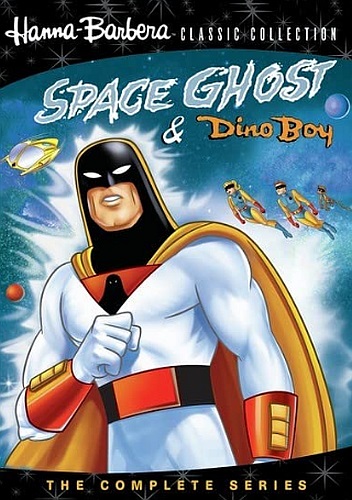
Currently watching: the complete DVD collection of one of my favorite Saturday morning cartoons as a kid, SPACE GHOST (1966-1968).
(Full DVD title: "Space Ghost & Dino Boy: The Complete Series" from the Hanna-Barbera Classic Collection. 20 episodes on 3 discs, 42 7-minute Space Ghost segments in all. Bonus feature is a movie-length documentary, "Simplicity: The Life and Art of Alex Toth.")
I love Cartoon Network's later comedy reworking of the character in his own talk show called "Space Ghost Coast To Coast", but that takes nothing away from my feeling for the original action-adventure space opera designed by comics legend Alex Toth.
It was only Hanna-Barbera's second adventure cartoon after "Jonny Quest", and their first superhero series. "Laugh-In" star Gary Owen did the voice for Space Ghost, and his teen sidekicks Jan and Jace were voiced by Ginny Tyler and Tim Matheson.
Other voice talent includes Ted Cassidy as Metallus, Vic Perrin as Creature King, Alan Reed as Glasstor, Keye Luke as Brak, Paul Frees as Brago, and Don Messick as Blip, Space Ghost's cute monkey companion who often gets him and the kids out of trouble.
Alex Toth's character designs and layouts are eye-pleasing, and the show was done while Hanna-Barbera were still doing quality animated shows. The music is great, too.
The secondary "Dino Boy" segments don't do anything for me--I don't even remember bothering to watch them when originally aired.
Super villains Zorak, Moltar, and Brak would later become regulars on the talk show, along with occasional appearances by Metallus, Tansit, Lokar, and Black Widow. It's fun seeing them play it straight as they do here in their introductory appearances.
Space Ghost, whose subterranean laboratory can be found on the Ghost Planet, is sort of an interplanetary policeman whose main powers are supplied by his power bands, which are worn on his wrists, and his inviso-belt.
Jan and Jace alert him of suspicious activity while on patrol in their scout ship and often get captured by the bad guys so that Space Ghost must fly to their rescue in his spaceship, the Phantom Cruiser.
The stories are flashy and colorful, with lots of explosions, and are kept very simple and formulaic so that they can be easily followed by younger viewers.
As far as light entertainment with a strong sense of nostalgia goes, I just love this kind of stuff.
Sizzling with supercharged action, the simple plot of director Takeshi Koike's sci-fi anime REDLINE (2009) serves as a backdrop for some of the most mindblowing, audacious cartoon animation to ever blaze its way across the screen.
The pre-titles sequence features a qualifying "Yellowline" race in the desert that already makes the podrace from THE PHANTOM MENACE look like a frog-jumping competition. We meet J.P., who resembles a brawny Ricky Nelson with a skyscraper pompadour and, thanks to his crooked partner Frisbee, has a reputation for fixing races. Sure enough, Frisbee's in deep with the mob on this one and sabotages J.P.'s car near the finish line, landing him in the hospital.
When some of the qualifiers for the Redline drop out, J.P.'s back in the game along with his heartthrob Sonoshee, a lovely lass with more interest in machines than men. But the location for the race turns out to be Roboworld, a militaristic society whose leaders are so opposed to the competition taking place on their world (and possibly having some of their military secrets broadcast galaxy-wide) that they declare all-out war against the racers. In order to win this one, J.P. will have to battle it out against ruthless drivers (including Sonoshee), the entire military force of Roboworld, and perhaps even his own sidekick Frisbee.
Fans of non-CGI animation should have a ball reveling in this 100% hand-drawn visual feast, whose creators invested seven years and 100,000 drawings in its making. Each frame of this dazzling tribute to old-school cartoon wizardry is as insanely detailed as panels from the more extravagant underground comix of the 60s and 70s, and unlike digital cartoons you can see the artists' and animators' hands in every painstaking detail.
The dynamic, hard-edged drawing style, a eye-pleasing mix of both the futuristic and retro, yields a wealth of beautifully-rendered character designs and backgrounds that are then brought to vivid life. Surreal touches, such as J.P.'s gravity-defying hairdo and an endless parade of grotesque aliens, rub shoulders with the hard-edged yet wildly-imaginative hardware of cars, spaceships, and other machinery.
The over-the-top character design (by co-writer Katsuhito Ishii, who also worked on the anime sequence from KILL BILL, VOL. 1 and helped create REDLINE's outstanding soundtrack) goes well with the film's larger-than-life cast of oddballs. These include J.P.'s multi-armed canine mechanic Pops, the towering cyborg Machine Head, and the various other racers whose bizarre appearance and unique personalities keep things interesting. Even the crowd scenes are filled with a vast array of colorful "extras."
While the plot busies itself with various concerns such as J.P.'s wooing of the reluctant Sonoshee and Frisbee's conflict of loyalties between him and the mob, REDLINE roars to life during its many spectacular action sequences. The imposing Colonel Votron and his Roboworld army launch a full-scale attack on the racers that begins when they leave the mothership and attempt to land their shuttle vehicles on the planet. The race itself is a non-stop series of thrilling setpieces which lead to the activation of the Roboworld president's ace in the hole, an out-of-control behemoth known as "Funky Boy" who proceeds to destroy everything in sight.
The DVD from Anchor Bay's "Manga" label is in 1.78:1 anamorphic widescreen with Dolby 5.1 and 2.0 soundtracks in both Japanese and English, with English subtitles. Extras consist of a 24-minute making-of featurette and the film's trailer.
Thrilling, funny, and endlessly watchable, REDLINE is chock-full of some of the most visually-stunning racing action and futuristic warfare ever created for an animated film. Best of all, it's a return to the glory days of hand-drawn animation which, in the words of its creators, offers something new by doing things the old way again.
Danish director Birgitte Stærmose (DARLING, ISTEDGADE) and prolific screenwriter Kim Fupz Aakeson (PERFECT SENSE, ACCUSED) have set out to make us all sad, contemplative, and mesmerized with their gloomy drama ROOM 304 (aka "Værelse 304"), which is like one of those long, detailed dreams that skirts the boundary between the nightmarish and the mundane.
It all takes place in a high-class hotel where all the characters or their relatives work, but instead of being the story of the everyday behind-the-scenes drama of managing a bustling hotel, which I initially expected, it's really a fairly simple account of the romantic and interpersonal relationships between some troubled souls who happen to work in the confined spaces of a big, oppressive hotel.
To make the simple storylines more interesting, screenwriter Aakeson has gathered up all the scenes and laid them out like jumbled jigsaw puzzle pieces for us to try and sort out ourselves. That way we see things that will occur much later and don't understand them until they reappear in a different context, when everything finally starts to come together.
We see the little details of married (but not to each other) co-workers sneaking around cheating on their spouses, daily compounding the lies and suspicion that will gradually come to light in tragic ways. We see a fervid subplot about a laundry room worker avenging himself on a guest who once raped his wife, which introduces a loaded pistol into the mix.
And we see the desk clerk covered in blood after a shocking murder, but, like all the other main plot points, we won't find out what happened until we've been slowly and subtly teased.
If it sounds anything like an Arthur Hailey story, it isn't. ROOM 304 is slow, somber, and achingly sad, and we see almost nothing of the hotel's guests or the usual practical concerns of running the place. It serves instead as a sort of dreamlike territory of the subconscious, where characters yearning for various unreachable things wander through their unfulfilling lives like fish in an aquarium.
Hotel director Kasper (Mikael Birkkjær) and front office manager Nina (Stine Stengade) are having a torrid affair that, we fear, will end badly. Just how badly is revealed to us as the puzzle pieces drift maddeningly into place, and one person's obsession and desperation override rational thought while other collateral damage is wrought.
Loneliness is another element casting a pall over such characters as emotionally needy stewardess Teresa (Ariadna Gil), who picks up men in the bar for unpleasant sex in her room. And then there's the daily grind of service workers such as two Filipino maids who toil on the periphery, observing and chatting about it all and never knowing when some sudden twist of fate might sweep them into a maelstrom of tragedy.
My favorite character is Martin (David Dencik, 2011's TINKER, TAILOR, SOLDIER, SPY), the withdrawn, hypersensitive, obsessive (he's always washing his hands) desk clerk. When Nina calls him into her office and tells him that, while very efficient, he needs to "smile more", the nonplussed Martin considers this for a moment and, straightfaced, assures her that he will "make a note of it." He's the one who ends up with blood all over him after the murder occurs.
The visual mood inside the hotel is consistently oppressive, rendered with a richly dark palette and much Rembrandt-style lighting. Stærmose's direction is fluid and artistically expressive, and remains interesting throughout even when the plot is moving along at a snail's pace.
It took me two viewings to fully appreciate ROOM 304, one just to wander around getting my bearings, and another to piece it all together and realize what a carefully wrought and thoroughly satisfying work of cinematic storytelling it is. The fadeout illicits much contemplation and, for me, a bit of emotional decompression.
When adult filmmaker Doris Wishman got together with bazooka-boobed Polish stripper Chesty Morgan in the mid-70s, the result was two of the most head-scratchingly cockeyed and totally off-the-wall nudesploitation flicks ever made. "Deadly Weapons" and "Double Agent 73" are now together on the same Blu-Ray disc along with an unofficial non-Chesty follow-up, "The Immoral Three", to form the Something Weird Video collection CHESTY MORGAN'S BOSOM BUDDIES.
It was a match made in junk-film heaven--Wishman, a filmmaker with an abundance of energy and enthusiasm but little actual skill, and Chesty, a stunning human visual effect who nevertheless displays absolutely no natural talent whatsoever in front of the camera. In fact, her absolute lack of any discernible acting skill makes everyone and everything else around her seem better by default. And yet, with those mind-bogglingly huge all-natural hooters and preternaturally unaffected (some might say "spaced-out") expression, she somehow demands our disbelieving attention every second she's on the screen.
"Deadly Weapons" (1974) features Chesty (here billed as "Zsa Zsa") as the faithful wife of a mob wiseguy named Larry who gets whacked after he steals an incriminating address book and tries to blackmail his boss with it. The grief-stricken Chesty vows revenge. Overhearing one of her hubby's killers referring to his addiction to "burlesque", Chesty knows what she must do--get a job as a stripper and wait for him to show up at the club.
Naturally, she has no trouble doing so after the bug-eyed manager gets a load of her blouse-bursting knockers, which gives Wishman a chance to include scenes from Chesty's burlesque "act" as part of the plot. When the killer shows up, she gets him alone long enough to wield the only weapons at her disposal, smothering him to death with her enormous cleavage in a scene that has to be gaped at to be believed.
Later, porn star Harry Reems (DEEP THROAT) meets the same fate despite sporting what must be one of the most formidable moustaches in film history. But screenwriter Judy J. Kushner (Doris' niece) saves the most shocking twist for the final minutes of the film, which should leave viewers shaking their heads in dismay.
With "Double Agent 73", Chesty portrays secret agent Jane Tennay, who, in service of a plot that doesn't really bear keeping track of, has a camera surgically implanted into her left boob. That way, whenever she kills an enemy agent she can snap a photo via her Nipple Cam for use back at headquarters in identifying the big cheese, "Mr. T." (no, not THAT "Mr. T.").
This gives the robotic Chesty an excuse to doff a variety of hideously unflattering outfits throughout the story, beat up bad guys with her wrecking-ball boobs, and snap their pictures. But first, we meet her while inexplicably sunbathing in a black bra, hot pants, and pantyhose while watching that old nudie-flick standby, naked coed volleyball.
Later, there's a weird slow-motion sequence with her beating up an attacker with her boobs while taking pictures of him, leading to a hilarous speeded-up car chase that's like a cross between "Bullitt" and "The Road Runner." In another highlight, Chesty's pretty blonde houseguest is mistaken for her by an assassin, giving director Wishman a chance to duplicate the shower scene from "Psycho" but with a decidedly different approach than Hitchcock. To her credit, Wishman does manage a couple of semi-cool action scenes in which Chesty is manipulated into looking like she's actually doing something, a feat even Hitch probably couldn't have pulled off.
Wishman's directorial style is primitive, but it's always watchable. She even shows a little imagination here and there, particularly during scenes of people getting beaten up, and there are flashes of rudimentary style. But the main fun here (aside from the inescapably nightmarish 70s decor and fashions) is in watching Wishman try to coax a performance out of Chesty Morgan the way nature photographers attempt to manipulate animals into "acting" for the camera.
While listening to breathless dramatic dialogue being dubbed over Chesty's expressionless closeups, to hilarious effect (Doris and her husband dubbed ALL the voices themselves), it finally occurred to me that these films reminded me of the 1970 TV series "Lancelot Link: Secret Chimp", in which footage of chimpanzees dressed as human characters was coupled with voiceover dialogue to create modest little spy spoofs. Even the look of the film, sets, and costumes is similar, and it wasn't hard to imagine Chesty fitting right in as Lancelot Link's female sidekick Mata Hairy ("Oh, Lancie!"), albeit with less acting ability than the original ape actress.
Since there were only two Doris Wishman epics produced with Chesty Morgan as the star, the third film in this collection, "The Immoral Three", aka "Hotter Than Hell" (1975), is more of a generic offering. That is, the three women who star in it have more generic physical endowments, although star Cindy Boudreau as "Genny" is still pretty conventionally stacked.
This time, agent Jane Tennay (also Boudreau) is murdered by a mysterious assailant. We discover that she had three daughters who were the result of "carelessness" during missions involving sexual relations with the enemy. The half-sisters Genny, Sandy (Sandra Kay), and Nancy (Michele Marie), strangers to one another until now, must find out who killed their mother and avenge her in order to inherit her $3,000,000 estate.
What follows is some dull softcore sex stuff such as a bikini-clad Sandy fellating a banana to entice the pool man and a drunken Genny doing a seductive dance in bra and panties (the elevator scene is actually kind of funny), mixed with scenes of abrupt, bloody violence as the girls' search for their mother's killer draws some desperate characters out of the woodwork. The final minutes are rather intense in their own haphazard way, with a surprise ending from right out of left field.
The triple-feature Blu-Ray from Something Weird Video is in 1080p high-definition widescreen 1.78:1 with mono sound. Bonus features are a gallery of Doris Wishman exploitation art and a sizable collection of entertaining trailers from her many films.
In recognition of one of his major influences, John Waters has the teenage son in "Serial Mom" breathlessly watching Doris Wishman's Chesty Morgan flicks on home video in the privacy of his bedroom. I, too, rented these movies back in the early 80s and found them, while not exactly "sexy", to be delightfully odd artifacts from a once-in-a-lifetime collaboration of cinematic forces. With CHESTY MORGAN'S BOSOM BUDDIES, we can revel once again in the bizarre.