HK and Cult Film News's Fan Box

Sunday, August 7, 2022

CALAMITY JANE -- Movie Review by Porfle


Originally posted on 12/17/15


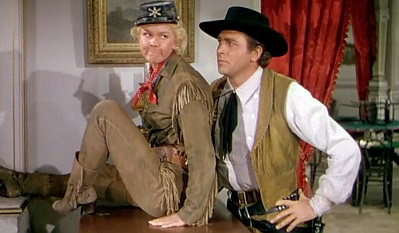
CALAMITY JANE (1953) takes place in a dreamy Technicolor version of the Old West straight out of the matinee oaters of the 30s and 40s.  In fact, when we get our first long shot of the town of Deadwood, it looks almost like a cowpoke version of Oz. 

The film hits the ground running with Doris Day's rousing opening number, "The Deadwood Stage (Whip-Crack-Away!)", in which she sails into town riding shotgun on the stagecoach and then makes her way into the saloon-slash-theater "The Golden Garter" to regale all her friends with tall tales of her latest exploits.

Doris Day is a hoot playing a blonde, female version of Gabby Hayes who, as the film progresses and she acquires a few wardrobe and makeup refinements, gradually reveals her true hidden beauty to her stunned male friends including Howard Keel's "Wild Bill" Hickock. 


Keel is his usual tall, oak-solid self with a singing voice as deep as the ocean.  Philip Carey is adequate though a tad nondescript as dashing cavalry officer Lt. Daniel Gilmartin.  The rest of the cast is populated by a delightful assortment of motley Western types along with Dick Wesson as tenderfoot actor Francis Fryer from back East (who must perform in drag when the Golden Garter's owner accidentally books him as a female performer).  Keep a sharp eye out for Glenn Strange and Bess Flowers in bit parts as well.

Allyn Ann McLerie, who would later play a matronly schoolmarm in the John Wayne classic THE COWBOYS, makes a wonderful transition from shy, homely maid to ravishing dancehall singer as Katie Brown.  When Calamity travels to Chicago to ask sought-after beauty Adelaid Adams to perform at the Golden Garter, she mistakes Miss Adams' maid Katie for the famous singer and fetches back her instead. 

The nervous Katie's true identity is quickly revealed during her disastrous debut performance, but with Calamity's prompting the rowdy audience gives her a second chance and, with renewed self-confidence, she wins them over on her own.


While the first half of the movie is an endlessly frothy fountain of fun, the second threatens to bog down in romantic plot complications when the four main characters--Calamity, Bill, Katie, and Danny--all fall in love with the wrong people.  Fortunately, the film is carried along by some genuine heartfelt sentiment (mainly through song) before bursting forth with the requisite happy-ending vibes as everyone gets paired up like we know they're meant to be.

The songs by Sammy Fain and Paul Francis Webster are just plain delightful.  In addition to the exhilarating "The Deadwood Stage (Whip-Crack-Away!)", Doris gets to perform such toe-tappers as "Just Blew in from the Windy City", "A Woman's Touch" (with Allyn Ann McLerie), and her duelling duet with Keel, "I Can Do Without You."  I'd forgotten that the Billboard chart-topper "Secret Love" originated from this show, so it was to my very pleasant surprise to hear Doris' beautiful rendition of it late in the film. 

Keel solos on the love song "My Heart Is Higher Than a Hawk (Deeper Than a Well)" and McLerie gets two onstage numbers, "Hive Full of Honey" and "It's Harry I'm Planning to Marry", while displaying one of the shapeliest pairs of gams you're likely to see in quite a spell.  A reprise of the film's opening number takes us into the feelgood fadeout with a goofy smile on our faces and a renewed appreciation for the divine Dodo.


Share/Save/Bookmark

Saturday, August 6, 2022

NIGHT OF OPEN SEX -- Blu-ray Review by Porfle


Originally posted on 2/21/20


From the title and cover art, I thought NIGHT OF OPEN SEX (Severin Films, 1983) was going to be one of Jess Franco's more experimental and largely plotless indulgences.

But sure enough, there is a plot, and a pretty passable one at that, although it has its work cut out for it competing against Franco's endless cinematic explorations of his beloved Lina Romay's bouncy naked body.

We first meet Lina (HOT NIGHTS OF LINDA, SINFONIA EROTICA, TWO FEMALE SPIES WITH FLOWERED PANTIES) as Moira, a popular local harlot who draws big, enthusiastic nightclub crowds just by writhing around onstage in various states of undress while wantonly pleasuring herself.


Naturally, she's the perfect choice for sleazo conman Vic (Miguel Aristu) to recruit in his plan to trick a dying Nazi general (Albino Graziani, MANSION OF THE LIVING DEAD) out of a hidden cache of gold by having her pose as his niece.

But first Vic and Moira must kidnap the real niece, Tina Klaus (Carla Simons), and get her to divulge the general's whereabouts in one of those scenes where Franco flirts with torture porn.

It's also a flirtation with real porn in that it contains some vaginal penetration, albeit with a hot curling iron as Moira proves she's as cruel as she is beautiful.


This early scene is brutal and rather shocking, especially since Moira is a character we're meant to like as we follow her sexual and materialistic exploits, some of which are in a humorous vein, for the remainder of the story.

The rest of the film is a series of near-hardcore sex scenes focusing on Moira flailing ecstatically with various partners including her blonde girlfriend Eva (Lorna Green, MACUMBA SEXUAL) and a moustachioed stud named Al Crosby (J.A. Mayans, CANNIBAL TERROR), who first abducts Moira and then teams up with her to search for the gold while finding time to engage in endless frantic couplings.


The aforementioned plot keeps chugging away during lulls in the sexual action and actually becomes somewhat intriguing as Moira and Al work to decipher the Nazi general's cryptic clues and make their way through lush seaside scenery where a hidden mansion awaits.

Adding to the suspense is another male-female duo on the gold hunt, and their sudden appearance during Moira and Al's climactic sexual frenzy, which is stoked to new heights by the sight of a big stack of shiny gold bars, augments the film's twisty and rather amusing finale.

Franco (COUNT DRACULA, VAMPYROS LESBOS, SHE KILLED IN ECSTASY), who makes a brief cameo appearance while tied up and gagged, is in relatively good technical form here with some steady camerawork and ideal locations. 


My favorite part is the opening, a gorgeous extended shot through the windshield of a car cruising down an oceanfront boulevard lined with lightposts beneath a dark, cloudy sunset. The entire film looks good considering the low budget and Franco's tendency to work fast and loose.

NIGHT OF OPEN SEX is neither the director's worst (so far I would nominate PAULA-PAULA) nor the best of the comparatively small number of his scores of films that I've seen. Non-Franco fans will likely find it lightweight and slow, even boring. Lina Romay fans will get a severe case of eyestrain. I found it interesting (Franco is always interesting) and fun.


Buy it at Severin Films

Scanned in 4k from the original negative

Special Features:

    In The Land Of Franco Part 2: Stephen Thrower Tours Multiple Franco Locations in Portugal
    When Donald Met Jess and Lina Part 2: Filmmaker Donald Farmer Interviews the Power Couple in 1993
    The Night of Open Jess: Interview with Stephen Thrower, Author of ‘Murderous Passions & Flowers of Perversion – The Delirious Cinema of Jesús Franco’


Share/Save/Bookmark

Thursday, August 4, 2022

7 WITCHES -- Movie Review by Porfle


Originally posted on 4/17/17


Sometimes you can tell from the very first frames that a film is going to be beautifully rendered and dripping with mood and atmosphere.  7 WITCHES (Indican Pictures, 2017) is just such a film, and watching it is like seeing a fresco of exquisite horror being painted before our eyes.

It begins in stark, finely-etched black-and-white with a massacre of young girls and their family members in what appears to be colonial days.  Then the present time is ushered in with muted colors as the same rural seaside location becomes the setting for a wedding between two women, local girl Aggie (Megan Hensley, THE CRAZIES, CHUPACABRA TERRITORY) and her city-girl lover Rose (Danika Golombek).

Rose's sister Kate (Persephone Apostolou, SMALL FISH, PARADISE HILLS) arrives, and immediately old sibling rivalry issues are reignited.  Kate also has a problem with Aggie because she's insufferably odd and enigmatic, with the look of a prim Amish girl but a knowing air of sick perversion just beneath the surface.


Kate and Rose's family--father, stepmom, and likably brassy aunt Paula (Macall Gordon, "The Man in the High Castle"), who enjoys a toke of the old herb now and then--get together with Aggie's clan of wax-museum oddballs in a secluded old beach house that's like something out of the 1600s.  Along for the ride is Cody (Mike Jones), a schlub whom everyone mistakenly thinks is engaged to Kate.

Aggie's relatives turn out to be a deeply disturbing bunch of musty artifacts from the Salem witch-hunt days who make us feel as though that whole episode in history might've been entirely justified.  And what begins simply as a very awkward social situation leading up to Rose and Aggie's wedding soon reveals itself as something entirely more sinister.

It's like one of those rom-com setups with the disparate characters shoved together in a house for the weekend and forced to hash out their differences BIG CHILL-style, only a lot more horrifying. Even the food (which Kate wisely refuses to eat) has a disgustingly vile look to it as we see it being prepared and dished out in harsh, hostile strokes. 


Kate's twilight foray into a nearby deserted settlement in the midde of nowhere uncovers troubling indications of things to come.  Meanwhile, Cody finds himself in the middle of an unexpected seduction that leads to one of the most fervidly revolting softcore sex scenes to ever unfurl itself onscreen. 

And that's just the beginning.  Before it's over, 7 WITCHES will take the viewer on a spookhouse tour that includes sudden, shocking violence, murder, perversion, and even cannibalism. 

Gorgeously photographed in pure creep-o-vision, it's a masterpiece of mood that's lush, oppressive, and absolutely dripping with sinister atmosphere.


Brady Hall (SCRAPPER, JERKBEAST) directs it all like a work of art, as though Lovecraft's Richard Upton Pickman had taken up film as a medium for recording his darkest imaginings. 

In fact, the story's most horrific scenes, with their grim, twisted imagery, give us an idea of what Lovecraft's or Edgar Allan Poe's nightmares might have looked like. 

7 WITCHES ratchets up the tension to the breaking point and then ends abruptly, leaving things tantalizingly unresolved.  Short and sweet (the running time is around 75 minutes or less), it's a must-see film for horror connoisseurs to savor like a fine vintage wine. 

Tech Specs
Runtime: 75mins
Format: 1:78 HD
Sound: Dolby Sr.
Country: USA
Language: English
Website: www.vowsfilm.com
Genre: Horror


Share/Save/Bookmark

Thursday, July 28, 2022

BLOODY MOON -- Blu-ray review by porfle


 Originally posted on 7/3/14


If nothing else, Jess Franco was a prolific director who dabbled mainly in the genres of horror and porn. Despite his popularity, the films I've seen from him so far (THE HOT NIGHTS OF LINDA, THE SINISTER EYES OF DR. ORLOFF, and especially the awful PAULA PAULA) have yet to convince me that his work is worth seeking out unless you're just looking for some "so bad it's okay" action.

My most recent Franco film, 1981's BLOODY MOON, while being a somewhat lively horror flick with lots of bad gore effects, also falls short of converting me into a Franco-phile. I do, however, admire his ability to take a low budget and limited resources and churn out theatrical product that also manages to endear itself to his numerous fans.

Maybe it's his crudely-executed enthusiasm for the filmmaking process that they find so fascinating. There isn't much else to recommend in this particular outing, which takes place in a Spanish boarding school for young women that's menaced by an unknown killer.


The film opens with the facially-disfigured Miguel (Alexander Waechter) raping and stabbing one of the students during a masquerade party while wearing a Mickey Mouse mask. Five years later, his sister Manuela (Nadja Gerganoff) succeeds in getting him released from the booby hatch in her custody, whereupon they return to the school which is owned by their tyrannical aunt, the Countess (María Rubio), who suspects them of wanting her out of the way so they can inherit her fortune.

We're shown a few cursory scenes of the female students during a language class but the place is actually more of a resort hotel with luxurious cabins and a swimming pool. So when they aren't reciting moron-level Spanish lessons, they're either disco dancing in the local club, swimming, or bumping uglies. Or getting murdered.


It all comes off like a poor man's Argento flick but with unlikable characters yakking some really bad (and badly dubbed) dialogue. There's a mentally-challenged mute handyman (Otto Retzer) who may be the killer, a handsome young chick-magnet gardener named Antonio (Peter Exacoustos) who may be the killer, a suave, sex-crazed school dean who may be the killer (Christoph Moosbrugger), and a final girl named Angela (Olivia Pascal) who may get killed and can't convince anyone that she just saw her best friend murdered by a pair of scissors through the chest in her own bedroom. Top this off with a bunch of unfunny comedy-relief dumb blondes running around, not to mention the incestuous Miguel and Manuela (who may be the killers), and you've got a sure recipe for apathy.

Franco, it must be said, didn't care much for the script but wasn't allowed to make changes. He was also promised a Pink Floyd score but got an ear-bending musical cacophony by some unknown Dutch guy instead. The film brims with bad acting and crude production values which we can almost sense Franco struggling to overcome with his own limited abilities. And while he manages a certain amount of suspense here and there, it mostly falls flat and is never actually "scary."


The main effect he achieves here is to work up sort of a jittery, frantic anxiety. Angela's nerve-wracking screams assault us as she flails around in bug-eyed terror when the mysterious killer goes after her. And it isn't just Angela--I don't think I've ever heard more unrestrained wall-to-wall screaming from the cast of a movie. The gore effects, simple as they are, contribute to what little unease the film is able to elicit, especially the centerpiece buzzsaw-beheading of what looks like a storefront mannequin. Animal lovers, on the other hand, will find the actual beheading of a live snake to be the most disturbing shot in the film.

The blu-ray disc from Severin Films is in 1080p full HD resolution widescreen with Dolby English mono sound. No subtitles. Extras consist of a trailer and an interesting interview with Franco about the making of the film.

While BLOODY MOON falls short of what I'd qualify as a "good" movie, there's enough entertainment value to save it from being a total bore, including lots of violence and a hefty amount of nudity. But scares, not so much.

Buy it at Amazon.com:

Blu-ray
DVD

This title will be released on July 8, 2014.

Share/Save/Bookmark

Wednesday, July 27, 2022

CONQUEST OF SPACE (1955) -- Movie Review by Porfle


Originally posted on 4/30/21


Currently watching: George Pal's CONQUEST OF SPACE (1955).

The man who brought us WAR OF THE WORLDS, THE TIME MACHINE, and WHEN WORLDS COLLIDE certainly knew how to produce a terrific-looking science fiction epic with excellent state-of-the-art special effects.

But those films had good screenplays that were based on classic novels, which is something that can't be said, by any stretch of the imagination, for Pal's monumental misfire CONQUEST OF SPACE.

I say "monumental" because this lavishly made space spectacle boasts special effects that are beautiful to look at, especially shots of a huge rotating-wheel space station orbiting a colorful Earth with sparkling stars set against the velvet blackness of space. 


The film is filled with such visual splendor as well as other fine production values, a large cast, and a general sense of wonder that only science fiction can provide. This is augmented by matte paintings by none other than the master of astronomical art himself, Chesley Bonestall, and direction by Byron Haskin (WAR OF THE WORLDS, TV's "The Outer Limits").

Unfortunately, the story and dialogue are every bit as ham-handed and dumb as the worst of the cheapo space exploration films that I find so perversely entertaining in a "so-bad-it's-good" sort of way--turkeys such as THE ANGRY RED PLANET, 12 TO THE MOON, FIRE MAIDENS FROM OUTER SPACE, JOURNEY TO THE 7TH PLANET, and even the venerable ROCKETSHIP XM.

Pal's space force consists of the usual military stereotypes from every run-of-the-mill WWII flick, with stiff-backed officers, soldiers who are either boyishly gung-ho or wracked with personal doubts and hang-ups, and of course the usual comedy relief bozo, this time in the form of Phil Foster. 


With a Brooklyn accent that could hammer nails, Foster mugs it up so heavily it makes even his later role as Laverne's father on "Laverne & Shirley" seem subtle by comparison. Equally overbearing is Mickey Shaughnessy as loudmouthed Sgt. Mahoney, who might've served as the model for the bulldog in "Tom & Jerry" cartoons.

The space-happy soldiers whoop it up while watching a Rosemary Clooney musical (thanks to some archive footage) and clown around with their space-age food tablets ("Hey, this one's coffee! Pass me some cream and sugar tablets!"). The obligatory rogue meteor lends a bit of disaster-movie excitement when it hits the space station early on.

All of this leads up to the big Mars expedition, which is sprung on them so suddenly by top brass that volunteers must be hurriedly rounded up even though they have no training for or even basic understanding of the mission. The ones who are eventually chosen greet the prospect with such reluctance that one wonders why they're working in outer space in the first place.


To make things worse, the commanding officer, General Merritt (Walter Brooke, BLOODLUST!), has suddenly developed the notion that God doesn't want their mission to succeed and that humans going to Mars is an abominable offense to the Almighty. Needless to say, this tends to become a detriment to the mission's success before it's over.

Brooke, who would later gain immortality by telling Dustin Hoffman a single word ("Plastics!") in THE GRADUATE, plays the role first as the standard no-nonsense officer before gradually lapsing into the stereotypical "religious nut" with the screenplay offering him no apparent reason for doing so save that it adds an extra element of peril to what would normally be a simple flight to Mars.

Eric Fleming, who would also go on to achieve icon status as trail boss Gil Favor on the long-running western TV series "Rawhide", gives a sturdy performance as Gen. Merritt's son Barney, who is mission captain even though he hates working in space and longs to return home to his wife. 


The rest of the cast includes some young actors who will become very familiar faces, including Ross Martin, William Redfield, Vito Scotti, and Benson Fong. Also on hand are William Hopper ("Perry Mason") and Joan Shawlee ("The Dick Van Dyke Show").

Despite all its positive elements, the main appeal of this colorful potboiler is its curious naivete regarding the actual future of space exploration, as well as the previously mentioned "bad movie" goodness that overwhelms its first-rate production values. CONQUEST OF SPACE can't be taken seriously, no matter how hard you try, but it can still be fun to watch.


Share/Save/Bookmark

Tuesday, July 26, 2022

RIO GRANDE -- Blu-ray Review by Porfle


Originally posted on 12/5/20


Legendary director John Ford had been trying for the longest time to get Republic Pictures head Herbert J. Yates to finance his dream project, THE QUIET MAN. 


Finally, Yates made a deal with Ford--direct a new cavalry western with John Wayne, which would be a surefire moneymaker for Republic, and he'd back Ford's nostalgic ode to his Irish heritage. And that's how RIO GRANDE (Olive Signature, 1950) came to be.

Future members of THE QUIET MAN's cast and crew were involved, including Wayne, his beautiful leading lady Maureen O'Hara (the chemistry was already strong in their first onscreen pairing), brawny Victor McLaglen, actor/singer Ken Curtis, Wayne's son Patrick, filmographer Archie Stout (who had worked with Duke since the early 30s), and film composer Victor Young. 


Unlike that film's dreamlike Technicolor visuals, RIO GRANDE is in Ford's own impeccable trademark black and white style, starkly enhancing the visual splendor of the film's desert locations with their vast plateaus almost as impressively as Ford's beloved Monument Valley. (Moab, Utah stands in for Arizona with the Colorado River playing the title role.)

Wayne stars as Lt. Col. Kirby Yorke, the tough but fair commander of a U.S. cavalry regiment encamped in an isolated spot that puts them in constant conflict with warlike Apache tribes nearby. This is yet another fully-realized performance by Wayne which thoroughly disproves the notion that he couldn't act, or that he was a one-note actor who only ever played himself.

One day Yorke's own son Jeff (Claude Jarman Jr. of THE YEARLING in a likable performance), whom he hasn't seen in fifteen years, appears as a new recruit. It seems that, having failed the mathematics requirements at Westpoint, he immediately enlisted in the cavalry after lying about his age. 


As if this didn't create enough tension, Yorke's estranged wife Kathleen (O'Hara)--with a little thing called the Civil War having come between them for all those years--shows up to have the boy discharged and take him home. But the dedicated young Jeff, to his father's obvious approval, will have none of it, as they both share the same sense of duty and honor.

Thus begins the film's main dramatic thrust as the long-separated couple rekindle their ever-smoldering romantic obsessions while wrestling over the fate of their son, even as the war between the cavalry and the Apaches reaches a boiling point.

Action fans can look forward to three major battle setpieces: one, the launching of a blistering nocturnal raid by the Apaches upon the encampment; two, when a wagon train of women and children being escorted away from the camp is suddenly set upon by Apache warriors, with only a small group of soldiers to defend them; and three, a climactic clash in which Yorke and his troops descend upon the Apaches' stronghold in order to rescue the civilians.


Those expecting constant thrills and a breakneck pace, however, may be disappointed. Quentin Tarantino once referred to Howard Hawks' RIO BRAVO as a "hangout film", since one of its main joys is in simply hanging out with its characters. Here, in addition to those irresistible stars, numerous scenes allow us to just pass the time with the supporting players or listen in as they serenade us with a selection of western songs.

These include the likes of Ben Johnson and Harry Carey, Jr. as a couple of very laidback but capable hillbilly recruits, Chill Wills as the easygoing regimental doctor, J. Carroll Naish as a world-weary general, and the choral group Sons of the Pioneers featuring silver-throated Ken Curtis (who would later achieve television immortality as Festus on "Gunsmoke"). The film's musical and comedy vignettes could almost be itemized on a bill of fare as an evening's program of entertainment.


The new Blu-ray release from Olive Signature is a high-definition digital restoration that brings out the pristine beauty of Ford's visuals. The disc's bonus menu offers interviews with Ben Johnson, Harry Carey, Jr., Claude Jarman, Jr., and Patrick Wayne, several featurettes, a trailer, a commentary track, and essays by film historians.

There are those who consider RIO GRANDE the lesser of Ford's three cavalry films, but for me it's just as rich and satisfying a viewing experience. Perhaps it's because the relatively slower pace and simpler story give it more room to breathe. You don't just rush through this movie; instead, you settle in and spend some quality time with it.


YEAR: 1950
GENRE: DRAMA
LANGUAGE: ENGLISH (with optional English subtitles)
LABEL: OLIVE FILMS
TOTAL RUNNING TIME: 105 min
RATING: N/A
VIDEO: 1.37:1 Aspect Ratio; B&W
AUDIO: MONO

OLIVE SIGNATURE FEATURES

    New High-Definition digital restoration
    Audio commentary by Nancy Schoenberger
    “Telling Real Histories” – Raoul Trujillo on representations of Indigenous Americans in film
    “Songs of the Rio Grande” – Marc Wanamaker on the Sons of the Pioneers
    “Strength and Courage” – Patrick Wayne on his father
    “Bigger Than Life” – with Claude Jarman, Jr.
    Visual essay by Tag Gallagher
    “The Making of Rio Grande” – with Leonard Maltin
    Essay by Paul Andrew Hutton
    Theatrical trailer


US+CANADA
STREET: 11/17/20
CAT: OS022
UPC: 887090602204
SRP: $39.95


Share/Save/Bookmark

Monday, July 25, 2022

THE QUIET MAN -- DVD Review by Porfle


Originally posted on 10/28/16


A dream, a theme park, a veritable phantasmagoria of idealized Irishness--John Ford's 1952 classic THE QUIET MAN (Olive Signature, Blu-ray and DVD) has quite likely turned more people temporarily Irish than any other film ever made.  It's the sweetly stereotypical Ireland that people like Ford himself imagined in his fondest fantasies whenever he yearned to return to the emerald isle of his parents' birth.

Here, of course, is the beautiful Irish countryside in all its verdant glory, made even more lush through the Technicolor process--none of Republic Pictures' trademark "Trucolor" for Ford--along with the usual cast of character types one might expect. 

There's the diminutive town tippler who's also its matchmaker, Michaleen Oge Flynn (Barry Fitzgerald); big, strapping farmer Will Danaher (Victor McLaglen) and his spinster sister, the impetuous redhead Mary Kate (Maureen O'Hara); imperious, wealthy widow Sarah Tillane (Mildred Natwick), on whom Danaher has his sights set; and the town's Catholic and Protestant spiritual leaders, Father Peter Lonergan (Ward Bond) and Reverend Cyril Playfair (Arthur Shields).


Ford renders his fantasy vision of rural Irish life with an artist's eye and a poet's heart, providing a backdrop of purity and contentment that the outside world can scarcely touch.  Custom is observed at all times--a scenic seaside horse race in which the riders vie for their ladies' bonnets, primly proper courtships whose etiquette seems unduly unyielding, and, at every opportunity, a pint or two in the local pub.

Into this seemingly timeless world comes childhood resident Sean Thornton (John Wayne), long Americanized but yearning to return to his pastoral roots to escape the haunting memory of killing a man in the boxing ring.  This gives him a reticence to fight that appears as cowardice when Danaher challenges him over Thornton's brazen courting of his sister Mary Kate.  Only later, after much tortured, hopeless struggle against Irish tradition, will Thornton relent.

Meanwhile, THE QUIET MAN seethes with fiery romance between Sean and Mary Kate, he brashly forward and unequivocal, she primly conservative on the outside while barely containing her inner passion.  A chaste, chaperoned outing with matchmaker Michaleen turns into a stolen tryst in a secluded hilltop cemetery as the lovers, buffeted by wind and rain, succumb to a desire as uncontrollable as the elements.


It's Ford at his most achingly romantic, his actors playing their roles with heartrending conviction.  This is also true of the couple's tempestuous marital relations--for marry they finally do, although a stubborn Danaher, tricked into allowing the marriage, refuses to give Mary Kate her dowry. 

Robbed of what is rightfully hers, she rejects Sean when he fails to understand its symbolic importance to her (independence, validation, self-worth) rendering their marriage a shambles from the start. 

Ford and co-writers Frank S. Nugent and Maurice Walsh fashioned the screenplay for THE QUIET MAN as though concocting a full-course meal.  No sooner do we think we're being served a lighthearted comedy of quaint customs and sexual mores than the course changes to deeply emotional yet sexually-charged romance.


With the ill-fated wedding scene, one thinks the film has crossed over into more complex social satire, and yet here it abruptly veers into the achingly tragic when Sean's agonizing guilt returns in full force. 

How the film not only rebounds from this low point but becomes more emotionally resonant and ultimately more joyous than ever is what makes it such an engaging and thoroughly satisfying experience. 

All the while, THE QUIET MAN is filled with little moments of grace and sweetness which lighten whatever darkness sometimes threatens to overcome it.  Barry Fitzgerald is a joy as Michaleen, the impish cupid who's also the town's bookmaker and most ardent drunkard.  The mutually-supportive relationship between Catholic (Bond) and Protestant (Shields) men of God is disarmingly sweet-spirited.  Danaher, for all his bluster, is a lovable ogre whose weaknesses are pride and a hopeless love for the widow Tillane which he lacks the charm to express.


But it's John Wayne and Maureen O'Hara, both incredibly effective and appealing actors at their best here, who give THE QUIET MAN its true heart and soul.  Seldom has there been a screen couple with such combustive chemistry.  Theirs is a wonderfully adult romance even in its most childlike and playful moments--we feel that once their unbridled passions are released, it will indeed be, as Michaleen surmises, "Homeric." 

The DVD from Olive Films' "Olive Signature" label is in 1.37:1 with mono sound and English subtitles.  Mastered from a 4K scan of the original camera negative.  There's a commentary by John Ford biographer Joseph McBride that's wall-to-wall and loaded with information.  Other extras include: a tribute to Maureen O'Hara featuring Juliet Mills, Hayley Mills, and Ally Sheedy; a visual essay by historian and Ford expert Tag Gallagher; a biography of Republic Pictures president Herbert J. Yates; a fond remembrance by Ford friend and biographer Peter Bogdanovich; and Leonard Maltin's 1992 featurette "The Making of 'The Quiet Man'."  The keepcase contains an illustrated 8-page booklet.

THE QUIET MAN reaches its climax with a near-breakup of a marriage and the manly settling of a heated dispute through Queensberry-ruled fisticuffs (which becomes a joyful cause célèbre for the entire village and its surroundings), and ends with a curtain call that not only allows the actors to take a bow but their characters to break the fourth wall and warmly acknowledge our presence. (This part is just so cheerful and uplifting that it always chokes me up.)

And, at Ford's behest, Maureen O'Hara playfully whispers something into John Wayne's ear that elicits a genuinely shocked reaction before their characters skip happily into the privacy of their idyllic cottage like a couple of naughty kids.  We'll never know what she says to him, and that's okay. 

Buy it at Amazon.com:
Blu-ray
DVD


Share/Save/Bookmark

Saturday, July 16, 2022

LOVING -- Blu-ray/DVD/Digital HD Review by Porfle


 Originally posted on 2/5/17


Subtlety is hardly the hallmark of your usual racially-charged potboiler about injustice in the late 1950s-early 1960s American South.  Which is why LOVING (2016), the fact-based account of a black woman and a white man arrested in the state of Virginia in 1958 for the crime of being married, is such a rare experience. 

As the title proclaims, it's a love story, although the love between Richard and Mildred Loving is one they have to fight for.

The trouble is, these simple country people aren't warriors.  Richard is a bricklayer, quiet and unassuming.  Mildred, homemaker and soon-to-be mother, shares these qualities.  They just want to live their lives together and raise a family in the place where they themselves were born. 


After a Virginia court forces them out of the state lest they go to prison on felony charges, the two take up residence in Washington, D.C., but their hearts yearn for home and family.  This gets them into trouble when they return in order for Richard's mother, a professional midwife, to deliver Mildred's first child. 

In a film with no broad, melodramatic strokes, there's a day-to-day realism that gently draws us in and lead performances which are quietly effective.  Joel Edgerton (REVENGE OF THE SITH, THE GIFT, OPEN WINDOW) plays Richard as utterly well-meaning, taciturn almost to a fault, and dedicated to nothing more than providing for his family.

Physically, Edgerton, with his blonde buzzcut and guileless face, reminds me of a cross between Dennis Quaid and the kid who played "Phil" in the "Mr. Bungle" educational film that Pee Wee Herman used to show.  He's often similarly childlike and naive, and doesn't understand why the state of Virginia can't just leave him and his wife in peace.


As Mildred, Ruth Negga ("Agents of S.H.I.E.L.D.", WORLD WAR Z) shares this reserved disposition until the burgeoning civil rights struggle of the early 60s compels her character to replace passivity with a growing resolve.  It begins with a letter to Bobby Kennedy, who passes it along to a zealous young ACLU lawyer named Bernie Cohen (Nick Kroll) with an eye toward taking the case to the Supreme Court and, just maybe, changing the Constitution.

But LOVING isn't a courtroom drama, and most of the legal matters occur in the periphery as Richard and Mildred continue trying to make the best of things, secretly taking up residence close to their birthplace in Virginia where they dream of finally settling down.

Constantly, the specter of intolerance hangs over them as in the person of a cold, unyielding sheriff (Marton Csokas, LORD OF THE RINGS, ROMULUS MY FATHER, JACK BROWN GENIUS) and various other potentially threatening townspeople. 


Despite the film's stately pace and lack of sensationalism, we're kept on edge with the knowledge that the idyllic existence the Lovings so desperately desire is susceptible to violent attack at any moment. 

Still, we're spared most of the dreadful, lurid excesses of so many other films of this nature, allowing writer/director Jeff Nichols (MIDNIGHT SPECIAL) to indulge himself and us in a sweetly and deeply emotional exploration of the symbiotic relationship between the two main characters--Mildred, quietly supportive but increasingly assertive in the face of adversity, and Richard, who defers to her as long as he can simply continue to lead his life as a good husband and father. 

Much of the backdrop for this story consists of actual locations and the period atmosphere is impeccably rendered.  (Classic car lovers will have a field day.)  The film is pictorially rich, and Nichols directs with a skill and restraint that always best serve the story without calling attention to his craft. 


The 2-disc set from Universal Pictures Home Entertainment contains Blu-ray and DVD versions of the film as well as instructions for downloading a digital HD copy.  Soundtracks and subtitles are available in English, Spanish, and French.  Bonus features include a thoughtful director's commentary as well as the following featurettes: "Making Loving", "A Loving Ensemble", "Loving v. Virginia", and "Virginia: A Loving Backdrop."

The historical importance of this story, of course, is legendary, yet LOVING is the kind of heartfelt personal drama that works its magic with a slow, deceptive subtlety whose cumulative impact is only realized in its final moments.  Indeed, it wasn't until the epilogue, when I felt tears rolling down my cheeks, that I suddenly realized just how effective LOVING really is.  

Buy it at Amazon.com:
Blu-ray
DVD

This title will be released on February 7, 2017.


Share/Save/Bookmark

Sunday, July 10, 2022

MAMA'S FAMILY: THE COMPLETE COLLECTION -- DVD Review by Porfle


 Originally posted on 10/24/17


Those who were there back when "The Carol Burnett Show" began will recall how a likable but callow young actress named Vicki Lawrence was the junior member of the cast, both in terms of age and talent, who usually played either Carol's younger sister or some flakey proto-Valley Girl character. 

That, of course, would change when the show introduced a new reoccurring sketch, "The Family", in which Vicki, amazingly enough, portrayed the sassy and crotchety old matriarch ("Mama") of a lower middle-class clan of smalltown Southern hicks which also consisted of Carol as neurotic daughter "Eunice" and Harvey Korman as her dullard of a husband, "Ed", in hotly dramatic, highly-dysfunctional family situations that were as painful to watch as they were hilarious. 

Vicki came into her own big-time as Mama, so much so that when Carol ended her show after eleven seasons, her producer husband Joe Hamilton immediately came up with a series spin-off called "Mama's Family" and starring Vicki in her classic characterization, beginning in 1982 on NBC.


Two years after its second-season cancellation on NBC, the show was belatedly picked up for the burgeoning first-run syndication market, where it thrived for four more seasons and reached its finale in January 1990. The show would last for six seasons, with all 130 episodes plus lots of extras now available on 22 discs in the Time-Life DVD collection MAMA'S FAMILY: THE COMPLETE COLLECTION.

Such a spin-off seemed inevitable as long as they could come up with another "family" with which Mama could work her magic.  The first two seasons boast Rue McClanahan as Mama's flakey spinster sister Fran and Betty White as her self-centered daughter Ellen.  Frequent "Carol Burnett Show" guest Ken Berry was Mama's cheerfully childlike son Vint, now living in her basement with his sexpot wife Naomi (Dorothy Lyman of "All My Children").

The fact that Vicki Lawrence was a young actress playing an old woman (most, if not all, of her adult cast mates were older) seemed to give her and the writers license to make her curmudgeonly attitude and acerbic remarks even more outrageous.  A certain delight comes from watching Vicki Lawrence pull off this characterization with such stunning success, especially after being in Carol's shadow for so long.  The character seemed to have been hiding inside her all that time, just waiting for a chance to burst forth.


Berry, after starring in the dull "Mayberry R.F.D.", finally gets a chance to play an addlebrained rube who's actually funny. Lyman is the quintessential trailer-park floozy Naomi, who starts out as Mama's adversarial next-door neighbor.  She turns out to be a high school heartthrob of Vint and, to Mama's horror, the two quickly make wedding plans that include a gaudy ceremony right there in Mama's own livingroom. 

The original "Family" segments on Carol's show displayed a frantic, chintzy kind of bargain-basement Southern Gothic that often came off like Tennessee Williams on laughing gas.  This is carried over into the new show's first season with guest appearances by Burnett and Korman, beginning with Vint and Naomi's disastrous two-part wedding episode. 

Carol Burnett's "Eunice", of course, is one of television's most inspired creations and the only one that can outshine Mama in her own setting.  Far beyond just being funny, Eunice is a tragic, monstrously self-absorbed creature whose simmering familial resentments and crushing disappointments in life always come bursting to the surface just in time to destroy any family gathering she's involved in.  And Mama, of course, is always right there with a cutting remark that slices her right in two.


This results in some of the most astoundingly raucous situations and character interplay in sitcom history, aided by McClanahan and White who add to the Southern Gothic family stew with their own long-standing grudges and gripes.  It's a to-die-for cast that any sitcom, or feature film for that matter, would give its left sprocket holes to have.

Their performances are absolutely inspired--after all, how often would they ever get a chance to play such characters in such extreme mock-dramatic situations and at such full tilt?  There's so much talent being utilitzed at its fullest here that, straining within the bounds of a simple TV sitcom as it is, the effect is often dizzying.  (It's a shame Burnett and Korman are around for so few episodes.)

With all of this going on, it hardly matters that the show isn't always "on" or that moments actually do betray the fact that we're watching a simple--and, yes, often kinda dumb--sitcom that relies largely on insult humor.  Because even in that context it does its job so well that we're entertained by the lesser moments while waiting for the great ones.


The characters frequently relish their chance to let fly with some choice zingers--which, like an athlete, they throw their whole body into--and the live audience goes nuts the way they would for shows like "Married With Children." In fact,  this show, surprisingly, often comes off as even more cynical and outrageous than that infamously sleazy series, albeit in more (relatively) subtle ways.

After the network cancellation and syndication reboot, the show lost McClanahan and White (along with Vint's two nondescript teenage kids) and got progressively tamer, with more standard sitcom plots and less of the early seasons' glorious excess.  Even the character of Mama herself seems to mellow somewhat as time goes by (she'd have to or we wouldn't be able to stand her after awhile) although she never completely loses that acidic edge.

The addition of the delightfully off-kilter Beverly Archer as nerdy next-door neighbor Iola gives Mama a like-minded foil to whom she can reveal her more vulnerable side. Allan Kayser also joins the cast as Eunice and Ed's juvenile delinquent son Bubba, with whom Mama gets stuck after his parents move to Florida without telling him. He's sort of a "Jethro" type and serves his purpose as an example of the crazy "younger generation" for old-fashioned Mama to play off of.


Guest stars throughout the show's run include Brent Spiner, William Windom, Geoffrey Lewis, Imogene Coca, Jack Gilford, Jerry Reed, Robert Mandan, Barney Martin, Cliff Osmond, Marge Redmond, Alan Oppenheimer, Dr. Joyce Brothers, Jack Dodson, Richard Dawson, and Alex Trebek.

The DVD set from Time-Life consists of 22 discs (130 episodes from original broadcast masters) in six cases with slipcover.  Approximate running time is 55 hours.  Episodes are in 1.33:1 full screen and stereo sound.  Each of the six season sets contains a wealth of bonus features such as a roundtable cast reunion and lengthy interviews with cast and crew including Vicki Lawrence, Carol Burnett, Ken Berry, Betty White, Dorothy Lyman, Beverly Archer, Allan Kayser, costume designer Bob Mackie, and executive producer Rick Hawkins.

"Mama's Family Tree" featurettes take a look at the show's various characters and their relationships.  There are two vintage "Family" segments from "The Carol Burnett Show", one featuring guest star Maggie Smith. 

Best of all, we get the 1982 TV-movie "Eunice", a real-time, in-studio theatrical play that follows the Harper family--Mama, Eunice, sister Ellen (White), and successful brother Phillip (Berry again), along with Harvey Korman's "Ed"--from Eunice's turbulent teen years in the 50's to the day of Mama's funeral in the late 70s. 


"Eunice" is absolutely prime stuff, a full-bodied, powerful, incredibly written and performed comedy-drama that has the live audience on its feet during the emotional curtain call.  It's the pinnacle of Burnett's "Eunice" character, played to the hilt, and is alone worth owning the set.

From its turbulent early episodes, each like a gleefully-staged trainwreck, to its more mellow final years, "Mama's Family" was one of the most enjoyably oddball examples of the sitcom genre ever to bombast its way across our television screens. MAMA'S FAMILY: THE COMPLETE COLLECTION takes all that controlled chaos, puts a lace doily on it, and lets us relive it all over again.


Available exclusively at Walmart
Read our original coverage HERE



Share/Save/Bookmark