Originally posted on 7/7/15
Samuel Goldwyn's career as a top-flight Hollywood film producer spanned many years and a wide variety of genres. The 6-disc DVD set SAMUEL GOLDWYN COLLECTION VOL. II is a prime sampling of his finest filmic output from the 30s and 40s, boasting such stars as Barbara Stanwyck, Humphrey Bogart, Gary Cooper, Walter Brennan, Bob Hope, Virginia Mayo, and Danny Kaye, along with some of Tinseltown's finest directors. Here's a recap of each film.
The Westerner (1940)
Several filmmakers have tried their hand at bringing the legendary Judge Roy Bean to the screen, with such familiar faces as Paul Newman, Ned Beatty, Edgar Buchanan, Victory Jory, and Jack Palance tackling the role on the big and small screens.
With THE WESTERNER (1940), director William Wyler (
THE BEST YEARS OF OUR LIVES) gives us one of the most unusual takes on Bean in the form of a 46-year-old Walter Brennan, a brilliant character actor who plays the judge as a likably funny oddball one moment, a dangerous and unpredictable sociopath the next.
Brennan's Roy Bean has set himself up as a fake judge whose courthouse is his own saloon with a jury pool made up of drunken, poker-playing cattlemen. All of them are at war with the homesteaders in the area who fence off the range for their crops, a crime Bean often punishes with hanging. Into this volatile culture clash rides Cole Harden (Gary Cooper), a saddle bum accused of horse theft who only escapes the hangman's noose by pretending to be a friend of Bean's most fervent fantasy woman, famed British beauty Lily Langtry.
With the promise of a lock of Langtry's hair--which he, of course, doesn't have--Cole not only cheats death but becomes an unlikely friend to the wildly unstable Bean. But his allegiances are mixed when he also befriends a spirited young farm woman named Jane Ellen (Doris Davenport) who lives with her father and takes the lead in trying to rally her fellow homesteaders against the often bloody onslaught of the cattlemen.
Naturally, romance blossoms between Cole and Jane Ellen, one which will be shaken when she believes him to have betrayed her trust after a particularly vicious attack leaves the fields of corn aflame and most of the farmers fleeing in defeat. Cole's only choice at that point is to use his friendship with Bean against him, setting him up for a showdown that will end in death for one or both of them.
As a counterpoint to Brennan's comical yet cruelty-tinged role--which won him an Oscar--the boyishly handsome Gary Cooper is at his laconic, likable "aw, shucks" best as the kindhearted drifter who won't suffer an insult but feels compelled to champion the farmers' almost hopeless cause (as SHANE will do years later, along with countless other heroic Western loners).
He has a childlike way about him at times and his scenes with his leading lady are playful, notably when Cole is trying to talk Jane Ellen out of a lock of hair to present to Bean as belonging to Miss Langtry. The more dramatic turns between the two later on are less convincing, however, lacking their earlier chemistry--a happily-ever-after epilogue seems tacked on, and the film never reaches the emotional highpoints between these two characters that it makes a cursory effort to achieve.
Before that, though, comes the exciting climactic scene which, rather than the battle between the two warring camps that we expect, is an odd episode in which Bean's obsession with Langtry lures him into a final showdown with Cole. The sequence is a novel one and is tinged with melancholy as we feel a conflicting sympathy for Brennan's otherwise rather monstrous character.
With its beautiful black-and-white cinematography by Gregg Toland (CITIZEN KANE), THE WESTERNER is an appealingly old-fashioned Western with the kind of period authenticity and genuine-ness that sets it apart from the slicker, more modern examples of the genre. There are a number of comic touches and a general lighthearted air that keeps things from getting too grim amidst all the shootings and hangings, tempered by a gradual note of melancholy in the relationship between Cole and Bean.
Unfortunately, we never really get to know the farmers enough to care about them, and the ranchers, including a young Chill Wills, are cartoon characters. (Very young versions of Forrest Tucker and Dana Andrews are on hand as well.) The fact that it's quirky enough to set it apart from run-of-the-mill Westerns with similar plots makes THE WESTERNER as watchable as it is, along with Brennan's Looney Tunes performance and Gary Cooper's endless, irresistible charm.
Dead End (1937)
Director William Wyler's 1937 drama DEAD END opens with a beautiful model vista of the city and its tenements and then dissolves to a vast soundstage set in which most of the story will unfold. It takes place on the edge of the East River, where (as the opening text tells us) every street in New York ends, and where the rich live in lofty apartments whose terraces overlook the poverty and hopelessness of the slum dwellers below.
These include the famed "Dead End Kids", led by Billy Halop, Leo Gorcey, and Huntz Hall when they were barely in their teens but already first-rate actors. They would go on to various incarnations as the East Side Kids and the Bowery Boys, but here, they're just a bunch of impressionable neighborhood punks who think they want to be big-time thugs like "Baby Face" Martin (Humphrey Bogart), a former Dead-Ender on the lam who has returned to see his mother and former girlfriend.
The kids are pretty much the main attraction here as they strut and act tough, huddled around a fire in an old barrel or swimming in the filthy water of the East River. They come from broken homes, often bragging about their stints in reform school or the beatings they got from the old man the night before. They're funny--especially Gorcey as "Spit" and Hall as "Dippy"--but are vicious when they prey on the pampered rich kid who must pass by them every day with his fine clothes and superior air.
Their leader, Tommy (Halop), lives with his older sister Drina (a luminous Sylvia Sidney) who struggles to support them even as she and her coworkers strike for higher wages. Drina loves local boy Dave (Joel McCrea), a struggling architect getting by painting signs, but his eyes are drawn to the wealthy playgirl Kay (Wendy Barrie), who likes him while finding his lifestyle distasteful.
Throughout DEAD END we see the gap between rich and poor as the rich are portrayed as pampered and privileged, the poor as downtrodden and exploited. Even Drina sports a bruise on her forehead which she got from a cop on the picket line. The more noble and strong-willed, like Dave (whom we know will eventually realize Drina's true worth in the end), hold on to their scruples while the weak turn to crime.
Meanwhile, a younger Bogart, still getting "with" billing after McCrae and Sidney, hones his tough-guy persona while also managing to bring some sympathy to his character when he's coldly rejected by his despairing mother (Marjorie Main) and finds that Francey (Claire Trevor), the neighborhood girl he was always sweet on, has fallen into prostitution. Main is light years from her "Ma Kettle" character here, while Trevor, always stunningly talented, gives a brief but heartbreaking performance.
These various factions naturally clash when forced to inhabit the same concrete jungle day after day, leading to a dramatic finale that sees Bogart and McCrae trading hot lead while Drina tries to keep her brother Tommy from being arrested after one of the gang squeals on him. The story ends as it began, with the Dead End Kids resolving their own external and internal conflicts the only way they know how, while hopefully learning something positive from it all.
Wyler's inventive direction explores that awesome soundstage to good advantage while making the most of his actors' faces in tight, dramatic closeups. Gregg Toland's lush black-and-white cinematography is shadowy and noirish, especially in the climactic scenes with Bogart and McCrae stalking each other through back alleys and across the rooftops. The supporting cast includes Allen Jenkins as Martin's crony "Hunk" and Ward Bond as a burly doorman who doesn't get along with the gang.
While the message may get a bit heavy-handed at times, DEAD END is a treat for lovers of classic film drama and the great actors and filmmakers of yesteryear. And the Dead End Kids themselves have never been more fascinating, natural, and bursting with energy and talent.
Stella Dallas (1937)
Barbara Stanwyck demonstrates why many film fans tend to think so highly of her talents in 1937's weepy classic STELLA DALLAS. She's a great deal of fun to watch in the role of a blowsy blue-collar girl who tries to better herself by marrying a rich man but ultimately finds only heartbreak. The "crying in your popcorn" kind, that is.
John Boles, burdened with the useless role of Henry Frankenstein's friend Victor in 1931's
FRANKENSTEIN, gets to play somewhat less of a stiff here even though his "Stephen Dallas" is a proper upper-class twit. (Boles was good at playing such a character, though, and manages to make Stephen about as sympathetic as anyone could.)
Having lost the love of his young life, Stephen has left his former pampered existence to make it on his own as an executive in a large factory where Stella's brother works. This is where she gets the idea of pursuing him with as much wild charm as she can muster until he's ready to turn sappy and stumble into the marriage trap.
But when Stella retains her lowbrow ways and fails to evolve into the proper society girl Stephen envisioned, they drift apart romantically and are kept together only by mutual love for their sweet little daughter, Laurel. Stephen moves to New York for business reasons and runs into his former love, Helen (Barbara O'Neil,
GONE WITH THE WIND), now a widow with three sons and suddenly available again.
As their love is rekindled, Stella devotes her life to raising Laurel with her only other friend being a boisterously obnoxious drunkard named Mr. Munn (Alan Hale, Sr.), whom Laurel can't stand. Laurel (Anne Shirley) loves visiting her father and Helen at her mansion, wishing that she could have the kind of life they offer, but refuses to leave her needy mother alone and unloved despite their threadbare lifestyle. This becomes increasingly embarrassing for Laurel when her friends and other townspeople begin to shun and ridicule Stella for her tacky clothing, oddly eccentric behavior, and apparently improper relationship with Mr. Munn.
Stanwyck's impeccable acting skills really shine through here. She has a field day in the role, seeming to revel in how unglamorous she can be as her character becomes more and more pathetic. Her Stella is blowsy, frowsy, crude, and sometimes downright loony--I began to suspect the onset of mental illness and perhaps even schizophrenia at times--yet she never overdoes it or comes off as maudlin or unconvincing.
I like the way Stella undergoes an almost clownish transformation when dressing to impress Laurel's new society friends and the havoc she wreaks at their summer resort simply by flouncing her way through it. Laurel's reaction when she discovers that her mother is the laughingstock of all her friends and their parents is heartrending, setting up the film's final headfirst plunge into pure, industrial-strength bathos.
Several scenes in the film's latter half stand out as the kind of aggressive, borderline-maudlin tearjerker stuff that many viewers will devour like a sumptuous dessert. Nowhere is this more so than in the final scenes, which (although they failed to move me quite as much as intended) are calculated for maximum cry-inducing potential. Stanwyck plays these to the hilt, and her final smile right at the fadeout is the perfect topper to such a manipulatively heart-tugging yarn.
The film's snappy pace whisks the viewer through the story with barely a moment to catch our breath. King Vidor's direction is straightforward and lean, just what this streamlined, uncluttered yarn needs.
The DVD has but one bonus feature, yet it's a doozy--the original 1925 silent production of STELLA DALLAS directed by Henry King (TWELVE O'CLOCK HIGH, THE GUNFIGHTER) and starring Ronald Coleman as Stephen, Alice Joyce as Helen, Jean Hersholt as Mr. Munn, and, in a delightful performance that's every bit the equal of Stanwyck's, Belle Bennett as Stella. (Douglas Fairbanks, Jr. also appears as Laurel's upper-class beau Dick Grosvenor.) This version of the story is thoroughly rewarding in its own right and, despite being presented here with no musical score, is quite a treasure for silent film fans.
STELLA DALLAS has but one purpose, and that is to move us to tears over a mother's desperate love for her child and the selfless sacrifice she'll eventually be forced to make to ensure her happiness. Thanks mainly to Barbara Stanwyck's richly watchable performance, it's more than effective at doing just that.
They Got Me Covered (1943)
Bob Hope's cowardly, vain, wisecracking persona is given quite a workout in the snappy 1943 wartime comedy THEY GOT ME COVERED, which finds him as a not-too-successful newspaper reporter on the trail of Axis spies in the very heart of Washington, D.C.
Bob plays Robert Kittredge, who has been right on top of several big breaking stories and missed every one of them. Given one last chance by his extremely exasperated boss Mr. Mason (Donald MacBride doing one of his great "nerve-wracked" routines) to come across with a big story, Bob stumbles right across one when a key informant named Vanescu (John Abbott) sells him information on a saboteur ring in the city right before they're attacked by enemy hitmen on Vanescu's trail.
Following the slimmest of clues, Bob and his beautiful gal-pal Christina (Dorothy Lamour), a reporter for the same paper, find their way into the secret haunts of the bad guys while dodging knives, bullets, and other dangers at every turn.
This sets us up for endless scenes of Bob either trying to fast-talk his way out of sticky situations or engaging in slapstick bits of business that border on the cartoonish.
Lenore Aubert plays another femme fatale not unlike her character in the later film
ABBOTT & COSTELLO MEET FRANKENSTEIN, and Hope's scenes with her are a nice contrast to his more lighthearted banter with lovely Lamour. The Axis powers are further represented by Otto Preminger as German spymaster Fauscheim, Edward Ciannelli as Baldanacco, and Phillip Ahn ("Kung Fu") as Nichimuro.
Other familiar faces that pop up here and there include Donald Meek, Arnold Stang, Gil Perkins, George Chandler, Anne O'Neal, Frank Sully, and Mary Treen. (Hope crony Bing Crosby's voice can be heard coming out of a music box in one scene, prompting an appropriately withering crack from Bob.)
Being that this is wartime and all, there are a couple of surprisingly grim murders of characters that we've come to like, including the intrepid Vanescu and a cute blonde exotic dancer (Marion Martin) whom the bad guys set Kittredge up with in order to discredit him. (Although after she belts out the awful Harold Arlen and Johnny Mercer tune "Palsy Walsy", you might want to kill her yourself.) The combination of light comedy with darker, more noirish qualities is both disquieting and oddly compelling.
Otherwise the film is pure fluff, not all that dazzling but not at all hard to take, either. The chemistry is nice between old pals Hope and Lamour, and Aubert as a sexy seductress is always welcome. Director David Butler (
CALAMITY JANE, YOU'LL FIND OUT, BRIGHT EYES) stages a slapstick finale inside a swanky beauty salon that brings it all to a frenetic finish.
If you're a fan of Bob Hope, of course, chances are you'll love THEY GOT ME COVERED. I'm always reminded that Hope is one of Woody Allen's main inspirations, and it's fun imagining Woody's classic dweeb character from such films as BANANAS or SLEEPER performing this role. Still, Bob was one of a kind, and this is a fun vehicle for his distinctive comedy style.
The Princess and the Pirate (1944)
Bob Hope winds up his craven yet imminently self-satisfied persona once again for the sumptuous period comedy THE PRINCESS AND THE PIRATE (1944), a Technicolor splash of frolicsome fun that's as raucous and irreverent as a live-action cartoon.
After being introduced to the most lethal, ruthless pirate of them all--Victor McLaglen (THE QUIET MAN) as a Bluto-like Captain Hook--we find Bob as Sylvester the Great, a luckless stage performer on a ship from England to America. A fellow passenger is the lovely Princess Margaret (Virginia Mayo), traveling incognito to escape from the rigid routine of a royal for awhile. Unfortunately, Hook and his bloodthirsty crew attack the ship, kill all the men, enslave all the women, and hold the princess for ransom.
Here, the film maintains the gallows humor of Hope's earlier YOU GOT ME COVERED (also directed by David Butler) but to an even greater degree, while also allowing co-star Walter Brennan to revel in one of his most grotesque characters ever (played, needless to say, "without 'em"). As Hook's nuttiest crewmember, a toothless, google-eyed old coot known as "Featherhead", Brennan is an absolute hoot and makes Popeye look like Gary Cooper.
Hope's character, of course, must rely on his dubious wits and even more dubious talents, disguising himself as an old gypsy woman to escape execution. When Featherhead gives him Hook's secret treasure map and helps him and the princess escape in a dinghy if he promises to split the treasure with him, they make their way to a rough waterfront town where Sylvester gets a job performing in a tavern.
Not surprisingly, the princess is the main draw as his "supporting" act and we get to watch Virginia Mayo lip-synch "Kiss Me In The Moonlight". Bob's own act is delightfully inept, incurring the wrath of the tavern's motley patrons.
Things are further complicated when the town's governor, La Roche (Walter Slezak), develops an interest in the princess and abducts her to his fortress-like mansion. Bob summons his courage--what little there is--and attempts a rescue, encountering not only La Roche but his cohort in crime, Captain Hook, along with his men. Hope's usual comedy antics ensue amidst a frenetic battle between sword-slinging factions when La Roche and Hook have a falling out that results in comic chaos.
McLaglen, as you might guess, is ideally cast as the monstrous pirate whose greed is exceeded only by his bloodlust. Walter Slezak also excells as a more sophisticated monster, the corrupt governor La Roche, while the unspeakably gorgeous Virginia Mayo turns every scene she appears in into a visual feast.
The cast also includes (in some cases, fleetingly) Marc Lawrence, Tom Tyler, Francis Ford, Tom Kennedy, Mike Mazurki, Ray Teal, Mickey Shaughnessy, and a very familiar face who shall remain nameless here. Blink and you'll miss none other than Rondo Hatton as the pirate in the window.
As usual, Hope is sharp as a tack at doing what he does best, playing the quick-witted, self-centered coward with an endless supply of comic panache. THE PRINCESS AND THE PIRATE may not be on the top shelf of the comedy store, but for Bob Hope fans it's a real bargain.
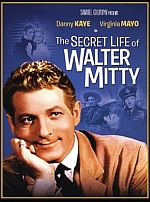
The Secret Life of Walter Mitty (1947)
With an incessantly nagging mother and a thanklessly boring job as proofreader for a company that publishes lurid pulp magazines (an occupation some might consider heavenly), it's no wonder that a constant series of outlandish fantasies make up THE SECRET LIFE OF WALTER MITTY (1947).
Danny Kaye's Mitty is an absent-minded milquetoast who tunes out his jabbering mom (Fay Bainter) and bad-tempered boss Mr. Pierce (Thurston Hall doing what he does best) by imagining himself as a courageous ship's captain, a heroic WWII flying ace, a brilliant surgeon, and even a leading fashion designer specializing in improbable hats for women.
Anything to distance himself from not only these two daily irritants but also from his mousey bride-to-be Gertrude Griswold (Ann Rutherford,
GONE WITH THE WIND), her bovine mother (Florence Bates), and obnoxious "friend" Tubby Wadsworth (Gordon Jones, ISLAND IN THE SKY, MCLINTOCK!) who still fancies Gertrude for himself. Any scene in which Walter must suffer these pushy boors with little or no protest is a study in slow-burn frustration that is relieved only when he finally tells them all to "SHUT UP!" (a major moment).
Before this breakthrough, however, Walter is going about his boring life when he inadvertently gets sucked into a situation brimming with intrigue and danger, thanks to a beautiful blonde named Rosalind van Hoorn (the ever-gorgeous Virginia Mayo) who's trying to keep a valuable notebook away from homicidal Nazi spies.
The idea of an everyman suddenly thrust unwillingly into the life of an "international man of action" and trying his best just to stay alive against a gang of ruthless, seasoned bad guys makes this seem almost like a comic variation of Hitchcock's later classic NORTH BY NORTHWEST (even the lovely Technicolor photography looks similar). The presence of a mysterious blonde whose true intentions are unclear makes it even more so.
Here, however, we get the added benefit of enjoying Walter's vivid daydreams along with him, which give Kaye a chance to show off his remarkable versatility as a comic vocalist and performer. He gets to sing two intricately zany songs in that trademark rapid-fire, tongue-twisting style which made his children's records so much fun to listen to when I was a wee lad.
The various alpha male characters he imagines himself as during these sequences are wonderfully arch and deadpan, a fun counterpoint to Walter's actual fumbling, jittery, bland demeanor.
The fun increases when real life becomes more exciting and scary than his wildest fantasies and he finds himself hanging out of windows high over city streets, dodging a knife-wielding killer (Henry Corden,
THE BAND WAGON, THE TEN COMMANDMENTS), and dealing with none other than Boris Karloff as one of the evil spies. In the meantime, Virginia Mayo is on hand to gorgeous things up every step of the way, making things even more watchable.
Director Norman Z. McLeod helmed two of the Marx Brothers' best Paramount comedies (MONKEY BUSINESS, HORSE FEATHERS) and is in fine form in this frothy adaptation of the James Thurber short story. The cast is brimming with interesting supporting and bit players including Frank Reicher (
KING KONG), Fritz Feld, "Three Stooges" regulars Vernon Dent, Christine McIntyre, Bess Flowers, and Dorothy Granger ("Punch Drunks"), and several more.
Danny Kaye looks so relatively normal and mild-mannered that it's always interesting to see him go off into one of his wacky musical numbers or well-practiced pratfalls. The endearingly funny THE SECRET LIFE OF WALTER MITTY is a fine showcase for his talents, which are just as bright and fresh today as they were when it was made.
------------------
The 6-disc DVD set from Warner Home Video is in the standard original (full-screen) ratio for all films, with Dolby Digital sound. All films are mono except THE WESTERNER and THE PRINCESS AND THE PIRATE which are in stereo. Subtitles are available for each film. Extras are as follows:
THE WESTERNER: none
DEAD END: theatrical trailer
STELLA DALLAS: the original 1925 silent version in its entirety
THEY GOT ME COVERED: none
THE PRINCESS AND THE PIRATE: theatrical trailer
THE SECRET LIFE OF WALTER MITTY: theatrical trailer, brief interview with an older Virginia Mayo
WBShop.com
Street date: 7/7/15
(Stills used in this review are not from the actual DVDs)

SAMUEL GOLDWYN COLLECTION VOL. II -- DVD Review by Porfle (THE WESTERNER, DEAD END, STELLA DALLAS, THEY GOT ME COVERED, THE PRINCESS AND THE PIRATE, THE SECRET LIFE OF WALTER MITTY)