HK and Cult Film News's Fan Box

Showing posts with label historical. Show all posts

Wednesday, June 24, 2026

SUFFERING OF NINKO -- DVD Review by Porfle


Originally posted on 7/26/18


For those with a taste for the unusual, SUFFERING OF NINKO (2016) should prove a delectable, perhaps even sumptous treat. While hardly the nuttiest Asian supernatural film set in ancient Japan that I've ever seen, it easily ranks as one of my more keenly unusual movie-watching experiences.

The establishing shots alone let us know that we're in for a beautifully rendered film by first time feature director (and writer and producer and editor) Norihiro Niwatsukino, whose credits on the project mark it as an intensely personal vision.

Set in Japan's Edo period (around the 16th century or so), the story begins in a monastery where young monk Ninko (Masato Tsujioka) is the most ardent and hardworking of all his peers. But for all his virtue and spiritual purity, he suffers from a terrible burden--he is incredibly, insanely irresistible to every woman he comes into contact with.


At first this is depicted with subtle hints of lighthearted comedy despite the film's solemn tone, with Ninko's excursions into a nearby village with his brothers to beg for alms descending into chaos as all the women in the area converge upon the group to grab, grope, drool over, and attempt to seduce the hapless Ninko with every feminine trick in their book and a few that are clearly made up on the spot.

Ninko's ordeal is deftly portrayed by showing us how his zen meditation sessions first serve as a source of peace and spiritual comfort but gradually evolve into furious psycho-sexual fever dreams that have him writhing in sexual agony before finally driving him out of his mind.

This sequence is the most surreal of the film and is enhanced by Edo-inspired drawings and animations (which recur throughout the film to add to its old Japanese storytelling style) and an unusual rendition of Ravel's "Bolero" played with traditional Japanese instruments.


Here we also get one of the first hints that Ninko is being haunted and perhaps stalked by a powerful supernatural female entity with long black hair, whom we see dancing seductively behind a bland-expression mask.

After recovering his senses, Ninko is ordered to set off on a journey of self-discovery to confront his problems and deal with them head on.  The narrative really gets going when he meets a mercenary ronin named Kanzo (Hideta Iwahashi) and the two of them are hired by local villagers to hunt down an evil sorceress, Yama-onna (Miho Wakabayashi), who seduces men with her irresistible sexuality and drains them of their lifeforce, leaving only lifeless, mummified husks.

We've seen hints of Yama-onna appearing teasingly to Ninko throughout the film, as though she senses his own sexual power and sees it, and him, as a challenge.  Ninko, meanwhile, suffers even more when it occurs to him that he may in fact be some kind of inhuman sexual creature himself.


Kanzo, the roguish swordsman, looks upon all this as an amusing (he likes Ninko) and profitable challenge to his skills.  Writer and director Norihiro Niwatsukino brings them all together for a surprising and, in some ways, exhilarating climax (in more ways than one) in which the film's narrative subtleties and eye-filling supernatural wonders intertwine. 

Old-fashioned storytelling blends with modern sex and violence to create a unique viewing experience in SUFFERING OF NINKO.  Those indulging in this enticing buffet of ancient Japanese delights will be well served.


TECH SPECS
Running Time: 70 mins.
Genre: Drama/Comedy
Aspect Ratio: 1.85:1
Audio: Stereo
Language: Japanese w/English Subtitles
Street Date: August 14, 2018
DVD SRP: $19.95


Share/Save/Bookmark

Monday, May 25, 2026

THE BEST YEARS OF OUR LIVES -- Blu-ray Review by Porfle


Originally posted on 10/28/13


Like so many soldiers throughout the ages, returning World War II veterans were faced with a special dilemma--they were back in the homefront they'd yearned for, yet surrounded by people who had no idea what they'd just been through and what they were going through now. 

The problems these men had fitting back into peacetime society--including becoming members of their own families again--are skillfully and sympathetically explored in director William Wyler's Oscar-winning masterwork THE BEST YEARS OF OUR LIVES (1946), now available on Blu-ray from Warner Home Video.


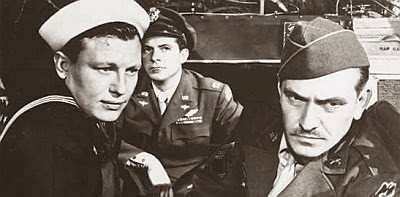
Three ex-servicemen--Army sergeant Al Stephenson (Frederic March,  DR. JEKYLL AND MR. HYDE), Air Force captain Fred Derry (Dana Andrews, CURSE OF THE DEMON),  and Navy swabbie Homer Parrish (Harold Russell)--hitch a long ride on a military transport to their hometown and become bosom buddies along the way. 

We begin to feel their tension at seeing family and friends again as they liken it to "storming the beaches", with Homer especially dreading the impending reunion due to the loss of his hands during his ship's sinking.  He fears not only how his folks will react but mostly whether or not his prospective bride, girl-next-door Wilma (Cathy O'Donnell, BEN HUR), will now reject him.

Fred has a different problem--his blond bombshell wife, Marie (a drop-dead gorgeous Virginia Mayo), to whom he had been married a mere twenty days before going overseas, is a party animal whose recent job in a nightclub has made her accustomed to a fast lifestyle which her unemployed husband can't provide. 


The young Andrews is ideally cast as a once-proud soldier who now must return to his old job as a drugstore soda jerk, biting his lip as a former underling orders him around while an uncaring boss, as did many at the time, regards him and other returning vets as a nuisance to society.  With Marie constantly berating him for not being successful or ambitious enough, and openly flaunting her intentions to "step out" on him, we can hardly blame Fred when he falls for Marie's exact opposite, the lovely and understanding Peggy (a vibrant Teresa Wright).

Trouble is,  Peggy is Al's daughter, and he's having his own problems without having to worry about her hooking up with a married man.  Unlike his two pals, former banker Al returns to a luxurious apartment but feels just as out-of-place among his wife and two kids.  Their reunion is tense and uncomfortable--empathetic viewers, in fact, may feel this way for much of the film--with Al first glimpsing his wife Milly (Myrna Loy) across the expanse of a long hallway that symbolizes the gulf still lying between them.  (He'll later describe the feeling of crossing that hallway as "like going overseas again.")


In  the film's opening scenes, it's heartrending to see the near-desperation with which the three main characters cling to each other's sympathetic company rather than face the prospect of returning to the families who now seem almost like strangers to them.  Later,  we fear that they'll never reassimilate back into normal life. 

This is especially true when restless Al urges Milly and Peggy to join him for a night out on the town.  March, seemingly slipping  into his celebrated Mr. Hyde persona at times,  portrays Al as a manic, nearly out-of-control drunk on his first night back--it's almost as though he's decompressing, or trying to put on the brakes like a speeding jet landing on a runway.  

It makes us glad that Milly is such a strong, sensible, supportive wife, with a rock-solid Myrna Loy (THE THIN MAN) lending her the stature of a woman any man would fight to come back home to and be glad to have on his side.  With her help, Al will eventually "mature" into a self-assured, no-nonsense personality whose unshakable principles threaten to get him into hot water back at the bank when he starts granting loans to other veterans with little or no collateral.  His drinking is another concern, as is the growing rift between him and Fred over daughter Peggy.

Even though we know Fred's marriage to Marie hasn't much of a future, his impulsiveness worries us when he steals a kiss from Peggy after an innocent lunch date.  Her growing attraction to him draws her into a terrible quandary which puts her at odds with her parents, and the scene of their most emotional confrontation is powerfully done. 

Meanwhile,  Fred's feelings of worthlessness are dramatically illustrated when he visits a "graveyard" for derelict bomber planes that are to be junked.  Sitting in the nose of a rusty, engineless plane and reliving his experiences as a bombadier, he realizes that he, too, is a wartime relic to be either recycled or tossed on the junk heap.  Director Wyler renders the sequence with exquisite skill, while Andrews gives it his all and musical composer Hugo Friedhofer pulls out all the stops--it's a gripping scene. 

Still, this is nothing compared to the emotional rollercoaster in store for the viewer regarding the unfortunate sailor, Homer.  Portrayed by real-life amputee Harold Russell, himself a former serviceman who won the Best Supporting Actor Oscar for his debut role, Homer endures excruciating emotional torment which we can't help but share as he feels isolated amidst his own family and impotent as a man. 


During a scene in which he silently allows his father to remove his "arms" and dress him in his pajamas--in what was certainly a reflection of his own real-life experiences-- Russell's face and demeanor tell us everything we need to know about the thoughts and emotions roiling inside him.  When he angrily thrusts his hooks through a windowpane in response to the curious looks of his little sister and her friends, it's a shocking and disturbing moment in cinema. 

Russell gives an earnest, painfully uninhibited performance that lends added dimension to what is already a devastatingly effective and multi-faceted story.  Andrews has probably never been better, nor has Teresa Wright, with their final scene together delivering a substantial payoff for the film as a whole.

March and Loy, the two old pros, come through like gangbusters as a couple whose problems only seem to make them stronger as long if they face them together.  And in a role that displayed her dramatic talent at a time when she was known mostly for comedy, Virginia Mayo proves that she's not only a knockout but can deliver a raucous, punchy performance (her "mirror" scene with Wright dazzles, as do her frenetic exchanges with Andrews.)  Also in the cast are stalwarts such as Hoagy Carmichael, Ray Collins, Steve Cochran (as Marie's oily-haired new beau), Don Beddoe, and Gladys George.

The single-disc Blu-ray from Warner Home Video is in 1.77:1 widescreen and English 1.0 sound.  Subtitles are in English, French,  and Spanish.  Bonus features consist of a brief introduction by Virginia Mayo, interview footage with Mayo and Teresa Wright, and the theatrical trailer. 

After THE BEST YEARS OF OUR LIVES has already put us through the wringer with its other stories of desperation and redemption,  it saves its deepest felt and most lasting impact for the final scenes between Harold Russell's "Homer" and girl-next-door Wilma (Cathy O'Donnell is sweetness incarnate in the role) finally resolving the long-running uncertainty that has lingered between them since his return.  It's one of the most heartrendingly emotional sequences I've ever seen, and if you can get through it without blubbering like a baby, then, as Kipling once said, "You're a better man than I am, Gunga Din!"


Share/Save/Bookmark

Sunday, May 17, 2026

THE SISSI COLLECTION -- Blu-ray Review by Porfle


Originally posted on 11/6/17


There are some movies that you can either pass over for lack of initial interest, or find a way to plug into.  I plugged into THE SISSI COLLECTION and was shocked--so to speak--to discover how much I quickly came to enjoy this sparkling Technicolor trilogy of Austrian films (plus two bonus films and various extras) now available in a deluxe Blu-ray set from Film Movement, newly restored in 2K.

Seventeen-year-old Romy Schneider is a delight as the sweet, utterly unpretentious Sissi (short for "Elizabeth"), a wild child who only reluctantly plays the royalty game when protocol, and her socially-conscious mother, demand.  Otherwise, this countrified Bavarian princess would rather be fishing, riding horses, or hunting (although she never shoots but only likes to look at the animals) with her father, whose similarly rough and "improper" ways she has thoroughly inherited. 

In SISSI (1955), the first of the three films, Sissi and her mother, Duchess Ludovika (Romy's real-life mother Magda), along with her older sister Nene, travel to Vienna to meet the young Emperor, Franz Joseph (Karlheinz Böhm, PEEPING TOM), whose marriage to Nene has been prearranged. (We know early on that Franz is both a nice guy and a decent ruler when he refuses to sign the execution order for eight political prisoners until he's satisfied they're deserving of such a fate.)


It's a love story that harkens back to Cinderella, with the wicked stepmother replaced here by a not-so-bad mom hung up on royal protocol and one older sister, also not wicked, who gets first crack at the handsome prince (or in this case, emperor). 

He, of course, first meets Sissi after she furtively escapes the palace for some fishing, and falls madly in love with the wild girl, thinking her a lovely commoner. Naturally, there's a festive ball that evening to announce his engagement to Nene, where he discovers Sissi's real identity and proposes to her instead.  Comfortingly familiar complications ensue in which our only concern, really, is how well-meaning sister Nene is going to take such a potentially devastating humiliation. 

But greater trouble looms on the horizon in the form of Franz Joseph's stern, unyielding mother, Archduchess Sophie (Vilma Degischer), who will stop at nothing to sabotage her son's marriage to a girl she deems utterly unworthy.  Meanwhile, the fiercely independent Sissi, to her husband's great delight, proves not only a wonderful wife but also a wise and compassionate leader who unites their subjects while charming even his most obstinate political opponents.


One might describe SISSI with the old Hollywood term "woman's picture"--which, let's face it, it is--but it's definitely something anyone in the mood for light, sumptuous, and visually dazzling entertainment can sit back and enjoy.  The vast, incredibly lavish indoor sets are dripping with whatever constitutes "royalty", while the outdoor scenery of Austria and other locations are some of God's most deliriously colorful handiwork.

The wedding of Sissi and Franz Joseph, and all the attendant ceremony, are almost brain-fryingly opulent.  I've never seen anything like it--just as one scenario appears as dazzling as it can get, it's topped by the next jaw-dropping spectacle.

The humor is of the mildly amusing and gently satirical variety, a welcome change of pace from overt slapstick and farce.  The initial mistaken-identity factor is well-played as Sissi charms Franz Josef with her sincere qualities before he discovers her regal origins.  The romantic and political entanglements are similarly handled with just the right amounts of light humor, heartfelt sentiment, suspense, and clever storytelling.


Ernst Marischka's surehanded direction (he wrote and directed all three films in the trilogy), along with impeccable production values, superb costumes, and a swirling symphonic musical score, blend to give the film an almost lighter-than-air quality, like an expertly prepared cinematic confection.  Watching it is like digging into an entire Bavarian cream pie with a big spoon right out of the plate.
 
SISSI has a relaxing, almost soothing quality because it just wants to amuse and delight us instead of dragging us through raucous farce or hand-wringing melodrama.  It has a pleasing mix of reality and fairytale magic that, to my surprise, I found guilelessly appealing and effortlessly watchable.

SISSI: THE YOUNG EMPRESS (1956) picks up right where the first one left off (the three films play like a mini-series and should be seen as such) with the young couple still madly in love while coping with crucial international affairs.  Chief among these are the strained relations between Austria and Hungary, the latter personified by angry young rebel Count Andrassy (Walther Reyer), whom Sissi will eventually charm with her love of his country and genuine concern for its people.


Meanwhile, Franz Joseph's mother, Archduchess Sophie, continues to refer to Sissi as "a little Bavarian princess who became Empress by chance." When the couple are blessed with a daughter, Sophie drives a wedge between them by insisting on raising the girl herself, apart from the mother, an arrangement that drives Sissi to leave her husband when he sides with his mother on the issue.

This second installment forces Sissi to contend with more sinister and oppressive conflicts than before, elevating the series as a whole to to an entirely different dramatic plane.

Still, it also has even more mindblowing pomp and circumstance for us to wallow in than the previous one--it's almost like royalty porn. One particularly opulent ball reminds us how much more fundamentally impressive reality is over CGI, as this series, without a single pixel of digital FX, often outdoes the most heavily computer-generated spectacles of today.  (At some points I felt as though the deluge of undiluted cinematic grandeur would cause me to faint dead away.)

The ballroom scene is also particularly noteworthy for featuring the most politically volatile situation thus far--one which, to the Archduchess' chagrin, is beautifully and most satisfyingly resolved by Sissi's quick thinking.


Here and in subsequent scenes, all the magnificent visuals are in service to an uplifting, engaging story in which the Sissi character is more endearing than ever.  She ends up an even more grandiose figure than before, not out of a lust for power but because her sweet and caring nature cause an entire country to fall in love with her.

An even more dazzling explosion of color and richly-appointed finery than its predecessor, SISSI: THE YOUNG EMPRESS is as charming and utterly captivating as its radiant young star, Romy Schneider.  It's a bit like taking that rich Bavarian cream pie, shoving it right in your face, and loving every gooey moment of it.

SISSI: THE FATEFUL YEARS OF THE EMPRESS (1957) has all the qualities of the first two films, but by this time the series reaches new maturity along with its main character.  Having conquered Count Andrassy and the people of Hungary, Sissi sets her winning ways to new purposes even as her vile mother-in-law, Archduchess Sophie, tries to poison her marriage to Franz by suggesting to him that she's being unfaithful.


To make matters worse, Sissi is stricken with an unknown disease which the royal physician warns may be incurable.  While she's bedridden, the grief-stricken Franz Joseph must contend with a growing rift between Austria and Italy that will be accentuated by the cold reception he and Sissi receive upon their eventual state visit there.

Despite all the dramatic complications, this third SISSI adventure is brimming with more beautiful nature photography and some charming rural vignettes as the royal couple vacation incognito at a small mountain lodge in the Alps. (This is followed by some location photography during Sissi's visit to Greece.)

Later, there's a breathtaking view of a cavernous opera house in Milan where the invited Italian aristocrats express their disapproval of the visiting royal couple by ordering their lowly servants to attend in their stead. This leads to some delightful comedy as Sissi and Franz Joseph receive the delighted commoners as royalty at a reception following the opera. 

But best of all is the ending sequence which contains some of the most strikingly splendid imagery of the series as the royal couple's regal procession passes majestically through the picturesque canals and streets of Venice, to the eerie silence of its disapproving citizens.  A final surprise and a heartwarming wrap-up bring both SISSI: THE FATEFUL YEARS OF THE EMPRESS and the trilogy as a whole to a stirring conclusion.


Disc four of the Blu-ray set features the film VICTORIA IN DOVER, aka "The Story of Vickie" (1954), which predates the "Sissi" series by a year while serving as a blueprint for it by featuring a headstrong teenage girl, chafing against the burdens of royalty, suddenly finding herself in a position of grave responsibility while also expected to enter into pre-arranged royal matrimony. 

Here, however, that solemn position is no less than Queen of England, and the callow young girl, Victoria (Romy again, of course, and just as captivating as ever) is beset on both sides by those who wish to use her to advance their own political goals.  In fact, the first half of the film is preoccupied with the turbulent political concerns that occur when Victoria unexpectedly becomes Queen and must shoulder burdens that a lesser person might find unbearable.

Finally, though, at about the halfway point, all of this changes abruptly and VICTORIA IN DOVER becomes just the kind of romantic fantasy that made the "Sissi" movies so irresistible.  It may be even more of a fairytale story, in fact, with Victoria stopping off at a humble roadside inn (in disguise as a commoner, of course) only to meet her intended husband, the German prince Albert (Adrian Hoven), who is also there posing as one of the little people. 

One thing leads to pretty much exactly what you think it will, although as usual this predictability is of the highly satisfying kind.  The romantic aspect is such that the film is positively Disneyesque at times--Victoria reminds me of Snow White, while the prince is definitely charming.  I almost expected them to start singing to each other during the "Romeo" scene on the balcony of Vickie's rustic hotel room. 

VICTORIA IN DOVER has everything we love about the "Sissi" series but with a different recipe.  It's still quite a sumptuous dish. 


BONUS FEATURES:

Disc five in THE SISSI COLLECTION contains two featurettes.  One is "Sissi's Great-Grandson at the Movies", an excerpt from the documentary "Elisabeth: Enigma of an Empress" which features the title descendant of the real-life Sissi comparing the historical figure to her cinematic counterpart. 

The other is "From Romy to Sissi", a lengthy black-and-white making-of documentary that's narrated in winsome fashion by Romy Schneider herself (who would die tragically at age 43) and is loaded with rare behind-the-scenes footage.

The disc also contains a fascinating novelty: the condensation of the "Sissi" trilogy into one film entitled FOREVER MY LOVE, which was then dubbed into English, given a theme song by Burt Bacharach, and released to American audiences by Paramount Pictures in 1962.  While somewhat rushed and disjointed (and unrestored), with less than ideal dubbing, this feature-length "greatest hits" package of the original trilogy is a novelty that I found keenly interesting.

Finally, the Blu-ray case contains a lavishly-illustated 20-page booklet with credits and a synopsis for each film, plus an essay by renowned film writer Farrah Smith Nehme.

In my opinion, THE SISSI COLLECTION is Blu-ray at its most dazzling and visually splendid.  A spectacular feast for the eyes, these highly enjoyable films deftly avoid melodrama, are never heavy-handed or maudlin, and never descend into soap opera.  As romantic comedy-drama, historical fiction, and pure cinematic pageantry, they're absolutely top-notch.

Type:  Blu-ray
Running Time: 600 mins. + extras
Rating:  NR
Genre:  Drama
Aspect Ratio: 1.78:1 Widescreen/4:3
Audio:  (BD) DTS-HD Master Audio/5.1 Dolby Digital / (Bonus DVD) 5.1 Dolby Digital/2.0 Stereo
Language: German with English Subtitles



Share/Save/Bookmark

Monday, March 16, 2026

Presenting -- The JOHN WAYNE/ "GREEN BERETS" Lunchbox!


Okay, this isn't a real lunchbox--we were just having a bit of fun with one of the goofier characters from John Wayne's controversial 1968 Viet Nam epic, THE GREEN BERETS. Namely, the doggedly "cute" little Vietnamese kid named "Ham Chunk" (Craig Jue) who's intended to make our heartstrings go all a-flutter.  (Click pics to enlarge.)


In the movie, Ham Chunk is an orphan who hangs around a U.S. military base deep in the combat zone and likes to play pranks on the soldiers (after which he points and utters his catchphrase, "Ha ha, you funny!")

He gets adopted by--or rather, adopts--an unconventional lieutenant named Peterson, played by Jim Hutton, who becomes his father figure.  The cuteness factor is cranked up to eleven during their scenes, especially when accompanied by film composer Miklos Rozsa's bathos-enriched "Ham Chunk" theme music.


[SPOILER] When Peterson fails to return from a dangerous mission, the kid loses it.  "Peter-san!  Peter-san!" he wails, searching desperately amongst the empty helicopters to no avail. 

It's up to the Duke to step up, take the poor kid by the hand, and lead him into the sunset (which, famously, sets in the East). [/SPOILER]


Anyway, the lunchbox may be fictitious, but we'd love to have one.  Whether in the lunchroom at school or the breakroom at work, it would make a dandy conversation piece!


[MORE SPOILERS:]


Share/Save/Bookmark

Tuesday, February 10, 2026

GONE WITH THE WIND 75TH ANNIVERSARY ULTIMATE COLLECTOR'S EDITION -- Blu-ray Review by Porfle


(Stills used in this review are not taken from the Blu-ray disc. This review was originally posted on 10/16/14.)

The year 1939, many believe, was the pinnacle of creativity in Hollywood, and MGM's super-production GONE WITH THE WIND is widely regarded as the finest film to come out of it. Unfortunately, I haven't had much luck over the years with trying to like it as much as I'm supposed to.

Watching the cut up, squeezed onto a small screen, interrupted by frequent commercials, and spread out over two nights version on network TV was underwhelming. Years later, my neighbor loaned me the 2-volume VHS version but I can't even remember if I watched it or not.

So I was determined that now, with the GONE WITH THE WIND 75TH ANNIVERSARY ULTIMATE COLLECTOR'S EDITION from Warner Bros. Home Entertainment in my hot little hands, I was going to sit down and, for the first time, really, really watch this undying classic. Like, definitively watch it, paying undivided attention to it and everything.


This time I think I finally got the most out of it that I'm ever going to get. The bottom line is that I find GONE WITH THE WIND not all that moving as drama, but as impressive as a movie can be when it comes to mind-boggling spectacle and sheer Hollywood movie-making magic--the quintessential "movie-movie."

Visually, it's simply one of the most gorgeous works of art ever concocted for the screen. Bold, impressionistic use of Technicolor coupled with exquisite special effects, set design, camerawork, and lighting combine to create an endless succession of stunning images.

Much of what we see in this recreation of the Old South before, during, and after the Civil War is purely the work of MGM's technical department, and watching these images unfold for close to four hours, especially in the first half before the intermission, almost felt like stuffing myself with some rich dessert.


The story, taken from Margaret Mitchell's wildly popular novel, takes place in an antebellum fairytale land ("Here in this pretty world, Gallantry took its last bow" the film's scrolling introduction tells us) of genteel, benevolent plantation masters, contented slaves, and a generation of young ladies and gentlemen whose leisure hours are filled with elegant parties and breathless romantic infatuations.

Probably the most breathless of them all is the Tara plantation's teenaged princess Scarlett O'Hara (Vivien Leigh), a spoiled, silly young girl who expects to get her own way even if that includes stealing handsome Ashley Wilkes (Leslie Howard) away from his intended bride and 2nd cousin Melanie Hamilton (Olivia de Havilland).

But a chance meeting with dashing rogue Rhett Butler (Clark Gable) during a party at the Wilkes' family mansion Twelve Oaks will usher in a new era of turbulent romantic entanglements in Scarlett's young life, one which will be intertwined with the encroachment of the Civil War and its devastating effect on an entire civilization soon to be "gone with the wind."


When war comes, it's here that Scarlett's character finally gains some dimension after being thrust into a chaotic world of violence and terror. Caught in an Atlanta that's under attack, she helps tend wounded soldiers until the enormity of war's horror (a famous wide shot of hundreds of injured men is still staggering) drives her away. But then she must deal with a weakened Melanie's painful delivery of her child while Northern forces close in.

Her frantic flight from the burning city in Rhett's carriage along with Melanie, her baby, and young slave girl Prissy (an endearingly funny Butterfly McQueen) is a thrilling high point of the film as they're menaced by crazed scavengers as well as exploding munitions and collapsing ruins.

Fans of KING KONG can even watch the Great Wall from that film go up in a final blaze of glory in one specatacular sequence. Like much of GONE WITH THE WIND's visual splendor, it's the kind of dazzling imagery that you just can't get with CGI. The later scenes at the ruins of Twelve Oaks and Tara, where Scarlett discovers just how lost her former life is, have a bleak, haunting quality that's nightmarish.


It's shocking to see such an idyllic, "pretty" existence so ruthlessly destroyed. When GONE WITH THE WIND is dealing with things like war's destructive and pointless waste in such effectively graphic terms, its easier to accept the film's initial idealization of the Old South way of life. The fact that this involves something of an idealization of slavery itself remains problematic. And yet, I once knew a black woman who counted this as her all-time favorite movie.

It helps that the black characters are all sympathetic even though largely stereotypical, and that the funny but wise Mammy (Hattie McDaniel, who won an Oscar for Best Supporting Actress) is more of a caring maternal figure to Scarlett than the rather aloof Mrs. Ellen O'Hara (Barbara O'Neill).

At any rate, all of this changes after the war ravages Scarlett's world and forces her to scrounge in the dirt, figuratively and literally, for her very existence while carpetbaggers try to wrest Tara from her grasp. In desperation she begins using men such as family friend Mr. Kennedy (Carroll Nye), whom she seduces away from her own sister, and finally the wealthy Rhett Butler, who offers financial support in return for the pretense of a tempestuous romance.


The rest of the story is a maelstrom of torrid emotional conflicts, deceptions, and assorted tragedies, most of them resulting from Scarlett's undying selfishness. Even as she enters middle age she's still the coquettish belle of the ball in her own mind. She uses people like pawns to further her own ends and is hardly an admirable heroine save for her tenacity and, in some cases, a reckless kind of courage.

I've never been able to make myself care much about Scarlett and I still find her generally insufferable, although Vivien Leigh's performance is so utterly perfect that it's a wonder to behold. The same holds true for the stalwart Clark Gable, whose manly and mostly honorable Rhett Butler is the main reason for me to stick with the sometimes turgid second half of the story. I can't imagine any other actor being able to pull off the role as well--his delivery of Rhett's celebrated final line is an unparalleled moment in film.

GONE WITH THE WIND is dense, intoxicating, a one-time-only convergence of creative forces that's almost otherworldly. It's like a cinematic fever dream. Maybe that's why I've always had trouble remembering previous viewings--as do other dreams, it drifts back into the ether when I awaken from it.


Warner Bros. four-disc, limited and numbered GONE WITH THE WIND 75TH ANNIVERSARY ULTIMATE COLLECTOR'S EDITION set adds to the excitement of the movie itself with some fun extras. Upon opening the box you get a handsome, richly-illustrated book about the film's opulent costuming entitled "Forever Scarlett: The Immortal Style of Gone With the Wind." In addition to this there's a music box with a picture of Rhett and Scarlett, and one of Rhett's monogrammed handkerchiefs.

Disc one is the Blu-ray restoration of the movie itself, which also contains a commentary track by film historian Rudy Behlmer and the original mono soundtrack.

Disc two features the TV-movie "Moviola: The Scarlett O'Hara War" which we reviewed HERE. There are also numerous other extras including:

"The Making of a Legend: Gone With the Wind"
"1939: Hollywood's Greatest Year"
"Gone With the Wind: The Legend Lives On"
"Gable: The King Remembered"
"Vivien Leigh: Scarlett and Beyond"
"Melanie Remembers: Reflections by Olivia De Havilland"
Cast and production bios, trailers, newsreels, and more

Disc three contains a documentary entitled "Old South, New South" which addresses, in depth, the issue of race in the film and in reality. There's also more newsreel footage of the film's Atlanta premiere.

Disc four is a flipper featuring the lengthy and exhaustive documentary "MGM: When the Lion Roars", hosted by Patrick Stewart.

Finally, the keepcase contains instructions on how to obtain your own digital HD copy of the film.

GONE WITH THE WIND is presented in its original non-widescreen format with Dolby Digital 5.1 soundtracks in English, French, and Spanish, and subtitles in several languages.

Full coverage of the "Gone with the Wind 75th Anniversary Ultimate Collector’s Edition" can be found HERE.


Stream rare and hard-to-find movies and TV shows at Warner Archive Instant; purchase discs at Warner Archive Collection. Even more at www.wbshop.com or www.wbultra.com
Share/Save/Bookmark

Tuesday, November 11, 2025

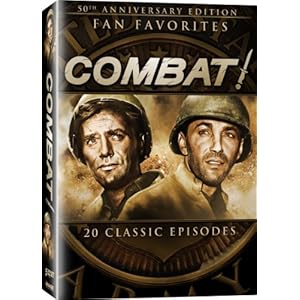
COMBAT! FAN FAVORITES 50TH ANNIVERSARY -- DVD Review by Porfle


Originally posted on 9/30/12


During the initial TV run of the World War II drama series "Combat!" (1962-67) I couldn't get into it because it was too grown-up.  During its syndicated reruns, I was going through my "pacifist" phase and couldn't stand to watch anything war-related unless it was blatantly, even stridently anti-war.  Now, however, I'm blazing my way through Image Entertainment's 5-disc DVD set COMBAT! FAN FAVORITES 50th ANNIVERSARY like Patton making a beeline to Berlin.

Without a doubt, this is some of the best stuff ever done for series television.  Gritty, realistic (as far as I know, anyway), and unflinchingly adult, the adventures of Sgt. Saunders (Vic Morrow), Lt. Hanley (Rick Jason), and their battle-weary squad of American infantry veterans in post-Normandy Europe puts us right in the middle of all the action and lets us share some of the emotional and existential turmoil that haunts these soldiers every perilous step of the way.

No flag-waving here--these are simply stories about hot, tired, and, most of all, scared soldiers doing a grueling job and trying to stay alive on the front lines.  The streetwise Kirby (Jack Hogan), Lousiana bayou denizen Caje (Pierre Jalbert), gentle giant Littlejohn (Dick Peabody), and compassionate medic Doc (Conlan Carter) wade into the fray with guns blazing yet struggle to retain their humanity, always coming across as three-dimensional human beings and never simple action figures.


Moral quandaries and crises of the soul get just as much play in these well-written stories as gunfights and explosions.  The dialogue snaps, crackles, and pops, and so do the performances.  Method actor Morrow is terrific as the gruff but sensitive Sgt. Saunders, who always does the right thing no matter how painful it may be, and doesn't hesitate, when necessary, to bark out a speech such as the following: "Kirby, I'm only gonna say this once, and I'll say it to all of you.  Keep your mouths shut, your heads down, and your ears open.  Follow my orders and don't ask why.  Is that clear?" 

Saunders sometimes questions orders himself, but his commanding officer Lt. Hanley is equally terse: "Because we were told to."  Rick Jason's seldom-seen character may seem like weak stuff at first, but his depth comes through in less flamboyant but equally dramatic sequences such as in the flashback episode "A Day in June" which, on a TV budget and with generous amounts of stock footage, depicts the D-Day landing at Normandy.  Jason also gets to show his stuff in "The Enemy", a tense two-man conflict between him and a cunning German demolitions expert played by Robert Duvall.  (Anna Lee guest stars as a nun.)

These taut, riveting dramas are punctuated by explosive battle sequences blazing with some of the most thundrous and thrilling action ever filmed for television, often of feature film quality but without the big-money effects.  The beautiful black-and-white photography sometimes approximates the texture of a Joe Kubert-drawn war comic, and many episodes boast skillful direction by the likes of Robert Altman, Ted Post, Bernard McEveety, and Burt Kennedy.  (Morrow himself directs three titles in this set.)  Editing and other production elements are also first-rate.


A two part episode, "Hills Are for Heroes", holds its own with "Saving Private Ryan" or "Band of Brothers" for fierce non-stop battle action that's realistic, harrowing, and emotionally devastating.  Written by "Star Trek: The Original Series" veteran Gene L. Coon and directed by Morrow, it's the story of the squad's seemingly doomed effort to capture a hilltop bunker that's practically impregnable. 

Mutiny looms as the body count rises, with Kirby and the others threatening to disobey the relentless orders that a heartbroken Lt. Hanley is forced to convey from the top.  The awful burden of command is depicted in scenes of almost unbearable intensity, with Hanley privately lamenting to Saunders that the brass "with their maps and their lines...forget they're talking about flesh and blood...and men who die when bullets hit them."
 
Attack after harrowing attack is doomed to bloody failure as Vic Morrow's sometimes impressionistic direction puts us right in the middle of the action (the handheld camerawork of the series is outstanding for its time), even capturing the POV of a dying soldier whose world has just been shot out from under him. 


If you took the first twenty minutes of "Saving Private Ryan" and extended the sequence to feature length (albeit on a much smaller scale), you'd have something approximating "Hills Are for Heroes."  In my opinion this incredible two-part episode, taken as a whole, constitutes one of the finest low-budget war films ever made.  By any standard, it's absolutely phenomenal television.

Each of the five discs in this DVD set follows a specific theme illustrated by four well-chosen episodes.  The first three themes are "Espionage", "New Replacements", and "The Squad", followed by "The Best of Hanley" and "The Best of Saunders."  "Espionage" begins the set with James Coburn as a German spy pretending to be an American G.I. in "Masquerade."  James Whitmore portrays a German officer trapped into impersonating a priest in "The Cassock", an episode that achieves a genuine kind of dramatic fascination when one of Saunders' men prevails upon the faux priest to hear his confession. 

"New Replacements" tells the stories of raw recruits--some fearful, some arrogant, and some just pitifully out of place--who, for better or worse, become attached to Saunders' squad.  Among the guest stars are John Cassavetes ("S.I.W."), Nick Adams, John Considine, Tab Hunter, and Buck Taylor.  "The Squad" shows us the day to day struggles, heartbreaks, and occasional victories experienced by the men under Saunders' command, with Lee Marvin giving his usual hardbitten performance as an abrasively uncompromising demolitions expert in "The Leader." 

"The Best of Saunders" begins with the Robert Altman-directed "Survival", probably my least favorite episode in the bunch, and steadily improves with the aid of some great stories and guest stars such as Rip Torn ("A Gift of Hope") and James Caan as a young German officer ("Anatomy of a Patrol").  "The Best of Hanley" contains some of the set's finest episodes with "A Day in June", "The Enemy", and "Hills Are for Heroes" parts 1 and 2.  Guest stars include Harry Dean Stanton, Sheckey Greene, a blink-and-you'll-miss-him Tom Skerritt (unbilled), and the aformentioned Robert Duvall and Anna Lee.

Other episodes not previously mentioned are "The Little Jewel", "The Long Walk", "Bridgehead", "Bridge at Chalons", "The Glory Among Men", "Rear Echelon Commandos", "The Celebrity", "The First Day", and "The Little Carousel."

The DVD set from Image Entertainment is in full frame (1.33:1) with Dolby Digital mono sound.  No subtitles or closed-captioning.  No bonus features.  Picture quality looks great to me, but my copy seemed to have a problem with occasionally jittery-sounding audio, particularly in the background music.  Not a dealbreaker for me, but audiophiles may want to give the set a test-drive before buying.

Perfect for Veteran's Day or any other day, COMBAT! FAN FAVORITES 50th ANNIVERSARY is solid entertainment all the way.  If you're into war movies or you just like first-rate, hard-hitting action and drama, television rarely gets any better than this. 


Share/Save/Bookmark

Sunday, May 4, 2025

JACK THE RIPPER (1959) -- Blu-ray Review by Porfle


Originally posted on 4/25/22


I saw JACK THE RIPPER (Severin Films, 1959) on TV as a kid in the 60s, and the thing I remember most is the horrific elevator scene at the end.  Sure enough, that memorable moment is right here in my long-overdue rewatch, and, although the rest of the film is in glorious black and white, that final ghastly image is in living, bloody color.

At least, it is in the US version. Severin's Blu-ray release has both this and the original British version, the rights of which were purchased for release in the States by famed film entrepreneur Joseph E. Levine (HERCULES) and jazzed-up (literally) with a new musical score, a teasing voiceover intro by Paul Frees inviting us to solve the mystery of Jack the Ripper ourselves while watching the film, and other small touches here and there including that color shot.

The film's original elements are gone, so Severin has assembled the best looking prints of both versions with the elements available.  The British director's cut, which is in 1.33:1, is near-pristine and quite lovely, while the US print (1.66:1) is considerably more worn.


This, however, is a plus for me, as my frequent readers will know.  I love a print that looks like it has been around the block a few times--it's a nostalgia thing, and a big reason why I love PLANET TERROR so much.

The story itself is a taut, wonderfully compelling fictional account by screenwriter Jimmy Sangster (CURSE OF FRANKENSTEIN, HORROR OF DRACULA) of the famous tale about mysterious serial killer Jack the Ripper's six notorious and very brutal slayings of prostitutes in London's Whitechapel district in 1888, a case that was never solved.

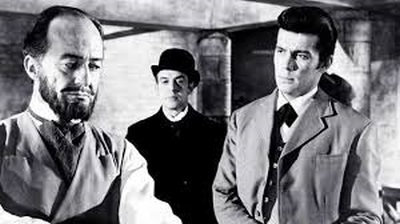
Here, London police inspector O'Neill (Eddie Byrne) and his American friend, Detective Sam Lowry (Lee Patterson) stay one step behind the killer's trail of ravaged bodies found in back alleys, their deaths apparently the work of a surgeon or other person with knowledge of anatomy and surgical tools.


Seeking advice from medical experts leads them to a hospital where we meet some of our main suspects--chief surgeon Sir David Rogers (Ewen Solon), aging and possibly over-the-hill Dr. Tranter (John Le Mesurier), surgical assistant Dr. Urquhart (Garard Green), and facially-disfigured hunchback (and thus chief suspect in the film's publicity) Louis Benz (Endre Muller), who tends to the surgical instruments during operations.

The atmosphere in the district is heated and volatile, with mobs of angry and often drunk men ready to form at a moment's notice to hunt down anyone even slightly suspected of being the ripper, resulting in a few tense sequences.

This mood is exacerbated by the sometimes claustrophobic nature of the film's stagebound sets (at Shepperton Studios), which are otherwise ideal for establishing the 19th-century setting filled with grimy cobblestone streets and dark, foggy alleyways where dastardly deeds are performed in the shadows.


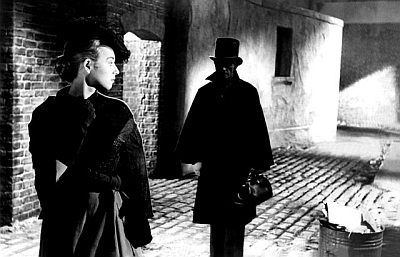
In contrast to these are the bright music hall scenes that are alive with period frivolity including a raucous can-can dance sequence and a clash between some posh visitors on the prowl for a good time and a naive young dancing girl who didn't realize this was part of her job description. When she gets wise to her companion's intentions, she flees into the night and right into the clutches of the mysterious stalker.

Production, direction, and photography are all credited to Robert S. Baker and Monty Berman, who stage each scene in a just-right way that, unless I'm mistaken, was an inspiration for some of the visuals of the later version, FROM HELL.

The black and white cinematography is exquisite, and the music in both versions very good. I enjoy the brash Jimmy McHugh and Pete Rugolo score (I had the 45 rpm single of the main theme at the time) while some might prefer the more stately original by Stanley Black.

The cast is top-notch, delivering Sangster's snappy dialogue with aplomb.  The romantic angle between Detective Lowry and Dr. Tranter's beautiful, plucky ward Anne (winsomely portrayed by Betty McDowall), who works at the hospital, is well-handled.


The main draw, of course, is the sick thrill of Jack the Ripper's horrific murders (some shockingly staged for 1959) and the increasing urgency for our detective heroes to put a stop to them.  In the exciting finale, the killer finally tracks down the woman he's been searching for (each murder begins with him asking, in creepy, sotto voice, "Mary Clark? Are you Mary Clark?") and then menacing Anne herself as Lowry races to her rescue.

The Blu-ray from Severin Films is in 2.0 English mono sound and 1080p full HD resolution.  The British version has English subtitles while the US version does not.

Besides the two versions of the film, extras include the US trailer, photo and poster gallery, alternate "continental" takes which contain nudity, an essential interview about the film with author Denis Meikle ("Jack the Ripper: The Murders and the Movies"), and a history of the case entitled "The Real Jack the Ripper." Last but not least is a commentary track with Robert S. Baker, Jimmy Sangster, and assistant director Peter Manley, moderated by film historian Marcus Hearn.

JACK THE RIPPER is moody, atmospheric black and white 50s-style horror entertainment at its best, sharply-rendered in all aspects and a real treat for genre fans.  And there's a reason that elevator scene stayed in my memory for over half a century--it really tops off the movie in shocking style.


Buy it from Severin Films

Special Features:
British Version
US Version
Audio Commentary With Co-Director/Co-Producer/Co-Cinematographer Robert S. Baker, Screenwriter Jimmy Sangster, Assistant Director Peter Manley, Moderated By British Horror Historian Marcus Hearn
Alternate Continental Takes
Interview With Denis Meikle, Author of “Jack The Ripper: The Murders And The Movies”
The Real Jack the Ripper Featurette
Theatrical Trailer
Poster & Still Gallery


Share/Save/Bookmark

Wednesday, April 23, 2025

THE BEATLES: MADE ON MERSEYSIDE -- DVD Review by Porfle


Originally posted on 8/12/19


Writer-director Alan Byron (BILLY FURY: THE SOUND OF FURY, PUNK '76) opens his 2018 documentary THE BEATLES: MADE ON MERSEYSIDE (Film Classics) with the familiar strains of "Twist and Shout." But it's the Isley Brothers version we hear, not the Beatles' celebrated cover.

This is typical of the entire film, which features not one note of actual Beatles' music (much as the documentary JIMI HENDRIX: THE GUITAR HERO had no actual Hendrix songs save for a public domain version of "Hey, Joe") and not that many images or film clips. It's a bit like making a documentary about the Apollo space program and not including any footage of the first moon landing. 

What compensation there is consists of ample interview footage of people either directly or indirectly involved with the Beatles during their five-year rise from obscurity to stardom, including their tour manager, a business associate of Brian Epstein, Epstein's secretary, and Pete Best's brother.


Best of all (pun intended), the Beatles' initial drummer Pete Best is on hand to offer his quiet, thoughtful reminiscences from a very first-hand point of view, and it's his segments that are the most welcome ray of sunshine in the whole presentation.

What makes it most worth watching, in fact, is finding out at the end that he's enjoying a happy life, both personally and professionally, including ample compensation for "The Beatles Anthology" and a new band which makes terrific music (I've heard them--they're really good).

There are also a couple of original members of the Quarrymen giving us their equally first-hand accounts of what went down on and offstage when John, Paul, and the rest were whooping it up at the Kaiserkeller and Star Club in Hamburg or electrifying local Liverpool kids at the Cavern and Casbah clubs.


Mona Best herself turns up in old footage with son Pete, which is of interest.  And last but certainly not least, Cynthia Lennon appears briefly a few times to share her own intimately personal perspective.

Most of the other interviewees relate familiar stories while the few film clips of the Beatles are augmented by lots of B-roll footage of Liverpool and Hamburg and various locations where the Beatles lived or performed.

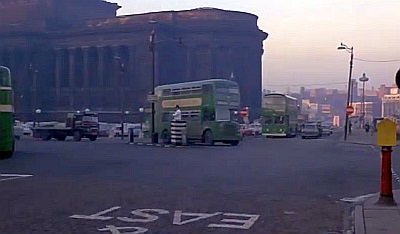
When we're told the old story of how young Paul and John acquired American rock and roll records from sailors down at the docks, we're shown a lengthy montage of freighters unloading their cargo at those docks.


Say they liked Elvis and we see a minute or two of Elvis performing; say they covered "Long Tall Sally" and we hear Little Richard singing it. Snatches of other songs later covered by the Beatles turn up in their original form as well.

The Beatles, it turns out, are in the periphery of their own documentary. There are some nice clips of Ringo near the end, talking about joining the band, being in the hospital, etc.  But again, no actual Beatle music.  The effect is ultimately a bit dull and, needless to say, disappointing.

The DVD from Film Movement is in 1.78:1 widescreen with 2.0 stereo sound. No subtitles or extras.

If THE BEATLES: MADE ON MERSEYSIDE were chosen to be enclosed in a time capsule, future archeologists would learn the usual pre-fame history of the group, and get brief samples of their images and speaking voices, but would have no idea what their legendary music sounded like.


Share/Save/Bookmark