HK and Cult Film News's Fan Box

Showing posts with label CD. Show all posts

Tuesday, July 21, 2026

ALL THE COLORS OF THE DARK -- Blu-ray/CD Review by Porfle


Originally posted on 1/27/19


I'm not all that familiar with the Italian "Giallo" genre (save for some Dario Argento classics such as TENEBRE) which consists of warped, horror-tinged murder stories with lots of bloody violence and other lurid elements. 

So it's always nice to catch a really good one like the Italian/Spanish co-production ALL THE COLORS OF THE DARK, aka "Tutti i colori del buio" (Severin Films, 1972) from Sergio Martino, the director who also gave us TORSO, SLAVE OF THE CANNIBAL GOD, and SCREAMERS.

This one is nowhere near as formally-shot and polished-looking as the usual Argento effort, but Martino has a loose, imaginative style that fits the "anything goes" nature of the material, as well as a talent for staging suspense scenes in interesting ways. 


Our heroine, Jane (cult star Edwige Fenech), has been plagued by horrible nightmares ever since the traumatic loss of her unborn baby following a car crash.  Her lover, Richard (George Hilton), is devoted but unable to help, especially since his job keeps him away for days at a time. 

Jane's sister Barbara (Susan Scott) advises her to visit Dr. Burton, the seemingly kindly psychiatrist she works for.  But Jane finds more solace with a new friend, Mary (Marina Malfatti), a mysterious woman who inducts her into a black magic cult filled with arcane rituals that take place in a creepy old castle in the country.

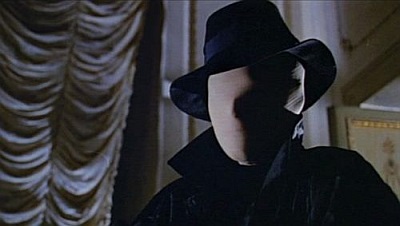
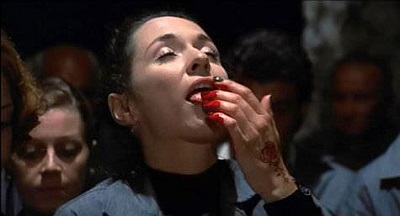
While the mentally and emotionally frazzled Jane may be a bit slow on the uptake, we can tell right away that being forced to drink fresh dog blood and then getting gang-banged by a bunch of stabby, whacked-out weirdos in a cult from which there is no escape probably isn't going to help her as much as a few quiet sessions with Dr. Burton.  Especially since one of the cult members is a creepy trench-coated stalker with neon blue eyes (Ivan Rassimov) who keeps following her everywhere and trying to kill her.


We're never quite sure if we're seeing something real or just one of Jane's waking nightmares, but this lively film keeps us on our toes by constantly alternating the talkier scenes with sudden bursts of action and sometimes shocking violence. 

Much of the suspense is effectively staged around the creaky, open elevator and winding staircase in Jane's shadowy apartment building, and there's a terrific sequence inside Dr. Burton's country estate where Jane discovers a grisly scene involving the elderly caretakers who've been charged with watching over her.

I noticed a few similarities here and there with ROSEMARY'S BABY, which had me suspecting Jane's lover Richard, her sister Barbara, her friend Mary, her shrink Dr. Burton--oh heck, practically everybody--of secretly being part of the cult and their sinister plans for Jane.  Director Martino does like to keep us guessing, all the way up to a nifty fake-out ending in which fantasy and reality clash with deadly results.


The 2-disc Blu-ray from Severin Films is widescreen 1080p full HD resolution with a new 4k scan from the original negative.  Audio is 2.0 English and Italian with English subtitles.  Bonus features include a very learned and thoughtful commentary with Kat Ellinger (author of "All the Colors of Sergio Martino"), interviews with Sergio Martino, screenwriter Ernesto Gastaldi, actor George Hilton & horror expert Antonio Tentori, trailers, and the unrestored alternate US cut of the film entitled "They're Coming to Get You." Also included is a CD of the film's musical score by Bruno Nicolai.

With a fine cast (Edwige Fenech fans will be extra happy), great use of scenic London locations, and a scintillating story full of colorful characters and sinister goings-on, ALL THE COLORS OF THE DARK is pure nerve-wracking fun all the way.


Special Features:
They’re Coming To Get You: Alternate US Cut (88 mins.)
Color My Nightmare: Interview with Director Sergio Martino
Last Of The Mohicans: Interview with Screenwriter Ernesto Gastaldi
Giallo is the Color: Interviews with Actor George Hilton & Italian Horror Expert Antonio Tentori
Audio Commentary with Kat Ellinger, Author of All The Colors of Sergio Martino
Trailers
BONUS Disc: CD Soundtrack 


Share/Save/Bookmark

Wednesday, July 15, 2026

ALL THE COLORS OF GIALLO -- Blu-ray/DVD/CD Review by Porfle


Originally posted on 1/31/19


A primer, a history, and a celebration of giallo all rolled into one 3-disc set, Severin Films' ALL THE COLORS OF GIALLO pretty much covers all the bases for new fans wanting to learn more and old ones who just want to revel in it all.

As the publicity states, "‘Giallo’ is Italian for ‘yellow’, the color of the lurid pulp novels that inspired one of the most intense, extreme and influential genres in movie history."

The genesis of all this is the krimi, or German crime novel, which contains elements (shadowy settings, shocking murders, mysterious phantom killers, police procedurals) that would later be adopted by Italian filmmakers but jacked up to new levels of violence and lavish indulgences in cinematic style for its own sake.


Disc One (Blu-ray) starts off with a feature-length documentary by Federico Caddeo entitled "All the Colors of Giallo", an exhaustive history of the genre that takes us from the beginnings of the German krimi books and films, and in particular the works of Edgar Wallace, all the way through the evolution of the giallo thrillers by such directors as Mario Bava, Lucio Fulci, and Dario Argento.

Several of giallo's main figures are interviewed including Fulci and Argento themselves, along with familiar screen talents such as Barbara Bouchet and Susan Scott.

"The Giallo Frames" offers even more on the subject, giving us an in-depth interview with John Martin, editor of "The Giallo Pages." 


But best of all (for me, anyway) is a full four-hour collection of giallo trailers that run the gamut of the entire genre and are accompanied by a commentary track from Kat Ellinger, author of "All the Colors of Sergio Martino."

Kat showed her depth of knowledge on the subject during her commentary for Martino's film "All the Colors of the Dark", but here she is a veritable gold mine of information and unbridled enthusiasm on each and every trailer that we see, keeping a running commentary that never fails to entertain.  Thus, the trailer collection becomes a four-hour documentary unto itself, and perhaps the highlight of the entire collection.

Disc two (DVD) delves deeper into the subject of the krimi, with the informative documentaries  "The Case Of The Krimi" and "The Case Of The Krimi: Interview With Film Historian Marcus Stiglegger."

Then we get yet another hour-and-a-half of trailers, this time mostly in beautiful, atmospheric black-and-white (with very nice picture quality as well) before turning to color for the later ones.


Klaus Kinski fans will be pleased to find that he appears in practically all of these krimi trailers, which are a lively bunch of clips providing much entertainment and amusement.

Disc three is a CD entitled "The Strange Sounds of the Bloodstained Films", containing twenty giallo soundtrack selections from such composers as Ennio Morricone, Riz Ortolani, Bruno Nicolai, Stelvio Cipriani, and others.  It's great stuff, whether you have it on in the background or don your headphones for an intensive listening session.

Experienced giallo fans will enjoy reliving old favorites with this collection of documentaries, interviews, and trailers, and those just getting into such lively, lurid, and lavishly cinematic fare may find their curiosity stoked into an insatiable desire.


Buy it from Severin Films

Special Features:

DISC 1 – Blu-ray
All the Colors of Giallo: A New Feature Length Documentary By Federico Caddeo
The Giallo Frames: Interview With John Martin, Editor Of The Giallo Pages
Audio Commentary with Kat Ellinger, Author of All The Colors Of Sergio Martino


DISC 2 – DVD: The Case of the Krimi
Kriminal!: Trailer Compilation
The Case Of The Krimi: Interview With Film Historian Marcus Stiglegger


DISC 3 – CD
The Strange Sounds Of The Bloodstained Films: Compiled By Alfonso Carillo of Rendezvous! From The Archives Of Beat Records. Remastered By Claudio Fuiano.


Share/Save/Bookmark

Monday, June 29, 2026

SHE KILLED IN ECSTASY -- Blu-ray+CD Review by Porfle


  Originally posted on 5/14/2015


Jess Franco's immediate follow-up to his relatively well-made VAMPYROS LESBOS is another dark, death-shrouded vehicle for the lovely and exotic Soledad Miranda (again billed as "Susann Korda") featuring some of the same castmembers including Paul Müller, Ewa Strömberg, and Franco himself.

The result, SHE KILLED IN ECSTASY (1971), is a slasher/revenge thriller which stands with his previous effort as one of my two favorite Franco films so far.

The storyline this time is lean and simple--genetic research scientist Dr. Johnson (Fred Williams) commits suicide after his maverick work with human embryos is viciously derided as inhumane by his peers, who suggest he be not only imprisoned but even executed for such atrocious ideas.


Devastated, his devoted wife (Soledad Miranda, known only as "Mrs. Johnson" throughout the film) vows revenge against the four scientists she holds responsible for her husband's death. These are Prof. Jonathan Walker (Howard Vernon), Dr. Franklin Houston (Paul Müller), Dr. Crawford (Ewa Strömberg), and, last but not least, Jesús Franco as the understandably nervous Dr. Donen.

Even before the murders begin, we get an idea of how casually perverse SHE KILLED IN ECSTASY is when we learn that Mrs. Johnson is keeping her husband's death a secret in order to have necrophilic relations with his corpse. While this may sound romantic on paper, it comes off as a bit strange in practice.

Soledad Miranda handles these scenes as she does all her others, with a smoldering intensity that is always enhanced by her dark, exquisite physical beauty. When she becomes a seductive femme fatale, donning various guises to stalk her male and female prey before brutally killing them, her presence always fascinates.


As Franco's muse for all-too-short a time, she seems to inspire him to do some of his best work. For example, the death of Dr. Crawford (Strömberg, who played Countess Carody's lover in VAMPYROS LESBOS) is artfully choreographed and shot, with the added visual flair of having the hapless woman suffocated with a clear plastic pillow through which we can still see her anguished face.

The murders of the male victims are more brutal and violent, although much of this is suggested rather than graphically depicted. Still, it's shocking enough to see Mrs. Johnson going through the motions of castration and aggravated genital mutilation (Franco's unfortunate shlub of a character gets special attention) on a level usually reserved for the most agregious rape-revenge plots.

This emphasizes just how deranged she is and to what extent she must sadistically torture and degrade the objects of her wrath as punishment for driving her husband to suicide. These scenes are heavily sado-masochistic as well.


A limited collector's edition, the handsome 2-disc Blu-ray+CD set from Severin Films is in 16 x 9 widescreen with 2.0 sound. The soundtrack is German with English subtitles. Extras consist of a 20-minute Franco interview, an interview with Soledad Miranda historian Amy Brown (the same one found in Severin's VAMPYROS LESBOS set), an interview with "Murderous Passions: The Delirious Cinema of Jess Franco" author Stephen Thrower, a brief interview with actor Paul Müller, and the original German trailer.

Disc two is actually a music CD entitled "3 Films by Jess Franco" containing tracks from VAMPYROS LESBOS, SHE KILLED IN ECSTASY, and THE DEVIL CAME FROM AKASAVA. These 24 musical tracks by Manfred Hübler and Siegfried Schwab are offbeat and enjoyable--much more so, in fact, when isolated in this way than when heard as backing for scenes which, in my opinion, they're often wildly inappropriate. I found much of this music to be terrifically listenable.

Although still displaying that unpolished quality characteristic of Franco's work, SHE KILLED IN ECSTASY is more crisply wrought and thematically unfettered than his other films I've seen. And as a companion piece to VAMPYROS LESBOS, it stands as a fitting testament to the talent and appeal of Soledad Miranda, whose promising career was so tragically cut short by a fatal car accident soon after filming was completed.


(Stills shown are not taken from the Blu-ray.)

Other Jess Franco reviews from HK and Cult Film News:


THE HOT NIGHTS OF LINDA
VAMPYROS LESBOS
THE SINISTER EYES OF DR. ORLOFF
BLOODY MOON
PAULA-PAULA


Share/Save/Bookmark

Saturday, April 11, 2026

AXE / KIDNAPPED COED -- Blu-ray + CD Review by Porfle


Originally posted on 3/31/22


Sometimes a disc falls into my hot little hands which is an all-round cinematic experience in itself, and goes beyond simply watching a movie or two and some extras. Severin Films' new 2-disc set, AXE/KIDNAPPED COED (one Blu-ray disc, one soundtrack CD) is just such a heady film-fan experience. 

Representing the entire filmic output of 70s independent writer/producer/actor/director Frederick R. Friedel (save for an obscure 2000 comedy called MY NEXT FUNERAL), it's a saga of how someone with a little money and a lot of talent made his mark in the regional movie industry, had his films robbed from him by a crooked distributor, and finally found a "rainbow at the end of the storm" decades later when his work was rediscovered by a whole new audience of fervidly appreciative fans.

Watching the first film, AXE, aka "Lisa, Lisa" (1974), my initial impression was that this guy Friedel is one of those creative talents who can take the kind of budget and resources usually reserved for the lowest drive-in dregs and work a kind of rough-hewn magic with them.  Even as the film's look and feel still have that unavoidable bottom-drawer ambience, there's something sharply intelligent about the camerawork and editing, as well as performances by a uniformly fine cast, which elevates it all into a much higher realm of watchability.


Two plotlines are introduced which will eventually intertwine--in one, three gangsters are on the lam after having dispatched some unlucky mug in his cheap hotel room, in luridly violent fashion.  Jack Canon plays Steele, the icily psychotic leader, Ray Green the equally sadistic thug Lomax, and Friedel himself is Billy, a novice criminal still hampered by a nagging conscience.  After the murder, they disappear into the North Carolina backwoods to find a place to lay low for awhile.

This brings them into a collision with plotline number two, in which a curiously disaffected young girl named Lisa (Leslie Lee) is the sole caretaker for her catatonic grandfather (Douglas Powers) in a remote two-storey farmhouse.  Scarcely into her teens, Lisa already seems shell-shocked by life, and barely reacts when Steele, Lomax, and Billy forcibly invite themselves to stay. 

While Lisa's deceptively placid countenance hides a fierce inner turmoil, the evil men now invading her life force her to take overt actions to defend herself.  This comes to a head when Lomax enters her bedroom at night with bad intent, and Lisa displays an aptitude for slicing and dicing heretofore reserved for chickens.

 
This is where AXE starts to live up to its lurid trailers and print ads (which scream the tagline "At last...total terror!"), with winsome nutcase Lisa wielding a straight razor and an axe in bloody fashion without ever breaking that strangely calm but troubled fascade.  Still, the film is never in the same league as THE TEXAS CHAIN SAW MASSACRE (alternate titles include CALIFORNIA AXE MASSACRE and THE VIRGIN SLAUGHTER) nor does it try to be.  It's mainly a compelling and pleasingly morbid character study with splashes of gore but little that could be called "graphic", although that didn't stop it from being condemned as one of England's infamous "video nasties" of the 80s.

As for the cast, the leads couldn't be better.  Leslie Lee is an ideal Lisa, pretty but strange, her sad face always interesting to look at as you wonder what the heck's going on behind it.  As Steele, Jack Canon is a classic big-screen tough guy that you just can't look away from.  He'd have been perfect as the lead in one of those tacky 70s or 80s TV cop shows like "Hunter"--as it is, one can only wonder why he never went farther as an actor.  Ray Green's bloated Lomax is sleaze personified, and Friedel himself, bearded and Brillo-haired, is a convincingly conflicted Billy who ends up trying to help Lisa. 

As a director, Friedel takes his time and lingers artistically over every sequence as much as the brisk shooting schedule allowed, drawing out every nuance of visual interest possible while admittedly playing fast and loose with the script.  An early scene of Steele and Lomax terrorizing a poor convenience store clerk (Carole Miller) is like a foretaste of Oliver Stone's NATURAL BORN KILLERS.  Never one to rely on sheer exploitation, Friedel shoots this and Lisa's rape scene later in the film--as well as the subsequent killings--not just as visceral exploitation but as an opportunity to indulge in a form of raw cinematic poetry.


Wanting to fully explore the potential he saw in Jack Canon during the making of AXE, Friedel then concocted the entire screeplay for his follow-up film KIDNAPPED COED, aka "Kidnapped Lover" (1976) around the actor's charismatic appeal.  Thus, Canon appears in almost every single scene and makes the most of his screen time with a performance that should've been a ticket to broader fame.

Equally compelling is young Leslie Ann Rivers as ginger-haired, bespectacled Sandra, a well-to-do teenage "coed" whom small-time crook Eddie Matlock (Canon) abducts in hopes of a big ransom.  Both actors have faces that are fascinating to look at and naturalistic acting styles that bring their characters to life. 

Friedel has a bigger budget here (around $40,000) which allows for more elaborate camera moves and other relative indulgences that really pay off in the movie's look and style.  Again, he takes plenty of time for character development as the two leads get to know each other and gradually even form a tentative romantic relationship, all done in a series of quirky exchanges taking place during some wildly unexpected situations.


These include a brutal, Scorsese-esque sequence in which both are attacked in their seedy hotel room by a couple of violent thugs who force their way in at gunpoint so that they can beat up Eddie and rape the horrified Sandra in another scene that's stunningly executed.  Continuing the theme that this just isn't his day, Eddie later encounters unfriendly shotgun-wielding farmers while simply trying to get water for his car radiator, and finally ends up in a life-or-death struggle against another bearish farmer who has just welcomed him and Sandra into his home before suddenly going pitchfork-wielding berserk. 

As all this happens to them, Eddie and Sandra's relationship wanders through different stages as the film itself passes, with varying degrees of finesse, through such disparate genres as thriller, horror, action, character drama, quirky romance, and even comedy.  Friedel admits in the commentary that he doesn't even remember whether or not there was a written screenplay for the film, but this only contributes to its off-kilter charm.  Mainly, though, it's Canon and Rivers that keep our eyes glued to this wildly uneven but compelling little film right up to its abrupt and somewhat anti-climactic ending.

The full story surrounding these two films from conception to oblivion (and, lucky for us, joyous rediscovery) is recounted in the hour-long bonus documentary "At Last… Total Terror! – The Incredible True Story of AXE & KIDNAPPED COED", which sees the warm reunion of Friedel and several key members of his production team who also gather to provide excellent commentary tracks for both films.


"Moose Magic – The George Newman Shaw & John Willhelm Story" (38 mins) tells of the two young musical geniuses who scored the films shortly before their tragic demise in a car accident.  Shining lights in the Charlotte, North Carolina music scene, these wonderfully creative and eclectic musicians contributed some offbeat, often minimalistic tracks to AXE and KIDNAPPED COED that are preserved in this set's second disc, a music CD which also includes several bonus tracks of the duo's non-movie-related jazz compositions that provide scintillating listening. 

A ten-minute interview with author Stephen Thrower ("Nightmare USA"), who helped bring Friedel and his films to the attention of new audiences, is followed by several trailers and TV spots for them. 

No doubt the oddest of all the bonus features is the full-length feature film BLOODY BROTHERS, which is actually a later re-edit by Friedel of both AXE and KIDNAPPED COED into one strange, disjointed narrative in which Jack Canon's "Steele" and "Eddie Matlock" characters are presented as identical twins unaware of each other's existence.  Their unrelated stories are intercut with little rhyme or reason, while recurring intertitles tell us that the two are gradually drawing closer to one another ("Five miles away", "One mile away", "1/2 mile away", etc.)


Since we know they'll never meet, we wonder what this is all leading up to, if anything. The main interest is seeing which scenes Friedel decides to include and how he cross-edits them, as well as what he leaves out, including the entire subplot of Eddie and his mom.  There's one scene that's entirely new, which shows Eddie on the beach performing a Jewish prayer ceremony even though he isn't Jewish.

This interesting oddity comes with another winning commentary track by Stephen Thrower. I really can't say how it would play for someone who hasn't already seen the two films on their own. 

Severin Films has restored AXE and KIDNAPPED COED from the original negatives (rescuing these from movie purgatory is part of the main documentary's gripping story) for this HD Blu-ray release, which is in 1.85:1 widescreen and mono sound.  No subtitles. 

AXE, KIDNAPPED COED, and their bastard sibling BLOODY BROTHERS, along with the abundance of extras that go along with them, add up to several hours of movie watching that are engrossing, enriching, and just plain fun.  It's all very satisfying in an exploitation vein, but not only that, Friedel's low-budget films are small-scale artistic wonders which yield all sorts of aesthetic rewards and make one wish he'd done more before being soured on the business. Rather than "so bad, they're good", his films are actually so good, they're great.


Stills used are not taken from the Blu-ray.



Share/Save/Bookmark

Monday, September 15, 2025

ZOMBIE 3 -- Blu-ray Review by Porfle


Originally posted on 5/19/18


Gory, lurid, and just plain nuts, Lucio Fulci's ZOMBIE 3 (Severin Films, 1988) sails over the top from the very first scene and just keeps on going. 

It's definitely not part of the George Romero universe.  Created by accident during a lab experiment to reanimate the dead, these zombies are some of the most groteseque, malicious, and aggressively hostile undead fiends to ever come leaping out of the bushes at you.

As expected, the makeup and gore effects are crude--obvious rubber masks and such--but are so wonderfully extreme that they're effective and fun nonetheless.  Lots of bladder effects are used to good advantage in the facial makeups, with plenty of graphic gore and severed limbs to go around.


The action is confined to a tropical resort island that just happens to have a top-secret military base where the disastrous experiment takes place.  After that, the good-guy scientists struggle to come up with an antidote to the highly-contagious zombie virus while the bad-guy military brass decide to just kill off everyone in the infected area, locals and tourists alike.

This includes a bevy of fun girls and their boyfriends in an RV, a young couple tooling around in their convertible, and three rowdy soldiers on leave, looking for a good time. 

Their trouble really starts when all are attacked by swarms of infected, virus-carrying birds, after which the injured must be protected by the others against growing hordes of horrific zombies intent on turning them all into pulled pork.


The rest of the film is a series of lively setpieces as various protagonists endure harrowing undead encounters which several of them won't survive.  Not only that, but they also must contend with military hit squads in hazmat suits who are machine-gunning anything that moves (which is where our three vacationing soldiers come in handy).

Direction and camerawork are pretty artless as usual, which is part of the film's charm.  ZOMBIE 3 was begun by Italian schlockmeister Lucio Fulci (ZOMBIE, DOOR INTO SILENCE, THE DEVIL'S HONEY) but actually completed by fellow filmmakers Bruno Mattei (ZOMBIES: THE BEGINNING, ISLAND OF THE LIVING DEAD, THE JAIL: THE WOMEN'S HELL, VIOLENCE IN A WOMEN'S PRISON) and Claudio Fragasso (ZOMBIE 4, TROLL 2).

As a result, ZOMBIE 3 is a frenetic conglomeration of so-bad-it's-good fun in which the subpar acting and dialogue, goofy characters, and hokey effects only add to its perverse appeal.  It's a non-stop zombie blowout that fans of the genre are sure to enjoy.


Release date: May 28, 2018

SPECIAL FEATURES:
Bonus Disc: CD Soundtrack (pictured below)
The Last Zombies – Interview With Co-Director/Co-Writer Claudio Fragasso and Co-Writer Rossella Drudi
Tough Guys – Interview with Actors/Stuntmen Massimo Vanni and Ottaviano Dell’Acqua
The Problem Solver – Interview with Replacement Director Bruno Mattei
Swimming with Zombies – Interview with Actress Marina Loi
In the Zombie Factory – Interview with FX Artist Franco Di Girolamo
Audio Commentary With Stars Deran Sarafian and Beatrice Ring
Trailer


Share/Save/Bookmark

Saturday, April 26, 2025

WEREWOLF IN A GIRLS' DORMITORY -- Blu-ray Review by Porfle


Originally posted on 10/31/2019
 

I've always loved movies about werewolves (not today's hulking CGI beasts but good old-fashioned "actors in monster makeup" ones).  So it's a special treat to discover this vintage Italian thriller WEREWOLF IN A GIRLS' DORMITORY, aka "Lycanthropus" (1961) which, up till now, I've known only via tantalizing pics in monster magazines and books. 

For a first-time viewer who's also a longtime Monster Kid, this modestly budgeted but exquisitely photographed (in luscious black and white) horror tale is something to savor, especially thanks to Severin Films' new 2-disc Blu-ray release (including a bonus CD of the musical score) which is, in their words, "newly scanned in 2k from archival elements recently discovered in a Rome lab vault."

Most of the exteriors and interiors are shot in an actual Italian mansion surrounded by stone walls, deep within a dark forest.  This adds greatly to the film's production values and atmosphere, yet doesn't detract from its charm as a modest and at times slightly hokey thriller that's nonetheless sober and intelligent enough to easily transcend the "so bad it's good" label.


The story takes place in an upper-class reform school for troubled girls, where headmaster Mr. Swift (Curt Lowens) maintains order while the school's lecherous benefactor Sir Alfred Whiteman (Maurice Marsac) pays certain students to have sex with him. Creepy groundskeeper Walter (Luciano Pigozzi of CASTLE OF THE LIVING DEAD as "Alan Collins") acts as his procurer.

This not only prompts a jealous Mrs. Whiteman (Annie Steinert) to take drastic measures but also opens up her husband to blackmail by a saucy young blonde (Mary McNeeran) with incriminating letters.

When the blonde is found mauled to death in the forest, suspicion wavers between vicious wolves known to roam the vicinity and a new addition to the staff, handsome Dr. Julian Olcott (Carl Schell, THE BLUE MAX), whose outwardly benign demeanor hides a shady past.


The dead girl's plucky friend Priscilla (Barbara Lass) puts her life on the line to investigate, forming an uneasy alliance with Dr. Olcott while risking a nocturnal foray or two into the forest where the carnage occurred. 

This results in some tautly suspenseful encounters with the ferocious fiend, plus a few of the more menacing human characters inhabiting the reformatory.  There's also a laboratory scene where experiments in lycanthropy management yield unfortunate results.

The fact that we aren't told who the werewolf is until near the end (unlike your usual lycanthrope tale where we know from the start) makes this a nifty whodunnit as well as a classically cool werewolf tale in which the title character is featured to very good advantage.  This uncut version includes mild gore and brief semi-nudity you probably didn't see if you caught it on TV as a kid.


The wolf man's makeup is less hairy than usual but is well-designed and looks delightfully feral, with some very effective closeups.  In fact, this fanged terror easily joins the hallowed ranks of my favorite werewolves.

Performances are fine and the film is neatly directed by Paolo Heusch (THE DAY THE SKY EXPLODED), who fashions screenwriter Ernesto Gastaldi's brisk, straightforward story into a low-key but involving tour through the same sort of territory Dario Argento would explore years later with much more artistic intent. 

For me, finally getting to see WEREWOLF IN A GIRLS' DORMITORY--especially such a lovely print as this--is a distinct pleasure that really satisfies my sweet tooth for classic old-school horror in a lycanthropic vein.  I'm happy to add it to my rotation of fun Monster Kid gems to revisit whenever the morbid mood strikes.


Buy it at Severin Films

Special Features:
   
    Commentary Track with David Del Valle and star Curt Lowens
    Bad Moon Rising: Interview with Screenwriter Ernesto Gastaldi
    Alternate Opening
    Italian Trailer
    US Trailer
    English Dub and Original Italian Soundtracks
    BONUS: CD Soundtrack and Special Booklet (w/rare photo-comic)


Share/Save/Bookmark

Monday, November 25, 2024

AENIGMA -- Blu-ray Review by Porfle


Originally posted on 6/25/20


They say hell hath no fury like a woman scorned, but it also has no fury like a woman who suffers the humiliation of a cruel college prank and then, while fleeing from her jeering tormenters, gets hit by a truck and ends up in a coma from which she uses her psychic powers to possess the body of a newly-enrolled student and exact bloody revenge upon everyone who put her there.

Which, incidentally, is the plot of Italian horror maestro Lucio Fulci's murderous melodrama AENIGMA (1987, Severin Films). Inspired by such films as CARRIE, PATRICK, and Dario Argento's SUSPIRIA, this lively entry gets all of that plot set-up out of the way in the first ten minutes and then gets right down to the good stuff.


Milijana Zirojevic as the put-upon "Kathy" spends the rest of the film in a hospital bed hooked up to a jumble of wires and looking the worse for wear, while her pretty surrogate, Eva (Lara Naszinski), moves into the girls' dorm (a nice SUSPIRIA-like interior location) and wastes no time linking up with her erstwhile tormentors for one juicy episode of bloody payback after another.

These include some pretty imaginative touches, such as a museum statue coming to life and giving one of the girls a cold reception. There's also what may be the only known instance of what can only be described as "death by snails" in horror film history.

The "headless Tom" sequence is another highlight, in which one of the girls pulls back her bed covers to find her boyfriend sans noggin, then runs screaming from room to room just to encounter the same sight over and over again.


Needless to say, the comatose Kathy--no longer flatlining now that her brain waves have something fun to do--has all the power of the supernatural at her disposal in exacting these imaginative revenge scenarios. 

This gives director Fulci a free hand to indulge in whatever way-out visuals (including some pleasantly outlandish gore) that strike his artistic fancy.

The story starts to get even more interesting when neurologist Dr. Robert Anderson (Jared Martin, a prolific actor whose face you'll probably recognize) is called in to deal with poor Eva's sudden fits of violent hysteria brought on by Kathy's mental control.


A sudden romance forms between the two, one whose inevitable complications (including a jealousy-fueled love triangle) form the basis for the film's lively finale. 

Performances are good--well, good enough, anyway--and Fulci (who does a cameo as a police inspector) gets the job done with his usual workmanlike skill, infectious enthusiasm for the genre, and occasional displays of style.

The 2-disc Blu-ray from Severin Films (with slipcover) contains a CD of the robust soundtrack music by Carlo Maria Cordio. The film itself was scanned in 4K from the original negative for the first time in America. Dialogue is in both Italian and English 2.0 mono, with English subtitles.


Bonus features include an audio commentary with Troy Howarth, author of "Splintered Visions--Lucio Fulci and His Films", and Mondo Digital's Nathaniel Thompson; an interview with screenwriter Giorgio Mariuzzo; the featurette "Italian Aenigma--Appraising Late Day Fulci"; trailers; and the film's Italian main titles.

While it could be described as derivative, I found AENIGMA's deftly-handled blend of familiar elements from earlier films to be quite enjoyable for that very reason.  It's your standard "bloody revenge in a girls' school" tale, Italian-horror style, and with Lucio Fulci at the helm it just can't help being a lot of fun to watch.


2-Disc Blu-ray Featuring CD Soundtrack and Limited Edition Slipcover
Limited to 1500 copies


Share/Save/Bookmark

Monday, October 30, 2023

BEYOND THE DARKNESS -- Blu-ray Review by Porfle


Originally posted on 7/29/17


I love to watch movies while I'm eating. Some movies, however, really--and I mean really--don't lend themselves to mealtime viewing.  Joe D'Amato's BEYOND THE DARKNESS, aka "Buio Omega" (1979, Severin Films) is one of them.  Hoo boy, is it ever.

Generally speaking, it's your basic Italian 70s-era Grand Guignol potboiler dripping with that old-country Goth flavor and a sort of lurid, rough-hewn visual flair characteristic of much of Italian cinema. 

But it's the particulars in this case that really drive the film into gut-punch territory.  When D'Amato (THE ALCOVE, EMMANUELLE AND THE WHITE SLAVE TRADE) wants to shock or gross us out, he delivers with some strong, graphic gore and cringe-inducing perversion that'll most likely set your nerves on edge and your stomach on "queasy."


It all starts when otherwise handsome and normal-looking young Frank (Kieran Canter, THE LONELY LADY) loses his beloved wife Anna (Cinzia Monreale, THE STENDHAL SYNDROME, THE BEYOND).  Unable to bear the loss, he steals her body from its grave and, using his skills as a taxidermist, preserves it in his basement laboratory so that he may, err..."consort" with her as before. 

In this he's helped by faithful family servant Iris (Franca Stoppi, THE OTHER HELL), who has an unhealthy relationship with Frank that's sexual, yet weirdly maternal.  Having Anna offed by a voodoo priestess was just step one in Iris' plot to become the mistress of the manor--and now, she has a vested interest in not only helping Frank preserve his dead wife's body (for the moment, anyway) but also in covering up the murders of young women that he just can't seem to resist having sex with in the bed next to Anna's corpse.

This latter activity is where BEYOND THE DARKNESS is indeed at its darkest, as D'Amato indulges in some classic body disposal that includes meat-cleaver dismemberment and then the old acid bath.  (Cremation comes later as well.)  Entrails, eyeballs, and all matter of offal are on the menu, especially when Frank gets a bit peckish during passion.  But even he has to hurl at the sight of Iris gobbling down a post-body-disposal platter of disgusting food in a scene that's the polar opposite of the erotic meal in TOM JONES.


Making these scenes even harder to stomach are several close shots that could pass as footage from an actual autopsy.  Indeed, they're often thought by fans to be just that, although D'Amato himself reveals that animal entrails and pig skins were used.

At any rate, the film continues along its morbidly merry way until a predictable plot twist sets up the very lively, very splattery finale.  A final heart-stopping shock right at the fadeout is particularly satisfying.  

(And speaking of hearts, we just know the director is pulling our legs when Frank, having removed Anna's heart while "processing" her, lovingly kisses and then lustily bites into it, causing the severed arteries to squirt blood.  Now that's some really dark humor, folks.)


Kieran Canter is a pretty one-note actor as Frank, but it's just the right note and he plays it with conviction.  Franca Stoppi, on the other hand, gives a bravura performance as a woman who's a monster, in the words of Ed Wood, to be both pitied and despised.  Also performing at their peak are The Goblins, who contribute their usual excellent musical score.

The Blu-ray from Severin Films features both English and Italian (with English subtitles) 2.0 soundtracks.  A generous Severin bonus menu includes a documentary-length interview with D'Amato that's augmented by comments from friends and coworkers and packed with film clips.  There are also interviews with Franca Stoppi and Cinzia Monreale, as well as a live Goblin performance from 2016 of the main title track, a "Locations Revisited" short, and the film's trailer.  Best of all, the first 2500 units will contain the entire Goblins soundtrack on its own CD disc. 

"Shock is an ideal way to involve the audience in the film," Joe D'Amato declares during his interview footage. "And cannibalism is definitely pretty shocking."  As is much of what he dishes out in BEYOND THE DARKNESS, for horror fans who like to gorge themselves on the grotesque.

Buy it from Severin Films


Share/Save/Bookmark

Saturday, May 27, 2023

RAIDERS OF THE LOST ARK, INDIANA JONES AND THE TEMPLE OF DOOM, INDIANA JONES AND THE LAST CRUSADE -- CD reviews by porfle


(Previously posted at time of CD's original release)


Among the outstanding film scores of master composer John Williams are his invaluable contributions to the Indiana Jones series. As director Steven Spielberg once said, "Sure, the whip, the hat, the jacket are part of the Indiana Jones iconography. But what really gives Indy his heart and spirit is John Williams' music."


Serving as highly convincing evidence of this comes three new CDs from Concord Records which contain the scores for RAIDERS OF THE LOST ARK, INDIANA JONES AND THE TEMPLE OF DOOM, and INDIANA JONES AND THE LAST CRUSADE. All are fully-remastered and augmented by previously-unreleased material, and each comes with an illustrated booklet with liner notes by Spielberg. Today I had the pleasure of listening to these CDs and would like to share my impressions of them with you.

The first thing I noticed is that, unlike many soundtrack recordings, these tracks are in the proper sequence as they appear in the movie. This is good because it helps the listener to better relive the movie in his or her mind while listening. The score for RAIDERS begins with that exotic, foreboding melody that accompanies the Paramount logo and our first view of the mysterious whip-wielding man in the fedora as he and his guide trudge through the jungle. The first four pieces--"In the Jungle", "The Idol Temple", "Escape From the Temple", and "Flight From Peru"--allow us to experience that entire opening sequence of the film in our minds. The rest of the score similarly serves as the backdrop to our own mental journey through the familiar story.

Most of this probably wouldn't appeal a whole lot to people who haven't seen the movies, because much of the music is very scene-specific, and is, in fact, almost what you might call "Mickey Mousing" (an often derogatory term used to describe music that parallels a film's action too closely). But John Williams is so good that even when he does this (as the never-sit-still nature of these movies often requires) it's still fully realized music that is exciting and intriguing to listen to.

"The Map Room: Dawn" builds dramatically to that breathtaking moment in which Indy pinpoints the location of the Ark. The sequence inside the Well of Souls and Indy's punishing fistfight on the flying wing are fast-moving tracks filled with musical variety. The longer, more cohesive pieces, such as the playful "Basket Game" or the robust "Desert Chase", are as stirring in their own right as an overture or a movement in a symphony and provide lengthy intervals of listening pleasure punctuated by moments of sheer grandeur.

While it's impossible for most of us to know exactly what images each passage of music is describing, there are those particular moments that stand out--the beam of light passing through Indy's staff and striking the map, Indy marching his horse down the mountain with grim determination in order to overtake the truck convoy, and the grand finale in which the terrifying power of the Ark is unleashed. These are the musical touchstones that bring our memories of the film to life and make the overall listening experience all the more rewarding.

This score never gets dull because it's just as kinetic and ever-changing as the movie's action. Williams uses the entire orchestra beautifully. Marion's theme is as romantic and exotic as ever, while the haunting "Ark" theme never ceases to elicit chills and evoke a strong feeling of ancient mysticism. And of course, Indy's theme ("Raiders March"), which we finally get to hear in all its glory at the end, is one of the most joyfully celebratory themes ever written for a movie character.


TEMPLE OF DOOM, as you might expect, begins on an entirely different note with a jaunty, Asian-flavored shuffle through Cole Porter's "Anything Goes", followed by a slow tension-building piece called "Indy Negotiates." Then it's off on another multi-track journey through non-stop action with "The Nightclub Brawl", "Fast Streets of Shanghai", "Map/Out of Fuel", and "Slalom on Mt. Humol", all frantic hyperkineticism filled with the familiar Williams touches, including frequent dashes of Indy's theme.

Then Short Round gets his own heroic theme worthy of an Arthurian knight, after which our journey toward the Temple of Doom begins. Again, much of the music is very scene-specific, but this time it often has a lush, orchestral openness that seems to describe vast panoramas of musical adventure ("The Scroll/To Pankot Palace"), with the occasional detour into romantic lyricism and frivolity ("Nocturnal Activities").

At this point the movie is off and running again, and so is Williams as he gives his orchestra quite a workout. The extended sequence inside the temple itself yields a number of exciting and often downright dissonant tracks ("Children in Chains", "The Temple of Doom", "Short Round Escapes", "Saving Willie") filled with pounding drums and the occasional chanting vocal chorus. In "Short Round Helps", Indy's theme bursts through the darkness for a welcome return, but is quickly pulled back into the maelstrom again. If you don't know quite what's going on in the story at any given time, just imagine Indy, Short Round, and Willie in big trouble and that really creepy bad guy and his minions trying to kill them, and the music will do the rest.

What I was waiting for mainly was "The Mine Car Chase." That's what I remember most about this movie, and the score here, as expected, is a mad dash of intensity that doesn't let up for a moment. (I can imagine the musicians all falling out of their chairs after the last note.) "Water", "Sword Trick", and "The Broken Bridge/British Relief" bring the action to a climax in similar style, finally giving way to the triumphant fadeout and another stirring end credits rendition of the "Raiders March", this time sprinkled with various TEMPLE OF DOOM-related themes. Overall, it's a difficult, almost exhausting score to listen to--the most nightmarish of Indy's adventures--but I found the experience rather invigorating and cathartic.


LAST CRUSADE has my favorite opening of all--a near 12-minute piece called "Indy's Very First Adventure" which starts out in a slow but inviting manner, builds ever so gradually, and finally blossoms into an exciting, delightfully humorous, and fairly self-contained composition that moves briskly and ends with a fanfare version of Indy's theme. I can see Williams conducting this at some formal event, like maybe the ribbon-cutting ceremony for a new Piggly Wiggly or something.

There must not have been much music for awhile after that, because we skip directly to "The Boat Scene", "X Marks the Spot", and "Ah, Rats!!!" (if you've seen the movie you'll no doubt recall those particular scenes) which continue the uncommonly lush orchestration of the opening piece. This sound will continue throughout the entire score, making it perhaps the most genuinely listenable of the three. There's a richness to the orchestrations and an abundance of melody that are almost intoxicating, at times given a religious-epic tone by the stately "Grail" theme which appears intermittently, and a noticeable lack of the harsh dissonance found throughout TEMPLE OF DOOM.

The score continues in this vein as Indy and his dad make their way into Austria and battle the Nazis. I have no idea just what's going on throughout much of this, but there's a lot of tension-building stuff mixed with passages of pure romanticism and the occasional action stings, all of which are a distinct pleasure to listen to. "Scherzo For Motorcycle and Orchestra" is especially invigorating and enjoyable, and is a great example of how much fun Williams seems to be having with this entire score.

"On the Tank" and "Belly of the Steel Beast" are just what they sound like--it's the action centerpiece of the film and the music drives it forward like a powerful engine. It's like classical music that's been working out at Gold's Gym every day for a few years. Then we proceed into "The Canyon of the Crescent Moon" to meet "The Keeper of the Grail", wherein the music takes on a solemn yet richly substantive elegance (with that "Grail" theme finally kicking in full-force) until the rip-roaring "Finale & End Credits." This reprise of the "Raiders March" and its recap of various themes from the film seems more joyous and triumphant than ever.

After a while I stopped keeping up with the track titles and just let the music carry me along. Even the most scene-specific passages seem to flow as though the composer were simply writing the grandest music he could think of for his own amusement, and it's never less than effortlessly entertaining on its own. I think Williams really improved a lot in the years between the first Indy film and this one--if it weren't for the sentimental attachment I have to RAIDERS and the feelings its music evokes in me, this score would easily be my favorite of the three. Maybe it is anyway.

I'll definitely be keeping these three Indiana Jones CDs handy for frequent background listening. Each has its own feel and its own strengths, perfect for whatever mood I may happen to be in at the time, and each is a splendid example of motion picture scoring at its absolute finest.

Share/Save/Bookmark