HK and Cult Film News's Fan Box

Showing posts with label DVD. Show all posts

Sunday, September 6, 2026

SGU: STARGATE UNIVERSE 1.5 -- DVD Review by Porfle


 Originally posted on 7/29/10


If you read my review of the first half-season of "SGU: Stargate Universe", you'll know that I liked it a lot but had certain reservations about it.  Judging from various message board posts and such, I'm sure many viewers felt the same way.  Fortunately, the release of SGU: STARGATE UNIVERSE 1.5 proves what I'd been hoping for--that the previous episodes were slowly leading up to a marked increase in the action and excitement levels of the show and that certain irritating aspects would be eliminated.  Which is exactly what has happened, barring one or two exceptions.

As before, a number of military and civilian personnel are stranded on a city-sized Ancient starship that's on a seemingly neverending journey through the cosmos, stopping for a few hours whenever it encounters a planet with a stargate and then jumping back into faster-than-light speed.  With Colonel Young (Louis Ferreira, DAWN OF THE DEAD remake) in command, the entire group is under military control, which leads to constant conflicts with the brilliant but unstable Dr. Rush (Robert Carlyle, THE WORLD IS NOT ENOUGH) and civilian leader Camile Wray (Ming-Na, ER). 

The professional and personal relationships between them and the rest of the ship's inhabitants generate much of the show's dramatic interplay, including a love triangle between true-blue soldier Lt. Matthew Scott (Brian J. Smith), fish-out-of-water senator's daughter Chloe Armstrong (Elyse Levesque), and the lovestruck Eli (David Blue), a neurotic nerd-savant hijacked into service because of his mad gaming skills.  Alaina Huffman plays Lt. Tamara Johansen, the closest thing to a medic on the ship, who carries some pesky romantic baggage with Col. Young.  And then there's Sgt. Greer (Jamil Walker Smith), who's so gung-ho that he seems to relish the thought of occasionally blowing away a civilian or two just to keep them in line.


The first half of the season spent a lot of time setting up the premise and then meandering along with stories about the hazards related to their mysterious starship and the heartbreak of being away from home while trying to find love among the stars.  But now that the writers have worked some of this stuff out of their systems, the show has gotten into gear and started kicking some ass.  With the appearance of a new race of enemy aliens--spindly blue CGI-generated creatures who covet our heroes' Ancient starship--we finally get some cool space battles (as always, the special effects are gorgeous) and deadly shipboard encounters.  Also, the military vs. civilians conflict embodied by Young and Rush erupts into a full-scale mutiny in one of the season's best episodes. 

One of the main improvements is the absence of those damn Kino diaries, which offered characters the chance to philosophize, navel-gaze, and blubber away precious show time with a blatant and boring writer's convenience.  The formula was pretty much the same every time--the subject fiddles with the Kino camera ("Is this on?"), starts to record a personal diary entry, gets either teary and emotional or speechless with inner turmoil, and then slaps their hand over the lens.  It was one of the worst aspects of the show and to my great relief has now been confined solely to the extras menu where it belongs.  However, we must still contend with the frequent appearance of those contemplative montages set to some truly awful emo ballads.  These really need to get sucked into a black hole along with the Kino diaries.


As usual, Robert Carlyle is the main on-camera talent here and makes the abrasive Dr. Rush a continually fascinating character whom we're never quite sure whether to admire or distrust.  Some insight into his backstory give us a little more understanding of his motives and attitudes.  Louis Ferreira's soulful, haunted Colonel Young holds our interest by going against the "infallible leader" type, playing a commander whose decisions may not always be 100% correct and are often swayed by emotion.  Watching these two characters either butt heads or struggle to cooperate for the good of the crew is one of the best things about the show. 

As the dreaded season cliffhanger (I hate those) draws nigh, Young's suspicion that his arch-enemy Colonel Telford (a solid Lou Diamond Phillips) is a mole for the Lucian Alliance leads to Dr. Rush undertaking a highly perilous undercover mission in Telford's body via the communication stones.  Rhona Mitra makes for a very formidable villain as the ruthless Commander Kiva, who has located another Icarus base and is attempting to dial the elusive ninth chevron.  The story arc which follows combines the pulp sci-fi action and suspense of the other Stargate shows with SGU's own darker edge, culminating in a blazing stargate invasion of the ship, a hostage crisis, and a countdown to total destruction, among various other points of interest.

 
The three-disc set (10 episodes) from 20-Century Fox and MGM is in 1.78:1 widescreen with English 5.1 Dolby and Spanish Dolby surround.  Captions are in English, Spanish, and French.  Each episode features a cast and crew commentary.  Extras also include about fifteen "Destiny SML" featurettes and several Kino diaries.  (Blu-Ray contains additional extras.)

With SGU: STARGATE UNIVERSE 1.5, the idea of mixing the sci-fi fun and excitement of the earlier Stargates with a darker, more serious sensibility--something which the first half of the season didn't quite pull off--seems to have finally started realizing its potential and yielding some first-rate episodes.  And suddenly the future of this show is well worth looking forward to.


For additional coverage, click here.


Share/Save/Bookmark

Saturday, September 5, 2026

SGU STARGATE UNIVERSE 1.0 -- DVD Review by Porfle


Originally posted on 2/15/10


Having somehow managed to avoid every single previous film and TV incarnation of "Stargate", I delved into the 3-disc DVD set SGU STARGATE UNIVERSE 1.0 (2009) not knowing quite what to expect. After a marathon viewing of all ten episodes (which constitute the first half of the first season), I find that while it isn't mindblowingly awesome, it's still a compelling start with the potential for greater things.

Fans of the saga up till now will know all this, but for us novices: billions of years ago, a race of aliens known as "The Ancients", from whom we are descended, built a series of ring-shaped portals called "stargates" which use wormholes to allow intergalactic travel. Having discovered one of these stargates on another planet, Earth scientists and military have been trying to unlock the "dial-up" code which will access the stargate's transportation function. But just as they do so, Icarus Base is attacked by hostile aliens known as The Lucian Alliance and all military and civilian personnel are forced to escape through the stargate to an unknown destination seconds before the planet explodes.

After their chaotic arrival, they find themselves on an immense, automated starship built long ago by the Ancients, which is speeding through hyperspace billions of light years from Earth for some unknown purpose. The ship, it turns out, slows down whenever it approaches a planet with a stargate, giving the crew a specified time to explore the planet and gather whatever materials they need from it before the ship automatically jumps back into hyperspace. Damage from some long-ago battle has made repair of its life-sustaining functions imperative, and as the passengers struggle to survive they also must deal with interpersonal conflicts and the uncertainty of ever being able to return home.


I like a good "spaceship exploring the cosmos" series and this one is shaping up pretty well so far. Not much has been done with the stargates as of yet--the crew only visit two or three planets in this set--but there's more than enough stuff going on aboard the Destiny to keep things hopping. As is often the case in sci-fi, the military and scientific factions frequently have heated disagreements over their priorities and there's a constant power struggle between stalwart Colonel Everett Young (Justin Louis) and the brilliant but arrogant chief scientist Dr. Nicholas Rush (Robert Carlyle), with the hapless civilians caught in the crossfire.

Carlyle, a fine actor who played a formidable Bond villain in THE WORLD IS NOT ENOUGH, makes Dr. Rush a fascinating character whose motives we're never quite sure of. At times he seems to place more importance on research and discovery than on preserving the lives of his shipmates, and some suspect that their presence aboard the Destiny may even be his doing. As his nemesis Colonel Young, Louis brings a soulful intensity to the role which has made him one of my favorite actors since he played Sarah Polley's ill-fated husband in the remake of DAWN OF THE DEAD. The interplay between these two solid actors makes for some of the show's best moments.


Among the military characters are Young's second-in-command, the troubled but heroic Lt. Scott (Brian J. Smith), hotheaded but dependable Sgt. Greer (Jamil Walker Smith), and cowardly, rage-stoked loose cannon Sgt. Spencer (Josh Blacker). Back on Earth, the Destiny's progress is monitored with intense interest by Lieutenant General Jack O'Neill (an amiable Richard Dean Anderson) and Colonel David Telford (Lou Diamond Phillips at his best), who will try not only to usurp Colonel Young's command but, eventually, his lonesome wife as well.

The civilians include Ming-Na ("E.R.") as Camile Wray, a human resources executive who thinks she should be in command, Alaina Huffman as plucky and wise medical officer Tamara Johansen, and David Blue as nerdy math genius Eli Wallace. Eli, recruited straight out of his mom's basement because he was able to break a vital stargate code imbedded into an online videogame, is the vicarious wish-fulfillment character for gamer geeks in the audience and alternates between being amusing and irritating. Another old favorite, Christopher McDonald, plays Senator Alan Armstrong, whose daughter Chloe (Elyse Levesque) finds herself the romantic interest of both Eli and Lt. Scott.


Proving of utmost importance to both the show's characters and its writers are the "communication stones", an Ancient device which allows the Destiny's passengers to temporarily swap bodies with certain Earth personnel. This makes way for a lot of emotional and sometimes soap opera-level scenes of Scott, Chloe, and Young, among others, sharing intimate moments with their friends and loved ones. Telford's body-swaps with Young pose a problem when he aggressively asserts his authority while aboard the Destiny and then later, during a momentary glitch in the transfer, finds himself having sex with Young's wife. (Oops!) The whole idea of someone inhabiting my body and then going off and having sex with people I don't know sorta gives me the willies anyway--who knows what you could catch?

These slow-burn stories are pretty leisurely-paced, with the only whiz-bang space-battle action taking place in the hectic first episode. However, I found them engrossing and often quite intriguing when not bogged down by unnecessary melodrama. In "Light", the ship is knocked off-course and is headed directly for a sun, which means that fifteen passengers must be chosen by lottery to escape in the shuttle while the rest face their impending doom. "Time" finds several of the main characters on a lush jungle planet where they are attacked--and killed--by vicious reptilian creatures, while the rest of the passengers start dying off due to a mysterious virus they've contracted there. (Okay, you know the main characters aren't really going to all die, but it's still an interesting episode.)

In "Life", Dr. Rush discovers a chair which may impart vital knowledge of the ship's functions to whomever sits in it, but only at great risk to his life (not unlike similar devices in FORBIDDEN PLANET and the ST:TOS episode "Spock's Brain"). "Justice", the final episode in the set, begins with one of the main characters shot dead and the gun being discovered in Colonel Young's quarters, leading to him losing his command and finding himself on trial for murder. A shocking revelation and an intriguing cliffhanger ending, with both Young and Rush apparently starting to lose it big-time, round out the set.


My main complaint about SGU STARGATE UNIVERSE is its tendency to grind to a halt in order to indulge in labored, overwrought melodrama, complete with maudlin plinky-piano music, which seems grafted onto the stories rather than contributing to their forward momentum. These detours from the main thrust of the plot are the sort of stuff you usually see under "deleted scenes" in the Extras menu and rightly so. One of the good things about a sci-fi show like BATTLESTAR GALACTICA is that it incorporates the interpersonal drama into the stories so well, something which SGU needs to work on in future episodes.

A major storytelling device which has its ups and downs is the floating camera sphere known as the "Kino", which is important to the crew for reconnaissance (it can be sent through the stargate to retrieve vital advance data) and surveillance, but which is also used by the writers to indulge in weepy, angsty diary entries by the Destiny's inhabitants. (As one IMDb commentator complains: "All they do is stand around on this dark dull boring spaceship moaning about stuff.") We get enough of that kind of soul-baring blather during Dr. Johansen's psych evaluation-confessionals, and all of this emo introspection justs gets to be too much after awhile.

Technically, the show is well-designed with some very nice fly-by shots of the Destiny streaking through hyperspace and a wealth of interesting though often underlit interior sets. Many of the ensemble scenes are directed with a documentary approach rather than the usual one-camera routine, allowing castmembers to use a looser and more theatrical acting style. Joel Goldsmith's music is a plus (except for the drippy plinky-piano stuff), although I could do without the emo-ballad montages.

The 3-disc DVD set from MGM and 20th-Century Fox is in 1.78:1 widescreen with English 5.1 Dolby Digital and Spanish Dolby Surround. Subtitles are in English, Spanish, and French. All episodes feature chatty commentary tracks with the cast and producers. Extras also include an extended version of the pilot "Air", conversations with the cast, numerous Kino diary entries and miscellaneous footage, and a helpful featurette for "Stargate" newbs entitled "Stargate 101: Presented by Dr. Daniel Jackson", which gives a basic history of the franchise.

SGU STARGATE UNIVERSE 1.0 lays the groundwork for what could be an exciting and provocative series that still has much room for improvement. I'll be looking forward to what's in store for us in the future, but for now, these ten introductory episodes provide a generous amount of thought-provoking sci-fi entertainment. Hopefully, the writers have a clear-cut destination in mind for the Destiny and for the show itself instead of trying to drag it out indefinitely--I'd hate to see it turn into "Gilligan's Starship."

Read our review of Season 1.5 here.


Share/Save/Bookmark

Thursday, August 27, 2026

BEYOND A REASONABLE DOUBT -- DVD Review by Porfle


Originally posted on 12/7/09


"Why," asks the tagline for 2009's BEYOND A REASONABLE DOUBT, "would a man frame himself for murder?" Hmm--because he's stupid? Or maybe because he's an ambitious young TV-news reporter who wants to prove that a big-shot district attorney, in a bid to become the next governor, has been planting DNA evidence to help him win high-profile murder cases?

If you chose either of those possibilities, you get a cigar. Jesse Metcalfe (LOADED, JOHN TUCKER MUST DIE) plays C.J. Nicholas, the boyish newshound with the half-baked scheme to have himself charged with the brutal murder of a prostitute with the help of his cameraman, Finley (Joel Moore). With an industrious fervor, they plant just about every bit of fake evidence necessary to have the cops come knocking at C.J.'s door with a warrant, led by the always likable Orlando Jones as Detective Ben Nickerson. Stupid mission accomplished!

But before you can say "oops", the DVD evidence needed to clear C.J. of the charges and prove district attorney Mark Hunter (Michael Douglas) guilty of evidence tampering is destroyed. Cut to our brilliant reporter on death row awaiting his execution by lethal injection. Can you say "duh"?

But wait--as chance would have it, C.J. has been romancing Hunter's pretty assistant, Ella (Amber Tamblyn, "Joan of Arcadia"), and she embarks on a little Nancy Drew action to try and clear his name. But Hunter's onto her, and sics his burly bad-cop henchman on her. Will she live long enough to save the day?

A remake of the 1956 film noir directed by Fritz Lang, this low-grade thriller by writer-director Peter Hyams (THE STAR CHAMBER, OUTLAND, 2010), which was filmed in Shreveport, Louisiana, is little more than a mildly-interesting way to waste an hour and a half. Hyams rushes us through the plot as though he's afraid to linger on anything for more than a few seconds, making it impossible for us to really get to know these characters or invest any emotion in them.


This is reflected in the choppy, hyper editing, which bombards us with way too many different shots and camera angles even in the slower scenes. Major story points and exposition are often revealed by on-the-spot TV reporters covering the trial, making us feel as though we've missed whole scenes. This kind of hurried-along, shorthand storytelling gives the film a flat, distant feeling that is in evidence even in the love scenes between C.J. and Ella, which are perfunctory at best, and drain much of the suspense from the courtroom scenes themselves, which should have been the film's high point. Murky cinematography and sound, along with one of master film composer David Shire's least effective scores, also fall short of the mark.

The story comes to life during its action and suspense sequences. Hyams delivers a rousing chase scene in the first half, with a frantic Finley racing to get to the courtroom on time with the evidence to clear C.J. as Hunter's crooked cop pursues him with intent to kill. Another chase in a parking garage has the bad guy trying to run down a fleeing Ella--there's a really neat shot of her cowering against a pillar as he does doughnuts around her in his car. In a less frenetic scene, Ella tries to steal some restricted files from a police computer before the cop in charge returns and catches her, generating some mild Hitchcock-style suspense. Here, the editing serves the film well for a change.


Metcalf and Tamblyn do what they can with their underwritten characters, but we never have more than a superficial interest in them. Douglas, of course, can make the most of material like this without breaking a sweat, and it's a shame his character wasn't fleshed out more--it would've been interesting to see him given more to do. As it is, he advances the plot and that's about it. On a positive note, none of the actors attempts one of those comically fake-sounding Southern accents that one sometimes hears in these Louisiana-based productions.

The DVD from Anchor Bay is in 1.85:1 anamorphic widescreen with Dolby Surround 5.1 and English and Spanish subtitles. Extras include a commentary with Hyams and Metcalfe, and two brief (less than four minutes apiece) featurettes. One is a making-of promo, "The Whole Truth--The Making of 'Beyond a Reasonable Doubt'" and the other, "Criminal Forensics--The Burden of Proof" features an ex-cop discussing how crime-scene evidence is collected and processed.

It's hard to sink your teeth into BEYOND A REASONABLE DOUBT--it's like sitting down to a steak dinner and being served a bowl of Jello. You might even be a little amazed at how rushed the story's resolution is, although just when you think it's over, there's a nifty twist right before the fadeout that almost makes the whole viewing experience worthwhile. It's too little too late, but I liked it.


Share/Save/Bookmark

Monday, August 24, 2026

RIGHTEOUS KILL -- DVD review by porfle


Originally posted on 1/4/09


Robert De Niro and Al Pacino--a pairing of dynamic acting talents that still gets one's attention the way it did back in '95 when Michael Mann first brought them together as the opposing leads in his bullet-riddled crime drama HEAT (although they only actually shared two scenes together). Perhaps the team-up of Bob and Al doesn't quite generate the same kind of heat in 2008 as it did then, but it's still a good deal of fun to see them on the screen together in Jon Avnet's cop drama RIGHTEOUS KILL, a vehicle that's almost but not quite worthy of them.

Veteran homicide detectives Turk (De Niro) and Rooster (Pacino) are old-school NYPD cops with a hands-on approach to handling bad guys. Turk in particular seems to have an anger management problem, and when certain vile criminals who have escaped justice due to legal technicalities start getting executed left and right, suspicion begins to fall upon him.

The fact that the film opens with Turk giving a videotaped confession would seem to render things a bit too cut-and-dried, and indeed we begin to consider other possibilities. Could he be taking the rap for his partner? Or perhaps even his forensic-specialist girlfriend, Karen (Carla Gugino)? The two younger cops who are working the case with them, Perez (John Leguizamo) and Riley (Donnie Wahlberg), seem exceedingly anxious to pin the murders on Turk. Might one of them be the killer?

One of the most interesting things about Russell Gewirtz' screenplay is the exploration of how much a cop may be capable of taking the law into his own hands when he has the power to do so. What if you know for certain that someone's guilty of a heinous crime, but he gets off? Is it right to frame him for something he didn't do, so that he'll get his deserved punishment? The moral dilemma is intensified when the vigilante action escalates from planting evidence to outright execution--the "righteous kill." And although Turk and Rooster both seem equally hard-nosed and ruthless, the difference between how far each is willing to go to exact justice may lead to ruin for one or both of them.

The casting of the two leads is great, but not the major event it might have been. Our overfamiliarity with Robert De Niro, especially as a comic figure in films such as MEET THE PARENTS, seems to have diluted the "actor" mystique he had back in the TAXI DRIVER and RAGING BULL days. Likewise with Pacino, no longer the riveting young talent from THE GODFATHER or SCARFACE, now the "hoo-ahh" guy with the big hair and the peacock strut who sometimes seems content to hang back and let his considerable presence carry a role. Which is enough, really, because each of these guys carries sufficient weight to make any film better, and who can resist seeing them playing off of each other?

They do seem to be on auto-pilot at times--De Niro's not really feelin' some of that less-than-thrilling dialogue, while Pacino often just seems to be having fun--but when they're on, as they are in several key scenes, we get some of that dangerous intensity that has always made them exciting. Especially De Niro, whose character starts to get a little scary later on because we really don't know what he'll do next. With Pacino, it eventually becomes apparent that his character's jovial fascade hides something more ominous than is first apparent, and he brings his old skills to bear when it counts.

Carla Gugino, who played Marv's gorgeous parole officer in SIN CITY, is well cast and makes the most of some juicy scenes with the two leads. Leguizamo and Wahlberg do good work here, as does the reliable Brian Dennehy as Lieutenant Hingis, who grudgingly begins to suspect that Turk is the killer. As the cocky criminal Spider, Curtis "50 Cent" Jackson proves that he's as adept at pretending to be a gangsta onscreen as he is onstage. And in a smaller role, Melissa Leo of TV's "Homicide: Life on the Street" is very good as the distraught mother of a murdered child.

Jon Avnet's direction is workmanlike and unflashy, the look of the film hovering somewhere between top-grade gloss and assembly-line competence. Although there is quite a bit of violence and tension along the way, what's missing is a hard-edged, gritty realism that would've pushed this film to a higher level. Even so, the action and suspense keep things moving while the performances are often impressive. And although I actually saw the twist ending coming from a few blocks away, the final revelation and emotional ending (which has faint echoes of that last scene in HEAT) are rewarding.

The 2.35:1 anamorphic widescreen image and Dolby Surround 5.1 sound are both good. Director Avnet provides an informative scene-specific commentary. Extras include two featurettes, "The Investigation: An In-Depth Look at 'Righteous Kill'" and "The Thin Blue Line: An Exploration of Cops & Criminals", the latter being of special interest as it exposes some of the real-life incidents that inspired the screenplay, with comments from actual cops. Subtitles are in English SDH and Spanish.

While this isn't quite the world-shaking pairing of De Niro and Pacino that some of us always wished for, RIGHTEOUS KILL is still a solid, exciting story for them to bluster around in. And there are definitely a lot of things in this world that are less fun than watching these two legendary tough guys playing out-of-control New York homicide cops with itchy trigger fingers. If that sounds like fun to you, then by all means check it out.


Share/Save/Bookmark

Sunday, August 23, 2026

THE BOYS IN THE BAND -- DVD Review by Porfle


Originally posted on 10/25/08


While growing up, I'd always known THE BOYS IN THE BAND (1970) as "that gay movie" because it was pretty much the first of its kind. Now that I've seen it, it's not the gay version of ROOTS as I'd long suspected, nor is it a farcical companion piece to LA CAGE AUX FOLLES. Based on the groundbreaking Off-Broadway play by Mart Crowley (who also wrote the screenplay) and starring the original cast, it's full of wonderfully witty dialogue along with some equally lowbrow humor, but what it eventually becomes is an emotional drama about people who joke about their own inner turmoil until the laughter turns to bitter tears and scathing recriminations.

The story begins with Michael giving a surprise birthday party in his apartment for his friend Harold, when suddenly his former college roommate, Alan, shows up. Which wouldn't be a problem, except Michael, Harold, and everyone else at the party are gay, while Alan is (seemingly) arrow-straight and unprepared for the sight of a bunch of guys drinking Pink Ladies and chorus dancing to "Love is Like a Heat Wave." Although the story is lighthearted and filled with breezy humor and wisecracks at first, we get the feeling we're in for some heavy drama sooner or later. Alan's presence at the party is the proverbial other shoe that begs to be dropped at some point, but even this is hardly the main event we think it will be--before the night is over, shoes will be dropping all over the place.


THE BOYS IN THE BAND is one of those filmed plays that often betrays its theatrical origins--but in a good way--while remaining almost self-consciously cinematic in order to balance things out. Director William Friedkin deftly keeps the camera moving and the characters in motion with various bits of business, and the acting, dialogue, and editing all crackle. Several of the lines are quoteworthy--when Michael's weekend lover Donald enters in his party attire and asks, "Am I stunning?", Michael responds, "You're absolutely stunning. You look like sh**, but I'm absolutely stunned."

Birthday boy Harold's belated appearance is worth waiting for--he's a real pip, and Friedkin lets us know it by giving him an entrance worthy of Karloff's monster in FRANKENSTEIN. Impeccably dressed and coolly detached, this self-described "32-year-old ugly pockmarked Jew fairy" saunters world-wearily into the midst of the film's first major blow-up and levels the whole thing like a cross between Bette Davis and Oscar Wilde. His acerbic attitude and dry, sarcastic witticisms usher in the film's next phase of frank dialogue and brittle interplay. As for Michael, he seems to morph into Joan Crawford the longer he's around Harold and starts in on him with relentlessly cutting putdowns, which the unflappable Harold disinterestedly waves off with bland retorts like "You hateful sow."

When a sudden rainstorm buffets the terrace and forces the party inside, putting everyone into close quarters including the shell-shocked Alan, it's here that Michael's alcohol-fueled cruel streak really comes to the fore and nobody is spared. He initiates a party game designed to humiliate the participants for his own sour amusement, but, in unintended ways, it forces the characters to confront problems that need to be worked out--not just gay problems, but universal ones as well. Even the cartoonishly-flamboyant Emory gets his fleeting moment to be a real person instead of a caricature. Ultimately, Michael himself turns out to have the biggest issues, and Harold's just the guy to make him face them.

By this time, we don't need kinetic visuals to keep us interested, so Friedkin gets more stagy during this sequence to focus attention on the dialogue. Still, he handles it all with exquisite dexterity. The final act is riveting, with the kind of raw emotion played to the hilt that you rarely see outside of something like Liz and Dick going at each other in WHO'S AFRAID OF VIRGINIA WOOLF?


As Michael, Kenneth Nelson runs the gamut of emotions in a brilliant and moving performance. Leonard Frey is so decadently cool as Harold, he could almost be a Bond villian. Laurence Luckinbill and Keith Prentice have some great moments together as Hank and Larry, a couple with painfully differing views on monogamy. Alan, whose homophobia may be a denial of his true nature, is played by Peter White with just the right enigmatic touch. 

The one really flaming queen in the bunch, Cliff Gorman's Emory--described by Alan as "a butterfly in heat"--is the most stereotypically camp character, but in a story in which almost everyone is gay, the omission of someone like Emory might seem unrealistic in itself. The rest of the ensemble is equally good, including Frederick Combs as Donald, Reuben Greene as Bernard, and Robert La Tourneaux as Cowboy, Emory's dumb-blonde birthday gift to Harold.

The film has been restored under Friedkin's supervision and remixed in stereo sound. In a way, the look reminded me of a really high-class Joe Sarno movie but without the sex. After watching it I couldn't wait to indulge in the bonus features, which include a commentary track with Friedkin and Crowley being interviewed, and three featurettes. The titles, "The Boys in the Band: The Play", "The Boys in the Band: The Movie", and "The Boys in the Band: Today", are self-explanatory, and feature retrospective comments by Friedkin, Crowley, and some of the surviving castmembers.

As far as the fine art of transferring plays to the screen goes, THE BOYS IN THE BAND is a tour-de-force for the young Friedkin and a robustly entertaining experience for the viewer. It's funny, emotionally searing, and cathartic. And it's a lot more than just "that gay movie", because anyone can recognize some of these characters' fears and insecurities in themselves. But the fact that they are gay gives it all a unique perspective that adds to its resonance.


Share/Save/Bookmark

Wednesday, August 19, 2026

FRANKENSTEIN'S DAUGHTER (1958) -- Blu-ray Review by Porfle


Originally posted on 10/26/21


I remember reading one of those capsule-review books that deemed director Richard Cunha's 1958 monster thriller FRANKENSTEIN'S DAUGHTER so bad as to be "practically unwatchable." Well, there's no denying it's definitely bad in a variety of ways. But for those of us who happen to like that quality in certain films, "unwatchable" it certainly isn't.

Cunha's list of films also includes GIANT FROM THE UNKNOWN, MISSILE TO THE MOON, and the ever-popular SHE DEMONS, all of which share a similar appeal as low-budget fare with a certain something that just makes them fun to watch despite how lacking they may be in production values and polish.

For this effort, he continues the classic "Frankenstein" saga, this time in the form of the famous scientist's unhinged grandson, Oliver (Donald Murphy), who now goes under the name "Mr. Frank." 


Oliver works as an assistant to benevolent old research scientist Prof. Morton (Felix Locher, familiar to "Star Trek" fans from the 1967 episode "The Deadly Years") but is really just using the old man's home laboratory to create an artificial being out of dead body parts as his forefathers did before him.

Meanwhile, Prof. Morton's cute teenage niece Trudy (Sandra Knight) is an unknowing test subject for Oliver, who slips her a formula that turns her into a "Miss Hyde"-type monster who runs around the neighborhood in a nightgown or bathing suit, terrorizing old ladies and such.

Her boyfriend Johnny (the great John Ashley, HOW TO MAKE A MONSTER, BEACH PARTY, BRIDES OF BLOOD) scoffs at her hazy memories of being a stalking beast, as do their friends Don (Harold Lloyd, Jr., son of the famous silent film comedian) and Suzie (sexy blonde Sally Todd, a former Playboy Playmate of the Month). Suzie will eventually throw boyfriend Don over for the scheming Mr. Frank, who plans to kill her and use her head on his patchwork creature.


From this brief description alone, one gets an idea of what a crazy mixed-up story this is, made all the better by earnest performances, an often downbeat and even noirish atmosphere (some of the black and white photography is actually quite good), some wonderfully wild scenes of Trudy during her monster rampage, and one of the worst monsters of all time, big-lug actor Harry Wilson (who specialized in brawny thug types) as "Frankenstein's Daughter."

Once we're told that the late Suzie's head has been transplanted onto the body of Oliver's monster, Wilson assumes the role under a badly-applied heavy makeup complete with lipstick-smeared lips and what appears to be a nylon jumpsuit with black rubber gloves.

It's quite a sight, seeing him do a sort of robotic walk while advancing on his hapless victims who must all back away slowly enough for him to catch them.

More fun comes when Prof. Morton persuades Trudy to have a pool party to cheer her up. Here, Page Cavanaugh and His Trio perform "Daddy Bird" and "Special Date" with vocal help from Harold Lloyd Jr. while Johnny and Trudy cook hot dogs for a gang of "teens" made up of MILFs and guys who look like they have their own teenage kids.


As the police and a not-too-bright Johnny close in on Oliver's nefarious undertakings, Donald Murphy keeps things hopping with his deliciously dastardly performance. Likable Sandra Knight, who would later co-star with then-husband Jack Nicholson in THE TERROR, wanders through the film in a daze, while John Ashley is his usual awesomely faux-Elvis self.

Director Cunha, who could keep things hopping even on a rock-bottom budget, delivers a film that looks good (thanks in no small part to The Film Detective's terrific new restoration--bonus features listed below) and has enough nutty plot twists to keep us mildly agog for the full running time, especially when that wildly improbable "female" monster is stalking the screen.

Naturally, those who don't enjoy bad movies as much as us junk-film junkies may very well agree with that old assessment of FRANKENSTEIN'S DAUGHTER as "practially unwatchable." But if you do get a kick out of them, this one should be right up your dark alley.


Buy it at Amazon.com


SPECIAL FEATURES:
Full Commentary track with Author/ Historian Tom Weaver
Full Color Booklet with original essay by Author/ Historian Tom Weaver
"RICHARD E. CUNHA: FILMMAKER OF THE UNKNOWN" - A new career retrospective from Ballyhoo Motion Pictures featuring an archival interview with director Richard E. Cunha
"JOHN ASHLEY: MAN FROM THE B'S" - A new career retrospective featuring film historian C. Courtney Joyner 


Frankenstein’s Daughter
The Film Detective

Genre: Horror, Sci-Fi
Original Release: 1958 (BW)
Not Rated
Running Time: 85 Minutes
Language: English
Subtitles: English, Spanish
SRP: $24.95 (Blu-ray) / $19.95 (DVD)
Discs: 1
UPC Code:  760137658283 (Blu-ray) / 760137658191 (DVD)
Catalog #:  FB1014 (Blu-ray) / FD1014 (DVD)


Share/Save/Bookmark

Monday, August 17, 2026

GHOST HUNTERS INTERNATIONAL SEASON ONE: PART 1 -- DVD Review by Porfle


Originally posted on 5/20/10


I get scared walking down the dark hallway to my bathroom at night...especially after I've been watching something scary on TV.  So, needless to say, I only watched SyFy's GHOST HUNTERS INTERNATIONAL SEASON ONE: PART 1 in the daytime.  At first, anyway.  Eventually I got to where I was watching it later and later at night.  Not that it isn't spooky, because it is, but it isn't freak-me-out spooky.

This show is a spin-off of SyFy's "Ghost Hunters", and, according to some fan comments I've read, the new team is comprised largely of rejects from that and other shows.  I can only go by what I've seen here but in some cases I wouldn't doubt it.  (More on this later.)  Unlike the USA-bound "Ghost Hunters", the international version takes us to some truly fascinating locations around the world, where the supposed hauntings can date back several centuries.  This set focuses largely on the UK, in addition to scenic places such as Romania, Germany, and New Zealand, where the team gets to nose around in an awe-inspiring assortment of gloomy castles, citadels, and other medieval haunts.

After establishing the ghostly history of a location and setting up their equipment in the most likely spots, it's "lights out."  Imagine going to some of the scariest places on earth and creeping around in the dark all night, actually trying to wake the dead--I kept thinking, "What the hell's wrong with these people?  Are they nuts or what?"  There's a definite vicarious thrill to watching such a thing, imagining how it would feel to be chasing ghosts in Frankenstein's castle or hearing the growl of a devil dog in some pitch-black subterranean dungeon. 


Team leader Robb seems capable and level-headed enough, though a little humor-challenged and stiff.  Second lead investigator Andy refers to himself as the main debunker for the group, and due to his small size is often called upon to climb around precarious places or shinny through creepy crawlspaces with an admirable willingness.  In addition to coordinating the missions, these two meet with the caretakers of each location they explore and present them with the "evidence", or lack thereof, that they gather along with their pronouncement of whether or not a convincing case has been made for an actual paranormal presence.  (Those with a financial interest in the location's tourist-appeal are often visibly disappointed by a negative finding.)

The fact that Robb and Andy are as intent on discerning logical explanations for various anomalies as they are in declaring them "paranormal" adds to the show's credibility.  In one episode, the mysterious recurring aromas of cigar smoke and port wine are discovered by a hair-dryer-wielding Andy to be emanating from the furniture itself whenever it's warmed by the sun.  Strange noises, lights, and other unexplained events are often determined to be caused by any number of mundane things.  Entire segments of GHI, in fact, can consist more of debunking ghosts than encountering them, which some viewers may find boring despite the show's efforts to squeeze dramatic moments out of every creak, bump, shadow, chilly draft, tingly feeling, etc. 

Science guy Barry, an outgoing Irishman with a really bad soul patch, heads up the evidence evaluations.  He also tends to display the classic "feets don't fail me now" reaction to sudden ghostly activity.  Bantam rooster Brian is the "tech guy" in charge of the equipment, but his most notable trait is his confrontational style when dealing with spirits.  During their investigation of an opera house in New Zealand in which the architect is said to have committed suicide, Brian struts around like a twitchy street punk while shouting things like "Your theater sucks!"  I'm thinking that this may be one of the reasons Brian disappears from the show somewhere around episode nine.  His gangly, spikey-haired replacement, Dustin, known for wearing his visor cap upside-down and backwards, tends toward the dorky side but is less abrasive.


Case manager and local-history researcher Donna takes the opposite approach, settling in and spending forever gently and patiently asking questions such as "Do you like to knit or crochet?" to potential entities.  In one episode, this drives the jumpier and less-patient team member Shannon to fake Donna out by reaching around and banging on the wall behind her, leading to the show's first really classic "reality TV-drama" moment--Donna complains to Robb about Shannon's frivolous lack of devotion to their solemn mission and bad blood forms between the two which won't be resolved.  After a couple more episodes in which she clearly appears uncomfortable to be there, Shannon disappears from the show, leaving a triumphant Donna as Queen Bee until an unfortunate reoccurrence of Crohn's disease forces her to drop out.

While the team gathers reams of footage from both video and heat-sensitive cameras, we see little or nothing of the shadowy forms that often have them bug-eyed and breathless.  Most of the evidence comes from their ultra-sensitive sound recorders, which sometimes pick up what could be interpreted as human speech in response to their repetitive questions.  Occasionally a digital photo will reveal something that resembles a face if you use your imagination (which the team tends to do).  Needless to say, watching actual paranormal investigators methodically going about their jobs ain't quite the same as it is in POLTERGEIST.

Little in the way of conclusive evidence is ever found, although it's fun to watch the ghost hunters' reactions to what they call "personal experiences" such as being touched or hearing disembodied footsteps.  (The night-vision camera, which makes them all look like goggle-eyed albinos, gives everything an added element of eerieness as well.)  And the historic locations themselves, including the actual castle in which much of the silent horror classic NOSFERATU was filmed, are fascinating to explore under such ominous conditions.


The 3-disc DVD set from Image Entertainment has an aspect ratio of 1.33:1 with Dolby Digital stereo.  Discs one and two contain four episodes apiece, while disc three has the remaining three episodes and over an hour's worth of deleted and extended scenes.  The packaging is a tad inconvenient, as the discs are stacked on one hub and secured in place by a removable screw.  There are no subtitles or closed-captioning.

Hardier souls who laugh at the thought of ghosts and go traipsing around in dark, spooky places as though it were nothing will probably regard all of this with a derisive chuckle while simply enjoying the scenery.  But if the very idea of real-life hauntings chills your blood as it does mine, then GHOST HUNTERS INTERNATIONAL SEASON ONE: PART 1 should give you a pretty hefty case of the creeps. 

 
Share/Save/Bookmark

Saturday, August 15, 2026

DEFYING GRAVITY: THE COMPLETE FIRST SEASON -- DVD Review by Porfle


Originally posted on 1/21/10


When I first heard of DEFYING GRAVITY: THE COMPLETE FIRST SEASON (2009), I wondered--how in the world could a sci-fi show with such a great premise get cancelled during its first season? After seeing all that there is of the show--and, apparently, all there ever will be--I'm at a loss to explain why the hell it didn't catch on with viewers.

Creator James Parriott's premise is pretty intriguing, with a crew of four men and four women embarking on a trip around the solar system in the Antares, a massive ship that looks like an updated version of the "Discovery" in 2001: A SPACE ODYSSEY. The plan is for them to touch down on seven planets during their journey, but what they don't know yet is that they'll also be seeking a number of mysterious glowing, living objects that have suddenly started communicating with a similar object found on Earth, known as "Beta." The initial attempt by the International Space Organization (ISO) to retrieve the first object, "Alpha", from Mars resulted in a failed mission and two stranded astronauts.

Maddux Donner (Ron Livingston, OFFICE SPACE, "Band of Brothers") and Ted Shaw (Malik Yoba), two surviving astronauts from the ill-fated Mars mission, find themselves among the Antares crew because Beta seems to want them there. Beta, in fact, appears to be pretty much in charge of everything, exerting its influence to manipulate the crew selection process and every step of the voyage later on. While in deep space, certain crewmembers begin having bizarre hallucinations based on traumatic incidents in their past. The closer they get to their first destination, Venus, the more Beta seems to be wielding total control over the mission's outcome as the beleaguered astronauts try to deal with situations that increasingly make no sense.


Each of the series' thirteen episodes shifts from the present mission to past incidents from the grueling selection and training process, with the subplots complimenting each other according to various themes. What I initially feared would be a bunch of contrived soap opera nonsense turned out to be rich character interaction that contributes to the emotional impact of the overall story arc. (Much of it is still soap opera, but damn good soap opera.)

Romantic entanglements and other dramatic developments have meaning beyond the usual titillation; the astronauts and their Earthbound allies, including two married couples separated by millions of miles, are portrayed as believable three-dimensional characters that we get to know and whose interactions we care about. In particular, veteran astronaut Donner and fresh-faced hopeful Zoe Barnes (the beautiful Laura Harris of SyFy's MERLIN AND THE BOOK OF BEASTS) have a complicated and increasingly touching relationship that becomes the emotional core of the entire season.


As sci-fi, DEFYING GRAVITY is a fascinating and plausible extrapolation of where the space program might be in fifty years, with beautiful set design and special effects that are both convincing and awe-inspiring. The premise--a mysterious alien race seemingly leaving guideposts for an evolving human race to follow to the stars--is reminiscent of 2001, but without the pessimistic outlook or the robotic humans who appear to have reached an evolutionary dead-end. And while the metaphysical stuff is consistently compelling, the show could exist without it as a straight, non-fantastical view of the future of space exploration. The way these two sensibilities are skillfully intertwined makes for some riveting viewing.

The show has a large cast and all are very good in their roles. Livingston makes a great flawed hero, with Harris endlessly appealing as Zoe. Other crewmembers include: Jen Crane (Christina Cox), a biologist whose husband was removed from the crew at the last minute; Nadia Schilling (Florentine Lahme), the hot-blooded German pilot who can't keep her hands off Donner; Steve Wassenfelder (Dylan Taylor), a clumsy, overweight physicist with no idea why Beta wants him on the mission; Dr. Evram Mintz (Eyal Podell), ship's doctor and psychologist whose old war wounds run deep; and Paula Morales (Paula Garcés), the landing vehicle pilot who finds her faith in God tested as the mission grows more and more bizarre.

The cast also features several key characters on Earth too numerous to mention, including duplicitous mission control chief Goss (Andrew Airlie) and Karen LeBlanc as Eve Weller-Shaw, the woman who first discovered Beta and remains inextricably linked to it.

Everyday life on the Antares is depicted in realistic fashion while the increasingly supernatural elements become downright creepy at times. SPFX are consistently convincing. The season climaxes with the Venus landing and its potentially disastrous outcome as the landing vehicle touches down far beyond safe walking distance to the "object" while one crewmember, driven by what seems to be yet another baffling hallucination, embarks on a suicidal course of action. The last moments of this episode--and thus the series itself--are quite moving. But the voyage is far from over and there are many loose ends, which is frustrating.

The four-disc DVD set from 20th-Century Fox is in 1.78:1 widescreen with English Dolby Digital 5.1 sound and English, French, and Spanish subtitles. The eight episodes that were actually aired are followed by the five unaired ones (I still can't believe this show got whacked mid-season). Disc four's extras include the featurette "Mission Accomplished--A Look at 'Defying Gravity'", several deleted scenes, and a photo slide show.

Really good TV sci-fi like this doesn't come along every day, and the fact that there will be no more episodes of this outstanding series is highly regrettable. Would it have maintained such a high level of interest as the story developed further during the rest of their six-year mission? I guess we'll never know. DEFYING GRAVITY: THE COMPLETE FIRST SEASON is a richly rewarding blend of soap opera and sensawunda, and it left me wanting more.


Share/Save/Bookmark

Friday, August 14, 2026

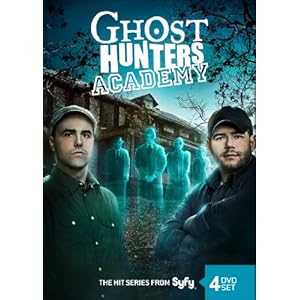
GHOST HUNTERS ACADEMY -- DVD Review by Porfle


Originally posted on 1/17/13


My first experience with this franchise was the DVD set "Ghost Hunters International Season One: Part 1", which was pleasant enough except that in the first few episodes it looked like they were aiming to include the usual reality TV-type interpersonal intrigue, back-biting, etc. rather than straight ghost-hunting, which I feared would get old fast.  Thankfully, they dropped that angle early on.

Unfortunately, GHOST HUNTERS ACADEMY jumps into all that with both feet and wallows around in it.  Image Entertainment's 4-disc DVD collection of this two-season spin-off series (2009-10), which lasted for only twelve episodes, is the standard elimination-style competition (a la "Survivor") in which contestants for a spot on "Ghost Hunters" are not only evaluated for their performances after each session but goaded into revealing who they think should be given the axe at episode's end.

It's like "Ghost Hunters" with a mean streak, with host-instructors Steve Gonsalvez and Dave Tango--mere second stringers on the main show--coming off like a couple of bullying, know-it-all doofs who have suddenly been given too much authority.  They seem to thrive on putting the earnest, nervous contestants on the spot and making them sweat ("WHY did you place a camera where NO VISUAL ACTIVITY has been reported?  WHY?") or lavishly berating them for not performing to their own elevated standards. 

Familiar locations are revisited, such as Eastern State Penitentiary in Philadelphia, Shawshank Prison, the creepy Waverly Hills Sanatorium, Colorado's Stanley Hotel (the inspiration for Stephen King's "The Shining"), and, my favorite, the Buffalo Central Terminal where the indy horror flick PRISON OF THE PSYCHOTIC DAMNED was shot.  The investigations seem rather cursory this time, however--there's no reveal to the site's host, only a caustic evaluation by Steve and Tango of the contestants' grievous failings. 

In fact, it occurred to me somewhere around episode five or six that there hadn't been a single convincingly paranormal event in the entire series thus far, besides those in "Ghost Hunters" flashbacks.  The episode titles themselves tell the story, pointing out the emphasis on personal drama rather than eerie encounters: "Web of Deceit" (referring to one contestant's failure to disclose her psychic abilities), "The Honeymoon's Over", "Back to Basics", "Drama Queen", "The Blame Game", and so on. 

Episode seven introduces a new group of hopefuls and a slightly new format in response to what were probably less than stellar ratings.  TAPS (The Atlantic Paranormal Society) co-founder Jason Hewes comes on to help whip the show into shape and the "cadets" as they're called seem more down-to-business.  But the "Survivor" template is adhered to even more closely, with everyone dishing the dirt on everyone else as bad feelings and grudges are encouraged. 

This second stage of the series does seem to get a little more into the "spirit" of the investigations, so to speak--there seems to be a bit more paranormal hoo-hah going on in these episodes.  But there's also a lot of boring down time, with a giggling Steve and Tango playing practical jokes on the contestants that are ostensibly meant to "test" them but come off mainly as simple pranks of the kind that are an anathema to this kind of show.

It's almost disheartening to hear the contestants' interview segments in which they speak excitedly about joining the GH team and becoming bonafide paranormal investigators, only to see them get bogged down in this superficial show's uninteresting machinations.  (The fact that we already know the second season's winner--since he's a part of the regular "Ghost Hunters" team already--eliminates much of the show's suspense as well.)
 
The 4-disc DVD set from Image Entertainment is in 1.78:1 widescreen with Dolby stereo sound.  No subtitles.  Disc four consists of several deleted and expanded scenes. 

There's no joy or catharsis when the final winner of GHOST HUNTERS ACADEMY is announced, only the feeling that we've just been through a lot of unpleasant rigamarole for nothing.  With the lack of paranormal activity throughout most of these episodes, you also get the distinct impression that the spirits themselves didn't consider the series worth showing up for.

Buy it at Amazon.com

Share/Save/Bookmark

Thursday, August 13, 2026

SHERLOCK -- DVD Review by Porfle


Originally posted on 2/23/22


For over a century, authors and filmmakers have been unable to resist rethinking, revising, and generally screwing around with Sir Arthur Conan Doyle's classic master detective Sherlock Holmes.  Even the silver screen's gold standard Holmes, Basil Rathbone, found himself transplanted from Victorian-era London into the middle of World War II in order to apply his peerless deductive skills toward fighting the Axis.  Over the years Holmes has met Sigmund Freud and Jack the Ripper, battled invading Martians, and exposed his private life for all to see.

While many of these updates are respectful of the original material, some are mere gimmicks designed to spoof or sensationalize.  But the three-part BBC-TV series SHERLOCK (2010), which places Holmes and the redoubtable Dr. John H. Watson squarely in the 21st century with the rest of us, is no gimmick.  Rather, it's an exhilarating opportunity for the celebrated sleuth and his loyal sidekick to engage a whole new world of mysteries.

Indeed, this Sherlock would fit comfortably into any time period.  He's not a fish out of water--his dynamic, self-contained character resists the need to be "updated" save for the modern detecting tools of which he readily avails himself.  Of course, he still has his violin, not to mention his problems with certain controlled substances.  The shag pipe has been replaced by nicotine patches, and instead of a journal, Watson records their adventures in his blog.


Holmes' rivalrous sibling Mycroft is here as well, now a member of the British government's inner circle and played very amusingly by Mark Gatiss.  Needless to say, the shadowy presence of a certain Moriarty hovers over it all.  Each episode is beautifully directed and shot, with inventive scene transitions and a fine musical score by David Arnold and Michael Price.  The scripts are replete with crackling dialogue and bits of business which convey the spirit of Doyle's original characters and stories in loving detail.  With all the familiar pieces falling into place in such a satisfying manner, SHERLOCK is a deep, delightful wallow in Holmesiana.

It took about half a minute for the wonderfully-named Benedict Cumberbatch to win me over as Holmes.  We first find him in the morgue, furiously laying into a corpse with a riding crop to assess the bruises.  Blithely unaware that a smitten attendant named Molly Hooper (Loo Brealey) is coming on to him, he responds to her timid invitation to coffee with a curt "Black, two sugars please, I'll be upstairs" before dashing off to the laboratory.  This leads directly to the fateful meeting between the two odd ducks, Holmes and Watson (Martin Freeman), both seeking a roommate as in the first chapter of the original Holmes novel, "A Study in Scarlet."  (This premiere episode is similarly titled "A Study in Pink.") 

Noticing Watson's crutch, the inquisitive Holmes asks, "Afganistan or Iraq?"  Watson, as in his initial incarnation, has been wounded both physically and mentally in the war and spends his days in therapy, but we get the feeling his unhappy life is about to get a lot more interesting.  "We don't know a single thing about each other," he says dubiously when Holmes takes it for granted that they'll be flatmates.
 

Fans know exactly what's coming next.  Our shared anticipation is rewarded when the droll, almost insanely perceptive Holmes casually reels off much of Watson's life story, based on simple observation, without missing a beat.  It's a marvelous scene, establishing his eccentric character beautifully with a few exquisite strokes.  Before long, both are ensconced in the familiar surroundings of 221B Baker Street, fussed over by their dear old landlady Mrs. Hudson (Una Stubbs).

"When the police are out of their depth, which is always, they consult me," he boasts when Detective Lastrade (Rupert Graves) of Scotland Yard summons him to the scene of a mysterious suicide.  Holmes invites Watson along as a medical consultant, thus beginning their grand collaboration.  A series of apparent self-poisonings has Scotland Yard baffled, and it's up to Holmes to figure out why unrelated Londoners are killing themselves with identical poison pills for no apparent reason.  This adventure will eventually lead him into a riveting battle of wits with the most unlikely of opponents.  

With a frustrated Lestrade constantly calling upon Holmes for help, the two bear a resemblance to Batman and Commissioner Gordon.  Which is fitting since, after all, Batman was partly based on Holmes in the first place.  (Maybe that's why the otherwise useless Robin was invented, to serve the Watson role of sounding board and appreciative audience to "the world's greatest detective.")

A clever convention that appears frequently is the use of floating text to show us not only what's popping up on various cell phones (Holmes prefers texting to talking) and other sources, but also lets us in on what's running through Holmes' mind as he riffles through various visual clues.  This way, he doesn't have to constantly explain everything to Watson for our benefit, and we get to see his thought processes in real time as he gathers and assesses information at lightning speed.

In the second episode, "The Blind Banker", Holmes sniffs out a racket involving stolen historical artifacts smuggled in from China and sold at auction.  When two of the smugglers are found dead in classic "locked room" scenarios, the killer's trail leads to a scary Chinese criminal cult that eventually gets their hands on our heroes.  While this episode gets slightly bogged down in procedure at times, there's plenty of exotic atmosphere, great character byplay, and a keenly suspenseful finale.


The third and last story of the season, "The Great Game", is an utter joy from start to finish.  It begins with Watson returning to the flat to find Holmes shooting bullets into the wall out of boredom, followed by that famous exchange in which Holmes reveals he doesn't know that the Earth goes round the sun.  Such information, he explains, isn't necessary in his work, and, in contemporary terms, he likens his brain to a hard drive from which all extraneous data must be deleted. 

The plot involves a mad bomber who communicates with Holmes through hostages who are wired with explosives and forced to read their captor's text messages aloud over the phone.  With only hours to solve each of the killer's mysterious puzzles and rescue the hostages one by one, the pace is frantic and the action non-stop, culminating in a final revelatory scene that should have Holmes fans in paroxysms of geek bliss. 

Do we ever get to see the big "M"?  Yes.  I won't go into detail, but the eventual face-to-face encounter between the world's greatest consulting detective and the world's greatest criminal mastermind is a sensational pay-off to all the build-up, and scintillating as hell.  (The words "You complete me" came to mind during their verbal sparring.)  It ends in a cliffhanger which, in a way, reminded me of a certain story called "The Final Problem."

The 2-disc DVD from Warner Home Video and BBC contains all three feature-length episodes (270 minutes total) in a 16:9 aspect ratio and Dolby Digital 5.1 stereo.  Subtitles are in English.  Episodes 1 and 3 contain cast and crew commentaries.  Other bonuses include a making-of featurette, "Unlocking Sherlock", and the original hour-long pilot which was later expanded and reshot to become "A Study in Pink."
 
Do I recommend SHERLOCK?  It's all I can do to keep from coming over to your house and forcing you to watch it with me.  This is intoxicating stuff for Holmes addicts, and I can't wait to see what's next.  In the words of the modern-day Sherlock: "The game is on!"


Share/Save/Bookmark

Wednesday, August 12, 2026

DAPHNE -- DVD Review by Porfle


Originally posted in 2008


Sizing herself up in the mirror before attending a stuffy party, Daphne du Maurier frowns at her fancy evening gown and mutters, "Why can't I just wear velvet trousers and a boyish belt?"

Based in part on her own letters and memoirs, the BBC TV-movie DAPHNE (2007) is all about the famous author wishing, like Pinocchio, that she were a boy. A bisexual boy, that is. The main emphasis is on Daphne's all-consuming infatuation for her American publisher's beautiful, outgoing wife, Ellen Doubleday, whom she meets while in the states to contest a plagiarism charge. Daphne finds Ellen an irresistible ray of sunshine in contrast to the increasingly distant relationship she endures with her troubled WWII veteran husband, Tommy (Andrew Havill).

After restraining her fierce romantic impulses as long as she can, Daphne finally professes her love to Ellen and is painfully rebuffed. "Love is love," she frets. "How can there be different ways?" She then finds rebound solace in the willing arms of the flamboyant stage diva Gertrude Lawrence, although their torrid affair leaves Daphne frustrated and unfulfilled. Interestingly, Daphne doesn't consider herself a "lesbian" at all--she despises the word, in fact. In her mind, if not her body, she has always been a boy.

I was expecting to see a serious, comprehensive look at the life of Daphne du Maurier here, so I didn't start getting into this movie until I realized that it's actually the sort of gaudy, hand-wringing upperclass soap opera--complete with furiously overwrought musical score--that people like Rock Hudson and Jane Wyman used to star in. Except in this case, the Rock Hudson role is played by the lead actress. Once I got what it was about, this handsomely mounted, well-played melodrama about unrequited love and gender identity, and how these feelings and experiences served as an inspiration in Daphne's writing, became fairly involving.

Geraldine Somerville ("Lily Potter" of the Harry Potter series) plays the troubled author of "Rebecca", "My Cousin Rachel", and "The Birds" with a long-suffering wistfulness which will appeal to either your empathy or your apathy. Elizabeth McGovern, aging nicely these days, is likable as the winsome social butterfly over which Daphne goes sweetly ga-ga. Best of all is Janet McTeer as brassy broad Gertrude Lawrence, who is the kind of woman Daphne finds exciting but wouldn't want to marry. The only other role I've seen McTeer play was Nelly in the 1992 WUTHERING HEIGHTS, so this is quite an interesting change which she handles beautifully.

The DVD image is 1.77:1, with Dolby Digital sound. The sole bonus feature is a du Maurier-penned documentary entitled "Vanishing Cornwall", which runs about half an hour and was directed by her son, Christian Browning. The author herself appears briefly at the beginning of this dry, rather dull look at the history of her beloved homeplace.

DAPHNE is the kind of smart, stately, yet tastefully decadent soap opera that you can indulge in like an unhealthy confection. That is, if you have the taste for such things. Otherwise, it may just leave you with a queasy stomach.


Share/Save/Bookmark

Thursday, August 6, 2026

CHROMESKULL: LAID TO REST 2 -- DVD review by porfle


(NOTE: This review is based on the unrated director's cut. Originally posted on 9/11/11.)


The tall, skinny, bald guy with the chrome skull-mask, the wicked knife, and the video camera perched on his shoulder like a parrot is back in CHROMESKULL: LAID TO REST 2 (2011) and this time, he's got back-up. 

The last we saw of Ol' Chrome-Dome (Nick Principe) back in the first LAID TO REST (2009), he was lying on the floor of a rural convenience store with his face ripped off and his skull smashed in.  Well, you can't keep a good monster down, so when this sequel picks up right where the last one left off, we see his crew sweep in, dispatch the investigating police, clean up the crime scene, and whisk their boss to an operating room where surgeons labor to save his life and what's left of his face.

It turns out that he's one of those multi-millionaires who can afford to do whatever the heck he pleases and pay people to willingly help him do it, even if that includes setting up an elaborate torture chamber for him (in his chrome-plating factory, naturally) and stocking it with kidnapped young girls.  His right-hand woman, Spann (the ever-popular Danielle Harris) even seems to enjoy her job, as does his main fixer, Preston, who is very well played by Brian Austin Greene. 


Green seems to revel in the Preston role, portraying a borderline psycho who wants to follow in his boss' footsteps by adopting the chromeskull mask and performing his first kills with an almost sexual ardor.  Not only do we get a shocking pre-titles sequence that harkens back to FRIDAY THE 13TH PART 2, but we get a little of PART 5 as well with an imitator going around making like the main man.  This not only gives Green a chance to stretch his acting muscles but also gives gore fans a double dose of carnage.

Like a cross between Jason Voorhees and Mason Verger of HANNIBAL, Chromeskull, now sporting a hideous patchwork face, spends his recovery time stalking a new girl to obsess on now that Princess, his previous object of interest, is out of the picture.  Her replacement is Jess (Mimi Michaels), who has an eye disease that's slowly making her go blind.  In one of the film's first startling kill scenes, Jess' best friend is dispatched in imaginatively gruesome fashion and Jess is abucted, waking up in a casket while being taunted by Preston.  Mimi Michaels plays the role to the hilt, screaming very convincingly and emoting her buns off.

Thomas Dekker returns as Tommy (last seen driving away with Princess in the last film) and gets caught up in the whole mess again, this time coming to the aid of Jess.  They both end up in Chromeskull's factory where they witness some of the film's more elaborate kills, including a virtuoso decapitation and a thing with a spring-loaded blade cluster (a chrome-plated custom job designed by Preston) giving another character a really big smile. 

Other death scenes of interest include a nasty disembowelment (with the victim being portrayed by twins in order to achieve a tricky single take), a head sliced vertically in half like a cantelope, the impromptu chrome-plating of somebody else's head, and another impressive single take in which Chromeskull wipes out a number of cops one after the other in gruesome ways.  The gore effects are achieved, as in the previous film, by combining excellent practical effects with some subtle CGI enhancements. 


Speaking of cops, they're a pretty ineffectual bunch here.  Owain Yeoman plays Detective King, who looks a little young to be heading the precinct, and Christopher Allen Nelson (Beatrix' almost-husband Tommy in KILL BILL) is Max, his best detective.  "Best" being a relative term, since the whole squad amounts to little more than kill fodder for Chromeskull.  When they bust into the chrome-plating factory to rescue Jess and Detective King yells, "You're safe now!", I thought, "Yeah, right."  Hot female detective Holland (Angelina Armani) fares no better.

Gail O'Grady appears as Jess' mother and a grown-up Eric Lloyd (of the SANTA CLAUSE series) is billed as "Geeky Lackey."  The actress who played Princess in the first LAID TO REST, Bobbi Sue Luther, is neither seen here (her flashback scenes were reshot with Allison Kyler replacing her) nor mentioned by name (unless I missed it).  

The DVD from Image Entertainment is in 1.78:1 widescreen with Dolby 5.1 surround sound.  Subtitles are in English and Spanish.  Extras include a commentary with director Robert Hall, co-writer Kevin Bocarde, and actor Brian Austin Green, along with a making-of featurette, deleted scenes, bloopers, and a trailer.  There's also a feature which allows viewers to jump to any one of the various kill scenes.  (Stick around through the closing credits for a two-minute epilogue.)

While the film is pretty fast-paced and the additions to the Chromeskull mythology fairly interesting, I prefer the first film with its creepier settings, more enigmatic killer, more likable characters, and more involving story.  This one has none of its dry humor (Sean Whalen and Kevin Gage are especially missed) and the main girl, Jess, is winsome but not really all that interesting.  Still, CHROMESKULL: LAID TO REST 2 is head and shoulders above most of the cheap slasher flicks being churned out lately, continuing the first film's "cavalcade of cool kills" approach with a little style and a lot of enthusiasm.  And Chromeskull is definitely one of the major movie monsters of the last few decades.


Share/Save/Bookmark