HK and Cult Film News's Fan Box

Showing posts with label film movement. Show all posts

Tuesday, September 1, 2026

THE TITFIELD THUNDERBOLT -- Blu-ray Review by Porfle


Originally posted on 12/23/19


In 1953 England's Ealing Studios, specialists in folksy feelgood comedies, released their first Technicolor film THE TITFIELD THUNDERBOLT (Film Movement Classics). And in keeping with that colorful milestone, it's one of their most cheerful, exhilarating comedies ever.

Titfield is one of those small English villages that's right out of a storybook, with an easygoing, tightly-knit citizenry to match.  When the powers-that-be threaten to close down their little railroad between Titfield and an adjacent town, leaving the transport business wide open for an unscrupulous pair of bus operators, some of the plucky leading citizens of the town get together to acquire the railway themselves and keep it running.


These include the railway founder's grandson, Gordon (John Gregson, THE LONGEST DAY, SOS PACIFIC) and elderly vicar Sam (George Relph), a die-hard train enthusiast, who persuade well-to-do pub owner Mr. Valentine (Stanley Holloway, PASSPORT TO PIMLICO, IN HARM'S WAY) to finance the endeavor with the promise that he can operate a traveling bar on the train that can stay open all hours of the day and night.

But even with the financing and resources all settled, there's still the matter of getting approval from the railway authorities, who will be sending an inspector in one month's time to assess the train's worthiness.


This gives bus owners Alec Pearce (Ewan Roberts) and Vernon Crump (Jack MacGowran) time to pull every dastardly trick in the book to wreck the budding railway's chances, even if it means wrecking the train itself.

Thus, the stage is set for one of the liveliest and most action-packed comedies to come out of England in the 50s.  Some of the bits of business in and around the Thunderbolt are worthy of Buster Keaton, at least in terms of cinematic enthusiasm and a sense of unbridled ebullience. 

We get some good old "will they make it there in time" suspense during the exciting climax in which everything seems to go wrong while the inspector is aboard, thanks to the never-ending attempts at sabotage from Pearce and Crump.
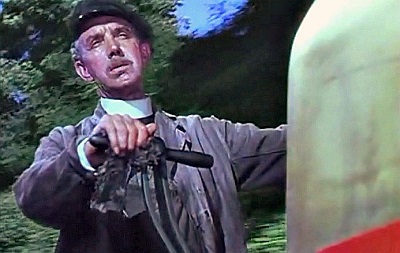

Not only that, but we're also treated to a few stunning setpieces including a runaway locomotive steaming through the streets of town and a thrilling derailment in which the model work is first class.

Enriching the experience even more is a top-notch cast giving very likable performances, including Hugh Griffith (WHAT?, BEN-HUR, EXODUS) as a crusty old former engineer constantly jostling with vicar Sam to see who gets to drive the train. 

The lush, verdant, pastoral setting and relaxed atmosphere of Titfield mirrors that of John Ford's similar-looking THE QUIET MAN, released a year earlier, with happy villagers evincing a sense of solidarity and togetherness which extends to their cooperative efforts to help keep their beloved railway going themselves.


The presence of Jack MacGowran playing yet another simpering toady is an even further tie to Ford's film, in which he served the same role (as "Ignatius Feeney") to Victor McLaglen's blustery bully. 

And the direction by Charles Crichton (A FISH CALLED WANDA, THE LAVENDER HILL MOB) and script by T.E.B. Clarke (PASSPORT TO PIMLICO, THE LAVENDER HILL MOB) suffer not a bit in comparison.

Most of all, THE TITFIELD THUNDERBOLT is an endearingly optimistic, benignly human story whose warmth and genuine humor are matched by a gorgeous, almost fairytale setting. And it will henceforth be on my short list of movies to reach for whenever I need a bit of cheering up.


Buy it from Film Movement


Tech Specs


1953
84 Minutes
United Kingdom
English
Comedy, Classics
Not Rated
Sound: Mono
Discs: 1


Blu-ray Features

Making The Titfield Thunderbolt featurette
Cinematographer Douglas Slocombe Home Movie Footage
The Lion Locomotive featurette
Locations featurette
Douglas Slocombe on Charles Crichton audio interview
The Titfield Thunderbolt original trailer
Stills gallery



Share/Save/Bookmark

Friday, August 28, 2026

SIN IN THE SUBURBS (1964) -- Movie Review by Porfle


Originally posted on 12/8/18


SIN IN THE SUBURBS (1964) is writer-director Joe Sarno continuing to come into his own as a filmmaker who takes the genre of naughty, softcore sex potboilers and invests it with an unusual dramatic heft and interesting characters who trade dialogue that's sharp and fun to listen to.

Not to say that the obligatory sleaze and tawdriness of such films are missing here--it's the sort of world Sarno's characters exist in, whether they be conniving lowlifes using sex for gain or well-to-do hypocrites posing as model citizens while indulging forbidden sexual perversions behind closed doors.

The term "when the cat's away" really fits this normal-looking 60s suburb in which lonely, sex-hungry wives, feeling neglected by their working husbands, have it off with various neighbors, workmen, or, in the case of Mrs. Lewis (Audrey Campbell, THE SEXPERTS), her teen daughter Kathy's high school friend.


Meanwhile, we see local sex-bomb Yvette lounging around the house in lingerie and paying the furniture bill by seducing the collector.  Yvette lives with her supposed "brother" Louis (W.B. Parker), and together they're hatching a scheme to start an illicit sex club which they hope will have frustrated neighbors shelling out hundreds of bucks for.

What starts out a bit like a sex comedy (the bill collector guy is funny) soon veers toward the dramatic as the sexual vortex so many of the characters seem caught in starts to spin out of control.  Lisa, left alone while husband Henry is at work, starts guzzling booze and luring abusive workmen into her home. Mrs. Lewis has daytime swingers' parties with friends in her own house, one of which is walked in upon by a her shocked daughter Kathy.

Kathy, it seems, has the wildest life of them all when she's molested by her would-be boyfriend and then seduced into a hot lesbian affair with Yvette. Judy Young plays her with just the right balance between still just a kid and becoming a troubled, sexually-confused young woman.


It's almost the stuff soap operas are made of, but it's all so edgy (for its time) and starkly compelling that we're constantly transfixed by what's going on and eager to see what happens next.  Sarno's evolving as a director with an instinctive talent for staging interesting shots and bringing out the best in his cast.

The story content is strictly adults-only for 1964, with elements such as adultery, attempted rape, lesbianism, and other sensitive subjects that were still taboo.  It feels like we're watching something on the shady side, getting a voyeuristic glimpse at these desperate sinful lives.

Sarno's screenplay goes beyond simple sexploitation and builds to an emotionally jarring ending after one of Yvette and Louis' illicit sex parties, which is staged remarkably and with lasting effect.

Sarno's black-and-white photography is crisp, noirish, and constantly interesting to look at.  The print used for Film Movement's Blu-ray edition is very good, even with the occasional scratches, specks, etc. which, for me, give it a nostalgic feel that recalls the well-worn prints we used to see at the local theater or on late-night TV.


Having just watched the original Star Trek episode "I, Mudd" the night before, I was surprised to see the actor who played the android "Norman", Richard Tatro, as the dangerous guy Lisa foolishly opens her front door to.

Yvette is played by none other than Dyanne Thorne (billed here as Lahna Monroe) of "Ilsa, She-Wolf of the S.S." fame, looking almost unrecognizable with her jet-black bouiffant hairdo. The film's one bit of actual nudity is a fleeting glimpse of her bare breasts.

SIN IN THE SUBURBS ends with a shadowy, poignant shot that looks like it might be straight out of early David Lynch.  And with it continues my fondness for Joe Sarno's exquisite black-and-white early films, which are unlike anything else I've seen.


Read our reviews of other Joe Sarno films HERE


Share/Save/Bookmark

Monday, July 20, 2026

CAM GIRL -- DVD Review by Porfle


Originally posted on 4/1/19


The title and cover art make it look like the kind of softcore sex drama you might've seen on Cinemax After Dark in the 80s, but the Italian production CAM GIRL (Film Movement, 2014) is a sober and ultimately unsettling look at a homegrown internet sex business slowly going off the rails.

Alice (Antonia Liskova) is hoping for an entry-level position in an advertising firm, but when her bitchy boss steals a profitable idea from her before firing her, Alice needs a way to make money fast.

Her beautiful friend Ross (Alessia Piovan) seems to be doing pretty well working for an outfit called Sexy Cam, so Alice decides to start her own cam girl business that will be different from the rest in that it won't exploit the girls and will always treat them fairly and profitably. 


Joined by struggling waitress Gilda (Sveva Alviti) and aspiring basketball player Martina (Ilaria Capponi), they form a core group that goes into the business with just enough reckless idealism and naivete' to get in way over their heads and find their lives crashing down around them.

The pace is slow and deliberate as all the story threads weave together into a narrative tapestry that eventually becomes more and more involving.

Characters and performances are consistently believable, as is every step of the girls' progress in discovering all the legal and financial pitfalls of such an endeavor along with unforeseen emotional consequences regarding romantic and family relationships.


All is fun and games at first and an early montage looks like something out of a high-end sex romp as the team of four are joined by several girls defecting from other webcam outfits. 

Dramatic tension sets in when Alice gets a hard lesson in economics and personnel management, especially when the girls start demanding their money while proving unreliable and irresponsible.

As Alice's idealism turns sour, CAM GIRL ratchets up the tension in other ways. Not only does her semi-partner and advisor Giovanni (Marco Cocci) prove untrustworthy, but the very real threat posed by their more mentally and emotionally unbalanced customers grows more alarming every day.


Director and co-writer Mirca Viola (L'AMORE FA MALE) leads us on a realistic, no-frills journey into the dark side of the webcam sex biz that inevitably ends in misfortune for some and tragedy for others. 

Production values are solid, with direction and photography effectively conveying the oppressive atmosphere in which Alice and the girls have found themselves trapped. 

CAM GIRL doesn't indulge in exploitative sex or tricky plot twists, but resolves things in a satisfyingly realistic manner.  It's a sordid slice of life that's too curdled to appease the palate or go down easy. 


Buy DVD or Stream It From Film Movement


TECH SPECS:
Format: NTSC, Italian w/English subtitles
Region: Region 1 (U.S. and Canada only. Read more about DVD formats.)
Number of discs: 1
Studio: Omnibus Entertainment (Distributed by Film Movement)
DVD Release Date: April 9, 2019
Run Time: 87 minutes
Bonus: None


Share/Save/Bookmark

Thursday, July 16, 2026

FAMOUS NATHAN -- DVD Review by Porfle


Originally posted on 9/18/15


Heartfelt and finely-crafted, the documentary FAMOUS NATHAN (2014) is a glowing tribute to filmmaker Lloyd Handwerker's celebrated grandfather Nathan, the hot dog maven of Brooklyn's Coney Island.  It's a story of dedication, a work ethic the like of which is long past, the will to succeed, and, most importantly, family values. 

Lloyd has combed his way through mounds of ancient home movies and audiotaped interviews in order to give voice and image to long-deceased grandfather Nathan, who tells of leaving Poland, where he toiled as a youngster to help feed his family, and coming to America to work his way from menial jobs to owning one of the most wildly successful restaurants in the history of fast food.

We learn of Nathan's Famous (the name given to his renowned eatery) from its humble beginnings in 1916 to its preeminence with Coney Island visitors who purchased, at its peak, tens of thousands of hot dogs a day.  Nathan's employees churned them out at record speed and took pride in performing at their peak at all times for a boss to whom they were intensely loyal.  Both they and Nathan's friends and competitors gladly attest at length, sometimes emotionally, to what a wonderful guy he was.


Relatives and family also speak highly of him but in more measured terms.  There were the usual squabbles with his sons, Murray and Sol (Lloyd's father), who felt they could never measure up to Nathan's high standards while often waiting in vain for words of praise.  (Sol remarks that if Nathan wasn't criticizing him for something, that was as close as he came to actual praise.) 

Unrest between the brothers themselves over how to run the business once Nathan was urged to take an unwanted retirement (he said he preferred to die on the job over a life of leisure) and subsequent unwise decisions that lead to the company's eventual downfall help give the narrative the same depth and drive of a fictional family saga. 

All the while Lloyd's artful use of montage--many of his faded film clips of a New York that no longer exists are priceless--gives us a sense of the bustling joy that was a day at Nathan's Famous while also humanizing the man whose name sits atop the sign. 


There's a warm humorous element to several of the interview segments with family friends (I loved watching some of the aging Jewish couples lovingly kvetching at each other as they argue over long-ago details) and Lloyd's likable dad Sol himself.  Sol's visit with now-senile brother Murray in an old folks' home is touching, especially the following exchange:

MURRAY: How old are you?
SOL: Eighty-five.
MURRAY: Eighty-five? (Shakes his head) How old am I?
SOL: You're eighty-nine.
MURRAY: Eighty-nine? (Laughs in disbelief)

Finally, FAMOUS NATHAN takes us through the final stages of the Handwerker empire which, no longer in Nathan's hands, takes on increasingly unsuccessful spin-off ventures and franchise operations until the family is forced to sell out to a corporation.  And thus, the once-bustling hot dog palace joins a crumbling Coney Island itself in a slow descent into oblivion.  Lloyd Handwerker manages to make us feel as melancholy about this as he obviously does. 


The DVD from Film Movement is in 1.78:1 widescreen with Dolby 5.1 surround sound.  There are no subtitles but closed captions are available.  Extras include a director's commentary, bonus and deleted footage, and trailers for this and other Film Movement releases.

I've always enjoyed a good, nostalgic documentary about fast food and novel tourist attractions in America (the History Channel's "American Eats" and "Highway Hangouts" are two of my favorites), and FAMOUS NATHAN pays off richly in that regard.  Better yet, though, is its wonderfully engaging portrait of an admirable man who dared to dream and then, against staggering odds, made that dream come true.


Share/Save/Bookmark

Tuesday, June 16, 2026

ROOM 304 -- DVD Review by Porfle


Originally posted on 1/20/19


Danish director Birgitte Stærmose (DARLING, ISTEDGADE) and prolific screenwriter Kim Fupz Aakeson (PERFECT SENSE, ACCUSED) have set out to make us all sad, contemplative, and mesmerized with their gloomy drama ROOM 304 (aka "Værelse 304"), which is like one of those long, detailed dreams that skirts the boundary between the nightmarish and the mundane.

It all takes place in a high-class hotel where all the characters or their relatives work, but instead of being the story of the everyday behind-the-scenes drama of managing a bustling hotel, which I initially expected, it's really a fairly simple account of the romantic and interpersonal relationships between some troubled souls who happen to work in the confined spaces of a big, oppressive hotel. 

To make the simple storylines more interesting, screenwriter Aakeson has gathered up all the scenes and laid them out like jumbled jigsaw puzzle pieces for us to try and sort out ourselves. That way we see things that will occur much later and don't understand them until they reappear in a different context, when everything finally starts to come together.


We see the little details of married  (but not to each other) co-workers sneaking around cheating on their spouses, daily compounding the lies and suspicion that will gradually come to light in tragic ways. We see a fervid subplot about a laundry room worker avenging himself on a guest who once raped his wife, which introduces a loaded pistol into the mix. 

And we see the desk clerk covered in blood after a shocking murder, but, like all the other main plot points, we won't find out what happened until we've been slowly and subtly teased.

If it sounds anything like an Arthur Hailey story, it isn't.  ROOM 304 is slow, somber, and achingly sad, and we see almost nothing of the hotel's guests or the usual practical concerns of running the place. It serves instead as a sort of dreamlike territory of the subconscious, where characters yearning for various unreachable things wander through their unfulfilling lives like fish in an aquarium. 


Hotel director Kasper (Mikael Birkkjær) and front office manager Nina (Stine Stengade) are having a torrid affair that, we fear, will end badly.  Just how badly is revealed to us as the puzzle pieces drift maddeningly into place, and one person's obsession and desperation override rational thought while other collateral damage is wrought. 

Loneliness is another element casting a pall over such characters as emotionally needy stewardess Teresa (Ariadna Gil), who picks up men in the bar for unpleasant sex in her room.  And then there's the daily grind of service workers such as two Filipino maids who toil on the periphery, observing and chatting about it all and never knowing when some sudden twist of fate might sweep them into a maelstrom of tragedy.

My favorite character is Martin (David Dencik, 2011's TINKER, TAILOR, SOLDIER, SPY), the withdrawn, hypersensitive, obsessive (he's always washing his hands) desk clerk. When Nina calls him into her office and tells him that, while very efficient, he needs to "smile more", the nonplussed Martin considers this for a moment and, straightfaced, assures her that he will "make a note of it." He's the one who ends up with blood all over him after the murder occurs.


The visual mood inside the hotel is consistently oppressive, rendered with a richly dark palette and much Rembrandt-style lighting. Stærmose's direction is fluid and artistically expressive, and remains interesting throughout even when the plot is moving along at a snail's pace.

It took me two viewings to fully appreciate ROOM 304, one just to wander around getting my bearings, and another to piece it all together and realize what a carefully wrought and thoroughly satisfying work of cinematic storytelling it is.  The fadeout illicits much contemplation and, for me, a bit of emotional decompression.


TECH SPECS
Type: DVD
Running Time: 88 minutes
Aspect Ratio: 1.85:1 Widescreen
Audio: 2.0 Stereo

Language: German and Danish w/English subtitles
Distributor: Film Movement
Extras: None


Share/Save/Bookmark

Thursday, March 12, 2026

THE MAD ADVENTURES OF "RABBI" JACOB -- Blu-ray Review by Porfle


Originally posted on 10/6/19


I was bored one night back in 1973, so I drove ten miles to see this obscure (to me, anyway) foreign comedy that had a funny trailer. Not expecting much, I ended up having the time of my life (well, one of them, anyway) because this kooky little French romp turned out to be one of the funniest, wildest and most delightful farce comedies I'd ever seen.

Now, forty some-odd years later, THE MAD ADVENTURES OF "RABBI" JACOB (Film Movement Classics) is just as funny, just as wild, and somehow even more delightful because it has aged like fine bubbly champagne that gets up your nose and makes you giggle.

Popular, rubber-faced French comic Louis de Funès plays Victor Pivert, a diminutive hothead speeding cross-country to his daughter's wedding while berating his chaffeur Solomon and yelling at other drivers, especially the foreign ones (he hates Belgians, Germans, Englishmen, anyone who isn't French).


Somehow--I'm not going to go into it here--Pivert gets mixed up in violent political intrigue between two Middle Eastern countries and is fleeing on a moped with a revolutionary named Slimane (Claude Giraud), a gang of ruthless killers hot on their heels.  And he can't depend on his chauffeur Solomon for help because he just fired him after finding out he was Jewish. (That wasn't the actual reason but it's an added factor.)

Then, somehow--I'm not going to go into it here--Pivert and Slimane assume the identities of a Hassidic rabbi named Jacob and his assistant. The real Rabbi Jacob is due to return to his French community after years in the U.S.A., and the imposters are welcomed by gleeful mobs of admirers as Pivert is expected to preside over the bar mitzvah of Jacob's nephew in addition to several other ceremonies and such of which he has absolutely no knowledge.

And as all this is going on, the little town is beseiged by Slimane's gun-blazing enemies, police detectives on the trail of Pivert because they think he's a killer, and Pivert's frantic wife who wants to throttle him for not showing up at their daughter's wedding.


Obviously I've tried to summarize the plot as well as possible, but it just can't come close to describing what a wonderfully wacky comic delight this movie is.  Pivert may be the most lovable bigot in any film comedy, especially since we know he's eventually going to learn his lesson before it's over.

He has a hilarious talent for deadpan mugging (I love the part where he tries to get the attention of two cops by making faces at them) and the frantic, cartoonish physicality of Leon Errol. Not only that, but when he's eluding his would-be killers in a chewing gum factory he and they all end up sliding into a vat of the stuff and emerging as gooey green blobs.

As Pivert contends with these murderous political zealots (the actors play their roles wonderfully straight) I was reminded of Woody Allen's perilous comedic entanglements with South American revolutionaries in BANANAS.


Indeed, much of the raucous slapstick comedy in this film is just as intensely off-the-wall and often startlingly bent as anything Woody came up with in his early, funnier films. 

The Tex Avery-level sight gags and outlandish situations come fast and furious. Pivert's nagging, spoiled wife berates him over the phone while working on a nervous patient (she's a dentist, of all things) and Pivert flees in a car with a boat on top that eventually goes into a lake and becomes a boat with a car on top. 

His experiences in the Jewish community filled with well-wishers who adore him (as Rabbi Jacob) are both achingly funny and heartwarming without ever getting sappy.  Needless to say, his daughter's belated wedding becomes the scene of a calamitous collision of all the different characters and plot elements that never lets up until the fadeout.

THE MAD ADVENTURES OF "RABBI" JACOB has a nice message of tolerance, but it shows it instead of preaching it to us and never lets it get in the way of the sparkling fun.  If you're looking for a truly feelgood comedy that will have you giddy with joyful laughter, this is it.


Buy it at Film Movement

Blu-ray Features
Interview with co-screenwriter Danièle Thompson
New essay by author Phoebe Maltz Bovy
Sound: Mono


DVD Features
Interview with co-screenwriter Danièle Thompson
New essay by author Phoebe Maltz Bovy
Sound: Mono


Share/Save/Bookmark

Friday, January 24, 2025

FRITZ LANG'S INDIAN EPIC (THE TIGER OF ESCHNAPUR and THE INDIAN TOMB) -- Blu-ray Review by Porfle


Originally posted on 11/26/2019
 

Sometimes legendary director Fritz Lang wanted his magnificent visuals to convey an important message (METROPOLIS, THE TESTAMENT OF DR. MABUSE, M) and sometimes he just wanted to offer audiences grand escapist entertainment.

The latter goal Lang achieved in spectacular style with the films THE TIGER OF ESCHANAPUR and THE INDIAN TOMB, known collectively as FRITZ LANG'S INDIAN EPIC (Film Movement Classics, 1959).

A forerunner of more recent two-film narratives such as KILL BILL and IT, this double feature tells the sprawling story of a catastrophic love triangle that develops when German engineer Harald Berger (Paul Hubschmid) is summoned to India by Prince Chandra (Walter Reyer) to oversee the construction of several buildings as well as shoring up some of the crumbling infrastructure of the palace itself.


As fate would have it, a beautiful temple dancer named Seetha (Debra Paget, THE TEN COMMANDMENTS) with whom the prince has fallen madly in love is being transported to the palace in the same caravan as Berger, and when the European valiantly saves her life from an attacking tiger during the trip, she becomes hopelessly smitten with him.  This soon develops into an all-consuming passion that will invoke the jealous prince's white-hot, vengeful wrath.

Amidst a backdrop of splendiferous Indian locations and incredibly opulent sets, photographed in sumptuous color with rich production values, this steamy melodrama is soap opera of the highest order mixed with scintillating political intrigue (the prince's brother and former brother-in-law are plotting against him) and irresistible "boys' adventure"-style action involving swordfights, man-eating tigers, mysterious underground passages, and other fun stuff.


While some have compared these films to RAIDERS OF THE LOST ARK, viewers expecting non-stop thrills will be disappointed. Instead, we're allowed to settle in  for a stately paced parade of visual treats (I haven't seen such regal eye-candy since the "Sissi" films with Romy Schneider) charged with constant tension and suspense and punctuated here and there with action sequences that have a Rudyard Kipling flavor.

The tension increases as Prince Chandra's suspicions toward his intended bride Seetha and the European stranger are eventually made evident, bringing out the arrogant, petulant worst in him.  When Berger finds it necessary to escape Chandra's wrath, he finds himself lost in the catacombs beneath the palace where he encounters a colony of lepers banished to the underground.

We're also introduced to Chandra's compound of deadly caged tigers into which, at one point, Berger is tossed with nothing but a spear with which to defend himself. Here, Lang's attention to gilt-edged realism falters a bit when a lunging tiger is noticeably fake (as is a monster-sized cobra in the second film) but I found such shortcomings easily forgivable in view of the scene's entertainment value.


Performances are earnest, with Debra Paget a standout not only for her talent but also thanks to her incredible beauty and sex appeal. Her temple dance in this film is a highlight of sheer sensuality (to be surpassed in the sequel) while her acting adds depth to a very sympathetic character.  Reyer, on the other hand, ably conveys the prince's incredible arrogance, selfishness, and cruelty. (A young Luciana Paluzzi appears all-too-briefly as Seetha's loyal servant.)

Finally, the two forbidden lovers make a desperate escape attempt, with the prince's soldiers doggedly pursuing them from the steamy jungles to the parched, wind-seared desert.  It's there that the dashing European engineer and the beautiful Indian temple dancer meet their apparent doom as part one of Lang's Indian epic, THE TIGER OF ESCHANAPUR, ends in classic cliffhanger style.

The second installment in Fritz Lang's sprawling two-part saga of Indian intrigue and forbidden romance, THE INDIAN TOMB, picks up right where its predecessor THE TIGER OF ESCHANAPUR left off. This time German engineer Harald Berger's sister Irene (Sabine Bethmann) and her husband Walter (Claus Holm), who is also Harald's associate, have come searching for him.


They're told that Harald went missing during a tiger hunt, but become increasingly suspicious of the prince and his motives. This is especially true when Chandra orders Walter to design a tomb for his wife Seetha, in which she is to be imprisoned on their wedding day. When Walter balks at creating what is in essence an execution chamber, Chandra threatens him and his wife.

Political tensions grow to a boiling point as Chandra's brother Prince Ramigani (René Deltgen), passed over for the throne and eager to amend that oversight, plots against him with the help of the prince's former brother-in-law who also despises him. Even the temple priests grow angry toward Chandra when he persists in his desire to marry Seetha (and then execute her) after she is discovered still alive in the desert.


This second film's highlight comes when Seetha performs a cobra dance in the temple which is meant to decide whether the gods wish her to live or die.  In a costume that's the very definition of "less is more" (it makes a string bikini look like a parka) the incredibly gorgeous and physically fit Debra Paget's dance number is, to put it mildly, memorable, despite the very fake-looking cobra which menaces her character throughout.

Suspense builds as Berger's sister and her husband bravely plot to locate where he's being held prisoner beneath the palace and free him.  The story, which has been rather sedately paced up till now, really picks up steam with Irene's encounter with the frenzied band of lepers and Berger's desperate escape from bondage just as he's about to be executed in his cell.

There's swordplay and other violent clashes when Ramigani's armed rebellion against Chandra kicks into gear, and Lang finally shows us why we keep seeing all that dynamite stored in the passages underneath the palace, leading to a flood populated by hungry alligators.


The 2-disc Blu-ray from Film Movement Classics is an exquisite 4K digital restoration of both classic films with an aspect ratio of 1.37:1 and mono sound. Each film features a verbose commentary by film historian David Kalat. Bonuses also include the making-of documentary "The Indian Epic" and the video essay "Debra Paget, For Example" by Mark Rappaport, as well as trailers and an enclosed illustrated booklet with an in-depth essay by film scholar Tom Gunning.

One thing's for sure, when this story finally comes to a head, it pays off in all sorts of fun ways.  Viewers who stick it out through both installments of FRITZ LANG'S INDIAN EPIC not only get to enjoy some of the screen's most dazzling opulence and eye-pleasing production values, but also a romantic, exotic action-adventure ending on a satisfying note that makes it all wonderfully worthwhile.


Buy it at Film Movement.com


THE TIGER OF ESCHNAPUR
NEW 4K DIGITAL RESTORATION
Film Movement Classics
1959
101 Minutes
Country: Germany, France, Italy
Language: German w/ English subtitles
Classics, Romance, Thriller
Not Rated
Blu-ray
Aspect Ratio: 1.37:1   
Sound: Mono   


THE INDIAN TOMB
NEW 4K DIGITAL RESTORATION
Film Movement Classics
1959
102 Minutes
Country: Germany, France, Italy
Language: German w/ English subtitles
Romance, Thriller, Classics
Not Rated
Blu-ray
Aspect Ratio: 1.37:1   
Sound: Mono


Here's the poster of the American theatrical release in which the two films were edited into one:


Share/Save/Bookmark

Friday, October 11, 2024

BAD LUCKY GOAT -- DVD Review by Porfle


Originally posted on 12/8/17


Not quite the "boy and his goat" story I expected, BAD LUCKY GOAT (Film Movement, 2017) is more the story of a boy, his older sister, and their goat head.

It starts out as an entire dead goat but they sell the carcass to a butcher, trade the skin for a watch that someone found on the beach, and hang onto the head until they're convinced that it's the cause of all the bad juju they've been suffering since leaving the house.

But that's just the bare bones of what happens on that ill-fated day when Cornelius ("Corn" for short) and his sister Rita, while heatedly arguing about things as usual, smash the family truck into an escaped goat while on an errand for their parents in a rural village in the Caribbean. 


The damaged truck and the dead goat are problems the two will spend the rest of the day trying to solve, and their troubles only increase when they do so by lying, cheating, and generally avoiding responsibility whenever possible.

They're likable kids, though, despite constantly being at each other's throats as siblings often are.  Their misdeeds really aren't so bad that we can't identify with them--mostly--and they do keep us entertained not only with their attempts to earn enough to have the truck fixed (hence the goat carcass transaction and various other bartering attempts) but also by ending up on the wrong side of the local crime boss whose goat it was in the first place, not to mention the police.

We get to meet a succession of colorful characters, most of whom are either earning a meager living without getting all that worked up about it or making cheerful indigenous music in peaceful natural surroundings with their friends. 


I enjoyed listening to their Creole patois, which I only recognized as a form of English after listening to it for a few minutes (I challenge anyone who speaks English to decipher the dialogue without the subtitles). 

During all this we get a chance to drink in the beautiful tropical scenery and mostly laid-back ambience while the story ambles along at its own unhurried pace just like a reggae song.  (With a little kidnapping, cock-fighting, and other things thrown in to spice things up.)

Colombian director Samir Oliveros doesn't try to grip us with any big drama or hilarity, and there isn't a chase to cut to.  This gives us time to get to know Corn and Rita, and watch them gradually and somewhat begrudgingly grow closer during their long day of tedious travails which will test both their mettle and their basic humanity. 

This relationship is what the film is really all about, and its sweetly-rendered resolution makes watching BAD LUCKY GOAT not unlike a soothing balm for the soul. 

Buy it from Film Movement

Extras:

Bonus short film "Miss World" by director Georgia Fu
Film Movement trailers


5.1 Surround Sound/2.0 Stereo
2.40:1 Widescreen
Creole With English Subtitles
76 Minutes


Share/Save/Bookmark

Thursday, October 10, 2024

SHATTERED -- DVD Review by Porfle


Originally posted on 12/20/17


Sometimes it's a chore to watch one of those Lifetime Channel-type dramas that gets a female protagonist into an untenable situation and then pulls out all the predictable stops to get her out of it.

Every once in a while, though, I find myself in the middle of one and stop and think: "Hmm...I'm enjoying this."  It's such a pleasant surprise that I'm compelled to regard the movie in a much more charitable light rather than wincing at every tired plot turn or turgid dialogue exchange.

In the case of SHATTERED (2017), the surprise doesn't stop there. In fact, it's full of surprises.  Just when things seem headed in the old familiar directions and we settle in to see them played out, the movie deftly sidesteps expectations and heads down an entirely different avenue.  Not just once, but several times--enough to keep us not just interested, but intrigued.


Molly Burnett (THE WEDDING PARTY, "Days of Our Lives") stars as Maureen, a smalltown single girl who meets, falls for, and marries Ken (Tom Malloy, HERO OF THE UNDERWORLD), the son of the town's wealthiest man.  They adopt a son named Logan, have a daughter named Emma, and start living the happy, carefree lives of the upper-class married.

But not is all as it seems.  Tom's father, Forest Burnett (the venerable Ray Wise, "Twin Peaks" ROBOCOP, THE AGGRESSION SCALE, HALLOWEED, CHILLERAMA), is an aspiring big fish/little pond politician whose fake smile masks a volatile demeanor as well as some deep, dark secrets.  His trophy wife Kate (Arianne Zucker) knows the secrets, but is trapped by fear and dependence. 

Maureen's trapped too but she just doesn't know it yet. Things start to go wrong when her adopted son Logan turns out to be a deeply troubled mental case who wields sharp instruments and mutters "Kill!"  Attempts to find out about his real parents and get professional help for him are blocked by the Burnetts, who fear the bad publicity. 


Or, in Forest's case, is there even more to it than that?  Of course there is, and thereby hinges the inevitable morass of marital and parental disaster that we're about to watch Maureen wade through like a leech-infested swamp for the next 90 minutes or so.

As I said, it all sounds so comfortingly yet tiresomely predictable, until something happens that comes right out of left field and changes everything. This messes with all our predictions to a degree that we're never quite sure what's going to come out of left field next. 

Not that any of it is particularly world-shaking, mind you.  The story progresses at a leisurely pace, with none of the dramatic intensity or thriller-type incidents usually found in these films (thus thwarting expectations yet again), and plays itself out with a sort of off-kilter calm. 


I was halfway through the big climactic scene before I realized it was the big climactic scene--that's how deceptively unsensational this story is.  It's just engaging enough to hold our attention and make us want to stick around to see how it all plays out. 

Direction by Natasha Kermani (IMITATION GIRL) is capable, with adequate-to-good performances.  Old pro Ray Wise comes off best, naturally, as does Arianne Zucker (once a co-star with Molly Burnett on "Days of Our Lives") as Forest's morally-conflicted wife.  Morgan Freeman's son Alfonso appears briefly as a mental health doctor.

I haven't revealed much about the plot (madness, infidelity, scandal, etc.) because finding out is the fun part.  SHATTERED is like a passable TV-movie that gradually evolves from dull to interesting and manages to stay that way until the end, which is more than I can say for a lot of movies I've seen.


Official site


Share/Save/Bookmark