HK and Cult Film News's Fan Box

Showing posts with label Television. Show all posts

Sunday, September 13, 2026

BEHEMOTH -- DVD Review by Porfle


Originally posted on 3/24/11


When a SyFy original movie has the words "worldwide destruction" in the synopsis, you can pretty much bet you're going to hear about it more than see it, with most of the action taking place in a centralized location with occasional dollops of bad CGI.  In BEHEMOTH (2011), the location is a mountain community in the wilds of Canada, and the CGI dishes up one of the goofiest monsters this side of REPTILICUS.

A rash of earth tremors and some mysterious deaths have the citizens of Ascension on edge, including concerned geologist Emily Allington (Pascale Hutton, GINGER SNAPS: UNLEASHED) and government agent Jack Murray (Ty Olsson, "Defying Gravity").  A lovable, quasi-senile old professor, William Walsh (William B. Davis, who was Cancer Man on "The X-Files"), believes that the ravaged Earth has dredged up a mythical beast to purge itself of Mankind as it sometimes does whenever we get too destructive with our global warming and whatnot. 

Ed Quinn ("Eureka") makes a pretty stalwart hero as logger Thomas Walsh, William's son and Emily's old boyfriend, who ends up guiding Jack up the quake-prone Mt. Lincoln in search of some vital equipment left behind by two missing agents.  Naturally, Emily insists on going along, and, even more naturally, Thomas' headstrong younger sister Grace (Cindy Busby, "Heartland") and her dopey boyfriend Jerrod (James Kirk) are camping out on the same mountain.


The behemoth, it turns out, is so big that it practically wears the mountain like a backpack and can flex its enormous CGI tentacles for miles.  Just as the romantic Jerrod picks the perfect moment to hit a knee and propose to Grace (thus marking himself for death), a giant eyeball pokes out of a hole in the rock wall and peers angrily at the two lovebirds.  Their reactions are somewhat comical as they scamper off down the mountain screaming "What was that!  What was that!" as a tentacle makes a grab for them.  This would probably be a good time to mention that some of the acting and dialogue in this flick aren't quite up to par.

Meanwhile, Thomas and Emily are having their own tentacle problems as they search for Jack's missing equipment, which turns out to be an anti-behemoth weapon.  We know exactly what they're going to do with it, too, because it's foreshadowed in the most obvious terms possible by one of William B. Davis' early lines.  Speaking of which, Professor Walsh and his waitress friend Zoe (Jessica Parker Kennedy) get trapped in a diner that's gone down a sinkhole and has tentacles sliding past the window like city buses.


The screenplay takes its time slowly building up to the action until finally it's time for the cameramen to start shaking their cameras around and the characters to start freaking out while the behemoth lobs its appendages at them.  As Professor Walsh works his tired old bones to a frazzle trying to rescue the infuriatingly-stupid Zoe, the big finale features the behemoth sticking its giant, roaring head out the top of Mt. Lincoln while tentacles writhe around it.  This is a sight that will either stupify viewers or have them rolling on the floor in bad-movie delight. 

The DVD from Vivendi is in widescreen with English Dolby Digital 5.1 sound.  Closed-captioned for the hearing impaired.  No extras.

BEHEMOTH is the kind of monster movie that used to run on a drive-in double bill before turning up years later on "Mystery Science Theater 3000."  If you can appreciate bad movies of recent vintage in addition to the finely-aged ones, you'll probably find it a somewhat enjoyable viewing experience.  If not, however, you should follow the advice of the town sheriff and evacuate the area around Mt. Lincoln as soon as possible. 



Share/Save/Bookmark

Saturday, September 12, 2026

FEROCIOUS PLANET -- DVD Review by Porfle


Originally posted on 7/1/11


About halfway through the TV-movie FEROCIOUS PLANET (2011), star Joe Flanigan brings viewers who have joined the film in progress up to speed:  "This is a hell of a day...a science experiment goes wrong, sticks us in a monster-filled parallel dimension with six hours to get home."  Viewers looking for something really good to watch immediately switch channels, while those of us with nothing better to do stick around and are mildly entertained for awhile.

If you catch the movie from the beginning, it doesn't take long to see that this entry in the SyFy Channel's "Maneater" series is one of those bad-CGI "monster of the week" flicks that they seem to churn out like sausage these days.  Alternately lighthearted and lightheaded, it at least manages to rise above its much stupider brethren by avoiding, for the most part anyway, the farcical and ridiculous.  Even so, this is hardly ever more than just a bunch of people in the woods running away from some fake-looking monsters.

Joe Flanigan plays a wrongly-disgraced Army colonel now doing security work in a lab where Dr. Jillian O'Hara (Dagmar Döring) and her nervous assistant Brian (Robert Soohan) are demonstrating their new invention to a skeptical senator (John Rhys-Davies with a really bad accent) and the President's science advisor, Dr. Karen Fast (Catherine Walker) in hopes of securing more funding.


Sort of a parallel-worlds viewer, the machine malfunctions and sends the group, along with part of the building they're standing in, into one of those hostile worlds filled with large creatures who want to eat them.  With only six hours to fix the device and return home, they must venture into the woods to find fifty gallons of water to power it (I didn't catch why) while avoiding the jaws and claws of numerous hungry whatsits.

Filmed mostly in the woods in Ireland, FEROCIOUS PLANET plays kind of like one of the more run-of-the-mill episodes of "Stargate: Atlantis" with Flanigan pretty much doing his Lt. Colonel John Sheppard character.  The humor is weak ("We're gonna need a bigger boat!" Flanigan incongruously quips upon first sight of a big creature) as is most of the other dialogue. 

Direction and camerawork are bland, while the performances are competent enough.  I liked Catherine Walker as Dr. Fast, whose dedication to scientific discovery compels her to set off on her own toward a distant building in hopes of meeting extraterrestrial beings.  What happens to her is pretty much the only thing in the whole movie that I cared anything about.


The rest of the story is your basic "fix the machine in time to get back home before the monsters get us" stuff, with various supporting characters periodically snuffing it in semi-gruesome ways.  This usually involves CGI gore, which isn't real gore like they had back in the good old practical-effects days so it has little dramatic effect.  The creatures come off okay in closeup, but for the most part they're so artificial-looking that they constantly took me out of the movie.

The DVD from Vivendi Entertainment is in widescreen with English Dolby 5.1 sound.  No subtitles, but does feature closed-captions.  There are no extras.

As a made-for-TV creature feature, FEROCIOUS PLANET isn't one of the worst I've ever seen but it definitely doesn't come close to being one of the best.  While watchable and even kind of fun at times, it isn't something I'd go out of my way for.


Share/Save/Bookmark

Sunday, September 6, 2026

SGU: STARGATE UNIVERSE 1.5 -- DVD Review by Porfle


 Originally posted on 7/29/10


If you read my review of the first half-season of "SGU: Stargate Universe", you'll know that I liked it a lot but had certain reservations about it.  Judging from various message board posts and such, I'm sure many viewers felt the same way.  Fortunately, the release of SGU: STARGATE UNIVERSE 1.5 proves what I'd been hoping for--that the previous episodes were slowly leading up to a marked increase in the action and excitement levels of the show and that certain irritating aspects would be eliminated.  Which is exactly what has happened, barring one or two exceptions.

As before, a number of military and civilian personnel are stranded on a city-sized Ancient starship that's on a seemingly neverending journey through the cosmos, stopping for a few hours whenever it encounters a planet with a stargate and then jumping back into faster-than-light speed.  With Colonel Young (Louis Ferreira, DAWN OF THE DEAD remake) in command, the entire group is under military control, which leads to constant conflicts with the brilliant but unstable Dr. Rush (Robert Carlyle, THE WORLD IS NOT ENOUGH) and civilian leader Camile Wray (Ming-Na, ER). 

The professional and personal relationships between them and the rest of the ship's inhabitants generate much of the show's dramatic interplay, including a love triangle between true-blue soldier Lt. Matthew Scott (Brian J. Smith), fish-out-of-water senator's daughter Chloe Armstrong (Elyse Levesque), and the lovestruck Eli (David Blue), a neurotic nerd-savant hijacked into service because of his mad gaming skills.  Alaina Huffman plays Lt. Tamara Johansen, the closest thing to a medic on the ship, who carries some pesky romantic baggage with Col. Young.  And then there's Sgt. Greer (Jamil Walker Smith), who's so gung-ho that he seems to relish the thought of occasionally blowing away a civilian or two just to keep them in line.


The first half of the season spent a lot of time setting up the premise and then meandering along with stories about the hazards related to their mysterious starship and the heartbreak of being away from home while trying to find love among the stars.  But now that the writers have worked some of this stuff out of their systems, the show has gotten into gear and started kicking some ass.  With the appearance of a new race of enemy aliens--spindly blue CGI-generated creatures who covet our heroes' Ancient starship--we finally get some cool space battles (as always, the special effects are gorgeous) and deadly shipboard encounters.  Also, the military vs. civilians conflict embodied by Young and Rush erupts into a full-scale mutiny in one of the season's best episodes. 

One of the main improvements is the absence of those damn Kino diaries, which offered characters the chance to philosophize, navel-gaze, and blubber away precious show time with a blatant and boring writer's convenience.  The formula was pretty much the same every time--the subject fiddles with the Kino camera ("Is this on?"), starts to record a personal diary entry, gets either teary and emotional or speechless with inner turmoil, and then slaps their hand over the lens.  It was one of the worst aspects of the show and to my great relief has now been confined solely to the extras menu where it belongs.  However, we must still contend with the frequent appearance of those contemplative montages set to some truly awful emo ballads.  These really need to get sucked into a black hole along with the Kino diaries.


As usual, Robert Carlyle is the main on-camera talent here and makes the abrasive Dr. Rush a continually fascinating character whom we're never quite sure whether to admire or distrust.  Some insight into his backstory give us a little more understanding of his motives and attitudes.  Louis Ferreira's soulful, haunted Colonel Young holds our interest by going against the "infallible leader" type, playing a commander whose decisions may not always be 100% correct and are often swayed by emotion.  Watching these two characters either butt heads or struggle to cooperate for the good of the crew is one of the best things about the show. 

As the dreaded season cliffhanger (I hate those) draws nigh, Young's suspicion that his arch-enemy Colonel Telford (a solid Lou Diamond Phillips) is a mole for the Lucian Alliance leads to Dr. Rush undertaking a highly perilous undercover mission in Telford's body via the communication stones.  Rhona Mitra makes for a very formidable villain as the ruthless Commander Kiva, who has located another Icarus base and is attempting to dial the elusive ninth chevron.  The story arc which follows combines the pulp sci-fi action and suspense of the other Stargate shows with SGU's own darker edge, culminating in a blazing stargate invasion of the ship, a hostage crisis, and a countdown to total destruction, among various other points of interest.

 
The three-disc set (10 episodes) from 20-Century Fox and MGM is in 1.78:1 widescreen with English 5.1 Dolby and Spanish Dolby surround.  Captions are in English, Spanish, and French.  Each episode features a cast and crew commentary.  Extras also include about fifteen "Destiny SML" featurettes and several Kino diaries.  (Blu-Ray contains additional extras.)

With SGU: STARGATE UNIVERSE 1.5, the idea of mixing the sci-fi fun and excitement of the earlier Stargates with a darker, more serious sensibility--something which the first half of the season didn't quite pull off--seems to have finally started realizing its potential and yielding some first-rate episodes.  And suddenly the future of this show is well worth looking forward to.


For additional coverage, click here.


Share/Save/Bookmark

Saturday, September 5, 2026

SGU STARGATE UNIVERSE 1.0 -- DVD Review by Porfle


Originally posted on 2/15/10


Having somehow managed to avoid every single previous film and TV incarnation of "Stargate", I delved into the 3-disc DVD set SGU STARGATE UNIVERSE 1.0 (2009) not knowing quite what to expect. After a marathon viewing of all ten episodes (which constitute the first half of the first season), I find that while it isn't mindblowingly awesome, it's still a compelling start with the potential for greater things.

Fans of the saga up till now will know all this, but for us novices: billions of years ago, a race of aliens known as "The Ancients", from whom we are descended, built a series of ring-shaped portals called "stargates" which use wormholes to allow intergalactic travel. Having discovered one of these stargates on another planet, Earth scientists and military have been trying to unlock the "dial-up" code which will access the stargate's transportation function. But just as they do so, Icarus Base is attacked by hostile aliens known as The Lucian Alliance and all military and civilian personnel are forced to escape through the stargate to an unknown destination seconds before the planet explodes.

After their chaotic arrival, they find themselves on an immense, automated starship built long ago by the Ancients, which is speeding through hyperspace billions of light years from Earth for some unknown purpose. The ship, it turns out, slows down whenever it approaches a planet with a stargate, giving the crew a specified time to explore the planet and gather whatever materials they need from it before the ship automatically jumps back into hyperspace. Damage from some long-ago battle has made repair of its life-sustaining functions imperative, and as the passengers struggle to survive they also must deal with interpersonal conflicts and the uncertainty of ever being able to return home.


I like a good "spaceship exploring the cosmos" series and this one is shaping up pretty well so far. Not much has been done with the stargates as of yet--the crew only visit two or three planets in this set--but there's more than enough stuff going on aboard the Destiny to keep things hopping. As is often the case in sci-fi, the military and scientific factions frequently have heated disagreements over their priorities and there's a constant power struggle between stalwart Colonel Everett Young (Justin Louis) and the brilliant but arrogant chief scientist Dr. Nicholas Rush (Robert Carlyle), with the hapless civilians caught in the crossfire.

Carlyle, a fine actor who played a formidable Bond villain in THE WORLD IS NOT ENOUGH, makes Dr. Rush a fascinating character whose motives we're never quite sure of. At times he seems to place more importance on research and discovery than on preserving the lives of his shipmates, and some suspect that their presence aboard the Destiny may even be his doing. As his nemesis Colonel Young, Louis brings a soulful intensity to the role which has made him one of my favorite actors since he played Sarah Polley's ill-fated husband in the remake of DAWN OF THE DEAD. The interplay between these two solid actors makes for some of the show's best moments.


Among the military characters are Young's second-in-command, the troubled but heroic Lt. Scott (Brian J. Smith), hotheaded but dependable Sgt. Greer (Jamil Walker Smith), and cowardly, rage-stoked loose cannon Sgt. Spencer (Josh Blacker). Back on Earth, the Destiny's progress is monitored with intense interest by Lieutenant General Jack O'Neill (an amiable Richard Dean Anderson) and Colonel David Telford (Lou Diamond Phillips at his best), who will try not only to usurp Colonel Young's command but, eventually, his lonesome wife as well.

The civilians include Ming-Na ("E.R.") as Camile Wray, a human resources executive who thinks she should be in command, Alaina Huffman as plucky and wise medical officer Tamara Johansen, and David Blue as nerdy math genius Eli Wallace. Eli, recruited straight out of his mom's basement because he was able to break a vital stargate code imbedded into an online videogame, is the vicarious wish-fulfillment character for gamer geeks in the audience and alternates between being amusing and irritating. Another old favorite, Christopher McDonald, plays Senator Alan Armstrong, whose daughter Chloe (Elyse Levesque) finds herself the romantic interest of both Eli and Lt. Scott.


Proving of utmost importance to both the show's characters and its writers are the "communication stones", an Ancient device which allows the Destiny's passengers to temporarily swap bodies with certain Earth personnel. This makes way for a lot of emotional and sometimes soap opera-level scenes of Scott, Chloe, and Young, among others, sharing intimate moments with their friends and loved ones. Telford's body-swaps with Young pose a problem when he aggressively asserts his authority while aboard the Destiny and then later, during a momentary glitch in the transfer, finds himself having sex with Young's wife. (Oops!) The whole idea of someone inhabiting my body and then going off and having sex with people I don't know sorta gives me the willies anyway--who knows what you could catch?

These slow-burn stories are pretty leisurely-paced, with the only whiz-bang space-battle action taking place in the hectic first episode. However, I found them engrossing and often quite intriguing when not bogged down by unnecessary melodrama. In "Light", the ship is knocked off-course and is headed directly for a sun, which means that fifteen passengers must be chosen by lottery to escape in the shuttle while the rest face their impending doom. "Time" finds several of the main characters on a lush jungle planet where they are attacked--and killed--by vicious reptilian creatures, while the rest of the passengers start dying off due to a mysterious virus they've contracted there. (Okay, you know the main characters aren't really going to all die, but it's still an interesting episode.)

In "Life", Dr. Rush discovers a chair which may impart vital knowledge of the ship's functions to whomever sits in it, but only at great risk to his life (not unlike similar devices in FORBIDDEN PLANET and the ST:TOS episode "Spock's Brain"). "Justice", the final episode in the set, begins with one of the main characters shot dead and the gun being discovered in Colonel Young's quarters, leading to him losing his command and finding himself on trial for murder. A shocking revelation and an intriguing cliffhanger ending, with both Young and Rush apparently starting to lose it big-time, round out the set.


My main complaint about SGU STARGATE UNIVERSE is its tendency to grind to a halt in order to indulge in labored, overwrought melodrama, complete with maudlin plinky-piano music, which seems grafted onto the stories rather than contributing to their forward momentum. These detours from the main thrust of the plot are the sort of stuff you usually see under "deleted scenes" in the Extras menu and rightly so. One of the good things about a sci-fi show like BATTLESTAR GALACTICA is that it incorporates the interpersonal drama into the stories so well, something which SGU needs to work on in future episodes.

A major storytelling device which has its ups and downs is the floating camera sphere known as the "Kino", which is important to the crew for reconnaissance (it can be sent through the stargate to retrieve vital advance data) and surveillance, but which is also used by the writers to indulge in weepy, angsty diary entries by the Destiny's inhabitants. (As one IMDb commentator complains: "All they do is stand around on this dark dull boring spaceship moaning about stuff.") We get enough of that kind of soul-baring blather during Dr. Johansen's psych evaluation-confessionals, and all of this emo introspection justs gets to be too much after awhile.

Technically, the show is well-designed with some very nice fly-by shots of the Destiny streaking through hyperspace and a wealth of interesting though often underlit interior sets. Many of the ensemble scenes are directed with a documentary approach rather than the usual one-camera routine, allowing castmembers to use a looser and more theatrical acting style. Joel Goldsmith's music is a plus (except for the drippy plinky-piano stuff), although I could do without the emo-ballad montages.

The 3-disc DVD set from MGM and 20th-Century Fox is in 1.78:1 widescreen with English 5.1 Dolby Digital and Spanish Dolby Surround. Subtitles are in English, Spanish, and French. All episodes feature chatty commentary tracks with the cast and producers. Extras also include an extended version of the pilot "Air", conversations with the cast, numerous Kino diary entries and miscellaneous footage, and a helpful featurette for "Stargate" newbs entitled "Stargate 101: Presented by Dr. Daniel Jackson", which gives a basic history of the franchise.

SGU STARGATE UNIVERSE 1.0 lays the groundwork for what could be an exciting and provocative series that still has much room for improvement. I'll be looking forward to what's in store for us in the future, but for now, these ten introductory episodes provide a generous amount of thought-provoking sci-fi entertainment. Hopefully, the writers have a clear-cut destination in mind for the Destiny and for the show itself instead of trying to drag it out indefinitely--I'd hate to see it turn into "Gilligan's Starship."

Read our review of Season 1.5 here.


Share/Save/Bookmark

Monday, August 17, 2026

GHOST HUNTERS INTERNATIONAL SEASON ONE: PART 1 -- DVD Review by Porfle


Originally posted on 5/20/10


I get scared walking down the dark hallway to my bathroom at night...especially after I've been watching something scary on TV.  So, needless to say, I only watched SyFy's GHOST HUNTERS INTERNATIONAL SEASON ONE: PART 1 in the daytime.  At first, anyway.  Eventually I got to where I was watching it later and later at night.  Not that it isn't spooky, because it is, but it isn't freak-me-out spooky.

This show is a spin-off of SyFy's "Ghost Hunters", and, according to some fan comments I've read, the new team is comprised largely of rejects from that and other shows.  I can only go by what I've seen here but in some cases I wouldn't doubt it.  (More on this later.)  Unlike the USA-bound "Ghost Hunters", the international version takes us to some truly fascinating locations around the world, where the supposed hauntings can date back several centuries.  This set focuses largely on the UK, in addition to scenic places such as Romania, Germany, and New Zealand, where the team gets to nose around in an awe-inspiring assortment of gloomy castles, citadels, and other medieval haunts.

After establishing the ghostly history of a location and setting up their equipment in the most likely spots, it's "lights out."  Imagine going to some of the scariest places on earth and creeping around in the dark all night, actually trying to wake the dead--I kept thinking, "What the hell's wrong with these people?  Are they nuts or what?"  There's a definite vicarious thrill to watching such a thing, imagining how it would feel to be chasing ghosts in Frankenstein's castle or hearing the growl of a devil dog in some pitch-black subterranean dungeon. 


Team leader Robb seems capable and level-headed enough, though a little humor-challenged and stiff.  Second lead investigator Andy refers to himself as the main debunker for the group, and due to his small size is often called upon to climb around precarious places or shinny through creepy crawlspaces with an admirable willingness.  In addition to coordinating the missions, these two meet with the caretakers of each location they explore and present them with the "evidence", or lack thereof, that they gather along with their pronouncement of whether or not a convincing case has been made for an actual paranormal presence.  (Those with a financial interest in the location's tourist-appeal are often visibly disappointed by a negative finding.)

The fact that Robb and Andy are as intent on discerning logical explanations for various anomalies as they are in declaring them "paranormal" adds to the show's credibility.  In one episode, the mysterious recurring aromas of cigar smoke and port wine are discovered by a hair-dryer-wielding Andy to be emanating from the furniture itself whenever it's warmed by the sun.  Strange noises, lights, and other unexplained events are often determined to be caused by any number of mundane things.  Entire segments of GHI, in fact, can consist more of debunking ghosts than encountering them, which some viewers may find boring despite the show's efforts to squeeze dramatic moments out of every creak, bump, shadow, chilly draft, tingly feeling, etc. 

Science guy Barry, an outgoing Irishman with a really bad soul patch, heads up the evidence evaluations.  He also tends to display the classic "feets don't fail me now" reaction to sudden ghostly activity.  Bantam rooster Brian is the "tech guy" in charge of the equipment, but his most notable trait is his confrontational style when dealing with spirits.  During their investigation of an opera house in New Zealand in which the architect is said to have committed suicide, Brian struts around like a twitchy street punk while shouting things like "Your theater sucks!"  I'm thinking that this may be one of the reasons Brian disappears from the show somewhere around episode nine.  His gangly, spikey-haired replacement, Dustin, known for wearing his visor cap upside-down and backwards, tends toward the dorky side but is less abrasive.


Case manager and local-history researcher Donna takes the opposite approach, settling in and spending forever gently and patiently asking questions such as "Do you like to knit or crochet?" to potential entities.  In one episode, this drives the jumpier and less-patient team member Shannon to fake Donna out by reaching around and banging on the wall behind her, leading to the show's first really classic "reality TV-drama" moment--Donna complains to Robb about Shannon's frivolous lack of devotion to their solemn mission and bad blood forms between the two which won't be resolved.  After a couple more episodes in which she clearly appears uncomfortable to be there, Shannon disappears from the show, leaving a triumphant Donna as Queen Bee until an unfortunate reoccurrence of Crohn's disease forces her to drop out.

While the team gathers reams of footage from both video and heat-sensitive cameras, we see little or nothing of the shadowy forms that often have them bug-eyed and breathless.  Most of the evidence comes from their ultra-sensitive sound recorders, which sometimes pick up what could be interpreted as human speech in response to their repetitive questions.  Occasionally a digital photo will reveal something that resembles a face if you use your imagination (which the team tends to do).  Needless to say, watching actual paranormal investigators methodically going about their jobs ain't quite the same as it is in POLTERGEIST.

Little in the way of conclusive evidence is ever found, although it's fun to watch the ghost hunters' reactions to what they call "personal experiences" such as being touched or hearing disembodied footsteps.  (The night-vision camera, which makes them all look like goggle-eyed albinos, gives everything an added element of eerieness as well.)  And the historic locations themselves, including the actual castle in which much of the silent horror classic NOSFERATU was filmed, are fascinating to explore under such ominous conditions.


The 3-disc DVD set from Image Entertainment has an aspect ratio of 1.33:1 with Dolby Digital stereo.  Discs one and two contain four episodes apiece, while disc three has the remaining three episodes and over an hour's worth of deleted and extended scenes.  The packaging is a tad inconvenient, as the discs are stacked on one hub and secured in place by a removable screw.  There are no subtitles or closed-captioning.

Hardier souls who laugh at the thought of ghosts and go traipsing around in dark, spooky places as though it were nothing will probably regard all of this with a derisive chuckle while simply enjoying the scenery.  But if the very idea of real-life hauntings chills your blood as it does mine, then GHOST HUNTERS INTERNATIONAL SEASON ONE: PART 1 should give you a pretty hefty case of the creeps. 

 
Share/Save/Bookmark

Sunday, August 16, 2026

The 3 Thugs Batman Slugs In Show Opening ("BATMAN" 1966) (video)


In the show's famous opening...

...we see an advancing horde of hoodlums headed for harm...

...which includes Joker, Penguin, and even Catwoman.

But we barely get to see the first three thugs...

...who act as point guard and get slugged first.

The first one looks surprised. "What the--Batman!"

The second is ready to riddle Robin with bullets.

And the third just seems to be courting a K.O.

Which Batman avidly administers.


I neither own nor claim any rights to this material.  Just having some fun with it.  Thanks for watching!


Share/Save/Bookmark

Saturday, August 15, 2026

DEFYING GRAVITY: THE COMPLETE FIRST SEASON -- DVD Review by Porfle


Originally posted on 1/21/10


When I first heard of DEFYING GRAVITY: THE COMPLETE FIRST SEASON (2009), I wondered--how in the world could a sci-fi show with such a great premise get cancelled during its first season? After seeing all that there is of the show--and, apparently, all there ever will be--I'm at a loss to explain why the hell it didn't catch on with viewers.

Creator James Parriott's premise is pretty intriguing, with a crew of four men and four women embarking on a trip around the solar system in the Antares, a massive ship that looks like an updated version of the "Discovery" in 2001: A SPACE ODYSSEY. The plan is for them to touch down on seven planets during their journey, but what they don't know yet is that they'll also be seeking a number of mysterious glowing, living objects that have suddenly started communicating with a similar object found on Earth, known as "Beta." The initial attempt by the International Space Organization (ISO) to retrieve the first object, "Alpha", from Mars resulted in a failed mission and two stranded astronauts.

Maddux Donner (Ron Livingston, OFFICE SPACE, "Band of Brothers") and Ted Shaw (Malik Yoba), two surviving astronauts from the ill-fated Mars mission, find themselves among the Antares crew because Beta seems to want them there. Beta, in fact, appears to be pretty much in charge of everything, exerting its influence to manipulate the crew selection process and every step of the voyage later on. While in deep space, certain crewmembers begin having bizarre hallucinations based on traumatic incidents in their past. The closer they get to their first destination, Venus, the more Beta seems to be wielding total control over the mission's outcome as the beleaguered astronauts try to deal with situations that increasingly make no sense.


Each of the series' thirteen episodes shifts from the present mission to past incidents from the grueling selection and training process, with the subplots complimenting each other according to various themes. What I initially feared would be a bunch of contrived soap opera nonsense turned out to be rich character interaction that contributes to the emotional impact of the overall story arc. (Much of it is still soap opera, but damn good soap opera.)

Romantic entanglements and other dramatic developments have meaning beyond the usual titillation; the astronauts and their Earthbound allies, including two married couples separated by millions of miles, are portrayed as believable three-dimensional characters that we get to know and whose interactions we care about. In particular, veteran astronaut Donner and fresh-faced hopeful Zoe Barnes (the beautiful Laura Harris of SyFy's MERLIN AND THE BOOK OF BEASTS) have a complicated and increasingly touching relationship that becomes the emotional core of the entire season.


As sci-fi, DEFYING GRAVITY is a fascinating and plausible extrapolation of where the space program might be in fifty years, with beautiful set design and special effects that are both convincing and awe-inspiring. The premise--a mysterious alien race seemingly leaving guideposts for an evolving human race to follow to the stars--is reminiscent of 2001, but without the pessimistic outlook or the robotic humans who appear to have reached an evolutionary dead-end. And while the metaphysical stuff is consistently compelling, the show could exist without it as a straight, non-fantastical view of the future of space exploration. The way these two sensibilities are skillfully intertwined makes for some riveting viewing.

The show has a large cast and all are very good in their roles. Livingston makes a great flawed hero, with Harris endlessly appealing as Zoe. Other crewmembers include: Jen Crane (Christina Cox), a biologist whose husband was removed from the crew at the last minute; Nadia Schilling (Florentine Lahme), the hot-blooded German pilot who can't keep her hands off Donner; Steve Wassenfelder (Dylan Taylor), a clumsy, overweight physicist with no idea why Beta wants him on the mission; Dr. Evram Mintz (Eyal Podell), ship's doctor and psychologist whose old war wounds run deep; and Paula Morales (Paula Garcés), the landing vehicle pilot who finds her faith in God tested as the mission grows more and more bizarre.

The cast also features several key characters on Earth too numerous to mention, including duplicitous mission control chief Goss (Andrew Airlie) and Karen LeBlanc as Eve Weller-Shaw, the woman who first discovered Beta and remains inextricably linked to it.

Everyday life on the Antares is depicted in realistic fashion while the increasingly supernatural elements become downright creepy at times. SPFX are consistently convincing. The season climaxes with the Venus landing and its potentially disastrous outcome as the landing vehicle touches down far beyond safe walking distance to the "object" while one crewmember, driven by what seems to be yet another baffling hallucination, embarks on a suicidal course of action. The last moments of this episode--and thus the series itself--are quite moving. But the voyage is far from over and there are many loose ends, which is frustrating.

The four-disc DVD set from 20th-Century Fox is in 1.78:1 widescreen with English Dolby Digital 5.1 sound and English, French, and Spanish subtitles. The eight episodes that were actually aired are followed by the five unaired ones (I still can't believe this show got whacked mid-season). Disc four's extras include the featurette "Mission Accomplished--A Look at 'Defying Gravity'", several deleted scenes, and a photo slide show.

Really good TV sci-fi like this doesn't come along every day, and the fact that there will be no more episodes of this outstanding series is highly regrettable. Would it have maintained such a high level of interest as the story developed further during the rest of their six-year mission? I guess we'll never know. DEFYING GRAVITY: THE COMPLETE FIRST SEASON is a richly rewarding blend of soap opera and sensawunda, and it left me wanting more.


Share/Save/Bookmark

Friday, August 14, 2026

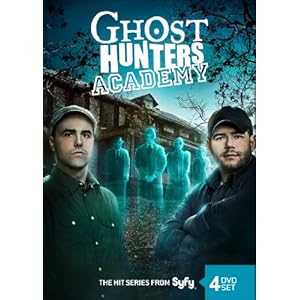
GHOST HUNTERS ACADEMY -- DVD Review by Porfle


Originally posted on 1/17/13


My first experience with this franchise was the DVD set "Ghost Hunters International Season One: Part 1", which was pleasant enough except that in the first few episodes it looked like they were aiming to include the usual reality TV-type interpersonal intrigue, back-biting, etc. rather than straight ghost-hunting, which I feared would get old fast.  Thankfully, they dropped that angle early on.

Unfortunately, GHOST HUNTERS ACADEMY jumps into all that with both feet and wallows around in it.  Image Entertainment's 4-disc DVD collection of this two-season spin-off series (2009-10), which lasted for only twelve episodes, is the standard elimination-style competition (a la "Survivor") in which contestants for a spot on "Ghost Hunters" are not only evaluated for their performances after each session but goaded into revealing who they think should be given the axe at episode's end.

It's like "Ghost Hunters" with a mean streak, with host-instructors Steve Gonsalvez and Dave Tango--mere second stringers on the main show--coming off like a couple of bullying, know-it-all doofs who have suddenly been given too much authority.  They seem to thrive on putting the earnest, nervous contestants on the spot and making them sweat ("WHY did you place a camera where NO VISUAL ACTIVITY has been reported?  WHY?") or lavishly berating them for not performing to their own elevated standards. 

Familiar locations are revisited, such as Eastern State Penitentiary in Philadelphia, Shawshank Prison, the creepy Waverly Hills Sanatorium, Colorado's Stanley Hotel (the inspiration for Stephen King's "The Shining"), and, my favorite, the Buffalo Central Terminal where the indy horror flick PRISON OF THE PSYCHOTIC DAMNED was shot.  The investigations seem rather cursory this time, however--there's no reveal to the site's host, only a caustic evaluation by Steve and Tango of the contestants' grievous failings. 

In fact, it occurred to me somewhere around episode five or six that there hadn't been a single convincingly paranormal event in the entire series thus far, besides those in "Ghost Hunters" flashbacks.  The episode titles themselves tell the story, pointing out the emphasis on personal drama rather than eerie encounters: "Web of Deceit" (referring to one contestant's failure to disclose her psychic abilities), "The Honeymoon's Over", "Back to Basics", "Drama Queen", "The Blame Game", and so on. 

Episode seven introduces a new group of hopefuls and a slightly new format in response to what were probably less than stellar ratings.  TAPS (The Atlantic Paranormal Society) co-founder Jason Hewes comes on to help whip the show into shape and the "cadets" as they're called seem more down-to-business.  But the "Survivor" template is adhered to even more closely, with everyone dishing the dirt on everyone else as bad feelings and grudges are encouraged. 

This second stage of the series does seem to get a little more into the "spirit" of the investigations, so to speak--there seems to be a bit more paranormal hoo-hah going on in these episodes.  But there's also a lot of boring down time, with a giggling Steve and Tango playing practical jokes on the contestants that are ostensibly meant to "test" them but come off mainly as simple pranks of the kind that are an anathema to this kind of show.

It's almost disheartening to hear the contestants' interview segments in which they speak excitedly about joining the GH team and becoming bonafide paranormal investigators, only to see them get bogged down in this superficial show's uninteresting machinations.  (The fact that we already know the second season's winner--since he's a part of the regular "Ghost Hunters" team already--eliminates much of the show's suspense as well.)
 
The 4-disc DVD set from Image Entertainment is in 1.78:1 widescreen with Dolby stereo sound.  No subtitles.  Disc four consists of several deleted and expanded scenes. 

There's no joy or catharsis when the final winner of GHOST HUNTERS ACADEMY is announced, only the feeling that we've just been through a lot of unpleasant rigamarole for nothing.  With the lack of paranormal activity throughout most of these episodes, you also get the distinct impression that the spirits themselves didn't consider the series worth showing up for.

Buy it at Amazon.com

Share/Save/Bookmark

Thursday, August 13, 2026

SHERLOCK -- DVD Review by Porfle


Originally posted on 2/23/22


For over a century, authors and filmmakers have been unable to resist rethinking, revising, and generally screwing around with Sir Arthur Conan Doyle's classic master detective Sherlock Holmes.  Even the silver screen's gold standard Holmes, Basil Rathbone, found himself transplanted from Victorian-era London into the middle of World War II in order to apply his peerless deductive skills toward fighting the Axis.  Over the years Holmes has met Sigmund Freud and Jack the Ripper, battled invading Martians, and exposed his private life for all to see.

While many of these updates are respectful of the original material, some are mere gimmicks designed to spoof or sensationalize.  But the three-part BBC-TV series SHERLOCK (2010), which places Holmes and the redoubtable Dr. John H. Watson squarely in the 21st century with the rest of us, is no gimmick.  Rather, it's an exhilarating opportunity for the celebrated sleuth and his loyal sidekick to engage a whole new world of mysteries.

Indeed, this Sherlock would fit comfortably into any time period.  He's not a fish out of water--his dynamic, self-contained character resists the need to be "updated" save for the modern detecting tools of which he readily avails himself.  Of course, he still has his violin, not to mention his problems with certain controlled substances.  The shag pipe has been replaced by nicotine patches, and instead of a journal, Watson records their adventures in his blog.


Holmes' rivalrous sibling Mycroft is here as well, now a member of the British government's inner circle and played very amusingly by Mark Gatiss.  Needless to say, the shadowy presence of a certain Moriarty hovers over it all.  Each episode is beautifully directed and shot, with inventive scene transitions and a fine musical score by David Arnold and Michael Price.  The scripts are replete with crackling dialogue and bits of business which convey the spirit of Doyle's original characters and stories in loving detail.  With all the familiar pieces falling into place in such a satisfying manner, SHERLOCK is a deep, delightful wallow in Holmesiana.

It took about half a minute for the wonderfully-named Benedict Cumberbatch to win me over as Holmes.  We first find him in the morgue, furiously laying into a corpse with a riding crop to assess the bruises.  Blithely unaware that a smitten attendant named Molly Hooper (Loo Brealey) is coming on to him, he responds to her timid invitation to coffee with a curt "Black, two sugars please, I'll be upstairs" before dashing off to the laboratory.  This leads directly to the fateful meeting between the two odd ducks, Holmes and Watson (Martin Freeman), both seeking a roommate as in the first chapter of the original Holmes novel, "A Study in Scarlet."  (This premiere episode is similarly titled "A Study in Pink.") 

Noticing Watson's crutch, the inquisitive Holmes asks, "Afganistan or Iraq?"  Watson, as in his initial incarnation, has been wounded both physically and mentally in the war and spends his days in therapy, but we get the feeling his unhappy life is about to get a lot more interesting.  "We don't know a single thing about each other," he says dubiously when Holmes takes it for granted that they'll be flatmates.
 

Fans know exactly what's coming next.  Our shared anticipation is rewarded when the droll, almost insanely perceptive Holmes casually reels off much of Watson's life story, based on simple observation, without missing a beat.  It's a marvelous scene, establishing his eccentric character beautifully with a few exquisite strokes.  Before long, both are ensconced in the familiar surroundings of 221B Baker Street, fussed over by their dear old landlady Mrs. Hudson (Una Stubbs).

"When the police are out of their depth, which is always, they consult me," he boasts when Detective Lastrade (Rupert Graves) of Scotland Yard summons him to the scene of a mysterious suicide.  Holmes invites Watson along as a medical consultant, thus beginning their grand collaboration.  A series of apparent self-poisonings has Scotland Yard baffled, and it's up to Holmes to figure out why unrelated Londoners are killing themselves with identical poison pills for no apparent reason.  This adventure will eventually lead him into a riveting battle of wits with the most unlikely of opponents.  

With a frustrated Lestrade constantly calling upon Holmes for help, the two bear a resemblance to Batman and Commissioner Gordon.  Which is fitting since, after all, Batman was partly based on Holmes in the first place.  (Maybe that's why the otherwise useless Robin was invented, to serve the Watson role of sounding board and appreciative audience to "the world's greatest detective.")

A clever convention that appears frequently is the use of floating text to show us not only what's popping up on various cell phones (Holmes prefers texting to talking) and other sources, but also lets us in on what's running through Holmes' mind as he riffles through various visual clues.  This way, he doesn't have to constantly explain everything to Watson for our benefit, and we get to see his thought processes in real time as he gathers and assesses information at lightning speed.

In the second episode, "The Blind Banker", Holmes sniffs out a racket involving stolen historical artifacts smuggled in from China and sold at auction.  When two of the smugglers are found dead in classic "locked room" scenarios, the killer's trail leads to a scary Chinese criminal cult that eventually gets their hands on our heroes.  While this episode gets slightly bogged down in procedure at times, there's plenty of exotic atmosphere, great character byplay, and a keenly suspenseful finale.


The third and last story of the season, "The Great Game", is an utter joy from start to finish.  It begins with Watson returning to the flat to find Holmes shooting bullets into the wall out of boredom, followed by that famous exchange in which Holmes reveals he doesn't know that the Earth goes round the sun.  Such information, he explains, isn't necessary in his work, and, in contemporary terms, he likens his brain to a hard drive from which all extraneous data must be deleted. 

The plot involves a mad bomber who communicates with Holmes through hostages who are wired with explosives and forced to read their captor's text messages aloud over the phone.  With only hours to solve each of the killer's mysterious puzzles and rescue the hostages one by one, the pace is frantic and the action non-stop, culminating in a final revelatory scene that should have Holmes fans in paroxysms of geek bliss. 

Do we ever get to see the big "M"?  Yes.  I won't go into detail, but the eventual face-to-face encounter between the world's greatest consulting detective and the world's greatest criminal mastermind is a sensational pay-off to all the build-up, and scintillating as hell.  (The words "You complete me" came to mind during their verbal sparring.)  It ends in a cliffhanger which, in a way, reminded me of a certain story called "The Final Problem."

The 2-disc DVD from Warner Home Video and BBC contains all three feature-length episodes (270 minutes total) in a 16:9 aspect ratio and Dolby Digital 5.1 stereo.  Subtitles are in English.  Episodes 1 and 3 contain cast and crew commentaries.  Other bonuses include a making-of featurette, "Unlocking Sherlock", and the original hour-long pilot which was later expanded and reshot to become "A Study in Pink."
 
Do I recommend SHERLOCK?  It's all I can do to keep from coming over to your house and forcing you to watch it with me.  This is intoxicating stuff for Holmes addicts, and I can't wait to see what's next.  In the words of the modern-day Sherlock: "The game is on!"


Share/Save/Bookmark

Wednesday, August 12, 2026

DAPHNE -- DVD Review by Porfle


Originally posted in 2008


Sizing herself up in the mirror before attending a stuffy party, Daphne du Maurier frowns at her fancy evening gown and mutters, "Why can't I just wear velvet trousers and a boyish belt?"

Based in part on her own letters and memoirs, the BBC TV-movie DAPHNE (2007) is all about the famous author wishing, like Pinocchio, that she were a boy. A bisexual boy, that is. The main emphasis is on Daphne's all-consuming infatuation for her American publisher's beautiful, outgoing wife, Ellen Doubleday, whom she meets while in the states to contest a plagiarism charge. Daphne finds Ellen an irresistible ray of sunshine in contrast to the increasingly distant relationship she endures with her troubled WWII veteran husband, Tommy (Andrew Havill).

After restraining her fierce romantic impulses as long as she can, Daphne finally professes her love to Ellen and is painfully rebuffed. "Love is love," she frets. "How can there be different ways?" She then finds rebound solace in the willing arms of the flamboyant stage diva Gertrude Lawrence, although their torrid affair leaves Daphne frustrated and unfulfilled. Interestingly, Daphne doesn't consider herself a "lesbian" at all--she despises the word, in fact. In her mind, if not her body, she has always been a boy.

I was expecting to see a serious, comprehensive look at the life of Daphne du Maurier here, so I didn't start getting into this movie until I realized that it's actually the sort of gaudy, hand-wringing upperclass soap opera--complete with furiously overwrought musical score--that people like Rock Hudson and Jane Wyman used to star in. Except in this case, the Rock Hudson role is played by the lead actress. Once I got what it was about, this handsomely mounted, well-played melodrama about unrequited love and gender identity, and how these feelings and experiences served as an inspiration in Daphne's writing, became fairly involving.

Geraldine Somerville ("Lily Potter" of the Harry Potter series) plays the troubled author of "Rebecca", "My Cousin Rachel", and "The Birds" with a long-suffering wistfulness which will appeal to either your empathy or your apathy. Elizabeth McGovern, aging nicely these days, is likable as the winsome social butterfly over which Daphne goes sweetly ga-ga. Best of all is Janet McTeer as brassy broad Gertrude Lawrence, who is the kind of woman Daphne finds exciting but wouldn't want to marry. The only other role I've seen McTeer play was Nelly in the 1992 WUTHERING HEIGHTS, so this is quite an interesting change which she handles beautifully.

The DVD image is 1.77:1, with Dolby Digital sound. The sole bonus feature is a du Maurier-penned documentary entitled "Vanishing Cornwall", which runs about half an hour and was directed by her son, Christian Browning. The author herself appears briefly at the beginning of this dry, rather dull look at the history of her beloved homeplace.

DAPHNE is the kind of smart, stately, yet tastefully decadent soap opera that you can indulge in like an unhealthy confection. That is, if you have the taste for such things. Otherwise, it may just leave you with a queasy stomach.


Share/Save/Bookmark

Friday, August 7, 2026

AGATHA CHRISTIE POIROT: SERIES 1/ AGATHA CHRISTIE POIROT: SERIES 2 -- DVD Reviews by Porfle


Originally posted on 1/26/12


Having been introduced to the British ITV series "Agatha Christie Poirot" through some of the later feature-length episodes, I was surprised to find the earlier seasons (circa 1989-90) of this long-running show to be faster-paced, funnier, and much lighter in tone--in general, more fun.  Not to disparage the more darkly dramatic ambience of the post-2000 ones, which are superb entertainment in their own right, but I like this lighthearted and mischievously sly side of Poirot much better.

The first ten one-hour episodes are collected in AGATHA CHRISTIE POIROT: SERIES 1, beginning with "The Adventure of the Clapham Cook" (which features a brief appearance by a young Danny Webb of ALIEN 3 fame).  Here, we're first introduced to Poirot's associate Captain Hastings (Hugh Fraser), a hale fellow with a boyish enthusiasm for things like automobiles and cricket.  Hastings isn't too quick on the uptake, at least not alongside a genius like Poirot, but he's good at following people, tackling escaping suspects, and serving as an appreciative audience for the vain Poirot's feats of deduction. 

Also on hand is Poirot's prim and efficient secretary Miss Lemon.  As played by Pauline Moran, she's made up to look just plain enough to render her strangely sexy, despite the fact that her character is as properly straitlaced as can be.  In Poirot's office-apartment in a magnificent old hotel complex, the three frequently engage in breezy banter that's often more fun than the mystery plots themselves.  This early incarnation of Poirot, unlike his later self, delights in playfully teasing his associates and exercising his exquisitely dry wit at their expense.

David Suchet's portrayal of the title character is, as always, absolutely impeccable.  His Poirot is an unwavering obsessive-compulsive who's fastidious, fussy, finicky, and mortified at anything that's out of place in his well-ordered world.  This, along with the sheer joy he derives from solving puzzles using his beloved "little gray cells", is what compels him to make right the wrongs that he encounters through his often desperate clients.  Another impetus is his friendly rivalry with Chief Inspector James Japp (Philip Jackson, also seen only in the early seasons of the show), a doggedly by-the-book cop who is continually baffled by Poirot's unconventional deductive skills.

"Murder in the Mews" begins with Poirot's infuriating battle with a Chinese laundry over the amount of starch in his collars and progresses to include a puzzling locked room murder made to look like a suicide.  In "The Adventure of Johnnie Waverly", the parents of a small boy are warned in advance that their son is going to be kidnapped at a particular time and place, which happens despite the presence of several police and Poirot himself.  "Four and Twenty Blackbirds" concerns the suspicious deaths of two estranged brothers within a short time of each other.

"The Third Floor Flat" finds Poirot's little gray cells atrophying during a long stretch between cases, until a murder in his own hotel has him sizing up all the various suspects as only he can.  "Triangle at Rhodes" benefits from gorgeous location photography with a vacationing Poirot getting drawn into the murder by poisoning of a woman whose husband is infuriated by her infidelity with another guest.  Another vacation, this time on board a cruise ship, is marred by a "Problem at Sea" when a wealthy but thoroughly unlikable woman is found stabbed in her cabin with the door locked.  Everyone including the woman's henpecked husband seems to have a strong alibi, giving Poirot a particularly challenging mental workout. 

"The Incredible Theft" is steeped in pre-WWII intrigue as a woman suspected of being a Nazi sympathiser is accused of stealing the plans for a new fighter plane in order to pass them along to German agents.  Old movie fans should get a kick out of "The King of Clubs", as a tyrannical studio boss is murdered in his mansion and the main suspect is a popular actress with whom he's been known to be at odds.  One of the perks of this episode is the use of an old-style glass shot during a soundstage scene, while another is the appearance of a young Sean Pertwee as the brother of the accused actress (Niamh Cusack). 

Finally, "The Dream" has something of an "Avengers" vibe as a crotchety old meat-pie tycoon complains to Poirot that he keeps having a recurring dream of committing suicide in his office at a particular time.  When he actually does just that, and at the precise time of his dream, Poirot finds himself with a real puzzler.  Joely Richardson guests as the man's daughter, while Alan Howard delivers a marvelously theatrical performance as the abrasive old coot.

Each story is bathed in the nostalgic glow of an old magazine illustration, with finely-rendered production design (art deco fans will be in hog heaven) and ideal locations lending an exquisite period atmosphere to every scene.  Direction is first-rate as are the uniformly excellent guest performances.  Unlike the denser and sometimes meandering plots of the later "Poirot", these episodes are briskly uncomplicated and easy to follow in addition to featuring much delightful character interplay that will be missing (and missed) when Poirot becomes a more solitary and stern character later on.  Captain Hastings and Chief Inspector Japp in particular are the perfect uncomprehending foils for Suchet's brilliant Poirot.

The three-disc DVD set from Acorn Media is in 4:3 full screen with Dolby Digital sound and English subtitles, with the titles newly remastered and in the original UK broadcast order.  There are no extras.  (Also available in a two-disc Blu-Ray version.)

Continuing right where season one left off is AGATHA CHRISTIE POIROT: SERIES 2, with nine more mysteries on three discs.  "Peril at End House" guest stars Polly Walker (PATRIOT GAMES, CLASH OF THE TITANS) as a beautiful heiress whom Poirot meets while staying at a Cornish resort.  The young woman's stories of a rash of recent life-threatening mishaps leads Poirot to believe that someone is trying to kill her, especially when a stray bullet zips through her bonnet as they're chatting by the seaside.  This story boasts some really nice twists and turns along with an appearance by Paul Geoffrey (EXCALIBUR, WUTHERING HEIGHTS). 

"The Veiled Lady" finds the portly detective helping another enchanting young lady, this time a blackmail victim imploring him to recover an incriminating letter.  A highlight of this adventure is Poirot and Hastings becoming cat burglars as they break into the blackmailer's house to conduct a search which results in their being arrested by none other than Chief Inspector Japp.  An imposing Terence Harvey of FROM HELL and PRIME SUSPECT 3 plays the formidable cad here, which seems to be his specialty. 

A foray into Chinatown to solve the murder of a Chinese businessman and the theft of his map to "The Lost Mine" leads Poirot into a winding maze of mystery.  In "The Cornish Mystery", the Belgian detective has a rude awakening when he's too late to save a woman who suspects her husband of trying to poison her.  Her tragic death fires him up big time, and woe to the killer when a fired-up Poirot aims his razor-sharp intellect at him (or her).  Freda Stanton, who played the hapless Princess Elspeth in DRAGONSLAYER, guest stars. 

Kenneth Colley, a familiar face to fans of THE EMPIRE STRIKES BACK, plays a banker who steps out of his house into the fog one day and is never seen again in "The Disappearance of Mr. Davenheim."  Sharp-eyed viewers will guess the secret behind this one pretty quick but it's still fun watching it play out.  "Double Sin" is a real twister with the delivery of some priceless antiques to a potential buyer ending in theft during a bus trip.  Here, Chief Inspector Japp bets the boastful Poirot that he can't solve the mystery without leaving his house, giving Hastings a rare opportunity for some solo detective work. 

"The Adventure of the Cheap Flat" finds a lucky young couple getting a lovely apartment for a steal, unaware that they're being set up for murder.  (The wife is played by Samantha Bond, who was Moneypenny to Pierce Brosnan's 007.)  Poirot and Hastings do a little more cat burglary in this one with similarly unfortunate results, while the search for some stolen submarine plans brings in William Hootkins (Porkins in STAR WARS, Eckhardt in BATMAN) as a visiting FBI agent played in stereotypical blustery "American" style.

A crackerjack mystery ensues surrounding "The Kidnapped Prime Minister" as Poirot infuriates police with his methodical and seemingly nonsensical approach to solving the crime as the seconds tick away before a crucial international arms summit.  Finally, "The Adventure of the Western Star" is the intriguing tale of a pair of priceless diamonds owned by two women who receive letters informing them that the gems are to be stolen in order to return them to the mystical idol from which they were taken.  Sure enough, this occurs--seemingly--but Poirot suspects that there's more to the case than meets the eye, and, as usual, he's right.

The three-disc DVD set from Acorn Media is in 4:3 full screen with Dolby Digital sound and English subtitles, with the titles newly remastered and in the original UK broadcast order.  There are no extras.  (Also available in a two-disc Blu-Ray version.)

As with the first set, AGATHA CHRISTIE POIROT: SERIES 2 is the kind of cozy entertainment you can snuggle up with as you would a volume of engrossing short stories on a rainy evening.  With their endlessly appealing blend of sumptuous production design, intriguing stories, and fascinating characters--not the least of which being David Suchet's masterful portrayal of the dazzling and strangely endearing Belgian detective himself--the adventures of Hercule Poirot are a feast for mystery fans. 


Share/Save/Bookmark

Wednesday, July 22, 2026

THE SACKETTS -- Movie Review by Porfle


Originally posted on 11/26/09
 
 
There were other made-for-TV Westerns before it, but THE SACKETTS (1979) is the first big multi-part cowboy epic that I can think of. It came out a full ten years before the LONESOME DOVE series and, though it isn't nearly as good, it does lay the groundwork for this type of sweeping TV Western.

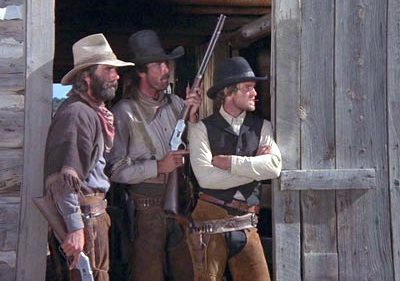
The story follows the adventures of the three Sackett brothers, Tell, Orrin, and Tyrell. Tell (Sam Elliott) is the loner of the bunch, and we're introduced to him as he is forced to flee his mining job after gunning down a crooked card dealer (James Gammon) who happens to be one of the dreaded Bigelow brothers.

Knowing that the other Bigelows will be after him for revenge, Tell disappears into the mountains, where he stumbles onto a rich vein of gold and starts his own one-man mining operation. When he totes a large bagful of the shiny stuff into the aptly-named town of Purgatorie to trade for cash, it doesn't take long for some of the less scrupulous denizens to try and surgically remove him from his new-found riches.


Meanwhile, his brothers Orrin (Tom Selleck) and Tyrell (Jeff Osterhage) have left their Tennessee homeplace to avoid a bloody feud between the Sacketts and another clan, and are headed West with a cattle drive. When they reach Abilene, Orrin falls for the golden-haired daughter of an ambitious politician named Pritts (John Vernon), who aims to drive all the Mexicans out of Sante Fe.

Tyrell, of course, falls in love with a lovely Mexican lass (Ana Alicia) whose father, Don Luis (Gilbert Roland), is the main stumbling block in Pritts' plans. When they all get together in Santa Fe, the situation soon turns deadly and guns start a-blazin'.

The script is a combination of two Louis L'Amour novels, "Sackett" and "The Daybreakers", and it isn't a very smooth blend, crosscutting between the two barely-related stories the way you might switch channels back-and-forth between two movies that are on at the same time.


The stories overlap only twice--once near the end of the first segment when the three Sacketts run into each other in Purgatorie, and again for the big finale as the Bigelow brothers finally catch up to Tell and he's reunited with Orrin and Tyrell to fight them off.

This awkward overlapping of the two stories bothered me the first time I watched THE SACKETTS, along with some jarring hand-held camerawork (no Steadicam here), an endlessly irritating and inept musical score by Jerrold Immel, and a strange performance by Mercedes McCambridge that makes Ma Sackett look like she's either perpetually tipsy or tetched in the head.

But further viewings have helped me to get over the various minus points and begin to appreciate all the good things about this movie. Despite its somewhat rough-hewn quality, THE SACKETTS is an engaging Western with lots of authentic atmosphere, good characters, and a terrific cast.


For starters, there's Sam Elliott and Tom Selleck, who I think are the two best Western actors of the past twenty or thirty years (with the exception of Clint Eastwood, of course), and Jeff Osterhage, a lesser-known actor who does a fine job here. Glenn Ford plays Tom Sunday, the ramrod of the cattle drive who later joins Orrin and Tyrell in their own cattle venture and eventually ends up as their enemy, and his intense, masterful performance (watch his face twitch in those close-ups!) is a joy to behold.

This can also be said for the great Ben Johnson as Cap Roundtree, who becomes Tell's gold-mining partner. Paul Koslo is a hoot as the blowhard would-be gunslinger Kid Newton. The Bigelow brothers are played by Jack Elam, Slim Pickens, Gene Evans, and James Gammon, and also appearing in the cast are the likes of L.Q. Jones, Ruth Roman, Pat Buttram, Shug Fisher, and Buck Taylor, in addition to the aforementioned John Vernon and Gilbert Roland. (Louis L'Amour himself does the opening narration.) If you're like me and you love great character actors as much as A-list stars, this is the kind of "all-star" cast that will put a smile on your face.

I can't give THE SACKETTS a super high score due to its various deficiencies, and the fact that it's not the polished effort that later TV Westerns like LONESOME DOVE would be, but it has enough going for it to get a solid three-and-a-half out of five spurs. The final shoot-out alone is worth waiting for--it's almost as much fun as the bullet-riddled free-for-all that ended OPEN RANGE. And that cast--awesome. There's one scene which features Sam Elliott, Tom Selleck, Glenn Ford, and Ben Johnson sitting around a campfire, and I thought "Damn...I wish I was sitting around that campfire, too."


Share/Save/Bookmark

Saturday, July 11, 2026

BONANZA: THE OFFICIAL FIRST SEASON, VOL. 1 & 2 -- DVD Review by Porfle


Originally posted on 9/3/09


One of my top five favorite TV westerns of all time, "Bonanza" certainly needs no introduction even for those who have never watched a single episode. If you fall into that category, then the release of BONANZA: THE OFFICIAL FIRST SEASON, VOLUMES 1 & 2 is the perfect introduction to the wild and wooly world of The Cartwrights--Ben, Adam, Hoss, and Little Joe--as they lord it over the rest of the world from the lofty majesty of their massive forest-bedecked Nevada ranch, the Ponderosa. And if you're already a fan, then you'll want to slap your brand on these little dogies before sundown.

Ben Cartwright, played by silver-haired, dulcet-voiced Canadian actor Lorne Greene, is one of those TV characters to whom marriage is the kiss of death for his hapless brides. As we join the Cartwright clan, Ben's already gone through three wives and sired a son by each. Soulful, taciturn Adam (Pernell Roberts), whose mother was a member of New England aristocracy, is the "cool" one who lets his gun do the talking while casting dark, sultry glances at any beauteous ladies within glancing distance.

Hoss (Dan Blocker), the gentle giant who's slow to anger but quick to finish off an entire hog before anyone else has even made it to the table, comes from sturdy Swedish stock. The youngest Cartwright is impetuous, girl-crazy action boy Little Joe (Michael Landon), a New Orleans-born hellion who's always leaping into trouble. Even their Chinese cook Hop Sing (Victor Sen Yung) is pee-oh'd.

These guys live in the coolest ranchhouse ever (which Adam designed and built) on the biggest spread in the northern hemisphere, and in these early episodes they're bitterly at odds with the devious Virginia City silver tycoons who covet their vast tracts of forest land with which to shore up their mine tunnels. In later seasons, Ben and his brood chill out considerably and become friendly, socializing members of the community who prefer reasoned diplomacy to gunplay. But when we first see them, they're coarse, boisterous wild men bristling with guns and running roughshod over the countryside. Just try cutting across the Ponderosa to get to where you're going a little faster--before you know it, you'll be staring down the barrels of four guns while the Cartwrights terrorize you like Hell's Angels on horseback.

In the VOLUME 1 pilot episode, "A Rose for Lotta" (9/12/1959), this very thing happens to none other than guest star Yvonne DeCarlo (Lily from "The Munsters"), a leggy actress who's been hired by those silver tycoons (including George MacCready and Willis Bouchey) to lure one of the Cartwrights into town so that he can be held hostage. The very sight of her speeding carriage throwing up Ponderosa dust in the distance sets our heroes' blood boiling and their bloodlust blazing, and they give chase with guns waving.

After roughing up her mousey driver (Ned Glass), tying him up, and tossing him in the back of Hop Sing's buckboard, Ben graciously instructs a willing Little Joe to escort the lady into town. The young Cartwright is set upon by ruffians but escapes, gleefully managing to create fiery havoc in the Chinese part of town. Meanwhile, Ben, Adam, and Hoss confront their wealthy foes in a local saloon, where Adam has a cool, melodramatic shootout with black-garbed gun-for-hire Langford Pool (a creepy Christopher Dark) complete with closeups of their twitchy eyes and sweating foreheads.

Even at home, these guys are off the hook. The episode begins with Adam and Little Joe talking trash about each other's moms, with Adam referring to Little Joe's dueling epee as "that New Orleans monkey pick you got handed down to you by your French Quarter mother", to which Joe responds with murder in his eyes, "I've never been able to see myself being kin to anything whelped out of a thin-nosed, blueblooded Boston yankee!"

A bareknuckled debate on the subject ensues right there in the livingroom (with Landon and Roberts doing most of their own stunts) before Hoss breaks it up by beating them both senseless with a few swipes of his ham fists. When Ben arrives on the scene with a blustery "Fire and brimstone!" we find that Lorne Greene's early interpretation of his character is decidedly larger-than-life. Roaring and bellowing with manic laughter at his sons' antics as though he's playing to the back row, Greene really pours it on here and sells this pilot with all he's got. To those used to the more sedate later episodes of the show, it's a pretty amazing sequence.

Before long, though, the Cartwrights begin to settle down and interact with their environment on a less hostile basis. (After all, it's hard to come up with interesting stories if you throw all of the guest stars off your land at gunpoint.) As Ben tells Adam: "Son, we can't ignore the rest of the world. We're the only stabilizing influence in the country." So he and the boys start using their influence to develop the town, help the poor, settle mining disputes, and try to keep the Indians and the settlers from killing each other.

The latter is forcefully depicted in "The Paiute War", in which a peaceful tribe is wrongfully blamed for some killings and the army is called in, resulting in a needless slaughter which horrifies the cavalry officer in charge. Definitely not your usual Cowboys vs. Indians stuff. Inadequate safety measures in a silver mine are a concern in "The Philip Diedesheimer Story", which sees Adam trapped in a cave-in while the mine's heartless owner (R.G. Armstrong) is more concerned with the bottom line than the lives of his workers.

The Cartwright curse rears its head again (and not for the last time) in "The Newcomers" when Hoss falls in love with a beautiful woman (Inger Stevens) who turns out to be dying of an incurable disease. In "Enter Mark Twain" the Cartwrights meet the soon-to-be-famous writer (Howard Duff), whose inflammatory political articles in the local newspaper spark a blazing gun battle in the streets of Virginia City. The scene in which the Cartwrights disarm a gunman and deliver him to the office of the crooked politician who hired him is cool as hell--they file imperiously out of the room like they own the place as Hoss empties the man's gun and flings it onto a desk without even looking.

Aside from the occasional comedy episode, these stories are thoughtful morality plays that mix hardbitten Western action with intense human drama. "The Truckee Strip" (which marks the first appearance of Joseph Messerli's famous end-credits watercolor paintings) is a Romeo-and-Juliet tale in which Little Joe falls in love with the daughter (Adrienne Hayes) of a rancher with whom Ben has had a long, bitter feud over a patch of land. Little Joe's growing disgust with the endless fighting and collateral damage leads him to pull a gun on his father at one point, which in turn prompts Ben to question his own unwavering convictions. Here, as well as in many subsequent episodes, it's interesting to see these characters grow and develop beyond their original one-dimensional qualities.

The show is consistently well-written and directed, with some early scripts by future "Star Trek" story editor Gene L. Coon and Christian Nyby (THE THING) directing several of them. The first television Western filmed in color, it's visually sumptuous and makes good use of sweeping outdoor locations. The sets and costumes have an authentic feel even though there's a storybook quality to them as well. Each episode is enhanced by a robust score by the prolific David Rose.


The first episode of VOLUME 2, "The Outcast", guest-starring a young Jack Lord and Susan Oliver, begins the tradition of announcing each episode's title with a musical fanfare. This set also continues the show's attention to racial issues with "The Fear Merchants", expanding Hop Sing's character beyond the usual stereotype as he and his people are menaced by violent bigotry in Virginia City. When a man (Frank Ferguson) accidentally shoots his daughter during an argument, a Chinese boy is accused of the deed and the Cartwrights are deputized to protect him from a lynch mob stirred up by a hatemongering mayoral candidate (Gene Evans).

This bunch contains some of my favorite episodes from the public domain DVDs I've bought over the years, only now in near-pristine condition. "Blood on the Land" features Everett Sloan as a ruthless old sheep farmer who stakes a claim on Ponderosa land and is willing to go to war with the Cartwrights to keep it. One of my favorites,"Desert Justice", boasts a great performance by Claude Akins as a hardcore U.S. Marshall bent on bringing one of the Cartwrights' ranch hands in for murder, even if it means killing anyone who gets in his way.

"The Stranger" marks the Cartwrights' growing acceptance by the citizens of Virginia City, as Ben is proposed as the new governor of the state of Nevada until a lawman from New Orleans (Lloyd Nolan) shows up with a warrant for his arrest on a murder charge. An especially exciting episode, "San Francisco Holiday", finds the Cartwrights and Hop Sing in the titular city where some of their ranch hands are shanghaied. Ed Wood regular Tor Johnson guest stars.

One of the series' best comedy episodes is "The Gunmen", in which Hoss and Little Joe (who are so much fun together that they'll be teamed many times) are mistaken for lookalike outlaws, the notorious Slade brothers, and must convince the terrified denizens of a small Texas town that they've got the wrong guys. The opening scene in which Landon and Blocker, as the Slades, gun down an entire saloon full of men in cold blood, is pretty startling.

The impressive roster of guest stars in volume one includes Ida Lupino, James Coburn, Ruth Roman, Barry Sullivan, R.G. Armstrong, Harry Carey Jr., John Beal, Mala Powers, Buddy Ebsen, Fay Spain, Alan Hale Jr., Anthony Caruso, Michael Forest, Jack Warden, Jane Greer, Alexander Scourby, Don Megowan, Hal Smith, Whitney Blake, Arthur Hunnicutt, Bill Quinn, Mort Mills, Barbara Luna, Raymond Bailey, Jose Gonzales-Gonzales, and Ralph Moody. Peter Coe of HOUSE OF FRANKENSTEIN and THE MUMMY'S CURSE makes a surprising appearance as an Indian.

Volume two's more familiar faces include Vic Morrow, Gene Evans, Christopher Dark (as yet another sleazy hired gun), Patricia Medina, Joan Staley, Sebastian Cabot, Hazel Court, Bert Freed, Ellen Corby, John Anderson, Philip Ahn, Frank Ferguson, Helen Westcott, Cameron Mitchell, Henry Hull, Paul Picerni, Stafford Repp, Gloria Talbott, Grant Williams, Richard Devon, Nestor Paiva, Kathleen Crowley, James Hong, Richard Deacon, Merry Anders, Don Dubbins, Rhys Williams, Gregory Walcott, and Morgan Woodward.

Both volumes are in original 4.3 full-screen with English mono sound. Each set contains four discs with four episodes per disc. Volume one bonus features include extensive photo galleries for most episodes, some episodic promos, original NBC logo, bumpers, and RCA spots for the pilot, Joe Messerli's original sketches for the closing credits paintings, and creator-producer David Dortort's 2002 personal recollections of Michael Landon, Dan Blocker, and the creation of that iconic flaming Ponderosa map through which the stars ride in the opening titles. There's also a wonderfully cornball half-hour 1953 "Fireside Theater" segment with Bruce Bennett called "Man of the Comstock", written by Dortort, which was sort of a forerunner to "Bonanza." Lastly, we get to see a bizarre alternate ending to the pilot in which the Cartwrights ride off singing the "Bonanza" theme song! (And not too well, either.)

Volume two contains more photo galleries and episodic promos, original NBC logo, bumpers, and RCA spots for "The Avenger", and David Dortort's reminiscences about Lorne Greene, Pernell Roberts, Victor Sen Yung, and how the Ponderosa got its name.

BONANZA: THE OFFICIAL FIRST SEASON, VOLUMES 1 & 2 are available seperately or together. For fans of the classic television Western, this rock-solid, robust series is great entertainment and is rightfully remembered as one of the finest shows of all time.


Share/Save/Bookmark