HK and Cult Film News's Fan Box

Showing posts with label Classics. Show all posts

Tuesday, September 8, 2026

Extreme Product Placement in Marx Bros' "LOVE HAPPY" (1949) (video)


"Love Happy" was conceived as a solo vehicle for Harpo. 

But, as usual, Chico needed the money. And Groucho got lured into it too. 

Before it was over, the producers were short on cash as well... ...and sold ad-space in the movie. 

Thus, the big chase finale is wall-to-wall product placement. 

 (See if you can spot the blooper in the Mobilgas shot at 1:15.) 


 I neither own nor claim any rights to this material. Just having some fun with it. Thanks for watching!


Share/Save/Bookmark

Sunday, August 2, 2026

DADDY-LONG-LEGS (1919) -- Movie Review by Porfle


Originally posted on 12/12/21


Currently rewatching: My favorite Mary Pickford movie and one of my favorite silent films ever, DADDY-LONG-LEGS (1919), which I haven't seen since it was on PBS back in the 80s.

Mary is radiant and utterly disarming in this classic film that's filled with laughs and pathos.

As usual, Mary's fascinating facial expressions and physical acting are a delight and her slight stature enables her to play the plucky orphan character from pre-teen to young woman. 


The story maintains a light tone most of the time despite some dark elements, such as Mary's character, Jerusha Abbott, being abandoned in a trash can as an infant and winding up in an orphange run by a cruel woman and her spiteful toady.

"Judy", as the children call her, is a rambunctious rebel and full of mischief, which Mary Pickford plays to the hilt. 

We see her in lots of frantic action of this nature (the sequence in which she and a younger boy inadvertently get drunk is particularly funny) until the years pass and Judy, now a young woman, is sponsored by a mysterious benefactor--whom she knows only as "Daddy-Long-Legs"--and sent to college.


Mary handles the transition between pre-teen and young lady flawlessly, as two different upper-class boys vie for her affection while her benefactor, "John Smith", remains in the background.

In addition to struggling with romantic matters, she also must deal with the prejudice her classmates and acquaintances have for her "common" status. 

While much of the story leans toward sentiment, it never becomes maudlin or descends into bathos even when Judy serves as a surrogate mother for a terminally-ill orphan.


All of the story elements are deftly interwoven and augmented by cleverly-written and rather witty intertitles and art. Direction, cinematography, and performances are uniformly fine.

I got a used copy of this rare DVD which, thank goodness, is in very good condition and features a great print of the film.

It even has a good musical score that was written for it and performed by a chamber orchestra.

This title along with TESS OF THE STORM COUNTRY and SPARROWS are my favorite Mary Pickford films. DADDY-LONG-LEGS in particular is one of the most delightfully entertaining silent films I've ever seen.


Share/Save/Bookmark

Saturday, July 11, 2026

BONANZA: THE OFFICIAL FIRST SEASON, VOL. 1 & 2 -- DVD Review by Porfle


Originally posted on 9/3/09


One of my top five favorite TV westerns of all time, "Bonanza" certainly needs no introduction even for those who have never watched a single episode. If you fall into that category, then the release of BONANZA: THE OFFICIAL FIRST SEASON, VOLUMES 1 & 2 is the perfect introduction to the wild and wooly world of The Cartwrights--Ben, Adam, Hoss, and Little Joe--as they lord it over the rest of the world from the lofty majesty of their massive forest-bedecked Nevada ranch, the Ponderosa. And if you're already a fan, then you'll want to slap your brand on these little dogies before sundown.

Ben Cartwright, played by silver-haired, dulcet-voiced Canadian actor Lorne Greene, is one of those TV characters to whom marriage is the kiss of death for his hapless brides. As we join the Cartwright clan, Ben's already gone through three wives and sired a son by each. Soulful, taciturn Adam (Pernell Roberts), whose mother was a member of New England aristocracy, is the "cool" one who lets his gun do the talking while casting dark, sultry glances at any beauteous ladies within glancing distance.

Hoss (Dan Blocker), the gentle giant who's slow to anger but quick to finish off an entire hog before anyone else has even made it to the table, comes from sturdy Swedish stock. The youngest Cartwright is impetuous, girl-crazy action boy Little Joe (Michael Landon), a New Orleans-born hellion who's always leaping into trouble. Even their Chinese cook Hop Sing (Victor Sen Yung) is pee-oh'd.

These guys live in the coolest ranchhouse ever (which Adam designed and built) on the biggest spread in the northern hemisphere, and in these early episodes they're bitterly at odds with the devious Virginia City silver tycoons who covet their vast tracts of forest land with which to shore up their mine tunnels. In later seasons, Ben and his brood chill out considerably and become friendly, socializing members of the community who prefer reasoned diplomacy to gunplay. But when we first see them, they're coarse, boisterous wild men bristling with guns and running roughshod over the countryside. Just try cutting across the Ponderosa to get to where you're going a little faster--before you know it, you'll be staring down the barrels of four guns while the Cartwrights terrorize you like Hell's Angels on horseback.

In the VOLUME 1 pilot episode, "A Rose for Lotta" (9/12/1959), this very thing happens to none other than guest star Yvonne DeCarlo (Lily from "The Munsters"), a leggy actress who's been hired by those silver tycoons (including George MacCready and Willis Bouchey) to lure one of the Cartwrights into town so that he can be held hostage. The very sight of her speeding carriage throwing up Ponderosa dust in the distance sets our heroes' blood boiling and their bloodlust blazing, and they give chase with guns waving.

After roughing up her mousey driver (Ned Glass), tying him up, and tossing him in the back of Hop Sing's buckboard, Ben graciously instructs a willing Little Joe to escort the lady into town. The young Cartwright is set upon by ruffians but escapes, gleefully managing to create fiery havoc in the Chinese part of town. Meanwhile, Ben, Adam, and Hoss confront their wealthy foes in a local saloon, where Adam has a cool, melodramatic shootout with black-garbed gun-for-hire Langford Pool (a creepy Christopher Dark) complete with closeups of their twitchy eyes and sweating foreheads.

Even at home, these guys are off the hook. The episode begins with Adam and Little Joe talking trash about each other's moms, with Adam referring to Little Joe's dueling epee as "that New Orleans monkey pick you got handed down to you by your French Quarter mother", to which Joe responds with murder in his eyes, "I've never been able to see myself being kin to anything whelped out of a thin-nosed, blueblooded Boston yankee!"

A bareknuckled debate on the subject ensues right there in the livingroom (with Landon and Roberts doing most of their own stunts) before Hoss breaks it up by beating them both senseless with a few swipes of his ham fists. When Ben arrives on the scene with a blustery "Fire and brimstone!" we find that Lorne Greene's early interpretation of his character is decidedly larger-than-life. Roaring and bellowing with manic laughter at his sons' antics as though he's playing to the back row, Greene really pours it on here and sells this pilot with all he's got. To those used to the more sedate later episodes of the show, it's a pretty amazing sequence.

Before long, though, the Cartwrights begin to settle down and interact with their environment on a less hostile basis. (After all, it's hard to come up with interesting stories if you throw all of the guest stars off your land at gunpoint.) As Ben tells Adam: "Son, we can't ignore the rest of the world. We're the only stabilizing influence in the country." So he and the boys start using their influence to develop the town, help the poor, settle mining disputes, and try to keep the Indians and the settlers from killing each other.

The latter is forcefully depicted in "The Paiute War", in which a peaceful tribe is wrongfully blamed for some killings and the army is called in, resulting in a needless slaughter which horrifies the cavalry officer in charge. Definitely not your usual Cowboys vs. Indians stuff. Inadequate safety measures in a silver mine are a concern in "The Philip Diedesheimer Story", which sees Adam trapped in a cave-in while the mine's heartless owner (R.G. Armstrong) is more concerned with the bottom line than the lives of his workers.

The Cartwright curse rears its head again (and not for the last time) in "The Newcomers" when Hoss falls in love with a beautiful woman (Inger Stevens) who turns out to be dying of an incurable disease. In "Enter Mark Twain" the Cartwrights meet the soon-to-be-famous writer (Howard Duff), whose inflammatory political articles in the local newspaper spark a blazing gun battle in the streets of Virginia City. The scene in which the Cartwrights disarm a gunman and deliver him to the office of the crooked politician who hired him is cool as hell--they file imperiously out of the room like they own the place as Hoss empties the man's gun and flings it onto a desk without even looking.

Aside from the occasional comedy episode, these stories are thoughtful morality plays that mix hardbitten Western action with intense human drama. "The Truckee Strip" (which marks the first appearance of Joseph Messerli's famous end-credits watercolor paintings) is a Romeo-and-Juliet tale in which Little Joe falls in love with the daughter (Adrienne Hayes) of a rancher with whom Ben has had a long, bitter feud over a patch of land. Little Joe's growing disgust with the endless fighting and collateral damage leads him to pull a gun on his father at one point, which in turn prompts Ben to question his own unwavering convictions. Here, as well as in many subsequent episodes, it's interesting to see these characters grow and develop beyond their original one-dimensional qualities.

The show is consistently well-written and directed, with some early scripts by future "Star Trek" story editor Gene L. Coon and Christian Nyby (THE THING) directing several of them. The first television Western filmed in color, it's visually sumptuous and makes good use of sweeping outdoor locations. The sets and costumes have an authentic feel even though there's a storybook quality to them as well. Each episode is enhanced by a robust score by the prolific David Rose.


The first episode of VOLUME 2, "The Outcast", guest-starring a young Jack Lord and Susan Oliver, begins the tradition of announcing each episode's title with a musical fanfare. This set also continues the show's attention to racial issues with "The Fear Merchants", expanding Hop Sing's character beyond the usual stereotype as he and his people are menaced by violent bigotry in Virginia City. When a man (Frank Ferguson) accidentally shoots his daughter during an argument, a Chinese boy is accused of the deed and the Cartwrights are deputized to protect him from a lynch mob stirred up by a hatemongering mayoral candidate (Gene Evans).

This bunch contains some of my favorite episodes from the public domain DVDs I've bought over the years, only now in near-pristine condition. "Blood on the Land" features Everett Sloan as a ruthless old sheep farmer who stakes a claim on Ponderosa land and is willing to go to war with the Cartwrights to keep it. One of my favorites,"Desert Justice", boasts a great performance by Claude Akins as a hardcore U.S. Marshall bent on bringing one of the Cartwrights' ranch hands in for murder, even if it means killing anyone who gets in his way.

"The Stranger" marks the Cartwrights' growing acceptance by the citizens of Virginia City, as Ben is proposed as the new governor of the state of Nevada until a lawman from New Orleans (Lloyd Nolan) shows up with a warrant for his arrest on a murder charge. An especially exciting episode, "San Francisco Holiday", finds the Cartwrights and Hop Sing in the titular city where some of their ranch hands are shanghaied. Ed Wood regular Tor Johnson guest stars.

One of the series' best comedy episodes is "The Gunmen", in which Hoss and Little Joe (who are so much fun together that they'll be teamed many times) are mistaken for lookalike outlaws, the notorious Slade brothers, and must convince the terrified denizens of a small Texas town that they've got the wrong guys. The opening scene in which Landon and Blocker, as the Slades, gun down an entire saloon full of men in cold blood, is pretty startling.

The impressive roster of guest stars in volume one includes Ida Lupino, James Coburn, Ruth Roman, Barry Sullivan, R.G. Armstrong, Harry Carey Jr., John Beal, Mala Powers, Buddy Ebsen, Fay Spain, Alan Hale Jr., Anthony Caruso, Michael Forest, Jack Warden, Jane Greer, Alexander Scourby, Don Megowan, Hal Smith, Whitney Blake, Arthur Hunnicutt, Bill Quinn, Mort Mills, Barbara Luna, Raymond Bailey, Jose Gonzales-Gonzales, and Ralph Moody. Peter Coe of HOUSE OF FRANKENSTEIN and THE MUMMY'S CURSE makes a surprising appearance as an Indian.

Volume two's more familiar faces include Vic Morrow, Gene Evans, Christopher Dark (as yet another sleazy hired gun), Patricia Medina, Joan Staley, Sebastian Cabot, Hazel Court, Bert Freed, Ellen Corby, John Anderson, Philip Ahn, Frank Ferguson, Helen Westcott, Cameron Mitchell, Henry Hull, Paul Picerni, Stafford Repp, Gloria Talbott, Grant Williams, Richard Devon, Nestor Paiva, Kathleen Crowley, James Hong, Richard Deacon, Merry Anders, Don Dubbins, Rhys Williams, Gregory Walcott, and Morgan Woodward.

Both volumes are in original 4.3 full-screen with English mono sound. Each set contains four discs with four episodes per disc. Volume one bonus features include extensive photo galleries for most episodes, some episodic promos, original NBC logo, bumpers, and RCA spots for the pilot, Joe Messerli's original sketches for the closing credits paintings, and creator-producer David Dortort's 2002 personal recollections of Michael Landon, Dan Blocker, and the creation of that iconic flaming Ponderosa map through which the stars ride in the opening titles. There's also a wonderfully cornball half-hour 1953 "Fireside Theater" segment with Bruce Bennett called "Man of the Comstock", written by Dortort, which was sort of a forerunner to "Bonanza." Lastly, we get to see a bizarre alternate ending to the pilot in which the Cartwrights ride off singing the "Bonanza" theme song! (And not too well, either.)

Volume two contains more photo galleries and episodic promos, original NBC logo, bumpers, and RCA spots for "The Avenger", and David Dortort's reminiscences about Lorne Greene, Pernell Roberts, Victor Sen Yung, and how the Ponderosa got its name.

BONANZA: THE OFFICIAL FIRST SEASON, VOLUMES 1 & 2 are available seperately or together. For fans of the classic television Western, this rock-solid, robust series is great entertainment and is rightfully remembered as one of the finest shows of all time.


Share/Save/Bookmark

Friday, April 24, 2026

THE CREATURE WALKS AMONG US -- Movie Review by Porfle


(NOTE: Originally posted at Bumscorner.com.  CONTAINS SPOILERS.)

 
 Last posted on 10/3/09

 
With the passing of Frankenstein, Dracula, the Wolf Man, and the Mummy from neighborhood theater screens in the late forties, it seemed the era of the classic gothic monster movie was over. England's Hammer Films would eventually revive each of these monsters in one form or another, in brilliant color and with a shocking (for the 50s) amount of blood, violence, and sex, but before they did, Universal Studios (now Universal-International) still had one great classic monster character up their sleeves.

THE CREATURE FROM THE BLACK LAGOON
(1954) introduced eager audiences to the "Gill Man", a human-fish hybrid that had somehow been left behind by evolution, who was forced to contend with a group of scientists invading his home in an isolated tributary of the Amazon river. After apparently being shot to death, the Gill Man sank lifelessly down into the dark depths, only to return a year later in REVENGE OF THE CREATURE. 
 
This time, he was captured and taken to a marine park in Florida, where more scientists tried unsuccessfully to domesticate him. But the Gill Man had no intention of joining "Flippy" the dolphin as a performing tourist attraction, so he escaped and wrought havoc along the Florida coastline until being tracked down and riddled with bullets yet again. A reprise of the previous film's ending, with the Creature drifting slowly toward the bottom of the ocean, brought another temporary end to his ongoing saga.


Finally, in 1956, U-I decided to resurrect the highly popular character for one last adventure, THE CREATURE WALKS AMONG US. It begins much like the first one, with yet another group of scientists setting out to track down the Creature, now residing in the Florida Everglades (this time, however, they're better organized, much better funded and equipped, and, as JAWS' Chief Brody would no doubt have advised, have a "bigger boat"). The leader of the expedition, wealthy and brilliant yet somehow not-all-there Dr. William Barton (a delightfully googly-eyed Jeff Morrow), is all a-titter about capturing the Gill Man and turning him into an air-breather (for reasons not all that logically explained), but is equally concerned that his young trophy wife Marcia (the lovely Leigh Snowden) has begun to slip from his rigid grasp and seek romantic fulfillment elsewhere. 
 
Handsome young Dr. Thomas Morgan (Rex Reason) is along to aid in the quest to capture the Creature, and also to share the focus of Dr. Barton's irrational jealousy along with Jed Grant (Gregg Palmer), a sex-obsessed wolf hired to help with the more dangerous aspects of the expedition but who is more interested in helping Mrs. Barton get horizontal.

The first half of the story is pretty slow going unless these various character interactions pique your interest (as they do mine). One early foray into the deep by Morgan, Grant, and Mrs. Barton does feature some nice Creature footage from the previous movies as he stalks and observes them from afar, but it isn't until about midway through the film that the first really good action takes place when the men set out in a motorboat with a sonar-tracking device and are attacked. 
 
First, the Creature smashes their floodlight, leaving them in the dark until they frantically light a couple of gasoline lamps. Then he leaps onto the boat and picks up the gasoline can in order to hurl it at them, accidentally dousing himself with the flammable liquid. Grant hits him with one of the lamps and the Creature goes up like a flaming torch. He retreats back into the water, but soon passes out from his third-degree burns and is captured.

 
Back on the boat, the Creature is bandaged and treated for his injuries by Barton and Morgan, who discover that not only does he have a more human-like secondary layer of skin underneath the scales, but also sports lungs capable of breathing air after a little surgical assistance -- fitting perfectly with Barton's goal of turning him into a land-dweller. When the bandages come off, the Creature's new look is revealed -- most of his fins and other identifying characteristics are gone, and his eyes have mutated to a more human appearance. But he's still a hulking, frightening monster. 
 
He escapes from the infirmary aboard the boat, interrupts a tender love scene between Grant and a less-than-willing Mrs. Barton, and plunges back into the water. No longer possessing gills, however, he begins to drown until Morgan dives in with an air hose and rescues him. At this point the Creature seems to realize that resistance is futile and becomes more docile.

Back on the mainland, the Creature (now crudely-garbed in a baggy outfit made of sailcloth) is transported by truck to a house in Southern California where he is enclosed within an electrically-charged fence. It is here that he begins to observe the volatile interactions between the supposedly more civilized humans -- Dr. Barton incessantly berating Marcia for being a "tramp", Grant horndogging after Marcia, etc. 
 
At last, Dr. Barton's jealousy gets the best of him and he murders one of the other men as the Creature watches, then drags the body into the cage to divert blame from himself. That does it -- Dr. Barton's uncouth behavior has finally gotten on the Creature's last good nerve, and he angrily rips the door off the cage and goes on a frenzied rampage through the house.

THE CREATURE WALKS AMONG US is considered by many monster fans to be the least of the three "Creature" films -- which, in fact, it probably is -- but I find it to be a worthy conclusion to the series. Not only is the conflict between the human characters interesting, but I think the idea of having the Gill Man transformed into an air-breather and placed among humans is a good one, and gives this third entry in the series a unique quality that was necessary for maintaining interest in a continuing saga that had already covered just about all the other possible story developments.

Technically, the film is just as well made as the first two, and the cast is fine, especially Jeff Morrow as the flaky Dr. Barton. Ricou Browning is once again on hand to ably portray the Creature in the underwater scenes, while the land-dwelling incarnation is handled this time by bulky character actor Don Megowan. Megowan manages to be quite expressive underneath the monster suit, using his eyes and body movements to convey the Creature's emotions ranging from anger to sadness. His final rampage through the house is the film's highlight, bringing to a fitting close not only this series but the entire Universal "classic monsters" era as a whole.

 
But it is at the very end of the film, when the Creature at last makes his way back to the water that is his home, that we best see him as the tragic figure he was always destined to be -- accosted by outsiders, taken forcibly from his natural environment, violated by cold science, and, finally, unable to return to the very water that had always sustained him.


Share/Save/Bookmark

Thursday, April 9, 2026

JAMES BOND: Breaking The Fourth Wall (video)


Sure, he's always shooting at us through that gun barrel. 


But how often has James Bond really broken the 4th wall and acknowledged our presence? 

Or even talked to us? 

I count three, and here they are... 


 I neither own nor claim any rights to this material. Just having some fun with it. Thanks for watching!


Share/Save/Bookmark

Wednesday, March 18, 2026

John Wayne's Coolest Scenes #68: You Know A Girl, "EL DORADO" (1966) (video)


John Wayne plays aging gunfighter Cole Thornton...

...who, to the surprise of his skeptical young friend Mississippi (James Caan)...

...does, indeed, know a girl (Charlene Holt).


I neither own nor claim any rights to this material.  Just having some fun with it.  Thanks for watching!


Share/Save/Bookmark

Monday, December 8, 2025

NUTCRACKER, THE MOTION PICTURE -- DVD Review by Porfle


Originally posted on 12/14/17


I don't remember ever sitting down and watching a production of Tchaikovsky’s classic musical fantasy (derived from the E.T.A. Hoffmann story “The Nutcracker and the Mouse King”) all the way through, so I was surprised to find that the 1986 screen adaptation, NUTCRACKER, THE MOTION PICTURE (Olive Films), is a lot less Christmassy than I imagined. 

It's also less skillfully rendered than I expected from director Carroll Ballard, who gave us the exquisite THE BLACK STALLION as well as NEVER CRY WOLF.  I think this is because Ballard excelled at more natural, realistic storytelling (albeit through a beautifully artistic eye) and was out of his element taking on a stagey ballet with an almost non-linear storyline that's told through music and dance.

He made a sort of metaphorical dance out of the boy and the horse getting to know and love each other in THE BLACK STALLION, and it was beautiful. Here, he's a bit at a loss as to how to shoot literal dance sequences, often editing a bunch of tight shots together in rapid succession to convey movement but losing the effect of the group choreography in doing so.


These sequences are at their best during the moments when Ballard pulls back and gives us a nice, wide master shot of the dancers doing their thing. Yet this is where his talent as a visual film artist is least utilized and the film is at its most stagey and uncinematic.  Throughout NUTCRACKER, THE MOTION PICTURE this uneasy juxtaposition of the cinematic and the theatrical seldom makes for a pleasing blend.

Indeed, I often found myself zoning out and simply enjoying Tchaikovsky’s brilliant music, rendered beautifully by the London Symphony Orchestra, as the images played out before me.  I found myself recognizing most of these oft-heard musical themes and savoring each one anew, gifts of the composer's genius that keep on giving across the centuries.

The story proper concerns a young girl named Clara (Vanessa Sharp) attending her parents' opulent Christmas party and hoping that finally this year she'll be old enough to join in the dance.  She especially looks forward to seeing her extremely eccentric godfather Herr Drosselmeier (Hugh Bigney), a clockmaker who never fails to bring the most special, magical gifts that he has fashioned himself.


This year Drosselmeier has outdone himself by building a toy castle in which one might actually see tiny figures dancing inside.  As an older Clara tells us in voiceover, he has a tendency to invade her dreams somehow, turning them into frightening but strangely wonderful nightmares.  This night is no different, and Clara's dream sleep becomes a wondrous journey through the magic castle and then into exotic foreign lands with the handsome Nutcracker Prince (Wade Walthall).

The opening act of the film contains the only real Christmas atmosphere, the rest being Clara's frightening encounter with some toy figures come to overgrown life (including production designer Maurice Sendak's grotesque animal creations) and then the balletic adventures of Clara's grown-up fantasy self, played by lissome ballet dancer Patricia Barker, in a sort of "Arabian Nights" world with Drosselmeier as an evil sheik or something. 

Barker bears a close resemblance to the younger Clara and is a pleasing surrogate figure with ample balletic skills.  It's nice watching her and the Nutcracker Prince during their elegant specialty numbers as well as a "snowflake" dance by members of the Pacific Northwest Ballet.


I prefer these moments to the more chaotic ones with too many toy soldiers, anthropomorphic animals, and other characters leaping about in a confusing blur of closeups and rapid editing.  The story finally comes to a climax of sorts (including a noticeably bad flying effect) which I actually found rather intriguing--it really does end the way nightmares often do, and Clara, awaking with a start, seems well pleased by her odd godfather's most unusual gift.

NUTCRACKER, THE MOTION PICTURE will please fans of Tchaikovsky’s gorgeous music even if they only listen to it. Those who look at it as well may find the images to be as much a mixed bag as the one from which Herr Drosselmeier produces his eclectic array of homemade Christmas gifts.  Try as he might, director Ballard just never quite gets a handle on this one. 


YEAR: 1986
GENRE: DANCE
LANGUAGE: ENGLISH (with optional English subtitles)
LABEL: OLIVE FILMS
TOTAL RUNNING TIME: 86 mins
RATING: G
VIDEO: 1.85:1 Aspect Ratio; COLOR
AUDIO: STEREO


Share/Save/Bookmark

Sunday, October 5, 2025

ALICE IN WONDERLAND (BBC-TV, 1966) -- DVD Review by Porfle


    Amazon.com: Alice in Wonderland (1966)(DVD) : Peter Sellers, John Gielgud,  Michael Redgrave, Wilfrid Brambell, Peter Cook, Alan Bennett, John Bird,  Leo McKern, Anne-Marie Mallik, Jonathan Miller, Cecil M. Hepworth, Elias  Koopman, Cecil
 
 
Originally posted on 3/14/10
 
 
A reimagining--or rather, unimagining--of Lewis Carroll's fantasy masterpiece, the 1966 TV production of ALICE IN WONDERLAND seems to be one of the most strangely ill-conceived artifacts ever to emerge from the BBC. While Carroll's story is designed to appeal to both children and adults, this version is about as kid-friendly as an Ingmar Bergman movie.

It starts out very nicely with Alice and her sister being properly dressed by their nurse for a lovely walk in the countryside. Sitting amidst the swaying grass to soak up some sun, the sister quietly reads as Alice succumbs to sleep. When she awakens, she's alone--until she spots a smartly-dressed figure checking his watch and hurrying along as though late. The White Rabbit, you ask? Nope, it's Wilfrid Brambell, who played Paul McCartney's very clean grandfather in A HARD DAY'S NIGHT. He's called "The White Rabbit", but we're given no indication as to why. It's here we discover that one of the conceits of this production is that none of the actors portraying non-human characters are costumed to resemble them. Why? I don't know...go ask Alice, I guess.

Anyway, Alice follows him into a drainage pipe that leads her into a large, airy building with white drapes billowing over tall windows. As she creeps down its spacious corridors we enjoy the only truly atmospheric part of her adventure. The familiar routine with Alice changing her size in order to fit through the doorway into Wonderland is also well-handled. It's here, though, that Alice begins to encounter the largely uninteresting weirdos that inhabit this joyless world. An uninspired jab at organized religion has them flocking like chickens after a spaced-out priest while spastically crossing themselves. Like much of the film, it reduces Carroll's droll satire to bug-eyed burlesque.


Familiar vignettes from the book are stocked with name actors either having a lark or showing up for the paycheck. The celebrated tea party features Peter Cook hamming it up as the Mad Hatter and Michael Gough portraying the March Hare as some middle-aged British guy, which is rather depressing. Peter Sellers makes scant impression as the King of Hearts, while Sir John Gielgud's Mock Turtle and Malcolm Muggeridge's Gryphon mutter and mince along the seashore as though they'd missed their meds. (Only Leo McKern as the Duchess manages to create a truly amusing character.) I can understand director Jonathan Miller's intent to emphasize the nightmarish qualities of the story, but whatever delight is inherent in the original text itself is largely overcome by the utter joylessness and willfully obtuse direction of these scenes.

Pretty young Anne-Marie Mallik may have been a good actress but you wouldn't know it from this, since she's been directed to respond to everything going on around her by reciting her lines in a petulant monotone while staring off expressionless into space. Her Alice is just as inscrutably peculiar as any of the creatures she meets on her listless sojourn through pastoral settings and dreary interiors that could hardly be described as a "wonderland" of any sort. She seems, in fact, to have wandered onto the grounds of an insane asylum, or perhaps to have just been committed to it herself.


The pop sensibilities of the mid-60s era seem to have had an unfortunate influence here--it's as though someone noticed what a "trip" Carroll's story was and thought it would be interesting to play it up as a mystical mind-trip (complete with a droning sitar score by Ravi Shankar), which dates this adaptation badly. Seeing groups of oddly-dressed people prancing about the English countryside like aimlessly frivolous fools reminded me of similar scenes in the Beatles' misguided MAGICAL MYSTERY TOUR. It wouldn't surprise me if this served as one of the inspirations for that failed effort in mindless psychedelia.

The DVD from BBC Warner is in 4.3 fullscreen and original mono, with English subtitles. Besides a brief photo gallery, a look at Ravi Shankar scoring the film, and a director's commentary, the extras menu features two very good reasons for seeking out this DVD. One is the original 1903 silent version of ALICE IN WONDERLAND, a fascinating eight-minute peek back at an ancient film whose entrancing images cling desperately to the ravaged nitrate print which seems to deteriorate as we're watching it. The second is Dennis Potter's excellent feature-length biopic of Lewis Carroll, ALICE (1965), which explores the stammering, painfully odd young writer's obsession with the young Alice Liddell and boasts a brilliant performance by George Baker.


Just as it's drained of color by the moody, almost noirish black-and-white 35mm film photography (which I liked very much), this ALICE IN WONDERLAND adaptation is almost entirely drained of magic as well. In its place is a dreary art-film opaqueness that ill serves Lewis Carroll's enchanting prose by resembling an uneasy cross between Monty Python and Carl Dreyer.


Share/Save/Bookmark

Sunday, September 21, 2025

SHOW ME THE MUMMY: A Look At The Classic Universal "Mummy" Series by Porfle


(The Mummy/The Mummy's Hand/The Mummy's Tomb/The Mummy's Ghost/The Mummy's Curse)

(Originally posted in 2009) 


Run! Or at least walk real fast! Here comes the Mummy--again!

Yes, I figure this is as good a time as any to take a look back at the classic original Universal Studios "Mummy" films that started it all back in the 30s and 40s. Let's see what we can dig up, shall we?

(Warning--this article contains a sarcophagus-load of spoilers!)

THE MUMMY (1932) stars Boris Karloff, receiving sole over-the-title billing here only a year after FRANKENSTEIN plucked him from relative obscurity. He plays Im-ho-tep, an Egyptian high priest who was mummified alive for the sacrilege of trying to use the Scroll of Thoth to bring his dead Princess Ankh-es-en-amon back to life. Thousands of years later his tomb is discovered by archeologists led by Sir Joseph Whemple (Arthur Byron), and when a junior member of the team reads aloud from the Scroll of Thoth, the mummified Im-ho-tep returns to life in one of the creepiest and coolest scenes in the Golden Age of Horror and drives the poor guy stark raving mad when the crumbling corpse emerges from his sarcophagus, grabs the scroll, and shuffles off to Buffalo (or its Egyptian equivalent, anyway).

Jack Pierce's makeup job on Karloff here is magnificent, but after a few wide shots and one really great close-up, we never get to see it again. For the rest of the film Karloff appears sans wrappings (but with another fine, densely-wrinkled makeup job by Pierce) under the guise of the fez-headed Ardeth Bay, a mysterious Egyptian who shows up years later to lead the archeological team of Whemple's son Frank (David Manners) straight to the tomb of Princess Ankh-es-en-amon. With the recovery of her mummy and the Scroll of Thoth, Ardeth Bay plans to bring his ancient princess back to life--until he discovers that her soul has been reincarnated in the body of young Helen Grosvenor (the fascinatingly-eccentric actress Zita Johann), whom he now begins to lure into his sinister clutches. Sir Joseph Whemple and his son Frank discover Bay's intentions and try to foil them, with the help of a wise old expert in the Egyptian occult named Dr. Muller (Edward Van Sloan).

Unlike FRANKENSTEIN and THE WOLF MAN, there was no basis in literature or folklore for the character of the living mummy. In fact, the original script by Nina Wilcox Putnam was based on the life of French mystic Cagliostro, who claimed to have been several centuries old. But due to the sensation caused by the discovery of King Tut's tomb, the script was changed to take advantage of the public's mummy-mania at the time and offer Karloff as the undying Im-ho-tep. It was also heavily influenced by the previous year's DRACULA with Bela Lugosi, containing many of the same story elements right down to the almost-identical characters played by Edward Van Sloan and David Manners, and the replacement of the crucifix with an Egyptian ankh as a talisman against evil.
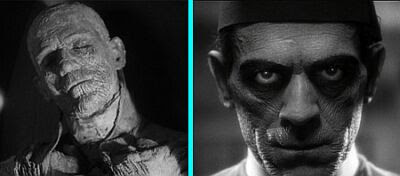

The cinematographer on DRACULA and a major influence on its look (especially in the early scenes in Dracula's castle) was German filmmaker Karl Freund, and THE MUMMY marked his first official stint in the director's chair. He gave the film its beautifully somber, almost expressionistic look and a deliberately-paced restraint that make it, as it has often been called, a "tone poem" of horror as opposed to the more lurid and over-the-top offerings in the genre. Today, many viewers might find it too slow and boring to sit through. But if your attention span encompasses an old-style form of storytelling that offers a wealth of exquisite subtlety and mood over visceral sensation, not to mention a great performance by Karloff, you will most likely find THE MUMMY to be one of the finest horror films ever made.


Strangely enough, it took Universal eight whole years to get around to making a sequel. But in 1940, they finally came up with THE MUMMY'S HAND, which, as it turned out, had nothing to do with the original story. This time, a couple of down-on-their-luck archeologists, the dashing Steve Banning (Dick Foran) and his pudgy comedy-relief sidekick "Babe" Jenson (Wallace Ford) are about ready to give up and leave Egypt when they stumble upon a clue that leads them to the ancient tomb of the Princess Ananka. But the tomb is guarded by the undying mummy of Kharis, who, like Im-ho-tep, was mummified alive for sacrilege. In lieu of the Scroll of Thoth, however, Kharis is kept alive by the fluid of boiled tana leaves, given to him over the years by a succession of High Priests who are dedicated to preserving the sanctity of the princess' tomb. The archeological expedition, which includes financial-backer and stage magician The Great Solvani (the lovable Cecil Kelloway) and his daughter Marta (the even more lovable Peggy Moran), is menaced by the Mummy until Steve and Babe locate the High Priests' temple and, in the exciting finale, vanquish the evil Professor Andoheb, current High Priest of Karnak (George Zucco) and set fire to the Mummy.

By this time, Karloff had better things to do than shuffle around wrapped head-to-toe in gauze, so actor Tom Tyler took over the title role. Better known as the title character of one of the greatest serials ever made, 1941's THE ADVENTURES OF CAPTAIN MARVEL, as well as a prolific Western star, Tyler brought an eerie presence to the role of the homicidal Kharis. In the movie's trailer and in some of the wider shots of the film itself, Tyler's eyes are menacing and expressive, yet in his close-ups they're masked to appear solid black. Some prefer this and consider it scarier-looking, but I think he looks much more impressive without the special effect. Anyway, this time the Mummy remains mute and leaves his wrappings on, thank goodness--no fez for Kharis--as will also be the case in the subsequent sequels.

Other precendents for the future films are set here as well. THE MUMMY'S HAND begins with an old priest handing down his knowledge and responsibilities to a successor, and relating the history of Kharis and Princess Ananka through flashbacks from the first film. Here, scenes from THE MUMMY are combined with new shots of Tom Tyler replacing those of Karloff to depict Kharis defiling the tomb of Princess Ananka and being condemned to a living death. This is a scenario we'll see again. Another is the discovery of "a greyish mark...like mold" on the throats of the Mummy's victims. And finally, there's the inherently lovelorn and amorous nature of these new-model High Priests of Karnak, who just can't seem to keep their hands off the leading ladies. George Zucco sets this precedent in motion by developing a high-school crush on the captive Peggy Moran and planning to give her and himself the old tana-leaf injection until Steve and Babe show up just in time to stick a fork in his scheme.

With THE MUMMY'S HAND, the series was already double-bill fodder with a running time of only 67 minutes. Even so, the expedition doesn't even reach the desert until the halfway point, and the Mummy makes his initial appearance several minutes after that. But the comedy bits and character scenes leading up to that are fun, and once the action gets started it never stops. The scene of the Mummy coming to life before the horrified eyes of expedition member Dr. Petrie (Charles Trowbridge) and strangling him as the gloating Andoheb looks on is one of the high points of the entire series. The cast is fine and the film as a whole is a polished, competent effort that stands on its own as one of the most likable horror films of the forties.


In 1942 came the follow-up, THE MUMMY'S TOMB, which brought a surprisingly downbeat and decidedly unsentimental aura to the series. Gone was the comedy relief, along with the exotic Egyptian setting itself, and with it the security of knowing that certain characters were immune from the Mummy's wrath. This is powerfully illustrated early on as the Steve Banning character from the previous film, now thirty years older and living in peaceful retirement in the quiet New England town of Mapleton, is visited in his bedroom one night by a vengeful (and somewhat singed) Kharis and strangled to death. The next night his elderly sister Jane, whose misfortune is to be of the same bloodline as a defiler of the Princess Ananka's tomb, meets the same fate. And when Babe (whose last name has somehow changed from Jensen to Hanson) hears the news and comes to Mapleton to pay his respects, sure enough the Mummy runs into him that very night, corners him in an alley, and gives him the old five-finger chokeroo. Even when I saw this as a kid, I was aghast that these characters were getting killed off--this was eighteen years before Janet Leigh's fatal shower in PSYCHO proved that no one was safe.

Well, Steve Banning's goofball son John (John Hubbard) survives and goes skipping merrily through the woods with his fiancee' Isobel (the lovely Elyse Knox, who happens to be actor Mark Harmon's mom) while the new current High Priest of Karnak, Mehemet Bey (Turhan Bey) scarfs an eyeload of her and falls head-over-heels in love just like his predecessor. So, using Kharis as a sort of proactive go-between, he orders him to kidnap Isobel and bring her to the cemetary where he works as caretaker so they can share tana-leaf cocktails and go sailing off into eternity together. Which doesn't seem quite right to Kharis, but he does it anyway (in later films he'll get righteously fed up with such tomfoolery). But this eventually brings the whole town down upon them and, in a fiery finale, John rescues Isobel while the Mummy is trapped on the balcony of the Banning home as it goes up in flames.

THE MUMMY'S TOMB establishes Universal's new horror star, Lon Chaney, Jr., as the Mummy for the remaining three films in the series, and the tall, beefy actor is definitely the most intimidating incarnation of Kharis. He's big, mean, and vengeful, and somehow Chaney is able to convey this through the rubber mask now used by Jack Pierce to create the character, with a combination of body language and hand gestures along with his imposing physique. The film itself is a lean one hour long, with a full eleven minutes devoted to a recap of the previous film as recounted by Steve Banning to his disbelieving houseguests right before his final encounter with Kharis, and there's also the traditional passing of the baton from one High Priest to another. This time, it's George Zucco again, who somehow survived being shot two or three times by Babe and managed to keep his job after having failed so miserably, handing things over to the young Turhan Bey, who proves to be a not-so-great choice himself. But somehow, even with its brief running time and generous padding, THE MUMMY'S TOMB manages to generate a good deal of monster-type entertainment. It also adds a curious element to the series' timeline--if THE MUMMY'S HAND takes place in the forties, then how come THE MUMMY'S TOMB, which is supposed to be about thirty years later, also takes place in the forties? Hmm...


Not long after these events, however, comes THE MUMMY'S GHOST (1944), which opens with George Zucco's now-ancient Andoheb yet again breaking in another High Priest and hoping for the best. (They're the High Priests of Arkam instead of Karnak now, for some reason--new management, maybe?) This time it's John Carradine, who made movies like this mainly to support his theater habit, as Yousef Bey. When Andoheb asks him, "You are Yousef Bey?" it sounds like he says "Useless" instead of "Yousef", which turns out to be pretty accurate. With the Bannings and Babe all out of the way (except for the surviving John Banning, who is inexplicably given a free pass), Yousef is charged with a new mission: go to America, where the Mummy is still running around in Mapleton, and bring him and the Princess Ananka back home to their resting place in Egypt. Instead of brewing tana leaves to keep the Mummy alive, since he apparently doesn't need them for that purpose anymore, they're to be used now to lure him in the same way the aroma of a Brontosaurus steak used to lure Fred Flintstone.

The usual flashbacks are dispensed with this time as Andoheb gives Yousef a quick verbal rundown of the story thus far, which he hands off to the previous film's Dr. Norman (Frank Reicher of 1933's KING KONG) to finish in a lecture to his skeptical Egyptology students back in Mapleton. Unfortunately, Dr. Norman brews up a batch of tana leaves himself during a home experiment that night and the Mummy shows up to kill off yet another familiar character before chugging the concoction like a frat rat at a keg party. His presence somehow attracts a sweet young Egyptian college student named Amina (Ramsay Ames), who sleepwalks to the scene of the murder and passes out on Dr. Norman's lawn, then becomes a suspect when she's discovered there the next morning. Her stuffy boyfriend Tom (Robert Lowery, who played a dour Batman in the 1949 serial BATMAN AND ROBIN) whines to the local sheriff about this to no avail, then thoughtfully leaves his dog Peanuts with Amina to help cheer her up. (In one scene it sounds like he says, "Come on, Penis" to the dog--sorry, but this just sounds funny to me because I can't stand the stiff-arsed Tom character).

Yousef Bey's seemingly simple task is made more difficult when he and the Mummy reach the museum where Ananka's body is kept. For just as Kharis reaches out to touch it (he actually cops a feel--really!), it crumbles to dust as her spirit flees to another body. Whose body, you ask? That's right--Amina, who is the physical reincarnation of Princess Ananka, and now serves as the vessel of her living soul as well. So the Mummy kidnaps her and brings her to the abandoned tower where he and Yousef are hiding out. (For some reason, they pick the one place in town with the most steps for the slow-moving Mummy to have to walk up and down.) Yousef, of course, takes one gander at the lovely, bound Amina and goes ga-ga, his priestly vows flying out the window as he grabs for the tana fluid and professes his eternal love to her. The Mummy overhears this sacrilege, however, and turns him into a priest-Frisbee. Meanwhile, Penis--I mean, Peanuts has managed to lead Tom and the other townsfolk to their hideout, and while making his escape with the now rapidly-aging Amina, the Mummy wanders into a swamp and they both sink into the quicksand as the horrified Tom and Peanuts look on.

At 61 minutes, THE MUMMY'S GHOST is a pretty eventful little film with some good Mummy action. A lengthy subplot about Inspector Walgreen (Barton McClane, THE MALTESE FALCON) investigating Dr. Norman's murder and setting a trap for the Mummy at Norman's house goes nowhere, since the Mummy never shows up there again. (It was a dumb idea, anyway--dig a big hole in Norman's yard, cover it with leaves, and hope the Mummy falls in. "Duh.") But the Mummy's angry rampage at the museum after Ananka's body crumbles to dust and his killing of the museum guard are memorable, as are some good, spookily-lit closeups of him during the movie. Chaney's performance is energetic and effective, regardless of the fact that he hated playing the mute, heavily-wrapped character. Plus, the murder of Dr. Norman and the downbeat ending continue the unsentimental, anyone-can-die attitude of the series.


Continuity flies out the window faster than a Mummy-propelled John Carradine in 1944's THE MUMMY'S CURSE, the final film in the series. Timeline? While this one takes place twenty-five years after the events of the last film, it's still the forties. Mapleton? Never heard of it. Now, the Mummy and Amina are buried beneath a bayou in Louisiana which is being drained by land developers. Don't look at me--I don't know how they got there. But the workers start dying, and a Mummy-shaped hole is discovered by Dr. James Halsey (Dennis Moore), who is investigating on behalf of the museum against the wishes of the gruff foreman, Pat Walsh (Addison Richards).

Halsey's assistant is the delightfully-named Dr. Ilzor Zandaab (Peter Coe, HOUSE OF FRANKENSTEIN), and it doesn't take long to find out that Zandaab is the new High Priest of Whatever, sent to finish the job that all the other idiots so overwhelmingly screwed up. This guy's different, though--he's hardcore, and nothing, not even Walsh's beautiful daughter Betty (Kay Harding), can sway him from his task. His eyes gleam with purpose as he narrates the extensive flashbacks (they're back!) for us, and if anybody has a chance of getting this long-standing Mummy business straightened out once and for all, it's this guy. He is my hero. One catch, though...he has a shifty-eyed henchman, Ragheb (Martin Kosleck), and sure enough, the henchman falls for Betty and screws everything up in the end. Somehow, I think Amon-Ra has a sick sense of humor and is just messing with these guys.

Comedy relief returns to the series--sorta--in the form of Cajun Joe (Kurt Katch) and a stereotypically-black swamp worker named Goobie (Napoleon Simpson), who exclaims at one point, "De Debbil's on de loose and he's dancin' wiff de Mummy!" Later, after some reconsideration, he amends this to observe, "De Mummy's on de loose and he's dancin' wiff de Debbil!" (Well, I did say "sorta.") Cajun Joe meets his end in a shot that graced the cover of at least one monster mag back in the 60s, while another likable character, Tante Berthe (Ann Codee), a singer who owns the local bar where everyone hangs out, gets hers while valiantly trying to keep the Mummy from grabbing a young girl found wandering around earlier in the swamp.

Played by Virginia Christine, who was "Mrs. Olson" in the old Folger's coffee commercials ("It's mountain grown!"), she turns out to be Amina herself. Her resurrection from the drained swamp is one of the most impressive, and downright odd, sequences in the entire series. Caked in dried clay, she struggles to break loose from her burial place and then staggers blindly through the woods, her head turned upward to the blazing sun as it glows through her closed eyelids, until finally she descends slowly into the water to cleanse herself. This is such a strangely beautiful, almost surreal sequence, it almost doesn't even fit into a relatively ordinary film like THE MUMMY'S CURSE, and is without a doubt the most memorable thing about it.

The Mummy has a lot more screen time in this film than in most of the others as he keeps trying to apprehend the fleeing Amina and killing anyone who gets in his way. He finally catches her and takes her to the abandoned monastery where he and Zandaab have been hiding out (and yes, it has about a hundred-and-fifty freaking steps for him to schlepp up and down), where he discovers that Ragheb has kidnapped Betty and has her tied up and ready for the old tana-leaf treatment. He's already killed Zandaab, who remained faithful to the cause to the bitter end (my hero!) and is duking it out with Dr. Halsey when the Mummy steps in and makes him sorry he ever went off-mission. Ragheb flees into a cell and locks the door, and the Mummy goes into a rage, ripping the bars out of the wall and bringing the roof down on both of them in a hair-raising scene that serves as a worthy end to this great character's involvement in the series. While discounted by some as the weakest "Mummy" film, I find THE MUMMY'S CURSE to be one of the most entertaining and unusual entries of all.

If you're into classic horror and especially the Universal monster flicks of the thirties and forties, and for some reason have managed to miss out on these movies after all these years, you can't go wrong with the "Mummy" series. From the undisputed classic Karloff original to the less prestigious but still totally cool programmers that followed, they remain some of the most highly-entertaining and rewatchable monster films that Universal Studios ever produced. So stick THE MUMMY--THE LEGACY COLLECTION (which contains all five films plus some cool extras) into your DVD player, pop some popcorn, brew up some tana leaves, and have some fun. It is the will of Amon-Ra!



Share/Save/Bookmark

Monday, July 28, 2025

THE BIG TRAIL -- DVD Review by Porfle


 Originally posted on 10/26/11


It's not every day you get to watch a 1930 blockbuster movie in widescreen, with enough sheer spectacle to leave even modern viewers breathless.  The movie in question is Raoul Walsh's Western epic THE BIG TRAIL, a young John Wayne's first starring role and a genuine treasure for Western fans.

Shot on 70mm film using an early widescreen process known as "Fox Grandeur", THE BIG TRAIL was expensive to shoot and expensive to project--new equipment had to be installed in theaters just to show it--and with the onset of the Great Depression, it seemed the "Fox Grandeur" process had come along at just the wrong time.  Only a couple of theaters in New York and Los Angeles ever exhibited the widescreen version, while everyone else saw a much less impressive 35mm Academy aspect ratio version that was filmed simutaneously.  It would be another two decades before Cinerama offered moviegoers such wide vistas again.

The story takes place as a cattle drive blazes the trail for a wagon train full of settlers bound to reach the land north of Oregon.  For five months, director Raoul Walsh and his crew filmed 185 full-sized Conestoga wagons (or "prairie schooners") and thousands of extras on a 2,000-mile trudge across five states, facing conditions much like those experienced by the actual pioneers.  The settings, including a bustling river town, a massive riverboat, and various outposts along the trail, are meticulously detailed and wonderfully authentic, as are the costumes, props, and all other aspects of the production. 


The 23-year-old John Wayne plays buckskin-clad Breck Coleman, a tall, good-natured frontiersman who hires on as the group's scout for two reasons.  One, he's infatuated with a lovely young pioneer woman named Ruth (Marguerite Churchill), who can't stand him, and two, he's sworn revenge against the burly bullwhacker Frack (a Bluto-like Tyrone Power, Sr.) and his weaselly henchman Lopez (Charles Stevens) for murdering his best friend in order to steal his valuable stock of wolf pelts.  To complicate things, these skunks are in cahoots with a lowdown riverboat gambler named Thorpe (Ian Keith), who is also smitten with Ruth and is looking for an opportunity to shoot Breck in the back somewhere along the trail.

The actors, from the stars down to the extras, all look and act as though they belong in that era, despite the sometimes stilted acting styles (a leftover from the silent era, along with the expository intertitles).  And when the settlers encounter various tribes of Indians along the way, both friendly and not-so-friendly, they definitely aren't refugees from central casting--they're the real thing.  Much of this film is like a window into the past because the Wild West as we know it still existed at the time this was made, and Walsh's cameras were there to record it in its gloriously uncivilized state.


Breathtaking scenery and amazingly rich tableaux fill the screen throughout the film, with wagons, horses, and cattle often stretching as far as the eye can see.  One sequence shows the wagon train during a harrowing river crossing, while another details the grueling task of lowering the wagons, livestock, and people down the face of a sheer cliff by ropes.  We also get the obligatory "circling the wagons" scene (never as well-done as it is here) as the hostile Cheyenne attack and the settlers fight desperately to repel them. 

The excitement comes from knowing that these events are actually taking place and not being simulated by special effects or augmented by CGI.  From the rolling hills and mountains of the midwest, through miles of burning desert, and finally to the lush, majestic redwood forests (with a brief stop-off at the Grand Canyon along the way), the genuine locations used for THE BIG TRAIL are a non-stop feast for the eyes.

As Bill Cooke recently stated on the Classic Horror Film Board, "John Wayne may be a little rough in his first acting role, but was never more charming."  The financial failure of THE BIG TRAIL would relegate Wayne to a long string of B-movies until his breakthrough role as "The Ringo Kid" in John Ford's 1939 classic STAGECOACH, but his Breck Coleman character is just as likable and appealing as any he ever played.  He's earnestly convincing whether palavering with his friends the Indians, bashfully courting the gal of his fancy, or stalking his best friend's killers with deadly determination.


Marguerite Churchill, whom I always liked as Otto Kruger's sassy secretary in DRACULA'S DAUGHTER (1936), is winsome as the girl Breck must try his darndest to win over.  As the loathesome Frack, Tyrone Power, Sr. is almost cartoonishly villainous, but he's a formidable bad guy nonetheless.  Tully Marshall is outstanding as Breck's pal, the aging frontiersman Zeke, while vaudeville comedian El Brendel provides love-it-or-hate-it comedy relief as a Swedish doofus named Gus who is constantly being harangued along the way by his tyrannical mother-in-law.

20th Century Fox's 2-disc DVD of this restored version of THE BIG TRAIL is a real treat for fans of John Wayne and of Westerns in general.  Despite some rough patches here and there, the film looks great and is always visually impressive.  Four informative featurettes and some photo galleries make for interesting supplemental viewing, although the same can't be said, unfortunately, for Richard Schickel's boring commentary track.  The second disc contains the standard fullscreen version, which is interesting for comparative purposes although you probably won't care to sit through the whole thing after watching the widescreen version.

For me, the combination of a great Western adventure with the novelty value of seeing a beautiful widescreen film shot in the early days of talking pictures is a thrill that's hard to beat.  Add to this the opportunity to watch John Wayne shine in his starring debut and director Raoul Walsh at the height of his creative skills, and you've got THE BIG TRAIL--surely one of the most spectacular and irresistibly entertaining Westerns ever made.  To borrow another quote from Bill Cooke:  "By the time this one is over, you actually feel as if you've taken a wagon train out West."


Share/Save/Bookmark

Wednesday, April 9, 2025

Chico Marx Forgets His Lines In "THE COCOANUTS" (1929) (video)


Chico and Harpo are breaking Bob (Oscar Shaw) out of jail...


...because Bob's girlfriend Polly (Mary Eaton) is being forced to marry bad guy Harvey Yates.

But Chico can't remember the name "Harvey Yates" to save his life.

So Bob finally has to turn psychic and say it for him.

"She's gotta have you. Because tonight she gonna be, uh, engaged."
"To who?"
"To Polly. He's engaged to Polly."
"POLLY'S GOING TO MARRY YATES?"

Nice mind-reading there, Bob!

And to top it all off, Harpo gets his foot stuck in the door on the way out.


I neither own nor claim any rights to this material.  Just having some fun with it. Thanks for watching!


Share/Save/Bookmark

Saturday, March 30, 2024

MY TOP 50 FAVORITE BAD MOVIES! by Porfle


If I don't mention one that you think is an extremely obvious choice, then I either don't like it or I haven't seen it yet.

(Click on the active links to read our reviews!)


1
Plan 9 From Outer Space (1959)

2
Village of the Giants (1965)

3
The Brain That Wouldn't Die (1962)

4
Frankenstein's Daughter (1958)

5
Jesse James Meets Frankenstein's Daughter (1966)

6
The Beast of Yucca Flats (1961)


7
Teenage Zombies (1959)

8
Playgirl Killer (1966)

9
Glen or Glenda (1953)

10
Attack of the 50 Foot Woman (1958)

11
The Killer Shrews (1959)

12
Manos: The Hands of Fate (1966)


13
If Ever I See You Again (1978)

14
Valentine Magic on Love Island (1980)

15
Blood Feast (1963)

16
The Giant Gila Monster (1959)

17
Bride of the Monster (1955)


18
Dracula vs. Frankenstein (1971)

19
Wild Guitar (1962)

20
The Cyclops (1957)

21
Teenagers From Outer Space (1959)

22
The Creeping Terror (1964)

23
Reefer Madness [Tell Your Children] (1936)

24
Zontar, The Thing from Venus (1966)


25
Curse of the Swamp Creature (1966)

26
Attack of the Giant Leeches [The Giant Leeches] (1959)

27

Orgy of the Dead (1965)

28
The Horror of Party Beach (1964)

29
Monstrosity [The Atomic Brain] (1964)

30
Battlefield Earth (2000)


31
Maniac (1934)

32
Monster From Green Hell (1957)

33
Bela Lugosi Meets a Brooklyn Gorilla (1952)

34
The Wild World of Batwoman (1966)

35
Robot Monster (1953)


36
Lisztomania (1975)

37
Mars Needs Women (1967)

38
The Doll Squad (1973)

39
The Crawling Hand (1963)

40
Killers From Space (1954)


41
The Neanderthal Man (1953)

42
Night of the Ghouls (1959)

43
Fire Maidens From Outer Space (1956)

44
Cat-Women of the Moon (1953)

45
Indestructible Man (1956)


46
Devil Girl From Mars (1954)

47
They Saved Hitler's Brain (1963)

48
The Wasp Woman (1959)

49
Armageddon (1998)

50
The Concorde - Airport '79 (1979)


Share/Save/Bookmark

Wednesday, February 21, 2024

TIME TO DIE -- Blu-ray Review by Porfle


Originally posted on 11/23/17


Sometimes I'm in the mood for a simple, matter-of-fact story told in a deliberate style that allows the viewer to contemplate what's happening rather than just passively observing flashes of action and drama. 

If, like TIME TO DIE, aka Tiempo de morir (1966, Film Movement Classics), this story happens to be a vintage Mexican western in exquisite black-and-white, then all the better.

There's a lot to contemplate in the story of Juan Sayago (Jorge Martínez de Hoyos, THE MAGNIFICENT SEVEN, THE PROFESSIONALS), who, after serving 18 years in prison for killing a man, is released and walks all the way through the lonely desert to return to his hometown where the dead man's two sons, now grown, wait patiently for their revenge. 


Juan doesn't want trouble, but only to rebuild his life just as he tries to reassemble the shambles of a home left when his mother died years ago.  But the hatred of proud, hot-tempered young Pedro Trueba (Enrique Rocha) is too strong, and his insistent provocations to violence unavoidable even as the man's younger brother Julian (Alfredo Leal), the less volatile of the two, has a conflicting sense of what he sees as a potentially honorable man.

The story seems almost reverse-inspired by HIGH NOON--this time it's the protagonist coming into town while his killers await him there, and the townspeople, rather than staying out of it, do everything they can to come between the opposing forces to avoid bloodshed. 

This is especially true of Juan's former love Maria (top-billed Marga López), now a rich, respected widow, and Julian's girlfriend Sonia (Blanca Sánchez), who fears the needless death or imprisonment of her future husband--strong women but unable, in their time, to affect the course of men doing men's business with harsh fate as their final arbiter.


There's also HIGH NOON's brand of crisp black-and-white photography and quiet, deliberate pacing as well as a preoccupation with time and timepieces.  In addition to brief snatches of its minimalist score, the film's soundtrack consists mainly of stark practical sound effects often backed by the constant rush of hot desert winds. 

A long moment in which Maria quietly dreads the inevitable future is accentuated by the loud ticking of a clock.  When the vengeful Pedro dons his father's old clothes and paces within his empty study, the dead man's spurs echo hollowly on the wooden floor as Pedro follows in his ghostly footsteps.

In 1962's THE MAGNIFICENT SEVEN, Jorge Martínez de Hoyos played a humble farmer seeking the aid of expert gunmen to help protect his village from marauders.  Here, he himself is such a gunman, but a tired, much older one who now wants only peace and a chance at redemption. 


It's a restrained, subtle performance that reflects Juan's wasted years behind bars and his weary regret for once killing a man while now facing the prospect of engaging his two sons in pointless conflict.

The main tragedy is that in this revenge western there are no bad guys and no clear-cut morality--only a relatively good man who was once forced to kill, and two brash young men honor-bound to avenge what they perceive to be the cowardly murder of their father. 

Director Arturo Ripstein, who began his career as Luis Buñuel's assistant director in 1962 and would become one of Mexico's leading filmmakers, handles his first feature film with a restrained confidence and an artistic eye.  He favors long, unhurried takes with fluid handheld camerawork (a rarity in those days before Steadicam) that tells the story unobtrusively and economically. 


Part of the novelty of this Mexican western comes from the setting, taking place not in the rough border town of Sergio Leone's A FISTFUL OF DOLLARS, but in a picturesque village with narrow cobblestone streets and whitewashed buildings of adobe and brick.  There's an almost turn-of-the-century modernity and sense of progress which the more civic-minded inhabitants are striving to keep untainted by the kind of violence threatened by Juan's return. 

The physical and emotional release of gunplay is held back from us until the very end, where neither we nor the surviving character(s) derive much satisfaction from it save for a curdled sense of relief.  In TIME TO DIE, the only real victor is Death itself.


BONUS FEATURES
Video Introduction by director Alex Cox (Repo Man)
Commentary by director Arturo Ripstein and actor Enrique Rocha
New essay by Carlos A. Gutiérrez, co-founder of Cinema Tropical
Booklet insert

PROGRAM INFORMATION
Type:  Blu-ray/DVD
Running Time: 89 mins. + extras
Rating:  N/A
Genre:  Western
Aspect Ratio: 1.33:1
Audio:  Stereo
Language: Spanish with English Subtitles

Buy it at Film Movement Classics

WATCH THE TRAILER


Share/Save/Bookmark