Get DVDs From Amazon

http://www.flkcinema.com/Forum.asp

http://www.flkcinema.com/Forum.asp
The Place to Chat about Rare Kung Fu and More!

HK FLIX Latest Additions

Wednesday, February 25, 2009

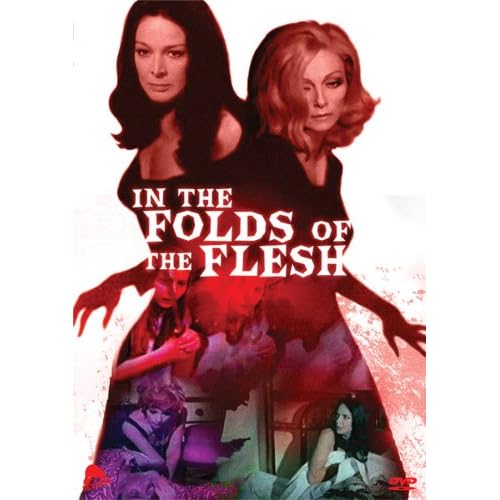
DVD Review: IN THE FOLDS OF THE FLESH (1970)


FILM:

IN THE FOLDS OF THE FLESH tells strange tale of villa on the outskirts of Switzerland. Occupied by three peculiar family members, the villa is taken hostage by a felon, who claims he saw a body buried outside the villa many years ago. The felon uses this ploy to blackmail the owners, and as the mystifying past of the villa is peeled off, the folds of the inhabitants begin to reveal their flesh.

IN THE FOLDS OF THE FLESH is a very, very bizarre giallo to say the least. It straddles between numerous genres and refuses to stay still in any of them. It has a natural thriller story that constantly dabbles in giallo and sex territory, but soon branches off into themes of incest and Nazism. Although such ideas seem radically opposite, they are absurdly thrown together in ITFOTF.

The film has a very psychedelic tone to it. Some of the giallo-esque murders done early on have such a bizarre and eccentric style that they actually become somewhat creative. Their composed with some thought and actually had me interested when such sequences came into play.

The flashback sequences are done with colors filters that actually work very well. Numerous colors bleed over the flashback sequences to inject a very dreamlike atmosphere in those particular spots.

The storyline begins with a lot of potential and many creative possibilities, but spirals down into a very dull fashion very early on. The film tends to drag about mid-way through and lose a lot of its steam near the end, but is able to manage a competent twist that makes in the final third somewhat watchable.

IN THE FOLD OF THE FLESH is a watchable giallo at best. It’s nowhere near the best the Italians have produced, but does a make for an interesting, if somewhat weak, viewing experience. Recommended for giallo/Italian horror collectors only.
6.5/10

VIDEO: The video quality is extremely well done. Considering the film’s date and background, the print is very watchable with some vibrant colors coming through every now and then. Some scratches and marks are apparent, but considering the material, this is expected.
7/10

AUDIO: The Audio does its job fine. The film is very quiet and slow, and the audio definitely reflects this. At a regular audio level the sound came through with no hisses or crackles. 6/10

EXTRAS: A trailer is all we are given in this release. 2/10

OVERALL: IN THE FOLDS OF THE FLESH is nothing to write home about. It’s very basic in almost every sense and never tries to push any of its lucid elements to the edge. As it stands is a small and strange film that combines some very strange ingredients to create a film you’d really think would never be produced. It’s not intense, sadistic, or extreme. It’s just bizarre.
6/10

Tuesday, February 24, 2009

RAIDERS OF THE LOST ARK, INDIANA JONES AND THE TEMPLE OF DOOM, INDIANA JONES AND THE LAST CRUSADE -- CD reviews by porfle

Among the outstanding film scores of master composer John Williams are his invaluable contributions to the Indiana Jones series. As director Steven Spielberg once said, "Sure, the whip, the hat, the jacket are part of the Indiana Jones iconography. But what really gives Indy his heart and spirit is John Williams' music."

Serving as highly convincing evidence of this comes three new CDs from Concord Records which contain the scores for RAIDERS OF THE LOST ARK, INDIANA JONES AND THE TEMPLE OF DOOM, and INDIANA JONES AND THE LAST CRUSADE. All are fully-remastered and augmented by previously-unreleased material, and each comes with an illustrated booklet with liner notes by Spielberg. Today I had the pleasure of listening to these CDs and would like to share my impressions of them with you.

The first thing I noticed is that, unlike many soundtrack recordings, these tracks are in the proper sequence as they appear in the movie. This is good because it helps the listener to better relive the movie in his or her mind while listening. The score for RAIDERS begins with that exotic, foreboding melody that accompanies the Paramount logo and our first view of the mysterious whip-wielding man in the fedora as he and his guide trudge through the jungle. The first four pieces--"In the Jungle", "The Idol Temple", "Escape From the Temple", and "Flight From Peru"--allow us to experience that entire opening sequence of the film in our minds. The rest of the score similarly serves as the backdrop to our own mental journey through the familiar story.

Most of this probably wouldn't appeal a whole lot to people who haven't seen the movies, because much of the music is very scene-specific, and is, in fact, almost what you might call "Mickey Mousing" (an often derogatory term used to describe music that parallels a film's action too closely). But John Williams is so good that even when he does this (as the never-sit-still nature of these movies often requires) it's still fully realized music that is exciting and intriguing to listen to.

"The Map Room: Dawn" builds dramatically to that breathtaking moment in which Indy pinpoints the location of the Ark. The sequence inside the Well of Souls and Indy's punishing fistfight on the flying wing are fast-moving tracks filled with musical variety. The longer, more cohesive pieces, such as the playful "Basket Game" or the robust "Desert Chase", are as stirring in their own right as an overture or a movement in a symphony and provide lengthy intervals of listening pleasure punctuated by moments of sheer grandeur.

While it's impossible for most of us to know exactly what images each passage of music is describing, there are those particular moments that stand out--the beam of light passing through Indy's staff and striking the map, Indy marching his horse down the mountain with grim determination in order to overtake the truck convoy, and the grand finale in which the terrifying power of the Ark is unleashed. These are the musical touchstones that bring our memories of the film to life and make the overall listening experience all the more rewarding.

This score never gets dull because it's just as kinetic and ever-changing as the movie's action. Williams uses the entire orchestra beautifully. Marion's theme is as romantic and exotic as ever, while the haunting "Ark" theme never ceases to elicit chills and evoke a strong feeling of ancient mysticism. And of course, Indy's theme ("Raiders March"), which we finally get to hear in all its glory at the end, is one of the most joyfully celebratory themes ever written for a movie character.

TEMPLE OF DOOM, as you might expect, begins on an entirely different note with a jaunty, Asian-flavored shuffle through Cole Porter's "Anything Goes", followed by a slow tension-building piece called "Indy Negotiates." Then it's off on another multi-track journey through non-stop action with "The Nightclub Brawl", "Fast Streets of Shanghai", "Map/Out of Fuel", and "Slalom on Mt. Humol", all frantic hyperkineticism filled with the familiar Williams touches, including frequent dashes of Indy's theme.

Then Short Round gets his own heroic theme worthy of an Arthurian knight, after which our journey toward the Temple of Doom begins. Again, much of the music is very scene-specific, but this time it often has a lush, orchestral openness that seems to describe vast panoramas of musical adventure ("The Scroll/To Pankot Palace"), with the occasional detour into romantic lyricism and frivolity ("Nocturnal Activities").

At this point the movie is off and running again, and so is Williams as he gives his orchestra quite a workout. The extended sequence inside the temple itself yields a number of exciting and often downright dissonant tracks ("Children in Chains", "The Temple of Doom", "Short Round Escapes", "Saving Willie") filled with pounding drums and the occasional chanting vocal chorus. In "Short Round Helps", Indy's theme bursts through the darkness for a welcome return, but is quickly pulled back into the maelstrom again. If you don't know quite what's going on in the story at any given time, just imagine Indy, Short Round, and Willie in big trouble and that really creepy bad guy and his minions trying to kill them, and the music will do the rest.

What I was waiting for mainly was "The Mine Car Chase." That's what I remember most about this movie, and the score here, as expected, is a mad dash of intensity that doesn't let up for a moment. (I can imagine the musicians all falling out of their chairs after the last note.) "Water", "Sword Trick", and "The Broken Bridge/British Relief" bring the action to a climax in similar style, finally giving way to the triumphant fadeout and another stirring end credits rendition of the "Raiders March", this time sprinkled with various TEMPLE OF DOOM-related themes. Overall, it's a difficult, almost exhausting score to listen to--the most nightmarish of Indy's adventures--but I found the experience rather invigorating and cathartic.


LAST CRUSADE has my favorite opening of all--a near 12-minute piece called "Indy's Very First Adventure" which starts out in a slow but inviting manner, builds ever so gradually, and finally blossoms into an exciting, delightfully humorous, and fairly self-contained composition that moves briskly and ends with a fanfare version of Indy's theme. I can see Williams conducting this at some formal event, like maybe the ribbon-cutting ceremony for a new Piggly Wiggly or something.

There must not have been much music for awhile after that, because we skip directly to "The Boat Scene", "X Marks the Spot", and "Ah, Rats!!!" (if you've seen the movie you'll no doubt recall those particular scenes) which continue the uncommonly lush orchestration of the opening piece. This sound will continue throughout the entire score, making it perhaps the most genuinely listenable of the three. There's a richness to the orchestrations and an abundance of melody that are almost intoxicating, at times given a religious-epic tone by the stately "Grail" theme which appears intermittently, and a noticeable lack of the harsh dissonance found throughout TEMPLE OF DOOM.

The score continues in this vein as Indy and his dad make their way into Austria and battle the Nazis. I have no idea just what's going on throughout much of this, but there's a lot of tension-building stuff mixed with passages of pure romanticism and the occasional action stings, all of which are a distinct pleasure to listen to. "Scherzo For Motorcycle and Orchestra" is especially invigorating and enjoyable, and is a great example of how much fun Williams seems to be having with this entire score.

"On the Tank" and "Belly of the Steel Beast" are just what they sound like--it's the action centerpiece of the film and the music drives it forward like a powerful engine. It's like classical music that's been working out at Gold's Gym every day for a few years. Then we proceed into "The Canyon of the Crescent Moon" to meet "The Keeper of the Grail", wherein the music takes on a solemn yet richly substantive elegance (with that "Grail" theme finally kicking in full-force) until the rip-roaring "Finale & End Credits." This reprise of the "Raiders March" and its recap of various themes from the film seems more joyous and triumphant than ever.

After a while I stopped keeping up with the track titles and just let the music carry me along. Even the most scene-specific passages seem to flow as though the composer were simply writing the grandest music he could think of for his own amusement, and it's never less than effortlessly entertaining on its own. I think Williams really improved a lot in the years between the first Indy film and this one--if it weren't for the sentimental attachment I have to RAIDERS and the feelings its music evokes in me, this score would easily be my favorite of the three. Maybe it is anyway.

I'll definitely be keeping these three Indiana Jones CDs handy for frequent background listening. Each has its own feel and its own strengths, perfect for whatever mood I may happen to be in at the time, and each is a splendid example of motion picture scoring at its absolute finest.

Dead Rising: Chop Till You Drop Ships Today

CAPCOM® SHIPS DEAD RISINGTM: CHOP TILL YOU DROP

Wii Gamers Get Their Own Taste of Zombie-laden Insanity with Humor, Hordes of the Undead and a Variety of Weapons at the Player's Disposal

SAN MATEO, Calif. — February 24, 2009 — Capcom®, a leading worldwide developer and publisher of video games, is pleased to announce that Dead Rising™: Chop Till You Drop ships today for the Wii™ home video game system. Taking advantage of the same proven technology that brought Resident Evil® 4 so successfully to Wii, Dead Rising: Chop Till You Drop delivers a more intuitive and interactive experience as players use the Wii Remote™ to shoot, slash and bludgeon their way through a zombie infested shopping mall, fighting for survival.

Dead Rising: Chop Till You Drop follows the harrowing tale of Frank West, an overly zealous freelance journalist on a hunt for the scoop of a lifetime. In pursuit of a juicy lead, he makes his way to the small suburban town of Willamette only to find that it has become overrun by zombies. Frank escapes to the local shopping mall, thinking it will be a bastion of safety but turns out to be anything but. A true struggle to survive the endless stream of enemies, players luckily have full reign of a realistic shopping centre and its varied stores offering an endless supply of real and makeshift weapons to fight off the flesh-hungry mob. If Frank is running low on health he can pay a visit to one of the many restaurants or cafes for a meal in order to restore his energy and continue the fight.

Dead Rising: Chop Till You Drop’s campy humor delivers welcome relief to players as they battle against an incessant tide of zombies and challenging bosses. Intense moments will give way to hilarious interludes as players get a kick out of dressing Frank up in a variety of comedic costumes and taking on the undead hordes with an impressive variety of improvised and sometimes highly ineffective weapons such as a toy sword or football.

The game is split into a series of individual cases all of which Frank must complete in order to gain vital information that will allow him to piece together the truth behind the horrendous epidemic. In addition to the cases, players will be faced with the dilemma of deciding the rescue priority of the residents of Wilamette who also sought sanctuary in the mall. Depending on the player’s skill, some may not be so fortunate as each rescue needs to be undertaken in a set time period, therefore players may need to delay completion of a case in order to save a fellow human.

Monday, February 23, 2009

The Interesting Origin of Resident Evil 5's Birdlady


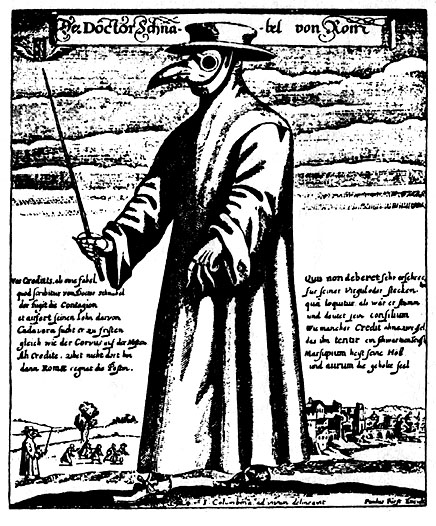
I was watching a documentary on The Black Death that I got off of Itunes and I was skimming wikipedia for some extra info. In the process, I came across something very interesting. Look's like someone on the RE5 development staff likes European History.

Now considering Resident Evil 5 is all about bio-weapons capable of causing a new black death (in scale and scope, if not even worse), the idea of someone trying to protect themselves for the disease wearing this outfit (or at least a hightech upgrade) has an interesting comparison to history. I'd be pretty shocked if this wasn't some sort of factor in Birdlady's design, even more so considering the strong speculation on who she is.

Here is a little more info on this early version of a Bio-Hazard Protection Suit.

http://en.wikipedia.org/wiki/Consequences_of_the_Black_Death

Considered an early form of hazmat suit, a plague doctor's clothing consisted of:

* A wide-brimmed black hat worn close to the head. At the time, a wide-brimmed black hat would have been identified a person as a doctor, much the same as how nowadays a hat may identify chefs, soldiers, and workers. The wide-brimmed hat may have also been used as partial shielding from infection.

* A primitive gas mask in the shape of a bird's beak. A common belief at the time was that the plague was spread by birds. There may have been a belief that by dressing in a bird-like mask, the wearer could draw the plague away from the patient and onto the garment the plague doctor wore. The mask also included red glass eyepieces, which were thought to make the wearer impervious to evil. The beak of the mask was often filled with strongly aromatic herbs and spices to overpower the miasmas or "bad air" which was also thought to carry the plague. At the very least, it may have served a dual purpose of dulling the smell of unburied corpses, sputum, and ruptured bouboules in plague victims.

* A long, black overcoat. The overcoat worn by the plague doctor was tucked in behind the beak mask at the neckline to minimize skin exposure. It extended to the feet, and was often coated head to toe in suet or wax. A coating of suet may have been used with the thought that the plague could be drawn away from the flesh of the infected victim and either trapped by the suet, or repelled by the wax. The coating of wax likely served as protection against respiratory droplet contamination, but it was not known at the time if coughing carried the plague. It was likely that the overcoat was waxed to simply prevent sputum or other bodily fluids from clinging to it.

* A wooden cane. The cane was used to both direct family members to move the patient, other individuals nearby, and possibly to examine the patient with directly.

* Leather breeches. Similar to waders worn by fishermen, leather breeches were worn beneath the cloak to protect the legs and groin from infection. Since the plague often tended to manifest itself first in the lymph nodes, particular attention was paid to protecting the armpits, neck, and groin. It is not known how often or widespread plague doctors were, or how effective they were in treatment of the disease. It's likely that while offering some protection to the wearer, they may have actually contributed more to the spreading of the disease than its treatment, in that the plague doctor unknowingly served as a vector for infected fleas to move from host to host.

Saturday, February 21, 2009

"Count Yorga" Star Robert Quarry Joins the Immortals

Robert Quarry, beloved the world over for his role as "Count Yorga", has passed away at the age of 83.

One of the most popular horror stars of the 70s, Quarry's enduring fame began with his starring role in the cult classic COUNT YORGA, VAMPIRE (1970) and its sequel THE RETURN OF COUNT YORGA (1971), and continued with such films as DEATHMASTER and DR. PHIBES RISES AGAIN (both released in 1972).

A prolific television actor before achieving genre icon status with his role as the bloodthirsty count, Quarry appeared in a number of films up until 1999 and only recently worked with actor-director Mark Redfield in his upcoming Poe adaptation THE TELL-TALE HEART. In his Classic Horror Film Board tribute thread, fellow castmember Ted Newsom offers this recollection:

Bob Quarry finally passed away.

He'd been in declining health for more than a year, and was a resident at the Motion Picture Country Home and Hospital.

His health and lucidity was on-again off-again over the last couple months. There were some grim periods, usually followed by a recovery. I'd go there every couple of days, feeling that's not nearly enough. The last time I saw him, though, he was bright and aware, kidding with the nurses. I pushed him around the hallway last time, just to add some variety. We paused by a wall lined with photographs taken in the late 30s by a Jack Parkovsky, latterly a resident of the home. Bob recognized the movie stars: Norma Shearer, Clark Gable, Jack Oakie, Constance Talmadge, Bela Lugosi, Ralph Bellamy.

For my own selfish reasons-- wanting to smoke a cigarette-- I rolled him out onto the patio for a while. It was late in the afternoon, dusk. I don't know that he'd been outside since he'd been there. "Let's go back in," he said.

He's survived by his niece, and a lot of friends and fans.
In Quarry's own words, "My motive is quite simple. I want to be able to continue to earn a decent living and earn the respect of the people I work with...if you want to last in this business, you have to give a lot. You can't just take." And this quote may help explain his lasting impact on horror film fandom: "I always tried to play villains like the heroes."

"PUNISHER: WAR ZONE" -- On DVD and Blu-Ray 3/17/09

Vengeance Has A Name.
One of Marvel comic’s most popular superhero action franchises returns with the March 17, 2009 DVD and Blu-ray Disc release of Punisher: War Zone. Frank Castle is back and it is six years into his vengeance driven zeal as "The Punisher" and he is now set to take on the mob.

The 2-Disc Special Edition DVD and Blu-ray contain a standard definition digital copy of the film as well as thrilling bonus features including multiple featurettes examining all elements of making the film plus audio commentary. The Blu-ray Disc also features MOLOG™, a BD Live application that allows users to insert and animate shapes, text, audio and other graphics right into the film as well as post "blogs" about the film to share with other registered MOLOG™ users. The standard one-disc DVD will include a Widescreen and Full Screen version of the film along with the theatrical trailer. Punisher: War Zone features a hit sound track from today’s hottest rock bands including Slayer, Slipknot, Seether, Rise Against, Hatebreed, Static-X and a new single from Rob Zombie.

Waging his one-man war on the world of organized crime, ruthless vigilante-hero Frank Castle (Ray Stevenson, HBO’s "Rome") sets his sights on overeager mob boss, Billy Russoti (Dominic West, HBO’s "The Wire"). After Russoti is left horribly disfigured by Castle, he sets out to seek vengeance under his new alias: Jigsaw. With the "Punisher Task Force" hot on his trail and the FBI unable to take Jigsaw in, Frank must stand up to the formidable army that Jigsaw has recruited before more of his evil deeds go unpunished.
The film is based on Marvel’s Punisher comic book series, written by Nick Santora and Art Marcum & Matt Holloway, and directed by Lexi Alexander.
*2-DISC SPECIAL EDITION DVD SPECIAL FEATURES
DISC ONE
"The Making of Punisher: War Zone" featurette
"Training to Become The Punisher" featurette
"The Weapons of The Punisher" featurette
"Meet Jigsaw" featurette
"Creating the Look of The Punisher" featurette
Audio commentary with Director Lexi Alexander and Director of Photography Steve Gainer, ASC
Theatrical trailer
*Special features Subject to change
DISC TWO
Digital Copy of the feature film
*Special features Subject to change

*BLU-RAY SPECIAL FEATURES
DISC ONE
"The Making of Punisher: War Zone" featurette
"Training to Become The Punisher" featurette
"The Weapons of The Punisher" featurette
"Meet Jigsaw" featurette
"Creating the Look of The Punisher" featurette
Audio commentary with Director Lexi Alexander and Director of Photography Steve Gainer, ASC
"MoLog" - Movie Blog network connected community and interactive movie blog tool set
Theatrical trailer
DISC TWO
Standard Definition Digital Copy of the feature film
*Special features Subject to change
CAST
Ray Stevenson HBO’s "Rome," Outpost, TV’s "Life Line," TV’s "Babylon Fields"
Dominic West HBO’s "The Wire," Hannibal Rising, 300, Mona Lisa Smile
Julie Benz Rambo, SAW V, Showtime’s "Dexter," TV’s "Buffy the Vampire Slayer"
Colin Salmon The Bank Job, Match Point, AVP: Alien vs. Predator, Resident Evil
Doug Hutchinson TV’s "Lost," TV’s "Kidnapped," The Green Mile, I am Sam
Dash Mihok The Longshots, I am Legend, Hollywoodland, Kiss Kiss Bang BangWayne Knight TV’s "Seinfeld," Kung Fu Panda, Rat Race, To Die For, Jurassic Park

PROGRAM INFORMATION
Year of Production: 2008
Title Copyright: © 2008 MHF Zweite Academy Film GmbH & Co. KG. MARVEL, THE PUNISHER and all MARVEL character names and distinctive likenesses thereof: TM & © 2008 Marvel Characters, Inc. All Rights Reserved.
Type: Theatrical Release
Rating: R for pervasive strong brutal violence, language and some drug use
Genre: Action
Closed Captioned: English Closed Captioned
Subtitles: English and Spanish
Format: DVD: Widescreen/Full Screen
Special Edition: Widescreen
Blu-ray: Widescreen
Feature Running Time: 107 minutes
DVD Audio Status: 5.1 Dolby Digital
Blu-ray Audio Status: 7.1 DTS HD Master Audio

Friday, February 20, 2009

PROTEGE -- DVD review by porfle

If you saw DONNIE BRASCO (or better yet, read the riveting book by Joe Pistone, who lived it), you'll already have an idea of the conflicting loyalties and constant fear of discovery experienced by undercover cop Nick (Daniel Wu) in the offbeat Hong Kong cop thriller PROTEGE, aka "Moon To" (2007).

For years Nick has been living as the trusted protege to Lin Quin (a makeup-aged Andy Lau), an ailing heroin kingpin who wishes to make a last big score so that his family will be set for life when he dies. Not the usual cartoon villain, Lau portrays Quin as a practical businessman who loves his family and rationalizes that his drugs only ruin the lives of weak-willed lowlifes. But when a botched drug raid indicates a rat within the organization with Nick as a suspect, Quin displays his ruthless and lethal side in a tense interrogation scene.

As Donnie Brasco developed warm feelings for his aging mob mentor Benjamin 'Lefty' Ruggiero over the years, so Nick finds himself caring for the dying Quin and his unsuspecting family. But the pain and suffering caused by Quin's heroin is brought home when Nick meets Fan (Zhang Jing Chu), a single mother living in his apartment building with her adorable three-year-old daughter. Fan is a wretched addict hiding from the abusive husband (Louis Koo) who got her hooked and who uses their own daughter to help him smuggle drugs. As Nick becomes more involved with Fan, trying his best to help her and her daughter, his inner conflicts slowly begin to reach a breaking point.

PROTEGE isn't your typical Hong Kong actioner--there isn't a single chop, kick, or really outlandish stunt--but the human drama is pretty intense. Just as you start to think it's going to be all about police vs. bad guys, the story goes in unexpected directions as Nick's relationships with Quin and Fan keep him in constant emotional turmoil.

The very first scene gives a good indication that we're in for something unusual. With brilliantly sunlit clouds swirling past outside, Fan shoots up in her crumbling apartment, then slowly sinks onto the couch, dead to the world. As harsh light shines through paper-patched windows and ragged curtains drift in the breeze, a bright red doll carriage rolls into the frame. Fan's daughter approaches her mother tentatively, plucks the needle from her arm, toddles over to the wastebasket, and daintily drops it in, as though she's done this countless times before. The scene is both horrible yet somehow dreamily ethereal, and a provocative way to start a movie.

Former Shaw Brothers actor Derek Yee's direction is sharp and imaginative yet remarkably unflamboyant, allowing him to emphasize certain scenes using only subtle stylistic changes. When he slowly rocks his camera from side to side during Nick and Fan's disturbing sex scene (Nick is awakened on the couch by a heroin-addled Fan and then frightened by her ecstatic convulsions during intercourse) it isn't merely to make the visuals more kinetic but to convey her disorientation from reality and his own confused feelings.

Certain moments related to Fan's shocking deterioration seem right out of a horror movie, while time-lapse shots of roiling clouds speeding past her slumlike apartment building (Yee photographs this location and its slovenly interiors beautifully) are unsettlingly surreal. Conversely, the film assumes a colorful travelogue look when Quin takes Nick to Thailand to meet the main man in the heroin chain. Beautiful country settings with hazy blue mountains and dazzling poppy fields serve as a stark contrast to the dark, miserable end result of such an endeavor.

Yee's screenplay is intended to enlighten us about the various aspects and consequences of heroin trafficking, and from this pastoral starting point (which sometimes has the bland instructional tone of an educational film) we're shown how the raw materials are refined in Quin's warehouse "kitchen" and turned into bricks of almost pure heroin for distribution. Early on, a mixup of ingredients that threatens to ruin an entire batch leads to a tense montage with Quin and his employees scrambling to salvage it. Yee and editor Kong Chi-Leung speed things up here and almost have us rooting for the bad guys to succeed, which gives us an idea of what Nick's daily life must be like.

The one really riveting action sequence in the film comes when a group of Customs officers, unaware that Nick is an undercover agent, apprehend him after he leaves the kitchen and brutally beat him until he leads them back to it. Suddenly all hell breaks loose as Quin's "cooks" dash to destroy the evidence while the Customs officers break down the steel door. Their leader is played by Liu Kai Chi, who was a renegade cop in 2005's KILL ZONE (aka "Saat po long") and is even more wonderfully out-of-control here. Graphic violence ensues, and a harrowing escape attempt from a window to a balcony below leads to one of the most realistic high-fall death scenes ever filmed. This sequence definitely got my heart pounding for awhile.

Daniel Wu brings a quiet strength and intensity to his role--we can see how Nick cares not only for Fan and her child but for the devastation Quin's family will endure when his crimes are exposed. Andy Lau is so likable as Quin that we can almost sympathize with him until he expresses his contemptuous disregard for the misery he causes. As Fan, Zhang Jing Chu does a remarkable job conveying a delicate waiflike quality one moment and then transforming into a mindless degenerate the next. (Described as a "cunning linguist" in Bey Logan's commentary, she had to learn Cantonese for the part.) Louis Koo comes off as a bit of a caricature as her no-good husband, yet he's interesting to watch and his eventual fate is nicely-played. Director Yee himself appears as Nick's boss on the police force. As for Liu Kai Chi, well, he's a wild man. I love the guy.

In 2.35:1 widescreen with Dolby Digital sound, the DVD looks and sounds fine. While this Dragon Dynasty release contains only one disc, there are the usual substantive extras, including the highly-informed and enthusiastic commentary we've come to expect from Hong Kong cinema expert Bey Logan. There's a well-produced "making of" featurette that lasts almost half an hour, followed by low-key, thoughtful interviews with Daniel Wu, Zhang Jing Chu, and producer Peter Chan. These indicate the depth of interest in the subject by all involved and how much research was done, particularly in talking to actual addicts and trying to discern what leads them to pursue heroin use at the cost of their own lives. The theatrical trailer is included, and the film can be watched in either the original Cantonese or the English dub with subtitles for the hard-of-hearing.

PROTEGE is that rare thriller that is so emotionally involving that it doesn't need to keep the viewer's interest stoked with a succession of fights and stunts. Rapid-fire editing and flashy camerawork are used sparingly (and are all the more effective for it in certain scenes), with the emphasis placed instead on rich characterizations, gripping suspense, and some images that are genuinely haunting. "Why do people take drugs?" Nick keeps asking himself throughout the story, and at the end, he finds out the hard way.

Wednesday, February 18, 2009

TOM AND JERRY TALES, VOL. 6 -- DVD review by porfle

It's been a long and bumpy road for Tom & Jerry since the 40s, back when their dazzling MGM theatrical cartoons used to win Academy Awards and delight audiences of all ages. With creators Joseph Hanna and William Barbera and cartoon genius Tex Avery at the helm, the hijinks of this ever-popular cat-and-mouse team were far and away some of the most inventive, technically impressive, and downright hilarious cartoons ever made. Since then, however, they've been at the mercy of whoever owned the rights to the characters at the time, and in whose hands they've rarely been well-served.

The 60s brought a series of off-puttingly bizarre and relentlessly unfunny episodes from director Gene Dietch, which sounded as though they'd been recorded in a public restroom and looked like they should've stayed there. The legendary Chuck Jones tried his hand next, but his outings with the famous duo resulted in cartoons that, while technically fine, were overly cute and too similar in style to the later, inferior Warner Brothers productions. After that, of course, came a string of bottom-of-the-barrel travesties cheaply made to serve as fodder for Saturday morning television.

Falling somewhere between the two extremes, but making an admirably sincere effort to recapture the style of the old shorts, is the 2006 television series from Warner Brothers entitled "Tom and Jerry Tales." Twenty-six half-hour episodes (with three cartoons each) were produced, featuring full animation, good character design, and lush, painterly backgrounds. These cartoons fall short in comparison to the MGM classics, yet they're worthy efforts in their own right and far superior to much of their ilk. In fact, when the opening titles sequence comes on, you might just think for a moment that you're seeing scenes from the original cartoons.

The latest DVD release in the series is TOM AND JERRY TALES: VOLUME SIX, which contains five episodes of the show with three six-minute cartoons apiece. Some of them, such as "Declaration of Independunce" and "Kitty Hawked", seem to adhere to the idea that cartoons should teach kids a lesson along with the laughs. This, however, soon gives way to a string of frenetic shorts which are pure slapstick brimming with old-school knockabout violence and a strong sense of fun.

The raucous "Catfish Folly" boasts a traditionally simple set-up--Tom and Jerry are fishing from opposite sides of a pond when a surly catfish begins terrorizing them both. In "Flamenco Fiasco", which actually lives up to its name, Tom's frantic efforts to beat Jerry in a Spanish-style dance contest literally bring down the hacienda. The beautifully-rendered safari-themed "You're Lion" even has Tom taking on the fearsome King of the Jungle in order to impress his bevy of gorgeous lionesses. It's yet another action-packed gagfest that's not only blessedly free of any educational pretenses, but darn near good enough to pass for a theatrical short from the good old days. And the same can be said for several of the other titles in this collection.

All of these colorful cartoons are light, fast-paced, and sometimes genuinely funny entertainment that should appeal strongly to children while being pretty easy for grown-up fans of the old MGM cartoons to take as well. The quality level varies a bit from one to the other according to the various writers and directors, but they're superior to any of the post-MGM incarnations, including the ones from the Chuck Jones era. It doesn't hurt that the music, despite having a tinny synth sound, successfully attempts to recreate the style of the great Scott Bradley.

I'll admit to an initial bias against these latter-day Tom and Jerry adventures, based on the woefully inept and misguided attempts of the past. But it didnt take long for them to win me over with their no-holds-barred attitude and often impressive animation and artwork. TOM AND JERRY TALES: VOLUME SIX isn't likely to win any Academy Awards, but these lavishly-produced cartoons should win over most cat-and-mouse fans who give it half a chance.

Available at Amazon.com

"LET THE RIGHT ONE IN" Debuts On DVD And Blu-ray Disc March 10

Terrifying Multi-Award Winning Vampire Tale From Magnolia Home Entertainment
Winner Of "Best Narrative Feature" At The Tribeca Film Festival
"BEST. VAMPIRE MOVIE. EVER." -Washington Examiner

"This is a vampire movie like no other... mesmerizing ..."-Newsweek

"As delicate, haunting and poetic a film as you're ever bound to see. A chilling fairy tale." - Guillermo del Toro (Pan's Labyrinth, Devil's Backbone)

Regularly bullied by his stronger classmates, 12-year-old Oskar's wish for a friend seems to come true when he meets his new neighbor Eli. A pale, serious young girl, Eli only comes out at night and doesn't seem affected by the freezing temperatures. Coinciding with her arrival is a series of inexplicable disappearances and murders. One man is found tied to a tree, another frozen in the lake, a woman bitten in the neck. Blood seems to be the common denominator - and for an introverted boy like Oskar, who is fascinated by gruesome stories, it doesn't take long before he figures out that Eli is a vampire.
But by now a subtle romance has blossomed between the two, and she gives him the strength to fight back against his aggressors. Oskar becomes increasingly aware of the tragic, inhuman dimension of Eli's plight, but cannot bring himself to forsake her. Frozen forever in a twelve-year-old's body, with all the burgeoning feelings and confused emotions of a young adolescent, Eli knows that she can only continue to live if she keeps on moving. But when Oskar faces his darkest hour, Eli returns to defend him the only way she can...

Format: Color, Dolby, Dubbed, DVD-Video, NTSC, Subtitled, Widescreen
Language: Swedish
Subtitles: English, Spanish
Region: Region 1 (U.S. and Canada only.)
Number of discs: 1
Rating: R
Studio: Magnolia Home Entertainment
DVD Release Date: March 10, 2009
Run Time: 114 minutes

Tuesday, February 17, 2009

"LOOK" -- Get Ready to be Watched on DVD May 5, 2009

Award-winning Writer and Director Adam Rifkin Offers a Twisted Take on the Reality of Living Life on Camera

Beverly Hills, CA – In these days of reality TV and hidden security cameras watching our every move, are we ever sure we’re really alone? There are an estimated 30 million surveillance cameras in the U.S. and the average American is captured on camera more than 200 times daily. Anchor Bay Entertainment addresses the question with Look, a provocative award-winning film coming to DVD on May 5, 2009. Written and Directed by Adam Rifkin (cult classic, Detroit Rock City), this critically acclaimed film is an unflinching look at the outrageous nature of what we do when we think we’re alone – as sex, drugs, and rocky relationships are all revealed through the fisheye of the lens. Look is a groundbreaking film experience that will leave you wondering, “Who’s watching me?” The poignant and eye-opening DVD is available for an SRP of $26.97.

"Everyone's a voyeur, but with hundreds of cameras capturing us each day, we're all unwitting exhibitionists as well,” said director Adam Rifkin. “With Look, I wanted to make a movie about the things that people do when they don't think they're being watched. With hundreds of cameras catching us each day -- in malls, in banks, in dressing rooms and yes, even in public bathrooms -- what secrets are we giving up to the countless eyes in the sky?"

Shot entirely from the point of view of security cameras, Look follows several interweaving storylines over the course of a random week in a random city. Watch intently as a tempted high school English teacher tries his best to be a decent husband, a department store floor manager uses the warehouse for more than just storage, a Mini-Mart clerk has big dreams, a lawyer struggles with a sexual dilemma, an untrusting mother uses a babycam as a means to protect her family, and sociopathic brothers ruin the day for the strangers they come across. Look doesn’t judge these people or the choices they make, but it does explore the secret lives that they – and we all lead.
Sometimes humorous, often disturbing, always thought-provoking; Look is unlike anything you’ve ever seen. From elevators to fitting rooms, Americans are caught unaware by over 200 surveillance cameras each day. Look takes this fact of compromised privacy and creates a movie that the Los Angeles Times praises as “A brilliant Hitchcockian suspense film,” Newsweek said “What Look reveals may shock you” and S calls it “a powerful, provocative and disturbing new drama.”

Extras include a behind-the-scenes “Look at Look” featurette, theatrical trailer, deleted scenes, and outrageous outtakes that are too hot for security TV.

Basics:
Street Date: May 5, 2009
Audio: Dolby Surround 5.1
Retail Price: $26.97
Genre: Drama
Rating: R
Run Time: 102 minutes
Bonus Features: Theatrical trailer, deleted scenes, “A Look at Look” featurette

Sunday, February 15, 2009

MONDO RONDO! HATTON You Oughtta Check This Out?

(Okay, I used that pun last year--so what!)

It's time for the 7TH ANNUAL RONDO HATTON CLASSIC HORROR AWARDS and voting begins TONIGHT, 11 p.m. ET, Feb. 15, 2009!!!

"Long live the Rondos!" - Ain't It Cool News
"I love Rondo!" - Guillermo del Toro

Forget the Oscars--forget the Emmys--it's time to cast your vote for the awards that really matter. Namely, the 2009 Rondos!

Growing in popularity by leaps and bounds is this increasingly prestigious annual award which was created by fans (David Colton and Kerry Gammill) for fans (this means you!) and is a fond tribute to the one and only Rondo Hatton of THE BRUTE MAN and HOUSE OF HORRORS fame. The eerily lifelike bust itself was sculpted by illustrator Gammill, and cast by modeler Tim Lindsey.

Everything you need to know about the Rondos, including nominees, past winners, upcoming unsanity, and tons of other stuff, can be found at The Rondo Hatton Classic Horror Awards website. And to find out how to participate in the excitement yourself, along with a crypt-load of other creepy threads on the subject, check out the Rondo folder at the Classic Horror Film Board.

All together now: "Da doo ron Rondo, da doo ron ron!"

Friday, February 13, 2009

Concord Records to Release First Three Expanded Indiana Jones™ Soundtracks Individually 2/17/09

Originally Available as Part of Last Year’s Limited-Edition Boxed Set, These Expanded and Remastered Soundtracks Feature Previously Unreleased Music From The First Three Films!

"Sure, the whip, the hat, the jacket are part of the Indiana Jones iconography. But what really gives Indy his heart and spirit is John Williams’ music."
- Steven Spielberg

Beverly Hills, CA – On February 17, 2009 Concord Records will release individually the soundtracks to the original three Indiana Jones films: Raiders of the Lost Ark, Indiana Jones and the Temple of Doom, Indiana Jones and the Last Crusade.

All three feature Oscar-winning composer John Williams’ soundtracks digitally remastered from the original tapes, plus unreleased music from each respective film. Previously available only as part of last year’s highly successful box set release Indiana Jones: The Soundtracks Collection, these reissued CD’s will be available individually for the first time. About the boxed set, Film Music Magazine raved, "It’s a collection on five CD’s that delivers over an hour of unheard Indy music, all with spectacular sound and sleek packaging. The chance to finally hear that minute of Indy toppling the Anubis statue in ‘Raiders’ is like a dream come true. Now with just about every bit of Indiana Jones music on deck here, listing to some of John Williams’ greatest achievements for the popcorn cinema has never sounded more fun, or fresh. Raid this covenant of CD’s immediately."

Produced by Laurent Bouzereau, the reissued CD’s expand the first three iconic Indiana Jones soundtrack albums, which have been collectors’ items for many years.

Concord Records also released the soundtrack to last year’s mega-blockbuster Indiana Jones & The Kingdom of the Crystal Skull (which was recently nominated for a 2009 Grammy® Award for Best Score Soundtrack Album For Motion Picture, Television Or Other Visual Media).

With 45 Academy Award nominations and five Oscars® under his belt, John Williams has composed many of the most famous film scores in history, and has collaborated with Steven Spielberg for the past 35 years on 23 films including Jaws, E.T. The Extra-Terrestrial and Schindler’s List. Williams also composed the acclaimed scores for George Lucas’ STAR WARS saga, Superman: The Movie, Memoirs of a Geisha, and the first three Harry Potter films.

Mr. Williams’ most recent work "Air and Simple Gifts," was commissioned for President Barack Obama’s inauguration and performed by renowned musicians Itzhak Perlman, Yo-Yo Ma, Gabriela Montero and Anthony McGill January 20th, 2009 for a global audience of millions.

INDIANA JONES, STAR WARS and related titles, character names and properties are trademarks and/or copyrights, in the United States and other countries, of Lucasfilm Ltd. and/or its affiliates. TM & © 2008 Lucasfilm Ltd. All rights reserved. All other trademarks and trade names are properties of their respective owners.

Indiana Jones Audio Streams:
"Washington Ending" & "Raiders March" Link 1 Link2
"Keeping Up With the Joneses" Link 1 Link 2

Amazon.com links:

"PROTÉGÉ" Makes Dragon Dynasty DVD Debut February 24th

Based On An Incredible True Story, Award-winning Action Thriller Starring Three Of Hong Kong's Hottest Stars From the Weinstein Company and Genius Products

"Enormously entertaining"
- LoveHKFilm

SANTA MONICA, CA – For an undercover drug trafficker, the fine line between right and wrong is tested beyond its limits when PROTÉGÉ debuts on DVD February 24th on the Dragon Dynasty label from Genius Products and The Weinstein Company. With a cast of Asian cinema superstars including Andy Lau (House of Flying Daggers), Daniel Wu (Legend of the Black Scorpion), Louis Koo (Flash Point) and Jingchu Zhang (Seven Swords), PROTÉGÉ earned Lau a 2007 Hong Kong Award for Best Supporting Actor and received nine Hong Kong Award nominations, including Best Picture, Best Actress (Zhang) and Best Supporting Actor (Koo).

Based on true stories of undercover agents on the police force, PROTÉGÉ follows their story among the clandestine drug world, as they struggle to balance both justice and crime. Packed with extensive all-new bonus features (see details below), the PROTÉGÉ DVD will be available for the suggested retail price of $19.97.
Synopsis
Protégé is the saga of a young cop infiltrating the deepest levels of a secret drug ring. He survives seven years of violent, nail-biting close calls, as he works his way from dealer to heir apparent. Every step consolidates his power and reveals another piece of his boss’s operations, bringing him closer to destroying a brutal heroin empire…or inheriting it.


Special Features
Commentary By Hong Kong Cinema Expert bey Logan
The Making Of Protégé
Undercover & Over The Edge: An Exclusive interview With Leading Man Daniel Wu
Chasing The Dragon: An Exclusive interview With Leading Lady Zhang Jing-chu
The Dealer: An Exclusive Interview With Producer Peter Cha
Original Theatrical Trailer

Basics
Price: $19.97
Street Date: February 24, 2009
Catalog Number: 81703
Rating: NR
Run Time: 108 minutes
Languages: English Dolby 5.1 and Cantonese Dolby 5.1
Subtitles: English, Spanish and English SDH
Closed Captioned

Buy it at Amazon.com

Thursday, February 12, 2009

Last House on the Beach Severin DVD Review by 42nd St Pete

Last House on the Beach 1978 from Severin Films. Directed by Franco Prosperi. Starring Ray Lovelock, Florinda Bolkan, Sherry Buchanan, & Laura Trotter.


Last House on the Left rippoff by the director of Mondo Cane. Real high on the cringe factor as three scumbags rob a bank, then hide out at a beach front house where a nun and five school girls are staying. One of crooks caves in the maids skull with an iron. Another of the guys tries to rape one of the girls and gets the business end of a rat tailed comb shoved into his groin.


The threesome torment and rape the girls. First the nun is raped. Then, one of the guys puts on make up and he and the guy who got stabbed double team one of the girls. The nun makes a deal with Aldo, the head douchebag. She’ll fix up the guy who got stabbed if they leave the girls alone. He agrees, but when one of the girls tries to escape, she is raped with a tree branch and left dead on the floor. Finally the nun gets the upper hand and she and the girls extract bloody revenge.


Florinda Bolkan is great in the lead as the nun. Lovelock is a convincing sadist and you despise him and his gang. An extra is an interview with Ray Lovelock, who is actually Italian. Franco Prosperi was one of the guys who created the phenomenon known as the “Mondo” movie. Mondo Cane, Africa Addido, and Farewell Uncle Tom are all part of his resume. Last House on the Beach was part of a slew of Italian ripoffs inspired by the granddaddy of sick flicks, Last House on the Left and each one was progressively grimmer than the original. The print is great and other extras include the German & Italian trailers.

Devil Hunter Severin DVD Review by 42nd St Pete

Devil Hunter 1980 from Severin Films. Directed by Jess Franco.


Great print, but its 89 minutes that seems like four hours. This film has all the low budget Franco charm: out of sync dubbing, cheezy gore, ample nudity, racism, & really bad acting. This film was on VHS , courtesy of the defunct Transworld as Mandingo Manhunter.


Shot on some island, or the Newark Botanical Gardens, we see an actress get kidnapped, interspersed with footage of natives sacrificing a girl to a huge , naked black guy , with bulging , bloodshot eyes. The actress is drugged & kidnapped for a 6 million dollar ransom. The black chic has her innards ripped out.


Peter( Al Cliver) is called in to deliver the ransom. The three kidnappers are like the 3 Stooges, actually the Stooges would be smarter than this band of jerk offs. One guy bitches that the “foliage” is creeping him out. Then why did you pick a jungle island? The actress, Ursula Fellner, is a willowy blonde that is half naked and chained up. She is abused through the entire film, just like she was in Sadomania. She is raped, standing up, by the lead bad guy, who’s gun is hanging between his legs during the rape. How phallic.


The natives, who look like they just left an 80’s disco, pray to a bulging eyed idol that looks like a Weirdo Model by Ed’ Big daddy” Roth. Now there’s a dated reference. They point out that their jungle has been invaded by white folk. This riles up the big guy, who goes in search of the intruders. One is decapitated. In the close up of his “severed head” his neck has a pulse and his tongue is moving. The “blood” looks like a mixture of red food dye & honey. Blood is supposed to flow like water, not ooze like snot.


Peter arranges a swap, the money for the girl. This goes badly as a shoot out starts and one of the crook’s blonde girlfriend gets shot in the leg. The helicopter is about to explode. No smoke trail or anything. Now you see it, then there is a explosion. The actress has now been captured by the cannibals. Peter finds the kidnappers camp and the wounded woman. He chains her up , but she gets free and is killed by the big guy. After all of the minor characters are wiped out, Peter faces the big guy, who now has the actress, in a fight to the death on a cliff.


Not exactly a career highlight for Al Cliver as he fights a big , naked black guys, who junk seems to fill the camera in some scenes. Too many close ups of a big black dick & yam bag. This was the “restored” footage ? Shoulda stayed lost if you ask me. The big guy gets tossed off the cliff, Al gets the girl and the natives trash the idol. End of story.


This film is best viewed with a bunch of friends, lots of liquor, and a bong. The only saving grace is the hot chicks. Even the rape scene is boring. For Franco completests and insomniacs only. Extras are a new interview with Franco.

Chiller Hit Arrives On DVD March 3rd From The Weinstein Company And Genius Products, Under the Dimension Extreme Label

This is one text message no one wants to receive!

On a quiet lakeside, a celebratory gathering of recent graduates grows grim as each of them receives an eerie text message: "In 3 days you’re dead." The gang assumes it’s a joke at first, but no one is laughing when members of the group begin to turn up dead. As the body count rises and the slayings become more and more vicious, a mysterious clue leading to the killer’s identity is discovered...but time is running out. 72 hours and counting!
With its sequel already in production, DEAD IN 3 DAYS is "a slick, well-shot and engaging slasher" (Bloody-disgusting.com) and its "finale is genuinely thrilling" (Variety).

Synopsis:
A peaceful lake community is terrorized when a close-knit group of friends becomes the target of a mysterious deranged killer. Triggered by an ominous text message sent to each of their cell phones, one-by-one the friends are killed by the stalker.

Basics
Price: $19.97
Street Date: March 3, 2009
Rating: R

Buy it at Amazon.com

"FEAST III: THE HAPPY FINISH" Chomps Its Way to DVD

THEY’RE NOT LEAVING TILL THEY GET DESSERT!
The Flesh-Hungry Creatures Are Back In The Shockingly Gruesome Feast Series Finale Debuting On DVD February 17 From The Weinstein Company And Genius Products

SANTA MONICA, CA – The gore-fest continues in the third installment of director John Gulager’s blood-curdling FEAST series when the hotly anticipatedFEAST III: THE HAPPY FINISH arrives on DVD February 17 from Genius Products and The Weinstein Company under the Dimension Extreme label. From the writers of Feast, Feast II and Saw IV and V, terror takes a frightening turn when the viscous attacks continue in the dark and deadly FEAST III: The Happy Finish.

Picking up moments after the end of FEAST II, the survivors are saved by Shot Bus Gus, a mysterious prophet who has the uncanny ability to control the beasts. Leading the survivors through the sewers into the big city, the group learns from the prophet that the beasts originated from a place called "The Hive." Armed with this new information and a renewed interest in living, the motley crew of strangers decide to fight back and destroy the beasts once and for all.

Featuring intense and disturbing performances from horror vixen Jenny Wade (No Reservations, Feast), Martin Klebba (Feast II, Pirates of the Caribbean: At World’s End), Clu Gulager (Feast) and Craig Henningsen ("The Slammer"), the un-godly monsters continue on their path of death and destruction in the third chapter of the FEAST series, based on the original"Project Greenlight"–winning film FEAST. FEAST III: THE HAPPY FINISH DVD will be available for the suggested retail price of $19.97.
Synopsis
The survivors fight for their lives, trying to get away from the nasty flesh-eating monsters that have taken over their town.

Special Features
A Look Back At John Gulager
Commentary By Director John Gulager, Writers Patrick Melon
Feast Trailers

Basics
Price: $19.97
Street Date: February 17, 2009
Catalog Number: 81782
MPAA Rating: Unrated
Runtime: 80 minutes
Languages: English Dolby 5.1
Subtitles: English and Spanish
Closed Captioned

Tuesday, February 10, 2009

March Releases From CBS Home Entertainment and Paramount Home Entertainment

RETURN OF THE MAN FROM UNCLE
The criminal organization THRUSH steals the A-bomb H975 and demands $300,000 to be delivered within 72 hours by their former antagonist Napoleon Solo. So U.N.C.L.E. has to reactivate the super agents Solo and Kuryakin after they were 15 years out of business to take down THRUSH once and for all...and save the world.

Actors: Robert Vaughn, David McCallum, Patrick Macnee, Anthony Zerbe, George Lazenby Format: Color, DVD-Video, Full Screen, NTSC
Language: English
Number of discs: 1
Studio: Paramount DVD
Release Date: March 3, 2009
Run Time: 96 minutes
Buy it at Amazon.com

ANDY RICHTER CONTROLS THE UNIVERSE
ANDY RICHTER CONTROLS THE UNIVERSE was touted as "the funniest new sitcom of the spring" (2002) by TIME Magazine and declared by US Magazine to have "scaled new heights." Set in Chicago, the half hour comedy chronicles the day to day happenings of Andy Richter, an aspiring short story writer working for a large corporation writing "how to" manuals. Andy is constantly thinking about possibilities and how every moment in life could just as easily go another way.

Actors: Andy Richter, Jonathan Slavin, James Patrick Stuart
Format: Box set, Color, DVD-Video, Widescreen, NTSC
Language: English
Number of discs: 3
Studio: Paramount DVD
Release Date: March 24, 2009
Run Time: 417 minutes
Buy it at Amazon.com
THE FUGITIVE
Dr. Richard Kimble is accused of the murder of his wife. The night before his execution, he escapes. The only chance to prove his innocence is to find the man who killed his wife. Kimble, persecuted by Lt. Gerard, risks his life several times when he reveals his identity to help other people out of trouble.

Actors: David Janssen, Barry Morse
Format: Box set, Color, DVD-Video, Full Screen, NTSC
Language: English
Number of discs: 4
Studio: Paramount DVD
Release Date: March 31, 2009
Run Time: 773 minutes
Buy it at Amazon.com

NASH BRIDGES: THE SECOND SEASON
NASH BRIDGES (Don Johnson) is a high-action drama about a San Francisco police investigator who deserves his reputation as a topnotch cop, but who's not always so successful when it comes to his personal life. As a member of the elite Special Investigations Unit, Nash relies on his streetwise instincts, keen sense of humor and charm to work his magic on the streets of San Francisco.

Actors: Don Johnson, Cheech Marin, Jeff Perry, Jamie Gomez, Jodie Lynn O'Keefe
Format: Box set, Color, Dolby, DVD-Video, Full Screen, NTSC
Language: English
Region: Region 1 (U.S. and Canada only.)
Aspect Ratio: 1.33:1
Number of discs: 5
Studio: Paramount DVD
Release Date: March 3, 2009
Run Time: 1072 minutes
Buy it at Amazon.com

Also coming in March:

7TH HEAVEN: THE EIGHTH SEASON

CAROLINE IN THE CITY: THE SECOND SEASON

FAMILY TIES: THE FIFTH SEASON

JAG: THE EIGHTH SEASON

MASTER OF THE GAME (1984)

JET LI IS..."THE ENFORCER"

Martial Arts Superstar Packs An Explosive DVD PunchFebruary 10th from The Weinstein Company And Genius Products
"Terrific…great action and some surprisingly touching moments"
- LoveHKFilm

SANTA MONICA, CA – An honest cop goes undercover to infiltrate a hardcore Hong Kong crime syndicate in the Special Collector’s Edition of THE ENFORCER, arresting audiences on DVD February 10th from Genius Products and The Weinstein Company’s heralded Dragon Dynasty label. An exciting combination of action-packed crime thriller and family drama, THE ENFORCER stars action legend Jet Li (Forbidden Kingdom, The Mummy 3: Tomb of the Dragon Emperor) as an undercover Chinese agent sent to Hong Kong to bring down one of the region’s most nefarious criminals. When another officer is taken hostage, his cover begins to unravel, exposing him and those closest to him to grave danger.

Directed by acclaimed filmmaker Corey Yuen Kwai (The Transporter, DOA: Dead or Alive) and also starring Anita Mui (Rumble in the Bronx), THE ENFORCER is considered one of Li’s best films and picked up a Hong Kong Film Award nomination for Best Action Choreography. Loaded with all-new bonus features, THE ENFORCER will be available for the suggested retail price of $19.97.
Synopsis:
A Chinese police officer goes undercover in an attempt to bring down a dangerous and highly regarded Hong Kong crime ring. When his cover is blown and his family is put in harm’s way, the stakes become much higher.

Special Features:
Crowd-pleaser: an exclusive interview with legendary producer, Wong Jing
Like Father, Like Son: an exclusive interview with star and former child prodigy, Tse Miu
Born to be Bad: an exclusive interview with super-kicking nemesis, Ken Lo
Feature-length audio commentary with Hong Kong Cinema expert Bey Logan
Basics
Price: $19.97
Street Date: February 10, 2009
Catalog Number: 81787
Rating: R
Run Time: 104 minutes
Languages: English Dolby 5.1
Subtitles: English and Spanish
Closed Captioned

Monday, February 9, 2009

Video Review of Jess Franco's Bloody Moon DVD

Hey! This is our new video review feature and we decided to kick it off with a review of Jess Franco's Bloody Moon which was just released on DVD from Severin. It's a great DVD as you'll see. Now just bring on THE SINFUL DWARF!


You can get Bloody Moon and other great titles at HKFlix. You also help me get Resident Evil 5. :)
http://www.hkflix.com/xq/asp/filmID.546599/aid.085597/qx/details.htm

Supreme Sleazy Fun Coming From Severin with The Sinful Dwarf!


SEVERIN TO RELEASE ‘THE SINFUL DWARF’

ON DVD FOR FIRST TIME EVER IN AMERICA

ON MARCH 30TH

Long-Reviled ‘Mother Of All Dwarfsploitation Films’

Promises To Incite Huge Ire From Little People

LOS ANGELES, CA, February 9, 2009 – Severin Films today announced the March 30th release of THE SINFUL DWARF, the infamous 1973 Danish-made/London-lensed shocker that has been called “perhaps the sleaziest film in EuroCult history.” Events surrounding this first ever North American DVD release are scheduled to include a rare theatrical screening at Austin’s Alamo Draft House on April 3rd, as well as national protests from various outraged Little People’s organizations. Severin’s restoration of the still-controversial movie was made possible by the recent discovery of a pristine 35mm print found hidden in a janitor’s closet at The Danish Film Institute.


“A young bride,” promised the original U.S. ads, “left alone to the lewd passions of an evil dwarf!” Former kiddie-show host Torben Bille stars in this EuroSleaze classic as a diminutive degenerate who imprisons drugged teenage runaways for use as sex slaves in the attic of his elderly alcoholic showgirl mother’s decrepit rooming house…and that’s just the first ten minutes. In their December 12th 1973 review, Variety condemned the film as “repulsive”, further declaring “Torben leers and lurches like a demented Bette Davis.” Over the past three-plus decades, the movie’s repellent international reputation was furthered by infrequent screenings of heavily censored fourth-generation bootleg videos as well as a recent viral campaign that shocked even the most jaded of fringe film bloggers. “Best. Plot. Ever.” wrote CinemaIsKing.com. “This whole movie delivers the goods!” while Mania.com raved, “A must-view. After all, can one really go through life without having seen a movie called THE SINFUL DWARF?”


“THE SINFUL DWARF is a towering achievement in graphic depravity,” says Carl Daft, co-founder and CEO of Severin Films. “With this release, Severin is officially going to Hell, and plans on taking as many EuroCult fans as we can with us.” As for the large-scale protests threatened by various Little People’s organizations, Daft is sanguine. “Clearly, THE SINFUL DWARF does not imply that all dwarves are pint-sized perverts with massive penchants for drug trafficking and sexual degeneracy. It would be like attacking Graham Greene for THE QUIET AMERICAN.”


Severin Films was formed in May 2006 with offices in Los Angeles and London. Hailed as “cheerfully perverse folks” by The New York Times, the label is dedicated to restoring and releasing the most provocative and controversial features from around the world. Their previous releases include the unrated Director’s Cut of GWENDOLINE starring Tawny Kitaen, recent lifetime Goya Award winner Jess Franco’s classics MACUMBA SEXUAL and THE SEXUAL STORY OF O, Walerian Borowczyk’s IMMORAL WOMEN, the two-volume limited-edition collections BLACK EMANUELLES BOX, and Enzo Castellari’s action classic INGLORIOUS BASTARDS, currently being remade by Quentin Tarantino. Their future releases include Oscar nominee Patrice Leconte’s international hits THE HAIRDRESSER’S HUSBAND and THE PERFUME OF YVONNE on April 28th. www.severin-films.com

Johnny Depp -- Public Enemy Number One?

In the action-thriller Public Enemies, acclaimed filmmaker Michael Mann directs Johnny Depp, Christian Bale and Academy Award® winner Marion Cotillard in the story of legendary Depression-era outlaw John Dillinger (Depp)—the charismatic bank robber whose lightning raids made him the number one target of J. Edgar Hoover’s fledgling FBI and its top agent, Melvin Purvis (Bale), and a folk hero to much of the downtrodden public.

No one could stop Dillinger and his gang. No jail could hold him. His charm and audacious jailbreaks endeared him to almost everyone—from his girlfriend Billie Frechette (Cotillard) to an American public who had no sympathy for the banks that had plunged the country into the Depression.

But while the adventures of Dillinger’s gang—later including the sociopathic Baby Face Nelson (Stephen Graham) and Alvin Karpis (Giovanni Ribisi)—thrilled many, Hoover (Billy Crudup) hit on the idea of exploiting the outlaw’s capture as a way to elevate his Bureau of Investigation into the national police force that became the FBI. He made Dillinger America ’s first Public Enemy Number One and sent in Purvis, the dashing “Clark Gable of the FBI.’’

However, Dillinger and his gang outwitted and outgunned Purvis’ men in wild chases and shootouts. Only after importing a crew of Western ex-lawmen (newly baptized as agents) and orchestrating epic betrayals—from the infamous “Lady in Red’’ to the Chicago crime boss Frank Nitti—were Purvis, the FBI and their new crew of gunfighters able to close in on Dillinger.

Release date: July 1, 2009
Genre: Action-Thriller
Cast: Johnny Depp, Christian Bale, Marion Cotillard, Giovanni Ribisi, Billy Crudup, Stephen Dorff, Rory Cochrane, Stephen Lang, David Wenham, Stephen Graham, Channing Tatum, Jason Clarke
Directed by: Michael Mann
Writers: Ronan Bennett, Michael Mann, Ann Biderman, Mark St. Germain
Produced by: Michael Mann, Kevin Misher
Executive Producers: G. Mac Brown, Jane Rosenthal

Thursday, February 5, 2009

SOUL MEN -- DVD review by porfle

Some comedies just make you laugh, which is great. But others, like SOUL MEN (2008), are so delightful that they not only make you laugh, but they make you feel so good that you can hardly sit still while you're watching it.

Director Malcolm Lee has a lot to do with that, because he knows how to get the most out of both funny dialogue scenes and flat-out slapstick, along with the more emotional stuff--all of which is perfectly balanced here. Writers Robert Ramsey and Matthew Stone have a lot to do with it, too, because they've put together a story with plenty of heart that'll have you feeling for the characters even as you're laughing at them. But most of all, what makes this movie tick is the perfect chemistry between its stars, Samuel L. Jackson and Bernie Mac, who make a terrific comedy team. These guys are just downright funny together.

They play Louis and Floyd, former backup singers who are reunited for a tribute performance after the death of their one-time lead singer Marcus Hooks (John Legend). Louis is on parole for bank robbery and is living in a dump, while Floyd, after handing over a successful car-washing business to his son, has been put out to pasture in a boring retirement community. While driving cross-country from California to the Apollo Theater in New York, the erstwhile friends hone their long-dormant singing skills at various small venues along the way, while trying to work out the personal issues that drove them apart years before.

Thus, much of SOUL MEN is a rollicking road movie with plenty of funny stuff going on before Louis and Floyd make it to the Apollo. My favorite is a stopover in Amarillo, Texas, where they perform in a honky tonk with a country-western band backing them up. It's a joyous moment, with Louis going out onto the dance floor to join the audience in a line dance as the two musical sensibilities mesh. That night a Viagra-stoked Floyd ends up in a hilarious sexual encounter with Jennifer Coolidge (the "MILF" from AMERICAN PIE) in which he learns the meaning of the term "velveteen rub."

Later, they stop off at the house of Odetta, the woman who came between them all those years ago, only to find that she's passed on and that her daughter Cleo now lives there, and one of them just may be her father. Sharon Leal is very good as Cleo, but even better is Affion Crockett as her no-account boyfriend Lester, a really bad aspiring rapper who makes the mistake of getting on Louis and Floyd's bad side. Lester's the funniest character and has the best line in the whole movie. Lying in the street after the guys have thwarted his attempt to kill them by hitting him with their car, he whines: "Let me kill you one time at least, man!"

The great Isaac Hayes appears as himself in a couple of scenes. Millie Jackson does a brief cameo, and 70s porn fans will be happy to see the venerable Vanessa del Rio in an amusing bit as one of Floyd's retirement community conquests. Also adding to the funny is Adam Herschman as a nerdy record company intern who's been charged with making sure Louis and Floyd get to the show on time, which becomes increasingly difficult after they land in jail.

As you might guess, there's a lot of great soul music in this movie. Samuel L. Jackson and Bernie Mac do their own vocals and they're not bad. The soundtrack includes songs by Booker T. and the MGs, Albert King, the Bar Kays, and Earth, Wind, and Fire, with a gorgeous new version of Isaac Hayes' "Never Can Say Goodbye" over the closing credits. Stanley Clarke performs the incidental music for the film.

The DVD is 2.35:1 widescreen with Dolby Digital sound. The commentary track by director Lee and writers Ramsey and Stone is outstanding. Extras include a trailer and several brief featurettes: "The Soul Men: Bernie Mac and Samuel L. Jackson", "The Cast of Soul Men", "Director Malcolm D. Lee", "A Tribute to Bernie Mac", "A Tribute to Isaac Hayes", "Boogie Ain't Nuttin': Behind-The-Scenes", and "Bernie Mac at the Apollo."

The latter is a fond look at Bernie doing some impromptu standup for the extras between takes during the Apollo scenes (which were actually filmed in the Strand Theater in Shreveport, Louisiana). He loved to entertain and always gave props to the fans for his success, who in turn clearly loved the guy. The closing credits also contain a moving tribute to both Bernie and Isaac Hayes, and the film is dedicated to them. The fact that they're both gone gives a bittersweet tinge to the feelgood ending of SOUL MEN, but it's nice to know that they left on such a high note.

Tuesday, February 3, 2009

SABRINA, THE TEENAGE WITCH: THE FIFTH SEASON -- DVD review by porfle

I just did something extremely out of character for me--I actually watched SABRINA THE TEENAGE WITCH: THE FIFTH SEASON on DVD. If you knew me, you'd be saying "Holy schnikes! Have you lost your freakin' mind?" Which is entirely possible, but the truth is, to paraphrase Sally Field, I liked it. I really liked it!

Not being familiar with seasons 1-4, I checked out the show's IMDb forum and discovered that season five came right after a network switch from ABC to the WB, which included a format change. Sabrina's high school friends were ditched along with her boyfriend Harvey, in favor of a whole new life in college. Instead of living at home with aunts Hilda and Zelda (also witches), she's staying on-campus with three roommates--crabby Roxie (Soleil Moon Frye), vain Morgan (Elisa Donovan), and space-case Miles (Trevor Lissauer)--and she works part-time in a coffee house with her friend Josh (David Lascher), a potential romantic replacement for Harvey. And with Hilda now the owner of the coffee house and Zelda teaching at the college, they're still right in the middle of things, along with Sabrina's wisecracking black cat Salem.

At first, I had a little trouble buying Melissa Joan Hart as the "Sabrina" from the old Archie Comics series. For one thing, she doesn't look a thing like the comics character, and for another, I still tend to think of her as Clarissa (as in Nickelodeon's "Clarissa Explains It All"). Being on that show must've been good practice for this one, although its pace wasn't nearly as frenetic. As I watched the first episode of this collection with its characters zipping around at hyper-speed and breathlessly spouting rapid-fire dialogue as though they were trying to beat the clock, it reminded me of Jack Webb's streamlined, no-frills direction on DRAGNET. I wondered if this cast read its lines off a teleprompter as they did on that show. Then I realized that since Anson Williams had directed this episode, I had just indirectly compared Jack Webb to Potsie Webber! Sorry, Jack!

Anyway, Melissa has always had a natural ease in front of the camera and a deft way of handling this sort of light comedy. Her energetic, self-effacing style and comedy skills make Sabrina an endearing character. Once I became familiar with the characters, pieced together some of the backstory, and got into the rhythm of the show, I started enjoying it. It helps that her new best friend Roxie is played by Soliel Moon Frye, another former child sitcom veteran who knows her way around wacky comedy hijinks, and who, in the intervening years, seems to have transformed from cute little "Punky Brewster" into something of a babe, which is always a good thing.

The stories are good-spirited and fun while rarely ever getting either too stupid or too sappy. The Halloween episode is pretty elaborate, of course, packed with monsters and ghouls. This season also includes an outstanding Christmas episode and a spring break trip to Florida that turns into an awesome "Beach Party" spoof. Even the Valentine's Day episode failed to make me gag. The rest of the time Sabrina contends with the usual college and romantic problems, and the humor is funny without getting overly raunchy or insult-oriented, which is pretty refreshing. All in all, this batch of stories wasn't hard to get through at all.

Caroline Rhea is her usual cute self as Hilda, and Beth Benedict sorta grew on me as Zelda. The rest of the supporting cast is good, with some interesting guest stars including David Garrison, Kal Penn, Estelle Harris, Matt McCoy, Richard Kline, Leslie Jordan, Gedde Watanabe, and even Frankie Avalon. In addition to Anson Williams, the direction is capably handled by the likes of Amanda Bearse ("Married w/Children") and Henry Winkler, and castmembers Melissa Joan Hart and Beth Benedict.

Visually, the show is bright and colorful, and generally looks great. Even the frequent use of cheap CGI is pretty nicely-done. The 3-disc, 22-episode DVD set is full screen (4.3) with Dolby Digital sound but (alas) no extras.

So, once again I've found myself delving into previously-uncharted "wacky sitcom" territory that I normally wouldn't be caught dead in, and emerged feeling curiously entertained. SABRINA, THE TEENAGE WITCH is a surprisingly fun and appealing show which, according to its IMDb fans, was even better in its first four seasons. But I, being blissfully ignorant of the show's previous greatness, found myself enjoying this fifth season DVD set very much. In fact, you might even say that I was--here it comes--"bewitched." Ha ha, get it? Never mind.

YAKUZA 3 Pre-Release FAQ by Patrick Coffman

RYUU
GA
GOTOKU 3

F.A.Q. / Walkthrough
by Patrick Coffman
(ryled@yahoo.com)
(hatoriki_kai on PSN)

Version 0.1--02/03/2009. Pre-release FAQ. Game release is 02/26/2009.

!!!SPOILERS AND ANNOYING RAMBLING WARNING!!!
I tend to ramble. I also tend to spoil everything. If you don't want spoilers,
or you just want clear instructions on beating the game, you might want to
check the "Quick Story Walkthrough" section. For each side mission, I'll also
first ramble about things, then I'll make a list of instructions, so you can
clear them without having to swim through text.
Oh--but, I should note this FAQ is written for the Japanese version, and it's
being written up before any word of a U.S. release. So, if you want full
translations of cut scenes, they'll be at the very end of the FAQ before the
"thank you's" and glossary.

NOTE: This FAQ is based upon the Japanese version of the game and the trans-
lations are the author's. They will be different from any official local-
izations.
Japanese text needed to make correct choices by import gamers cannot be
displayed at GameFAQs. This version will, therefore, not include any
Japanese text.
Japanese text is Romanized using a slight variation of the Hepburn system.
Double or "long" vowels will be donated as described in the "How to Pronounce
Japanese" section.
SIGNIFICANT NAME CHANGES: (from what I know if Yakuza 1)
KAZAMA Shintarou -> U.S. name: Shintaro Fuma
HANAYA -> U.S. name: Kage

COPYRIGHT information: This FAQ is to be hosted only on sites with the author's
consent, such as GameFAQs (www.gamefaqs.com), and IS NOT TO BE SOLD, but
distributed freely. Full credit to the author must be given for replication of
all or part of this document. The author's expressed written permission is also
needed--just like the NBA!


TABLE of CONTENTS:
1. INTRODUCTION
1a. How to Use This F.A.Q.
1b. A Word from the Author
1c. Mini-F.A.Q.
1d. How to Pronounce Japanese
2. The BASICS
2a. The Adventure
2a-I. Controls
2a-II. Display
2a-III. Start Menu Options
2a-IV. Building Up
2a-V. Story Progression
2b. Fighting
2b-I. Commands
2b-II. General Battle Advice
2b-III. Strategies for Enemies by Type
3. STORY WALKTHROUGH
4. QUICK STORY WALKTHROUGH
5. APPENDICES
5a. Missions
5a-I. Kamuro Missions
5a-II. Okinawa Missions
5b. Extra Skills & Power-Ups
5b-I. Revelations
5b-II. Training
5c. The Underground Colisseum
5d. Romancing the Cabaret Club Girls
5e. Grooming the No. 1 Cabaret Club Girl
5f. Skill Games & Gambling
5g. Coin Locker Keys
5h. Maps
5i. Shops
5j. Items
5j-I. Weapons
5j-II. Armors
5j-III. Accessories
5j-IV. Effect/Healing Items
5k. Main Characters List
5l. Completion Lists
6. EXTRAS
6a. Unlockables
6a-I. Unlockable Items
6a-II. Battle Review Mode
6a-III. Adventure Review Mode
6b. The Hidden Boss
6c. Trophies
6d. Trivia
7. MAIN STORY CINEMA TRANSLATIONS
8. GLOSSARY
9. "THANK-YOU"'S


----------------
1. INTRODUCTION
----------------

---------------------------
1a. How to Use This F.A.Q.
---------------------------

Navigating the F.A.Q. should be simple. Even notepad has the "Find" feature.
I'd suggest using "Find" and typing in the exact text as it appears in the
Table of Contents. For instance, if it says "8a-1. The Abyss," then typing
in "8a-1. The Abyss" would get you there. Typing in "8a-1." would probably
work, too. I know F.A.Q.'s can get rather lengthy....


---------------------------
1b. A Word from the Author
---------------------------

Finally.
I mean, I liked Kenzan. I REALLY liked Kenzan. But, it was a slasher, based
on samurai, rather than a modern-day, grimey, action-flick-esque brawler. It
was a little weird to see that the next Ryuu ga Gotoku game would be about
Miyamoto Musashi, and you'd be in early Edo Period Japan, and all.
Not that there was anything wrong with that. I still say if you have a PS3
and you don't mind playing an import, well, get Kenzan. That game was amazing.
But...you know, it'll feel good to get back to the streets of the Kabuki--
er, Kamuro--District.
For those who've never played a Ryuu ga Gotoku game before, let me just sum up
the experience that awaits. You'll be playing a guy in an action-RPG setting,
and your main focus will be on laying the smack down on hustlers, thugs, and
Japanese mafiosi. There will be conspiracy around every turn, secrets at every
corner, and when you get on the streets of Kamuro, you'll really feel like
you're walking around the busy streets of Tokyo at night.
Except you'll be a tall, beefy badass who doesn't take crap from anyone.
But, the beauty of this game doesn't lie solely in its brutal combat. Rather,
it's the story, characters, cinematic presentation, and, most of all, the
dialogue.
So.... If you're one of those brave enough to import this title and use a
lengthy (sorry!) guide to help you along, well, then, I really hope you enjoy
this game. If you want the great dialogue to be in English as you play so you
can get the little jokes and great lines here and there? I'm sorry in advance
that I can't replicate that. So, go e-mail Sega and tell them to localize this
game and Kenzan!
As for me, I just can't wait to get back out in Kamuro. It's gonna feel good
to smack some thugs around again.


----------------
1c. Mini-F.A.Q.
----------------

Q: How did they make three sequels to that first game?! No offense, but this
series is garbage.
A: Well, no game is going to be anyone's cup of tea or anything, but, this
series certainly isn't garbage, and it's also one of the best-selling serieses
out there in Japan at the moment.
It failed in the U.S. partly because of marketing errors (namely, in the
way it was perceived by the press, who thought it was a different kind of
game).
But, it also failed because of the sluggish battle system with its frustrat-
ing lock-on system that failed every time an opponent didn't just stand still,
laborious menu systems, "old-school" interfaces with not many shortcuts and
such, and many, many things that could simply be missed and never gotten
again unless someone played through the entire game again. I mean...there
were lots of missions you could easily fail.
Still, I loved the game. The combat was addictive and brutal, the story was
amazing, the character designs and cinematic feel just wonderful.... It was
truly a great game, but I could see why it would be hard for people to get
into it. When I first played it, I actually didn't like it very much at all
until I built Kiryuu up to a certain point!
However, if you haven't played #2 yet, I'd seriously suggest picking it up
or renting it, or whatever. There were huge improvements to the game's
engine. And Kenzan improved it even above and beyond that!
To be honest, Kenzan and this game are the best games I have on the PS3,
hands down. I'd say these are seriously great games that could be sleeper
hits if they were localized and marketed correctly, without any fanboyish
delusion whatsoever. Action/adventure games with great stories, cinematic
presentation, truly humorous moments, and brutal, over-the-top action that
flows well? Oh--and that's not even mentioning all the side materials there
are in these games.
Seriously, these are great games and it's a shame they'll be missed by many
because of the failed localization of the first title.

Q: Is this game Shenmue?
A: No.... It's actually quite far from it.
People still argue this point with me, but, there are actually a very few
points this game shares with Shenmue. Namely, they're both *published* by
Sega--though they're not the same development teams. They're both adventure
games set in Japan (tho' Shenmue II was in Hong Kong). They both involve you
investigating. They both have brawling elements.
Here's the thing. Have you played both of these serieses?? Shenmue was
written with a much more family-friendly story. It did feature the main
character's father's death in the beginning, but the rest really does feel
like a cartoon for the "tween" age.
Shenmue has a huge emphasis on the adventure aspect. You can pick up many
items that have nothing to do with anything and just look at them, then put
them down (remember the orange in the first game?). There are incidental
things like the cockroach in the cupboard. The main story changes slightly
depending on exactly who you talk to and where.
In fact, it's much more ike a text adventure presented with beautiful, 3D
models than an action game. You'll be talking to people. A LOT. Even many
of the fights are completely Q.T.E.'s (Quick-Time Events), which are basically
scripted, "Dragon's-Lair"-like scenes. You wanna go to the next building you
have to go to in order for the plot to advance? Well, first, you gotta have
someone point it out, otherwise Ryo can't even interact with it at all. You
wanna find someone based on a partial telephone number? Well, you have to
find the appropriate person to interview before you can even have Ryo realize
that you can look in a phone book.
Rather than all that, although there are many side games and such in the
Ryu ga Gotoku series, there's much, much more of an emphasis on the actual
fighting in the story. Much more action. Much, much more action. It's also
very brutal, and there's really ugly, ugly language in these games, as well as
a lot of adult situations and entertainment that you wouldn't find in
Shenmue.
So, no; this game is actually quite different from Shenmue.

Q: Is this a GTA4 ripoff?
A: No. You won't be driving around. You won't be able to kill everyone you
see. You won't have to keep track of what gangs will shoot at you when you
go to certain parts of town or worrying about a "wanted" level.
Most importantly, you won't be trying to build a gang empire. That's one of
the biggest misconceptions about this series. You're not a guy who wants to
get recruited by the mob, build up his rank, and then topple everything and
get the city under his control. This limits your freedom a lot, because you
won't be freely running around, messing up everything in town, committing
crime here and there for money and respect.
Instead, you play a jaded, disenfranchised tough guy in a dark, twisted
world of government conspiracies and mob wars, trying to fight for what's
right and protect those who need it. You're much more like a film noir pulp
detective or action movie hero than anything else.
And that means this isn't a sandbox game. There is a world, but, it's much
more like Hyrule in a Legend of Zelda game, or one of the many worlds present-
ted in the various and sundry "JRPG's" out there. Sure, things will change
depending on the main story or on if you do little side things to help people
who need it, but, that's about it. You can't go around blowing up everything
and killing whoever you want, so...it's not a sandbox game.

Q: So, if this does well...will we finally see it? Will Shenmue 3 finally come
out??
A: No.
First of all, the reason there hasn't been another Shenmue is certainly not
because Sega's just been waiting for a big hit to finally come along so they
can afford it again. They're not sitting around, eager to make enough money
so they can finally make another Shenmue for you.
Secondly, this game is not related to Shenmue. When the first game was in
development, people thought that perhaps some of the design team from Shenmue
was involved because the characters looked a lot like real people, as they did
in Shenmue.
But, it turns out, that's not the case. Nagoshi himself worked on Suzuki's
projects such as Virtua Fighter 2, but, he's been making his own games for a
while now, what with Spike Out and Super Monkey Ball. He's making his own
game here; not a Suzuki Yu game.
Don't get me wrong here. I know you're all tired of this response on the
message boards, and I know avid fans of Shenmue will be angry by this, but I
certainly wouldn't mind a new Shenmue. I wouldn't mind seeing what was
supposed to happen in the rest of the story.
It's just that the Ryuu ga Gotoku series is a completely different series.
It's much more successful than Shenmue was monetarily (in Japan, anyway). As
much as I liked Shenmue, it's a totally different game. It's like suggesting
that with the impending success of Street Fighter IV, Capcom can now finally
make that sequel to Warzard/Red Earth you've wanted all this time, or that
they'll make a sequel to the brawler The Punisher if Biohazard/Resident Evil
5 sells well....


------------------------------
1d. How to Pronounce Japanese
------------------------------

I know many people take Japanese now, and are used to hearing it from their
subtitled DVD's and such, but when I was growing up in America, there were many
people who couldn't say anything right ever. "Ryuu" (the character from "Street
Fighter") became "RYE-you," and his famous "Shouryuuken" move became all sorts
of things--the "All You Can" is my favorite.
Anyway, enough ranting. Japanese is a fairly monotone language filled with
polysyllabic words. Here's how to pronounce the consonants:

"k" = "k" as in "kite." The "k" sound is harshly aspirated in Japanese and
sometimes sounds like a "t" to English speakers because of that. In other
words, a strong puff of air comes from the lungs when saying this often.
"g" = "g" as in "good." This is a voiced "k." Also,
= "ng" as in "fang" when it comes in the middle of a word quite often,
especially in the Tokyo area.
"s" = "s" as in "lapse." The "s" in Japanese is a rather "hard" "s". It's
actually with the tongue pressed up closer to the roof of the mouth than in
English.
= "sh" as in "shape." This occurs before the "i" and "y" sounds.
TO AVOID CONFUSION I SHALL WRITE IT AS "sh" IN THESE INSTANCES.
"z" = "dz" as in "gadzooks!" The "d" is slight, so often it will sound just
like an English "z;" a voiced "s."
= "j" as in "jam." This occurs before the "i" and "y" sounds.
TO AVOID CONFUSION I SHALL WRITE IT AS "j" IN THESE INSTANCES.
"t" = "t" as in "top." Actually, this "t" is not heavily aspirated, so it
may sometimes sound like a "k" or a "d" to some English speakers.
= "ch" as in "chopper." Again, not seriously aspirated, this appears only
before the "i" and "y" sounds.
TO AVOID CONFUSION I SHALL WRITE IT AS "ch" IN THESE INSTANCES.
= "ts" as in "lets" before a "u."
TO AVOID CONFUSION I SHALL WRITE IT AS "ts" IN THIS INSTANCE.
"d" = "d" as in "don't." A voiced "t."
"n" = ... This is difficult. There are two different sounds written "n" in
Romanised Japanese.
"n" at the beginning of a syllable = "n" as in "not."
"n" by itself is its own syllable; no vowel is needed. This is a different
"letter" in the Japanese writing system, and is similar to the French
"n." In other words, the tongue doesn't touch the roof of the mouth and
a nasal sound is produced.
Before "p," "b," and "m," the lips close and this sound comes out like
an "m."
TO AVOID CONFUSION I SHALL WRITE IT AS "n'" IF IT COMES BEFORE A VOWEL AND
SHOULD BE PRONOUNCED AS THE "FRENCH 'N'." ALSO, I SHALL WRITE IT AS "m"
BEFORE LABIAL SOUNDS.
"h" = "h" as in "hat." This is actually a "hard h;" the tongue is, again,
raised up agains the roof of the mouth (farther back than the "s") and the
air almost hisses out.
= "f" as in.... Well, our "f" is just an approximation. When the lips
are pursed for "u," the air puffs out and sounds like an "f." The lip should
not touch the teeth, generally. This occurs only before the "u" sound.
TO AVOID CONFUSION I SHALL WRITE IT AS "f" IN THIS INSTANCE.
"b" = "b" as in "boy."
"p" = "p" as in "pad."
"m" = "m" as in "map."
"y" = "y" as in "you." Not that this comes right after other consonants
frequently and should be pronounced the same but with the other consonant
attached to its front; NOT AS ANOTHER SYLLABLE. For example, "kyuu" is
not "KYE-you" or something like that; it's more like "Q" as in "the letter
'Q.'"
"r" = ... Well, unfortunately, this one's a bit tricky. The tongue generally
flaps against the raised ridge behind the front teeth on the roof of the mouth
and sounds like the "tt" in "butter" in the middle of words, and comes fully
in contact with them at the beginning of words to make more of a conventional
"l" sound.
"w" = "w" as in "wane."

There are five vowels in Japanese writing:

"a" = "a" as in "father."
"i" = "ee" as in "feet." After a "voiceless" consonant (p, k, etc), the "i"
sound is muted; almost whispered with no voice. To many, it sounds like it
vanishes, but it doesn't completely.
"u" = "oo" as in "loop." Just like "i," after voiceless consonants the "u"
sound seems to vanish, but just gets quite muted and becomes almost voiceless.
"e" = "ay" as in "say," sorta. It's kind of between there and the "e" in "bet."
"o" = "oh" as in "oh, man!"

Vowels are read each after the other (without the gutteral break in "uh-oh!").
This makes pseudo-diphthongs as such:

"ai" = "ah + ee." Sounds similar to "eye."
"au" = "ah + ooh." Sounds similar to "ow" as in "cow."
"ae" = "ah + eh." No equivalent.
"ao" = "ah + oh." No equivalent.

Also, vowels can be lengthened. This means you say the vowel twice (again
without a break); making it last longer. It doesn't mean there's some weird
other sound (such as the difference between long and short vowels in English).

Here is a list of the ways I will lengthen the vowels:

"aa" or "a-"
"ii" or "i-"
"uu" or "u-"
"ei" or "e-" or "ee" Note that "ei" is sometimes pronounced as two "e" sounds
and sometimes as an "e" + "i." The difference is negligable and most Japanese
people wouldn't distinguish it.
"ou" or "o-" or "oh" or "oo" Again, "ou" is sometimes pronounced as two "o"
sounds and someitmes as as "o" + "u." The difference, again, is negligable.
The reason for "oo" to show up is because of the way the word would be written
in Japanese script, usually using the word "big" ("ookii" or "ooi" [rare, but
used as a prefix often].)

In other words, it's not "GOW-key." It's not "GOO-key." It's "GO-key." (the
"Street Fighter" character Gouki, that is.)

Consonants can be lengthened, too. This makes it sound like the word has
stopped and paused for a split second. Hold your mouth in the position of
the consonant. Sometimes it makes it sound a bit more stressed; like the
muscles were more tense than usual in the mouth. This takes a bit of practice
sometimes. Most consonants can do this, and they will be written twice.

Here is a listing of all the syllables that occur in modern Japanese:

a ka sa ta na ha ma ya ra wa ga za da ba pa n(or "m")
i ki shi chi ni hi mi ri gi ji ji bi pi
u ku su tsu nu fu mu yu ru gu zu zu bu pu
e ke se te ne he me re ge ze de be pe
o ko so to no ho mo yo ro wo* go zo do bo po

kya sha cha nya hya mya rya gya ja ja bya pya
kyu shu chu nyu hyu myu ryu gyu ju ju byu pyu
kyo sho cho nyo hyo myo ryo gyo jo jo byo pyo

*--This is really pronounced the same as "o" except by some pre-WWII people.
It's listed here because it's usually used as a "particle word."

"Stressing" syllables should usually only occur with elongated vowels and
syllables starting with a stopped (doubled) consonant. There are some words
that have clear "stress," but many words have none at all.

Lastly, note that I will use an apostrophe to separate sounds that I feel
need to be separated so you can pronounce them correctly. This will probably
only occur with "n" sounds in the middle of words (that's the nasal, solitary
"n" that is its own syllable) and long vowel patterns. For example, "Ma'ou"
should be pronounced "ma + oh (long)"--tho' I'll probably forget the apostrophe
sometimes in this instance. "In'e" should be pronounced "i + n + e;" not "i +
ne."


--------------
2. The BASICS
--------------

------------------
2a. The Adventure
------------------

2a-I. Controls
---------------

D-Pad: In battles, use to switch between unarmed or one of the three assigned
weapons. You can assign these weapons in the Pause Menu. Also, pressing
down will cause you to drop a weapon if you've picked one up during a battle.
Left Analog Stick: Use to walk or run. You can also use this to move the
cursor in menus.
Right Analog Stick: Use to move the camera.
Start: Use to pause the game and bring up the Pause Menu.
Select: Use to pause the game and bring up the Quit Menu.
Square: Use for weak attacks. Rapidly tap this to help Kiryuu get up when
knocked down.
Triangle: Use for heavy attacks. Rapidly tap this to help Kiryuu get up when
knocked down.
Also, this is the button for Heat Actions, when you're in Heat Mode and when
a Heat Action is available (you'll see a prompt at the top of the screen).
Confirm Button (Circle on a Japanese PS3, X on a U.S. PS3): Use to confirm
selections in menus, talk to people, or to examine items. Press while talking
to someone to speed up their text.
Press during a conversation with R1 held down to skip the entire conversation!
Cancel Button (X on a Japanese PS3, Circle on a U.S. PS3): Use to back out of
menus. Press while talking to someone to speed up their text.
Circle Button: Use to grapple people or pick up objects in battle. Rapidly
tap this to help Kiryuu get up when knocked down.
X Button: Use to sway (sidestep); you can use directional inputs on the Left
Analog Stick to sway certain directions. Once swaying, you can use the X
Button (plus a directional input) to roll.
Rapidly tap this to help Kiryuu get up when knocked down.
L1: Press and hold to guard.
L2: Use to set the camera behind Kiryuu.
L3 (press the Left Analog Stick in): Toggles the on-screen mini-map between a
wider view, a closer view, or no mini-map at all.
R1: Hold this to target the nearest enemy. Kiryuu can only sway backward or
to the side with this button held down; otherwise, he'll sway forward.
During a conversation, hold this button and press the Confirm Button to skip
all dialogue!
R2: Use to taunt, which will build Heat Gauge.
R3 (press the Right Analog Stick in): Use to set the camera behind Kiryuu.


2a-II. Display
---------------

COMBAT SCREEN
When in combat, there are three bars in the upper, left-hand corner of the
screen. The thick, orange bar is your health. The thin, yellow bar above it is
your experience, and the blue bar beneath it is your Heat Gauge.
In the lower, right-hand corner, you'll see your enemy's health. The game
displays the health of the enemy you are hitting.


2a-III. Start Menu Options
---------------------------

2a-IV. Building Up
-------------------

2a-V. Story Progression
------------------------

-------------
2b. Fighting
-------------

2b-I. Commands
---------------

2b-II. General Battle Advice
-----------------------------

2b-III. Strategies for Enemies by Type
---------------------------------------

---------------------
3. STORY WALKTHROUGH
---------------------

OFFICIAL PROLOGUE (from ryu-ga-gotoku.com)
In January of 2007, Haruka and Kiryuu left Kamuro-chou, and began living a new
life. Heading down to Okinawa, they founded the Morninglory Child Welfare Facil-
ity, and lived modest-yet-happy lives with the children of various special cir-
cumstances.

However, they were suddenly met with a new threat: people buying up the land.
Two plans suddenly took Okinawa by storm: the plan to expand the military base
and the plan to build a new resort. With his restful solace now in the sites of
the absurd power of the government, Kiryuu alone faced the local crime organ-
ization involved in the land purchases.

It was a small struggle in the frontier of the southern islands. However, it
would become an incident that involved the Toujou Association...and even the
entire country....

Two years later, in March of 2009, sparked by two attacks with guns at the same
time in Okinawa and Tokyo, matters again became violent.*

Kiryuu, with the people he trusts and loves attacked, returns to Kamuro because
he must find the truth behind the events. He returns to find the "man who looks
just like Kazama"** witnessed at both scenes....

*--this is hard to translate, because they use that "jiken" word a lot in Japan
and it carries a little more weight than it does in English. It's kinda like
"Kiryuu's gonna be on the case again!" or something.

**--official U.S. name "Fuma"

PROLOGUE
CHAPTER 1
CHAPTER 2
CHAPTER 3
CHAPTER 4
CHAPTER 5
CHAPTER 6
CHAPTER 7
CHAPTER 8
CHAPTER 9
CHAPTER 10
CHAPTER 11
CHAPTER 12


---------------------------
4. QUICK STORY WALKTHROUGH
---------------------------

PROLOGUE
CHAPTER 1
CHAPTER 2
CHAPTER 3
CHAPTER 4
CHAPTER 5
CHAPTER 6
CHAPTER 7
CHAPTER 8
CHAPTER 9
CHAPTER 10
CHAPTER 11
CHAPTER 12


--------------
5. APPENDICES
--------------

-------------
5a. Missions
-------------

5a-I. Kamuro Missions
----------------------

5a-II. Okinawa Missions
------------------------

-----------------------------
5b. Extra Skills & Power-Ups
-----------------------------

5b-I. Revelations
------------------

Scattered about both towns, there are scenes Kiryuu can witness in order to get
a new move. Once you reach the appropriate spots in the story or complete
certain side quests or other events, you'll probably notice something out of the
ordinary, just waiting for you to watch.
In order to view the event, you will have to have Kiryuu look at the subject
in question with his cell phone. Once you see something happening, Kiryuu will
record the event, and then you'll be able to choose something to learn from it.
Choose the right revelation, and Kiryuu will blog about it from his phone, which
will make him learn a Heat Move you can use from then on!


5b-II. Training
----------------

------------------------------
5c. The Underground Colisseum
------------------------------

-------------------------------------
5d. Romancing the Cabaret Club Girls
-------------------------------------

- CLUB AGEHA (in Kamuro) -

SAYAKA ARAKI
SAKURAI RINA
NISHIYAMA RIHO
NEMU

- CLUB KOAKUMA (in Kamuro) -

MOMOKA ERI
MUTOU SHIZUKA
AYUKAWA RINA

- CLUB FLAWLESS (in Ryukyu) -

TSUCHIYA MIKA
KANESHIRO NAO
UNTEN SAYA


-----------------------------------------
5e. Grooming the No. 1 Cabaret Club Girl
-----------------------------------------

---------------------------
5f. Skill Games & Gambling
---------------------------

U.F.O. CATCHER

KARAOKE

DARTS

BILLIARDS

GOLF

BATTING CAGES

BOWLING

MAHJONG

CHINCHIRORIN (DICE GAME)

CHOUHAN (DICE GAME)

OICHOKABU (CARD GAME)

KOIKOI (CARD GAME)

POKER

BLACKJACK

SHOGI

ROULETTE

ANSWER x ANSWER

BOXCELIOS

FISHING

---------------------
5g. Coin Locker Keys
---------------------

KAMURO DISTRICT

RYUKYU TOWN

---------
5h. Maps
---------

KAMURO DISTRICT

KAMURO

Hotel |____|
District | |---- 3
| | 2|-----------------------T Kou'enmae Street
|1 | | | |
4|S | | | | |
| | | | -|
5 | | 6 | 7 8|9 |
T-------------------------------------------- Shichifuku Street
| 10 | | | |
|11 12 | | 13| | --------
|-------| |14 | |-|--| |--|
|+15++++| |----| | | |--| | Champion
|------S| | | | | |16|17| District
| | | |20 | --------
18| | 19 | | | |
--| | | | | |21
| 22| C S|23 | | |
-------------------------------------------- Taihei Street
|24 | |||25 | | |
--------| | | -- | | |
| 26 | | | | |
-------| |27|28 |29 |30 31|32|
33|-----|---+-----+-----+--|
--| 34 | | |35 | |
36|37 |--/ \----| | |
| |---------+ | |
| 38|39||40 41| | |
| |---------+ --+--------
| 42 |43 44|S 45 |
------------------------------------ Shouwa Street
T

Tenka'ichi Nakamichi Pink Senryou
Street Street Street Street

1. Yoshida Batting Center
2. Dragon Palace
3. Kamuro Heights Site / Sai no Kawara (aka "River Styx," "Purgatory," "Limbo")
4. M Store
5. Jidou Park
6. MEB--Adult Entertainment Information
7. Jewel--Cabaret Club
8. Parking Lot
9. Kanrai Korean Restaurant (aka "Hallae" or "Han'rae")
10. The Amano Building
11. Deborah--A Club (note: on the wall, it says "Debola")
12. Club Sega at the square in front of the theaters
13. Beam--A Video Shop
14. Bantam--A Bar
15. Square in front of the theaters
16. Atenshi--A Gay Bar
17. Shellac--A Bar
18. Mach Bowl
19. Milennium Tower
20. Paradise--An Erotic Entertainment Club
21. Komaki's Lair
22. Matsuya at Taihei Street West
23. Matsuya at Taihei Street East
24. Gelato Shop
25. Kotobuki Pharmacy
26. Vacant Area--find the Weapons Video Dealer here
27. Cafe' Central
28. Smile Burger
29. Poppo at Chuudou
30. Asia--A Strip Club
31. Kyuushuu Ichibansei Ramen
32. Love In Heart--A Massage Parlor
33. Poppo at Tenkaichi
34. The Third Park
35. Shine--A Cabaret Club
36. Serena Bar
37. Stardust--A Host Club
38. Alps Tea Shop
39. Club Sega at Chuudou
40. Ebisuya Pawn Shop
41. Rokuransou (aka "Liu Lan Zhuang" or "Luk Laan Jong")--Mahjong Parlor
42. Sushi Gin
43. Don Quijote Supermarket
44. Poppo at Shouwa Street
45. Le Marche--Accessories Store


RYUKYU TOWN

----------
5i. Shops
----------

----------
5j. Items
----------

5j-I. Weapons
--------------

5j-II. Armors
--------------

5j-III. Accessories
--------------------

5j-IV. Effect/Healing Items
----------------------------

-------------------------
5k. Main Characters List
-------------------------

I'll list the character by their family name, when appropriate. If characters
have a strange nickname, I'll list it under that--for instance, "Mammoth" Tatsu
would be listed under "M," not "T." I'll also write their family name in all
caps.

LIST OF LIKELY-TO-RETURN CHARACTERS
These are not confirmed, but they're very likely to appear:

AMON Joh
Gary Buster HOLMES
EMOTO (the doctor)
TOBE (the bartender at Bantam)
SUDOU Jun'ichi
DOUJIMA Yayoi
HAYASHI Hiroshi


A
-

AKIMOTO
Role: Story character (side story)
Appears in: ???
Voice Actor: ???
Description: This dorky-looking guy can be found on the beach at Okinawa with
his girlfriend, a hostess girl named Mizuki. In the past, he's threatened to
kill himself over Mizuki--and then, later, threatened to kill her, too.
Kiryuu and Haruka talked him out of it both times.
Despite the dark nature of his side stories, they definitely have a comical
element to them. For instance, in the last game, Mizuki told Akimoto that he
she was pregnant with his child--even though they hadn't even kissed yet!
Akimoto responded by jumping up and down. "Whoo-hoo! I'm gonna be a
daddy!" The drip.

ARAKI Sayaka
Role: Cabaret club girl
Appears in: ???
Voice Actor: (herself)
Description: One of the cabaret club girls at Club Ageha in Kamuro.

Ayako
Role: Story figure
Appears in: ???
Voice Actor: ???
Description: At 11, Ayako is the oldest at the Morninglory. She seems kinda
motherly, helping with the chores and taking care of the other kids. If you
ask her to do something, she'll never say "no," so, she really pushes herslef
too hard.

AYUKAWA Rina
Role: Cabaret club girl
Appears in: ???
Voice Actor: (herself)
Description: One of the cabaret club girls at Club Koakuma in Kamuro.


B
-

C
-

D
-

DATE Makoto
Role: Story character, ally???
Appears in: ???
Voice Actor: YAMAJI Kazuhiro
Inugami (movie): Bounomiya Takanao
Kamen Rider Den'ou (series): Leoimazin (voice)
Tekken (anime movie): Mishima Kazuya
Kingdom Hearts II (game): Cid
Dirge of Cerberus Final Fantasy VII (game): Cid Highwind
Description: Hey, look--it's Captain Film Noir!
Date was a full-fledged detective back in the days when Kiryuu took the fall
for Nishikiyama Akira, pretending to have shot their boss, Doujima Souhei, so
Nishiki could get ahead in life. He made a name for himself by pointing out
the discrepencies in the reports of the incident and for arguing against the
idea that Kiryuu was the culprit--even though Kiryuu had confessed.
Unfortunately, he didn't make a good name for himself. Rather, he was
disgraced. When Kiryuu was released from prison 10 years later, Date caught
him fleeing from a brawl at a funeral, trying to gather information from his
boss, Kazama Shintarou. He helped Kiryuu escape, and has been almost like a
sidekick throughout the series.
Date is still investigating the yakuza and still keeping tabs on the Toujou
Association. He is shocked when Kiryuu shows him the picture sketched by
Saki, the mute girl, of a man who appeared and shot the Okinawan syndicate's
boss, Nakahara. It is a picture of Kazama Shintarou, whose death Kiryuu
actually witnessed in the first game.
Still, he gives Kiryuu information on the gangsters he believes to be
responsible for the shooting of Doujima Daigo, the current head of the Toujou
Association. Unknown to Date, it is actually the man who looks like Kazama,
or possibly the CIA members who were with him at the meeting.(UPDATE NEEDED)

DOUJIMA Daigo
Role: Story character, ally???
Appears in: ???
Voice Actor: TOKUSHIGE Satoshi
"An actor born in 1978. In 2000, he took the grand prix in the audition show,
'Looking for the 21st Century's ISHIHARA Yuujirou!" and debuted in the acting
world. Since then, he has had a wide range of appearances in television,
films, and commercials."
Seibu Keisatsu Special ("Western Police Division" drama): Tachibana Kazuma
Fuurinkazan (drama): Uesugi Kenshin
Ryuu ga Gotoku 2 (game): Doujima Daigo
Description: Daigo is the son of Doujima Souhei, the second head of the Toujou
Association and head of the Doujima Group to which Kiryuu belonged.
His father was killed by Nishikiyama Akira when he tried to force Sawamura
Yumi, childhood love of both Nishikiyama and Kiryuu, to sleep with him. After
the turmoil, Kiryuu succeeded Souhei's successor, Sera, but abdicated shortly
thereafter, to a man known to him as Terada Yukio.
Terada turned out to be a Korean named Kim Taejin. Former member of the
Jin'gweonhwa, a Korean syndicate nearly completely wiped out by the Toujou
Association, he ultimately died trying to betray the Association.
Because of his toughness and his role in the whole incident, Daigo was named
successor to the Toujou Association's throne.
One day, a man met with Daigo--a man who was presumed dead. One of the
leaders on the assault of the Jin'gweonhwa, the man known as Kazama Shintarou
was also like a father to Kiryuu. Even though he had used his body to cover a
grenade in the heat of the battle some years earlier in the first game, and
died before Kiryuu, the man appeared to be back, and now standing in Daigo's
office--with a CIA operative.
When Daigo refuses the land deal the man who looks like Kazama urges him to
take place in, he is shot. While he recuperates, chaos follows the Toujou
Association. (UPDATE NEEDED)
Here's the official press release on Daigo:

"The sixth head of the Toujou Association. He's the son of Doujima Souhei,
who was the head of the Doujima Group Kiryuu once belonged to. He gained
the trust of Kiryuu and succeeded him as head of the Association. He's
giving his all to making the Toujou Association, which was weakend from
its struggle with the Omi Alliance, back into the strong syndicate it once
was."


E
-

Eri
Role: Story figure
Appears in: ???
Voice Actor: ???
Description: Eri is a nine-year-old girl at the Morninglory. She feels infer-
ior because she has no parents and is very poor, so, she's having a hard time
making friends at school.


F
-

G
-

H
-

HAMAZAKI Gou
Role: Boss???
Appears in: ???
Voice Actor: TAKAHASHI George (there are kanji for his personal name, making
it really "Takahashi Jouji," but he writes his name in katakana, evoking the
name "George")
"A singer and celebrity from variety shows born in 1958. He was the vocalist
and lead guitarist for the rock band, 'The Toraburyuu' [written in kanji, but
a pun for the English word 'Trouble']. He's become a regular commentator for
'Sunday Japan' and '2:00 Ciao!' on TBS."
Description: A powerful "tough guy," Hamazaki is head of his group in the Tou-
jou Association. Yokohama is his territory, and so, he has ties to the Se Waa
syndicate from China.
When Doujima Daigo, current head of the Toujou Association, is shot, some of
the major group heads meet to discuss what needs to be done. Mine Yoshitaka
and Kashiwagi Osamu seem to think the best course of action would be to set up
an acting head in Daigo's absence and consult with allied syndicates to re-
group.
Kanda Tsuyoshi, on the other hand, feels that now is the time for them to
act and catch the man who tried to assassinate Daigo. Hamazaki agrees with
him. "Isn't it a yakuza's role to exact vengeance?" he asks.
However, once Kanda starts making overtures to villifying Kiryuu and remov-
ing him from the picture, Hamazaki spots it as an attempt to kill the former
head, leaving the seat vacant for him to take over. He wouldn't want to lose
to the other group head, so he feels he has to enter the battle to protect his
own interests.
Here's the official press release on Hamazaki:

"The head of the Hamazaki Group, an affiliate of the Toujou Association.
People call him the 'Hama Emperor,'* because of his tough appearance and
burly physique. Based in Yokohama, it seems he has a lot of dealings going
on in Chinatown. It's rumored that he's linked to the Chinese Mafia, the
Se Waa."

*--this is obviously a pun on his name, Hamazaki, and the "hama" in Yokohama.

HANAYA
U.S. Name: Kage
Role: Story character
Appears in: ???
Voice Actor: FUJIWARA Yoshiaki
Power-move-using professional wrestler
Ryuu ga Gotoku Kenzan! (game): Hon'ami Kouetsu
Description: This mustachioed bulldog of a man spends his time collecting all
data and secret information on anyone and anything that he can. He ostensibly
knows everything that goes on in Kamuro, because of his hidden cameras and
army of informants.
Of course, he sells this information at a high price. This makes him one of
the richest and most powerful men in town, really.
Also a matter of course is the fact that he won't be able to clearly solve
the puzzles at hand--that's what Kiryuu's around for. In the first game, he
worked closely with Kiryuu and supported him as he unraveled the mysteries of
the Toujou Association's missing money, and in the second game, he helped him
find out the secret behind the ominous, dangerous Korean syndicate and the
brewing gang war.
This game is no different. Kiryuu will once again need to rely on the help
of his friend if he's going to find out what's going on with the land deal and
assassination attempts.

HASEBE (??? - NEED UPDATE)
Role: Chapter 4 Boss
Appears in: Chapter 4
Voice Actor: ???
Description: ???


I
-

IBUKI
Role: Story figure
Appears in: ???
Voice Actor: ???
Description: This is the shady, sunglasses-sporting guy you get your hit man
jobs from in Kamuro.

Izumi
Role: Story figure
Appears in: ???
Voice Actor: ???
Description: At 8 years old, Izumi is the youngest kid at the Morninglory.
She's also the smallest.
She doesn't seem to get the fact that she needs to get along with the other
orphans so well, and can be very selfish.


J
-

K
-

KANDA Tsuyoshi
Role: Chapter 6 Boss
Appears in: ???
Voice Actor: MIYASAKO Hiroyuki
The Detective Family (drama): Tanaka Daisuke
At-Home Dad (drama): Sugio Yuusuke
Casshern (2004 movie): Akuborn
Description: Brutish, hulking, and volatile, Kanda is the current head of the
Nishikiyama Group, one of the members of the Toujou Association. The first
head of the Nishikiyama Group was Kiryuu's childhood friend, Nishikiyama
Akira, who turned on Kiryuu and became his rival. So, Kanda still seems to
view Kiryuu as the enemy.
After Doujima Daigo, the current head of the Toujou Association, is shot,
Kanda argues that they need to find the culprit and bring him in, rather than
regroup and recover from the attack. As Mine mentions Kiryuu's name, Kanda
becomes angry and declares Kiryuu the enemy of the Toujou Association from
years past.
Hamada Gou says that he doesn't care about Kiryuu or anything, but he also
doesn't want to see Kanda become the next group head, so he feels that he
should go after Kiryuu himself. This, of course, creates unrest and dissolves
the thin union in the Toujou Association. Kanda Tsuyoshi says, "A war...we're
finally at war!!"
Here's the official press release on Kanda:

"The third head of the Toujou Association affiliate, the Nishikiyama Group.
He plans on expanding the group's influence, centering it in the Kamuro
District. He plots to swallow up the Kamuro District, weakened by thorough
lines of military might."

KASHIWAGI Jun
Role: Story character
Appears in: ???
Voice Actor: SAKUYA Shunsuke
Ginga Densetsu Weed (anime): Blue
Samurai Champloo (anime): Hayashi, Rakuzuki
Naruto (anime): Ukon, Sakon
Bleach (anime): Udagawa Ryou
Onimusha 2 (game): Saika Magoichi
Shenmue (game): Larry
Final Fantasy X (game): Rin
Description: Kashiwagi is the current head of the Kazama Group, started by
Kazama Shintarou, the man who was like a father to Kiryuu. Like Kazama, he
tried to have a noble heart, acting to help people. In the first game, he
shows up with reinforcements in the battle against Shimano that would cost
Kazama's life. In the second game, he lent his support to Kiryuu.
Now, a man who looks and sounds just like Kazama Shintarou has appeared,
even though Kashiwagi himself was there to see Kazama die. This man suddenly
visited the Toujou Association Headquarters and shot Doujima Daigo, the cur-
rent head of the Association, because he refused to take part in a land deal
in Okinawa.
With Daigo shot, Kashiwagi calls a meeting of the heads of the various
groups in the Toujou Association. He suggests that they take the time to
consult with other syndicates and be careful, regrouping and recovering from
the attack.
Although Mine seems to agree, the other group heads present, Hamazaki and
Kanda, don't see it that way. Instead, they start making power plays with
each other, and it isn't long before their thin ties disintegrate. With
Kiryuu in their sites, because he's the former Association Head, a war is
brewing in the Toujou Association.

Kazuki
Role: Story character
Appears in: ??
Voice Actor: TSUCHIDA Hiroshi
Ninja Sentai Kakuranger (special effects show): Ninja Blue
Evolution: Dr. Allan
Sakigake!! Chromartie High School (anime): Sada Masashi
Shin Megami Tensei Devil Children Light & Dark (anime): Gale
Skullman (anime): Skullman
Tottoko Hamtarou (anime): Yukio
Blue Dragon (anime): Gilliam
One Piece (anime): Capote
Ikusagami (game): Oda Nobunaga
Soul Calibur III, IV (games): Zasalamel
Tekken 4, 5, Dark Resurrection, 6 (games): Yoshimitsu
Description: The manager of Stardust, a host club in Kamuro, Kazuki helped
Kiryuu get in touch with Kazama Shintarou in the first game during the third
Toujou Association's chariman's funeral. Since then, he's always had some
allegience to Kiryuu and his group.
In the second game, he was kidnapped and replaced with a double by a
mysterious crime syndicate from Korea. Both the double and Kazuki were shot,
but Kazuki survived the attack thanks to Kiryuu and friends, who spirited him
off to a small clinic nearby run by Dr. Emoto.

KANESHIRO Nao
Role: Cabaret club girl
Appears in: ???
Voice Actor: ???
Description: One of the cabaret club girls at Club Flawless in Ryukyu.

KIRYUU Kazuma
Role: Main character
Appears in: Entire game
Voice Actor: KURODA Takaya
Wolf's Rain (anime): Darcia
Sakigake!! Chromartie High School (anime): Masked Takenouchi
Bobobo-bo Bo-bobo (anime): Hargen
One Piece (anime): Bogard
Transformers Galaxy Force (anime): Starscream
Bleach (anime): Baura
Sengoku Musou (game series): Hattori Hanzou
The King of Fighters 2000, 2001 (games): Rin, Long
Shinibidou Imashime (game): Gamuran
Ryuu ga Gotoku Kenzan! (game): Miyamoto Musashi (aka Kiryuu Kazumanosuke)
Description: Grizzled, jaded, tough, yet with a pure heart, this is the main
character of the Ryuu ga Gotoku series. As a child, he was taken in by the
yakuza, Kazama Shintarou, who sponsored him at the Sunflower Orphanage. He
quickly rose through the ranks of his group, the Doujima Group, due partly to
his powerful physique and righteous attitude, and partly to his loyalty to
Kazama. He became known as the "Dragon of Doujima."
He had two close friends from the orphanage. One was Nishikiyama Akira, who
was watched over by Kiryuu as though he were a younger brother, and Sawamura
Yumi, possibly the love of Kiryuu's life. Doujima Souhei, the head of the
Doujima Group--and the whole Toujou Association of yakuza in the Kamuro
District, approached Yumi and attempted to force himself on her. Nishikiyama
wouldn't tolerate that, even if it was his oyabun, so he shot Doujima.
Hearing the news, Kiryuu raced to help Nishikiyama, even going so far as to
take the blame for the shooting so Nishikiyama could still have a career.
Kiryuu went to jail for 10 years. The new head of the organization, Sera
Masaru, expelled Kiryuu from the gang. But, later, when Kiryuu was released
only to find that the Toujou Association was in chaos because Sera had been
killed over a large sum of money that had gone missing from the banks, Kiryuu
had to once again get tangled up in the dangerous games of the yakuza.
In the end, Kazama was left dead, killed by Shimano Futoshi, but he passed
the secret along to Kiryuu that he and Sera and Yumi had conspired against
Yumi's power-hungry husband, Jingu Kyouhei, to steal money he was laundering
and prevent him from taking over. He also revealed that he was the one who
killed Kiryuu's real parents--that's why he was taking care of him for so
long. But, to Kiryuu, Kazama was his true father.
In order to protect Yumi's child, Haruka, Kiryuu stood against Jingu and
Nishikiyama both as they tried to snatch the stolen money. In the process,
Yumi was finally killed, Jingu was killed, and Nishikiyama took his own life.
It was also revealed that Sera had named Kiryuu the 4th head of the Toujou
Association--though he would soon abdicate from that thankless post.
With nowhere else to go, Haruka settled with Kiryuu, who gladly took in his
only reason to keep going.
After the two found themselves again in the line of fire because of the
dealings of the Toujou Association, Kiryuu decided it was best for them to try
and leave that dangerous life behind for good. So, the two moved to Okinawa
and opened the Morninglory Orphanage, taking care of less-fortunate children,
the same as both of them had been cared for by the Sunflower.
But their peace would not last. First, the local yakuza group, the Ryuudou
House, began interfering with the orphanage's business because of anti-foreign
sentiment (which applied to mainlanders to the islanders of Okinawa, which was
once its own country). On top of that, land deals set forth by both the
Minister of Defense, who was working with the U.S. to expand the military base
in Okinawa and include a ballistic missile defense system, and by the Minister
of Travel, who wanted to create a resort, started threatening their little
orphanage.
In the midst of all this, suddenly, Nakahara Shigeru, the head of the
Ryuudou House, was shot. Kiryuu raced to see if everything was alright. In
the hospital, he was met by the grim, mute child Nakahara was taking care of,
Saki. She showed Kiryuu a drawing of the man responsible for the shooting--a
man who looked exactly like Kazama Shintarou, the man who was like a father
to Kiryuu, and had died in his arms.
When Doujima Daigo, current head of the Toujou Association, is shot, Kazama
is again named as the criminal. With Daigo out of the picture, the various
groups start to grumble, and chaos sets in. Kashiwagi, a trusted ally of
Kiryuu's, suggests that they regroup. He and Mine Yoshitaka, another group
head, even believe that they should consult with Kiryuu, as he was once head
of the Association.
But other group heads, such as Hamazaki Gou and Kanda Tsuyoshi, have other
ideas. They plan on succeeding Daigo and claiming the territory as their own.
To do so, they need to come after Kiryuu, the only ex-head of the Association
who can still give orders.
Here's the official press release for Kiryuu:

"The former fourth head of the Toujou Association. He's the legendary
gangster known as the "Dragon of the Doujima" because of the dragon
tattooed on his back. After the fierce battle with the Omi Alliance, he
moves to Okinawa with Haruka and opens the Morninglory Child Welfare
Facility. However, when he becomes wrapped up once more in trouble, he
once again throws himself into the action."

KOMAKI Soutarou
Role: Trainer, arena entrant?
Appears in: ???
Voice Actor: ???
Description: This old man is successor to a brand of martial arts known as
"Komaki-Ryuu Kobujutsu" ("Komaki Unarmed Martial Arts"). In the previous
games, Kiryuu learned many techniques from Komaki, and he'll have to do so
again at Komaki's dojo in Kamuro.

Kouji
Role: Story figure
Appears in: ???
Voice Actor: ???
Description: Kouji is a ten-year-old boy at the Morninglory. Naturally eager
to play sports, he'll learn to play any kind of ball well. He likes baseball
the most, so, he's always getting people together on the beach to play.


L
-

LAU Ka Lung
Role: Chapter 8 Boss
Appears in: Chapter 8
Voice Actor: TATSUZAWA Shin'ichi ?
Description: A cold-hearted crime boss, Lau is the leader of the local chapter
of the Se Waa, a Hong-Kong-based Chinese crime organization.
In the first game, he kidnapped Haruka because of her ties to her father, a
powerful armed forces mogul named Jingu Kyouhei. He also kidnapped her
because she held the key to the missing money the Toujou Association was
laundering for Jingu.
When his name is mentioned to Kiryuu, he seems shocked by the news. Then,
the game shows us a flashback of Lau torturing Kiryuu. At that time, Kazama
Shintarou came and rescued Kiryuu.
In the first game, Kiryuu defeated Lau, and it seemed like he killed him.
In fact, members of the Se Waa were after Kiryuu for revenge. But now, here
he is again.
Lau is named after real-life martial artist and star and director of Hong
Kong kung-fu cinema, Lau Ka Leung (Lau Ga Leung, Lau Karleung, Lau Kar Leung,
Liu Chia Liang, etc.). I think American fans might be a little more familiar
with his adoptive brother, Gordon Liu (Lau Ka Fai).


M
-

MAJIMA Gorou
Role: Chapter 1 Boss, Chapter 7 Boss
Appears in: ???
Voice Actor: Ugaki Hidenari
King of Bandits Jin (Ou dorobou Jing) (anime): Cube de Ice
Naruto (anime): Fuujin
One Piece (anime): Yama
Nintama Rantarou: Oozuki
Tekken 5 (game): Ganryuu
Ryuu ga Gotoku Kenzan! (game): Majima Gorohachi (aka Shishido Baiken)
Description: This eyepatch-sporting former head of the Majima Group and Majima
Construction Companies is back in action, with his penchant for sudden vio-
lence, careless actions, and surviving things that should normally kill
people.
Majima is Kiryuu's senior, and so, is paid due respect. Though he is truly
a psychopath, he operates by a strange moral code, and seems to admire Kiryuu
as though he were his naive younger brother--even if he sometimes puts himself
right in Kiryuu's way and the two end up beating the snot out of each other.
This time, it seems that Majima has been reinstated as head of his own group
in the Toujou Association. He calls his outfit the "Majima Group" when Kiryuu
comes to see him in Tokyo.
He also still wants to fight Kiryuu in the underground arena.
The word "majime" in Japanese means something like "in earnest" or
"serious." I'm sure the closeness between this word and Majima's name was not
by accident. Majima is definitely "hard-core," taking things very seriously--
even if it's by his own strange code that often causes more trouble than it
should.
A fan favorite, he may even be more popular a character in the series than
Kiryuu himself.

Man in a Black Suit
Role: Chapter 5 Boss
Appears in: Chapter 5
Voice Actor: ???
Description: ???

Mikio
Role: Story character, ally???
Appears in: ???
Voice Actor: MIYAGAWA Daisuke
Shibatora: Baby-Faced Cop Shibata Taketora (drama): Shinjou Touru
The Glory of Team Battista (drama): Narumi Ryou
Description: This guy really wants to be a high-ranking officer of the
Okinawan syndicate, the Ryuudou House. He often hangs around with Nakahara,
current head of the Ryuudou House, and Shimabukuro Rikiya, the person most
likely to succeed Nakahara. When Nakahara is shot by a mysterious visitor,
he is at the hospital with Saki, the mute girl Nakahara was taking care of.
Here's the official press release for this goofball:

"A low-ranking member of the Ryuudou Family. He's really putting a lot of
effort into his work, hoping to be noticed by Nakahara and Rikiya. He may
be acting as Rikiya's younger brother, but, he's just a young man with a
goofy face and a soft heart."

MINAMIDA
Role: Story character
Appears in: ???
Voice Actor: ???
Description: This lookalike of Dr. Brown from Back to the Future has some sort
of virtual reality headset to help Kiryuu train.

MINE Yoshitaka
Role: Story character, Last Boss (Chapter 12)
Appears in: ???
Voice Actor: NAKAMURA Shidou (the Second)
"A kabuki actor born in 1972. In 1981, he first set foot on the stage for the
Kabuki-Za company. Since then, he has been given the main role in many kabuki
productions. Because of his strong acting talent, he has been in many commer-
cials, movies, and television dramas."
Musashi (t.v. drama): Tokugawa Hidetada
Shinsengumi! (t.v. drama): Takimoto Sutesuke
Death Note (movie series): Ryuuku (voice)
Otokotachi no Yamato (movie): Uchida Mamoru
Death Note (anime): Ryuuku
Arashi no Yoru ni (anime movie): Gabu
Description: This young, well-groomed man is an ecomonic genius, and head of
the Hakuhou Association, one of the groups in the Toujou Association.
After Doujima Daigo, current head of the Toujou Association, is shot by a
man who looks exactly like the presumed-dead Kazama Shintarou, former head of
the Kazama Group, Mine enters into a meeting with the other group heads. He
believes the appropriate course of action would be to regroup and discuss with
other syndicates. He also believes that they should go to Kiryuu, the retired
fourth chairman of the Toujou Association, for advice on regrouping.
However, the other heads--particularly Hamazaki Gou and Kanda Tsuyoshi--have
other plans. It seems that the chaos of four years earlier is returning; with
the current head in the hospital, they are already starting to fight for his
seat.
In the promotional videos, Mine is seen saying that he wishes the land deal
to go through, against Daigo's wishes. After Kiryuu comes to see him in
Tokyo, he tells him that he'll take care of anything that gets in his way--
even if that means taking Kiryuu out.
Here's the official press release for Mine:

"The leader of the Hakuhou Association, an affiliate of the Toujou Assoc-
iation, Moving millions of yen around in realty and the stock market, he's
in charge of the Toujou Association's bank. In his mid-30s, he's still
young, and with his intelligence and economic talent, he's gained the
trust of the sixth association head, Doujima Daigo, and suddenly rose to
executive status."

Mitsuo
Role: Story figure
Appears in: ???
Voice Actor: ???
Description: Mitsuo is the 9-year-old son of an American father and a Japanese
mother. He was raised by his single mother until her death, and then came to
the Morninglory to live with the other orphans and Kiryuu.

Mizuki
Role: Story character (side story)
Appears in: ???
Voice Actor: ???
Description: On the beach of Okinawa, you can find this former cabaret club
girl with her boyfriend, Akimoto. In the past, Akimoto threatened to kill
himself over her--and then even threatened to kill her as well! Kiryuu and
Haruka talked him out of it both times.
Despite the dark nature of his side stories, they definitely have a comical
element to them. For instance, in the last game, Mizuki told Akimoto that he
she was pregnant with his child--even though they hadn't even kissed yet!
Akimoto responded by jumping up and down. "Whoo-hoo! I'm gonna be a
daddy!" The drip.

MOMOKA Eri
Role: Cabaret club girl
Appears in: ???
Voice Actor: (herself)
Description: One of the cabaret club girls at Club Koakuma in Kamuro.

MUTOU Shizuka
Role: Cabaret club girl
Appears in: ???
Voice Actor: (herself)
Description: One of the cabaret club girls at Club Koakuma in Kamuro.

Mystery Man
Role: Story character, Chapter 10 Boss
Appears in: ???
Voice Actor: WATARI Tetsuya
"An actor born in 1941. He is the chief representative director of Ishihara
Promotions. His masterpieces include the serieses, 'The Western Police Divi-
sion,' 'Howl at the Sun,' and 'The Big City.' Today, he's still got a
top-notch career, appearing in movies, television dramas, and commercials."
Tokyo Drifter (movie): Hondou Tetsuya ("Tetsu the Phoenix")
Stray Dog (1973 remake of the Kurosawa film): Detective Murakami
Detective Cockroach (movie): Detective Narugami
Jingi no Hakaba (movie): Ishikawa Rikio
Brother (movie): Head of the Jinseikai Group
Otokotachi no Yamato: Itou Seiichi
Daitokai ("The Big Cities" series): Kuroiwa Raisuke
Seibu Keisatsu ("The Western Police Division" series): Daimon Keisuke
Taiyou ni Hoero! ("Howl at the Sun" series): Tachibana Hyougo
Ryuu ga Gotoku (game series): Kazama Shintarou
Description: This man looks exactly like Kazama Shintarou. How he is related
is yet to be seen. (UPDATE NEEDED)
When Nakahara Shigeru, head of the Okinawan syndicate, the Ryuudou House, is
shot, only Saki, a mute girl Nakahara was taking care of, witnesses the in-
cident. She gives Kiryuu the startling evidence in one of her sketches that
a man who looks just like Kazama was the culprit.
Later, in Tokyo, Doujima Daigo, the sixth and current head of the Toujou
Asccociation, meets with a man who looks exactly like Kazama. There is a CIA
operative with the man. This mysterious man urges Doujima to buy the land
where Kiryuu has his orphanage in Okinawa. He offers no explanation as to
why he's there to visit Daigo--Kazama died in Kiryuu's arms and was believed
dead.
When Daigo refuses, the mystery man looks a little disappointed. Either he
or the CIA agent with him shoots Daigo a second later. (UPDATE NEEDED)
Here's the official press release on this unknown figure:

"A mysterious man who, out of nowhere, comes to the Toujou Association's
headquarters. He looks exactly like the late KAZAMA Shintarou,* former
head of the Toujou Association's Kazama Group and sponsor and father
figure to Kiryuu. He urges Doujima Daigo to take part in buying land in
Okinawa, but his aims and true identity are completely shrouded in
mystery."


N
-

NAKAHARA Shigeru
Role: Story character, boss???
Appears in: ???
Voice Actor: IZUMIYA Shigeru
"A singer-songwriter, actor, and celebrity on various talk and variety shows,
born in 1948. He was also the visual director of the film, 'Thunder Road,
Blooming Out of Season' (aka 'Crazy Thunder Road;' 'Kuruizaki Sanda- Ro-do').
Acting in the particular world of ruffians, he has made that world his main
topic of interest."
Heisei Tanuki Gassen Ponpoko (anime movie): Kenta
Godzilla Final Wars: Taguchi Samon
Description: Nakahara is the head of the Okinawan syndicate, the Ryuudou House.
Old and grizzled, he has a strong patriotic love for the Okinawan area, even
to the point where he tries to drive off mainlanders who move there, such as
Kiryuu.
He also takes care of a young girl, Saki, who does not speak. Because of
his care with this girl, Kiryuu is able to convince him to leave him and his
orphanage alone. That would be best for Okinawa and for the children in the
area.
Nakahara is shot suddenly over the real estate schemes going on in the
area. While they're still operating on him, the sole clue to the culprit's
identity is given to Kiryuu: Saki's drawing, depicting a man Kiryuu had seen
die with his own eyes. The culprit was someone who looked exactly like Kazama
Shintarou.
Here's the official press release on Nakahara:

"Head of the Ryuudou Family. He's like a father to Shimabukuro Rikiya,
sponsoring him in the syndicate. He lives in the same area as Kiryuu and
Haruka. An old-fashioned gangster, clinging to the ideas of justice and
compassion, he is a very honorable man. However, because of his involve-
ment in the land purchase for the area of the Morninglory Child Welfare
Facility, he has become an enemy of Kiryuu's."

NATSUME
Role: Cabaret club girl (side-story figure)
Appears in: ???
Voice Actor: ???
Description: This is the No. 1 Cabaret Club Girl at the club South Island in
Ryukyu. She keeps acting up arrogantly, and the atmosphere of the place has
really taken a nosedive. She even talks back to the manager, so, they're in
a bad way. It's up to Kiryuu to groom another girl to knock Natsume off her
high horse!

Nemu
Role: Cabaret club girl
Appears in: ???
Voice Actor: (herself)
Description: One of the cabaret club girls at Club Ageha in Kamuro.

NISHIYAMA Riho
Role: Cabaret club girl
Appears in: ???
Voice Actor: (herself)
Description: One of the cabaret club girls at Club Ageha in Kamuro.


O
-

P
-

Q
-

R
-

Riona
Role: Story figure
Appears in: ???
Voice Actory: ???
Description: Riona is a nine-year-old girl at the Morninglory. She's got an
eye for fashion.
She had her right arm burned in a fire that also claimed the lives of her
parents. To hide her scars, she always wears long sleeves.


S
-

Saki
Role: Story character
Appears in: ???
Voice Actor: ??? (mute)
Description: This little girl lives with Nakahara Shigeru, head of the Ryuudou
House. When Kiryuu comes to see Nakahara to ask him to stop harassing them,
since Nakahara seems to not want any non-Okinawans in the area, he spies
Saki sitting near the paper door to the house, drawing. Since Kiryuu runs an
orphanage, he knows that Nakahara must believe in his heart that it's in the
best interest of the children to let Kiryuu and his orphanage stay.
Saki has stopped talking. It is unclear at this moment whether she is a
mute for physical reasons or if she's just reacting from emotional trauma.
(UPDATE NEEDED)
She can draw, however, and she draws very well. When Nakahara is shot,
Kiryuu, Haruka, and Rikiya race to the hospital. Living with Nakahara, Saki
is the only witness to the crime. Without speaking, she shows Kiryuu a pic-
ture of the man who shot her guardian.
To Kiryuu's amazement and disbelief, the drawing looks exactly like his
late father figure, who died in his arms--Kazama Shintarou.

SAKURAI Rina
Role: Cabaret club girl
Appears in: ???
Voice Actor: (herself)
Description: One of the cabaret club girls at Club Ageha in Kamuro.

SAWAMURA Haruka
Role: Story character
Appears in: Many chapters
Voice Actor: KUGIMIYA Rie
Shin megami tensei Devil Children (anime): Metty
Juunikokki (anime): Taiki
Choujuushin Gravion (anime): Brigitta
Pitaten (anime): Uematsu Koboshi
Konjiki no Gashbel!! (anime): Tio
Hagane no renkinjutsushi (Full-Metal Alchemist anime): Alphonse Elrich
Bleach (anime): Kurosaki Karin
Yakitate!! Japan (anime): Monica Adenauer
Okusama ha Mahoushoujo (anime): Kiyomizu Mika
Kidousenshi Gundam 00 (anime): Neena Trinity
Crimson Tears (game): Kaede
Samurai Spirits tenka ichi kenkakuden (game): Rimururu, Champloo
Zenosaga (game): Mary Godwin
Riviera -Yakusoku no chi Riviera- (game): Excel
Ryuu ga Gotoku Kenzan! (game): Haruka
Description: Haruka is the daughter of Sawamura Yumi, Kiryuu's childhood love.
Yumi ran away from her husband, Jingu Kyouhei, and hid Haruka in an orphan-
age, tending to her needs under the disguise of her own fictional sister,
Mizuki. When everything falls apart because of the money she stole from Jingu
that was being laundered through the Toujou Association, all was revealed to
Haruka--just before her mother sacrificed herself to save her.
Now, she stays with the only person she trusts--Kiryuu. After Kiryuu and
Haruka once again get wrapped up in dangerous happenings, the two decide to
move away from Tokyo and the Toujou Association.
That lands them in Okinawa, the archipelago to the south of the "main"
islands of Japan. Okinawa is a much calmer, more tropical place than mainland
Japan, and has its own customs and culture (since it used to be its own king-
dom).
The two open the Morninglory Orphanage, and live there with the unfortunate
children of the area. Everything seems well except that the local yakuza
group, the Ryuudou House, doesn't take kindly to mainlanders. However, after
time, Kiryuu is able to impress the head of the Ryuudou House, Nakahara
Shigeru, and his second-in-charge, Shimabukuro Rikiya.
Just as things seem to be going well, Nakahara is shot by a man who looks
exactly like Kazama Shintarou over real estate schemes in the area. Haruka
and Kiryuu mut head to Tokyo to get to the bottom of things.
Here's the official press release for Haruka:

"The 12-year-old child left behind by the love of Kiryuu's life, Sawamura
Yumi. She decided to live with Kiryuu after Yumi died. Her courage comes
from her mother. Now, she has gone with Kiryuu to Okinawa, and lives with
orphaned boys and girls at Morninglory."

SAYAMA Kaoru
Role: Story figure
Appears in: Prologue?
Voice Actor: DAIKI Yuu
Kaseifu wa Mita! (drama): (a character in the 16th series)
Samurai Spirits -Haten Kouma no Shou- (anime): Amakusa Shirou Tokisada
Himechan no Ribon (anime): Kobayashi Daichi
Description: Sayama was Kiryuu's love interest in the second game. In that
game, she was a detective from Osaka known as the "Yakuza-Hunter."
There were many events in the second game that tied directly into Sayama's
past. In order to investigate the matter fully and discover the truth about
who she was, she allowed Kiryuu to continue his investigation rather than
follow her orders to escort him away from the case entirely, and the two
became close.
At the start of this game, Kiryuu, Haruka, and Sayama are all visiting
graves of some of the important figures in the story. Here, we learn that she
has to quit her current work, and is going to travel overseas to pursue some
other opportunity.
And so, Kiryuu and Sayama both depart and go their separate ways in the
beginning of the game.

SHIMABUKURO Rikiya
Role: Story figure, Chapter 2 Boss
Appears in: ???
Voice Actor: FUJIWARA Tatsuya
"An actor born in 1982. In 1997, he debuted on stage under the direction of
Ninagawa Yukio in Shintokumaru. Since then, he has been active in a wide
sphere of roles, including commercials, television shows, and movies. He is
set to play MIYAMOTO Musashi in the stage play Musashi in 2009."
Sabu (movie): Eiji
Battle Royale (movie series): Nanahara Shuuya
Death Note (movie series): Yagami Light
Description: Rikiya is a high-ranking officer for the Ryuudou House. He has a
large habu tattooed on his back. When Kiryuu sees it, he says, "That's a
pretty impressive snake." Rikiya gets angry, and tells Kiryuu it's not just
any snake; it's a "habu!"
That's because he really loves Okinawa and its culture, who revere the
snakes, which are mainly found in the Ryukyu Islands. He loves Okinawa so
much that he apparently can't suffer mainlanders like Kiryuu and Haruka to
come along and take over the place.
However, he soon becomes friendly with Kiryuu and comes to see him when his
oyabun, Nakahara Shigeru, is shot--by someone who looks just like Kiryuu's old
mentor and father figure, Kazama Shintarou.
Here's the official press release for Rikiya:

"A young, high-ranking officer in the Okinawan syndicate, the Ryuudou
House. He's a man who burns with loyalty--and love for Okinawa. Patrol-
ling the area where the Morninglory is located, he knows Kiryuu and
Haruka. He regarded Kiryuu as an enemy, since he came from the mainland,
but he respects Kiryuu's manliness, and so he cooperates with him."

SHINOZUKA, Mack
Role: Trainer
Appears in: ???
Voice Actor: ???
Description: This swift-footed half-African-American, half-Japanese photo-
grapher can be found here and there in both cities--Kamuro and Ryukyu.
Kiryuu can practice Chase Battles with him, and can, therefore, learn some new
techniques for chasing people.

Shirou
Role: Story figure
Appears in: ???
Voice Actor: ???
Description: Shirou is an eight-year-old boy at the Morninglory. He's an
introvert, but he's very focused and bright. He studies hard to become a
doctor, but, because he's puny, he's always picked on at school.

SUZUKI Yoshinobu
Role: Story character, boss???
Appears in: ???
Voice Actor: ???
Description: Suzuki Yoshinobu is the Japanese Minister of Domestic Travel. He
introduces an initiative to build a large resort in Okinawa, where Kiryuu has
his Morninglory Orphanage.


T
-

Taichi
Role: Story figure
Appears in: ???
Voice Actor: ???
Description: Taichi is a 10-year-old boy at the Morninglory. He loves profes-
sional wrestling. He gets a little carried away when playing around, but,
he actually cares a lot for the younger children. He's like a leader to them.

TAMASHIRO (?? - NEED UPDATE)
Role: Chapter 3 Boss
Appears in: Chapter 3
Voice Actor: ???
Description: ???

TAMIYA Ryuuzou
Role: Story character
Appears in: ???
Voice Actor: OOTSUKA Akio
Metal Gear Solid (game series): Solid Snake
Vampire Princess Miyu (anime): Oojima Youichi
Cowboy Bebop (anime): Whitney Haggis Matsumoto
Samurai Champloo (anime): Okuru
You're Under Arrest (anime): Oota
Devil May Cry (anime): Morrison
Trigun (anime): Raidei the Blade
Fushigi no Umi no Nadia (anime): Captain Nemo
Black Jack (new series): Black Jack
Bleach (anime): Kyouraku Harumi
Magic Knights Rayearth (anime): Windham
Amon Devilman Revelation (anime): Amon
The Hakkenden (anime): Inumura Oosumi
Porco Rosso (anime movie): Curtis
Ghost in the Shell (anime movie and serieses): Batou
Tekken (anime): Jack-2
Valkyrie Profile (game): Hugo
Onimusha (game series): Oda Nobunaga
Kessen III (game): Uesugi Kenshin
Genji (game): Musashibou Benkei
Samurai Spirits Tenkaichi Kenkakuden (game): Minazuki Zankurou
Shenmue (game): Jimenez Garcia
Street Fighter IV: Seth
Samurai Warriors (game series after X-Treme Legends): Honda Tadakatsu
Musou Orochi (game series): Honda Tadakatsu
Senjou no Valkyria: Radi Yager
Soul Calibur II (game, X-Box): Spawn
Bakumatsu Roman Gekka no Kenshi (game series): Amano Hyou
Brave Fencer Musashiden (game): Jan, Wokka
Moero! Justice Gakuen! (game): Kazama Daigo, Wild Daigo
Yoshitsune Ki (game): Musashibou Benkei
Legend of Dragoon (game): Zeke
Legaia Duel Saga (game): Avalon
Description: Tamiya Ryuuzou is the Japanese Minister of Defense. He initiates
a plan to expand the U.S. military base in Okinawa and host a ballistic
missile defense system (B.M.D.). This, of course, threatens Kiryuu's orphan-
age.
Perhaps his name was chosen to evoke the image of Tanaka Ryuuzou, who was a
huge business mogul. He was an executive of the Hanshin Electric Railways and
owned the Hanshin Tigers baseball team.

TSUBAKI Ayana
Role: Masseuse
Appears in: ???
Voice Actor: (herself)
Description: This is the masseuse in Kamuro. Her voice actor is a "new half,"
a term for a male-to-female transgendered person in Japan.

TSUCHIYA Mika
Role: Cabaret club girl
Appears in: ???
Voice Actor: ???
Description: One of the cabaret club girls in Club Flawless in Ryukyu.


U
-

UEYAMA Renji
Appears in: ???
Voice Actor: ???
Description: This hefty, geeky guy used to hang out in the weird, empty space
across from the Third Park in Kamuro and sell videos that Kiryuu could watch
to learn techniques for weapons--and he also sold the weapons themselves.
Now, he's graduated to his own shop, called Works Ueyama. In here, Kiryuu
can have his weapons and equipment improved--and he can even have Ueyama
make him completely new weapons. You'll need to get the plans for the
weapons first, and then the materials to build them, though.

UNTEN Saya
Appeasr in: ???
Voice Actor: ???
Description: One of the cabaret club girls in Club Flawless in Ryukyu.


V
-

W
-

X
-

Y
-

YONASHI Shouji
Role: Trainer
Appears in: ???
Voice Actor: ???
Description: This self-proclaimed weapons master will teach Kiryuu how to use
several different weapons in Okinawa.

Yuuya
Role: Story character
Appears in: ???
Voice Actor: MIYAKE Kenta
Detective Conan (anime): Detective Tsubaki
Naruto (anime): Shiro Bou
Heat Guy J (anime): Giovanni Gallo
Rockman .exe (anime): Count Electric, Leagueman, Whaleman
Ikki Tousen (anime): Taishi Ci
Bobobo-bo Bo-bobo (anime): Ishikawa Goemon
Otogi Zoushi (anime): Watanabe Tsuna
Growlancer VI Precarious World (game): Hoffman
Summon Knight 4 (game): Craule
Shin Onimusha Dawn of Dreams (game): Shima Sakon
Street Fighter IV (game): Zangief
Sonic Heroes (game): Victor the Crocodile
Final Fantasy X (game): Biran Ronzo
Description: An earnest worker at the Host Club, Stardust, Yuuya acts half as
the No. 1 Host there, and also half as a bouncer with his powerful brawling
attacks. He and his boss, Kazuki, are Kiryuu's friends.


Z
-


---------------------
5l. Completion Lists
---------------------

----------
6. EXTRAS
----------

----------------
6a. Unlockables
----------------

6a-I. Unlockable Items
-----------------------

6a-II. Battle Review Mode
--------------------------

6a-III. Adventure Review Mode
------------------------------

--------------------
6b. The Hidden Boss
--------------------

-------------
6c. Trophies
-------------

Special thanks to Colemanc for pointing me to where I could find the Japanese
list of Trophies before the game's release!

Platinum
Platinum Trophy - Get all the game's Trophies (what a surprise, eh?)

Gold
All Substories - Complete all Substories (missions)
Mini-Game Master - Complete all Mini-Games (if it's anything like the other
games, there will be target scores to get on all mini-games so you can check
'em off your completion list)
Proof of Being the Strongest - Clear the game on the unlockable EX Hard
difficulty

Silver
Walking Bank - Have over 10,000,000 Yen on your person
Boss 10 (Defeat Mine) - Defeat Mine in Story Mode's Chapter 12 (secret trophy)
Eco-Master - Pick up 30 pieces of trash from the beach in front of the
Morninglory Orphanage (secret trophy)

Bronze
Substory 10 - Clear 10 Substories
Substory 30 - Clear 30 Substories
Substory 50 - Clear 50 Substories
Substory 80 - Clear 80 Substories
Tough Guy Hunter - Catch all Hitmen
Big Spender - Spend 300,000 yen in one visit to a Cabaret Club
Good Coordinating - Get a Cabaret Club Girl's fashion, etc. set up well in the
"Groom A Cabaret Club Girl" side game
Key Wanderer - Open all coin lockers, both in Kamuro and Ryuukyuu
Gourmet Master - Order the most expensive dish at all restaurants
Heat Action Master - Finish a battle with a Heat Action 50 times
Legendary Champion - Win all tournaments at the Arena
Trial Special - Make one weapon at Ueyama's
Started A Blog - Have one Revelation
The Path to Training - Meet all masters/instructors
Salon Craze - Play two beauty-salon modes (maybe the massage, or something?)
Hat Trick - Get a Hat Trick at Darts
Break Ace - Get a Brake Ace at 9-ball billiards
Karaoke King - Sing all karaoke songs
Boiled Turkey - Get a Turkey in Bowling
Exceptional Gambler - Get 10,000 cumulative points at Chinchirorin, Koikoi, and
Oichokabu (they use a Japanese word for "Exceptional" because these are
Japanese games)
Great Gambler - Get 10,000 cumulative points at Roulette, Poker, and Blackjack
(they used the English word "Great" because these are Western games)
Pro Gamer - Get the trophies at the three games in the arcade. For the UFO
Catcher, get 10 dolls. For Anser x Anser, win 10 rounds. For the shooting
game, get the High Score.
Immovable Shogi Player - Win shogi without moving the "King" piece even once
Exposed Dragon - Use a Naked Pair Wait (Hadakatanki) in Mahjong
Nice Hitter - Pass the Hard Course at Yoshida Batting Center
Powerful Driver - Hit a 350-yard drive in Competition Mode in Golf
Tuna Lord - Catch a tuna when Fishing
Ultimate Challenger - Play all unlockable Ultimate Fighting modes
Marathon Runner - Run 42,195km
Boss 01 (Majima) - Defeat Majima in Story Mode's Chapter 1 (secret trophy)
Boss 02 (Rikiya) - Defeat Rikiya in Story Mode's Chapter 2 (secret trophy)
Boss 03 (Tamashiro) - Defeat Tamashiro in Story Mode's Chapter 3 (it might be
read "Tamaki," we'll have to wait and see) (secret trophy)
Boss 04 (Hasebe) - Defeat Hasebe in Story Mode's Chapter 4 (secret trophy)
Boss 05 (Mysterious Foreigner) - Defeat the Man in the Black Suit in Story
Mode's Chapter 5 (secret trophy)
Boss 06 (Kanda) - Defeat Kanda in Story Mode's Chapter 6 (secret trophy)
Boss 07 (Majima II) - Defeat Majima in Story Mode's Chapter 7 (secret trophy)
Boss 08 (Lau Kar Lung) - Defeat Lau Kar Lung in Story Mode's Chapter 8
(secret trophy)
Boss 09 (Kazama) - Defeat Kazama in Story Mode's Chapter 10 (secret trophy)
Thank You From the Staff - Clear Story Mode (secret trophy)
Runaway Train - Knock down 100 people (secret trophy)
People Watcher - Start 10 battles by staring at people in first-person mode
(secret trophy)
Destroyer - Break 100 weapons in battle (secret trophy)
Volunteer - Pick up 5 pieces of trash at the beach in front of the Morninglory
(secret trophy)


-----------
6c. Trivia
-----------

KIRYUU KAZUMA'S TRUE IDENTITY?
The name "Kiryuu Kazuma" is taken directly from an old television show in Japan
called "Seibu Keisatsu," or "The Western Police Division." The show focused on
a bunch of detectives known as the "Daimon Corps," because their chief was named
Daimon Keisuke.
Oh, by the way, that chief? He was played by Watari Tetsuya, the guy who
played Kazama Shintarou. Also, Kiryuu's actor is named "Kanou Ryuu." Though
Kanou is a very common name in Japan (Mortal Kombat fans should probably know
that "Kano" ostensibly has this name--though it's mispronounced), there is
actually the slight possibility that the guy who wanted to become a yakuza in
the first game (Kanou) takes his name from this actor.
Special thanks to Ancaryvan for the tip about Seibu Keisatsu.


----------------------------------
7. MAIN STORY CINEMA TRANSLATIONS
----------------------------------

HOW TO NAVIGATE: Since these are LONG, I'm going to try and do something to
help navigation a little. Before each cut scene, I'll put the title of the
scene, and six +'s before and after the title. I'll then put six ='s before and
after the name of the chapter they're found in, then the cut scene number.

For example:

++++++ Example ++++++
====== Chapter X.Y ======

Where X is the chapter and Y is the cut scene number.

This way, a "Find" search should be able to locate the right cut scene.

Sorry for formatting errors, grammatical mistakes, typos...stuff like that!
This is my translation and it will be different from the official one (if an
official English-language version ever comes out, of course). It's also my
translation and cannot be copied without permission--certainly without credit.


++++++(Promotional Movie from 01/23/2009)++++++

- March, 2009 -
- Tokyo -

Doujima Daigo: "I told you 'no.' I don't care if you add a billion to that
billion; it's still 'no.'"

- The Toujou Association's Sixth Chairman -
- Doujima Daigo -

Mine Yoshitaka: That call just now...that was the Okinawa thing again, wasn't
it...?
Daigo: ....
Mine: I know you owe that guy, and all, but if we sit on this, you know, there
are other powerful--
Daigo: That's enough! I won't take that land away. The Toujou Association's been
saved so many times by its Fourth Head.... I won't take his home out from
under him.

- Okinawa -

(Sign: Asagao ["Morninglory"])

Kiryuu: Let's eat!
Everyone: Itadakimasu! (set expression of thanks before eating)

- Morninglory -
- A Child Welfare Facility -

Kiryuu was living the quiet life with the orphans

Until--

Reporter: We've learned today that Minister of Defense Tamiya Yuuzou, who plans
to expand the American base in Okinawa, and Minister of Domestic Travel Suzuki
Yoshinobu, in charge of the project of opening a resort in the area, are both
planning to visit the area.

(Caption 1, under minsters' photographs: Both Ministers to Visit Okinawa at Same
Time)
(Caption 2, on right side of screen: Local Residents Gather at Airport to Pro-
test Bill to Expand Base)
(Signs: "Stop the Base Expansion!" "'NO' to Base Expansion!" "Bring Peace to
Okinawa!")

- An Unstable Okinawa -

- A Bill to Expand the U.S. Military Base -

Tamiya: My duty is to protect the country. I've got nothing more to say.

- The Minister of Defense -
- Tamiya Yuuzou -

- A Plan to Establish a Large-Scale Resort -

Suzuki: I'd like to show all the other ministers that be establishing a resort,
I want to contribute to the development of the area in a fun way.

- The Minister of Land, Infrastructure, Transport, and Tourism -
- Suzuki Yoshinobu -

Haruka: We got one of these again.... It says we're evicted--are we?

- Real Estate Purchases Involved in the Expansion Projects -

Haruka: Do we have to leave...?

- The Threat of Eviction Comes to the Morninglory -

Kiryuu: Hey...just what are you guys up to, scattering these things about like
that?

- The Local Crime Organization -
- The Ryuudou House -

Rikiya: Get the hell out of Okinawa right now!

- Junior Head of the Ryuudou House -
- Shimabukuro Rikiya -

Nakahara: You're here about the eviction, right?
Kiryuu: I'm not leaving.
Nakahara: What?!

- Head of the Ryuudou House -
- Nakahara Shigeru -

Kiryuu: It's really just a mob shakedown, after all.
Nakahara: It's what??

- Threats Arise Because of the Land Purchase Deals -

- Kiryuu Meets a Lone Girl at This Moment -

- Saki, A Girl Who Can't Speak -

- And Then, the Real Story Begins -

Kiryuu: What's with you? Is something wrong?
Rikiya: The old man...he's...he's been shot.

- The Shooting of Group Head Nakahara -

Miki: Brother!

- The Shooter, Seen By Saki... -

Kiryuu: This is...

- ...Is A Man Who Was Thought Dead -

Kiryuu: ...Boss Kazama!

- A Mere 2 1/2 Hours Later -

Daigo: K-Kazama--!
Mystery Man: Surprised?

- The Man Drawn In the Sketchbook -

Mystery Man: We, the Toujou Association, can't afford to back away from the
Okinawa Land Purchase.
Daigo: And...if I refuse...?
Mystery Man: .... That's a shame.

- This Shooting Destroys the Balance of the Toujou Association -

Kashiwagi: Our leader may have been taken out of commission, but, we can't let
our Association lose sight of our main purpose.

- The Desires of the Group Heads Come to Light -

Mine: The best course of action in this instance would be to ask for the advice
of our 4th Chairman, Kiryuu.

- Head of the Hakuhou Group -
- Mine Yoshitaka -

Mine: Would it make you ******* happy if Daigo died? WOULD IT??

Kanda: You wanna call Kiryuu back?!

- Head of the Nishikiyama Group -
- Kanda Tsuyoshi -

Kanda: Mine!! No matter what you do, you're going down!! And I'll ******* have
revenge on Kiryuu, too!

Hamazaki: But, you see, I don't want to let the Nishikiyama Group's Head snatch
the seat of Daigo's successor, neither.

- Head of the Hamazaki Group -
- Hamazaki Gou -

Hamazaki: A Chinese butcher's knife really cuts well, doesn't it?

- Meanwhile, As For Kiryuu -

- He's Returned to Kamuro to Find the Truth Behind the Case -

Kanda: It's finally time to fight, dammit!

Kiryuu: Who's the enemy here?*
Kashiwagi: This is--!!

Date: There are only four people in the Toujou Association these days who could
come up with something like this....

Majima: Welcome to the Majima Group's headquarters!
Kiryuu: Brother Majima...?

Hanaya: Over a year ago, Daigo started searching for a traitor inside the
Association.

- Who Is The Traitor Working With the Government? -

Kanda: Kiryuu!!

Mine: I get rid of everything in my way...even if that means stopping you,
Kiryuu.

Hamazaki: I wanna get all of Kamuro under my control.

Tamiya: Just like you, I, Tamiya Ryuuzou, put my own interests first.

- A Vast Conspiracy that Shakes the Foundations of Japan -

- And the CIA Finally Makes Its Move -

Kiryuu: Who're you...? .... So, you don't understand Japanese, huh?

- Also -

- What Is the True Identity of the Mysterious Man Pulling the Strings? -

Kiryuu: Are you Boss Kazama?!
Mystery Man: "YOU" ga Kiryuu Kazuma desu ka? (So, "YOU" are Kiryuu Kazuma?)**

Rikiya: I just wanna be a real man!
Kiryuu: A day will come where you can put your life on your line and be a man.
Trust me.

- The Fierce Battle Will Be Taken to the Limit -

- The Shocking Truth -

Kazama: We'll meet in Hell!

- All of These Ambitions Will Rage -

- This Is the Fate of All Real Men -

Kiryuu: Any of you wanna die...? LET'S DO THIS!

- Ryuu ga Gotoku 3 -

*--The line is literally "just where is the enemy?" But, I think he may be
saying it because some of the group heads (Kanda especially) are calling
Kiryuu the "enemy."
*--He literally says the English word "you."


------------
8. GLOSSARY
------------
I know, I know...this is really an appendix and should be in that section, but,
it just seems to fit more at the end.

ACALA: This is a Buddhist deity, sometimes called the ruler of fire. He pro-
tects the world from demons, principally, and is usually shown looking very
fierce and holding a sword and a rope. When the letter "c" is used to Roman-
ize Sanskrit, it's actually read like a "ch," so it's actually "Achala."
In Japan, he is known as "Fudou," because "Fudou" means something like "un-
bending; obsinate; lit. 'not moving'." That's a close translation from the
Sanskrit.
He is most often called by his title, "Myou'ou," which literally means some-
thing like "king of clarity," but is used to mean something like "Divine
King."
Coincidentally, that "Myou" is also read "Akira," and can be a person's name.
One of the most popular anime/manga serieses from Japan was called Devilman
and featured a man named Fudou Akira, who is killed and/or possessed (the
story has been 'reconned' and changed a few times) by the demon Amon.
Could Nagoshi be a Devilman fan...?
Yeah; I'm pretty sure he is.
ANIKI: A term used by younger males to older ones who they esteem and whom
they consider a mentor or protector. Literally, it means something like
"older brother whom I hold in high esteem," or something else hard to
translate. Yakuza typically use this term in movies and such. In very
familiar circles, they'll also just say "Niisan" or "Niichan," a term also
used by children to older males, but it isn't as respectful as "Aniki."
AVALOKITESVARA: This is the Bodhisattva of Compassion in Buddhism. His name
literally means "He who observes the sounds of the world." In other words,
this is the one to pray to when you're desperate or sad.
Avalokitesvara is most often worshipped as a female diety outside India,
known in China as "Guan Yin" (short for "Guan Shih Yin"), Kannon (short for
"Kanseon") in Japan, and Guaneum or Guanse'eum in Korean.
The origin of th female Avalokitesvara is a little fuzzy, but most point to a
legend about a princess whose wicked father was mean to her and tried to force
her to marry. She later had to give up her eyes to save her father when he
was very ill, and so he regretted being so mean to someone who would give so
much to him. Other accounts have her being whisked away by tigers and by
Ksitagarbha to become a goddess-like figure in the heavens.
BAI LING: This is a mushroom from China, with the Cantonese name "Baak Ling"
and the Japanese names "Bairingu," "Hakureitake," and "Agitake." It report-
edly has many medicinal purposes, and is supposed to taste good, but I can't
verify. I believe it's fairly expensive.
BENTOU: A Japanese-style boxed lunch. They were sold at railway stations, so
that travelers could just take them quickly and go.
BOKUTOU: From the Sino-Japanese ("on'youmi") readings of the words "wood" and
"sword," this word refers to a wooden practice sword.
BULGOGI: Also spelled "purgogi," this means "beef" in Korean, but refers
most often to a special, marinated, thinly-sliced beef that is barbecued.
CHAA SIU: Chinese barbequed pork, usually a bit sweet and succulent.
--> CHAA SIU MIN: Ramen with Chinese barbequed pork inside (yum).
CABARET CLUB: Called "Kyabakura" for short (from "kyabare kurabu"), these are
mostly adult-entertainment-themed bars where guests can be sat with a young
woman employed by the bar for company. These aren't whorehouses; the women
working these places are usually there to provide a similar service to that
geisha provided in a more traditional sense; they make conversation and
generally make the customer comfortable so that he'll order more food and
(especially) more drinks.
Just like escort services, while the guest is with the employee, there isn't
to be sex going on. There are many stories of guests getting together with
the employees after business hours or forming relationships with them; this
isn't entirely out of the question. However, just like with most in the sex
entertainment trade, it's just business and not anything really serious.
--> CABARET CLUB GIRL ("Kyabakurajou") A hostess employed by a cabaret club.
CHENG LUNG (or "Qing Long" or "Shouryuu" or "Seiryuu"): One of the four
divine beasts (each guards a direction). This is the Blue Dragon, who
protects the East.
--> CHENG LUNG DOU (or "Qing Long Dao" or "Shouryuutou" or "Seiryuutou"): a
sword bearing the Cheng Lung name.
CHOUHAN: An old gambling game in Japan, where a dealer rolls two dice and the
players bet on whether it will be "chou" (even) or "han" (odd). You'll see
this in many samurai flicks such as the Zatou'ichi films starring Katsu
Shintarou.
DESHI: Pupil; apprentice; disciple; etc. Basically, a student, taken under
the wing of a mentor.
DHARMA: A monk said to have entered China and given groundwork for "Chan" or
"Zen" Buddhism. There are many strange tales of his life, including the one
where he was meditating so much that his arms and legs fell off, and then was
found in his cave by two men. These men are said to have struck and killed
the monk, who fell down and said, "Thank you!" before he died--because that
action "awakened" him; made him attain Nirvana; what-have-you.
--> DHARMA STATUE: This is a common item in Japan. The idea is that you
buy one for your business and paint one of his eyes on, then the other when
you have some great luck happen. Basically, it's there to wish prosperity
upon your business. It's round, red, and has the Dharma's face painted on
it.
DOSU: This is a Japanese word, referring to specifically one of those knives
used primarily by sushi chefs that look like thin French vegetable knives and
are usually quite sharp and expensive. The word also more broadly can be
used to just mean "knife."
ENCOUNTER BOSSES: Called "Encount Bosses" in Japan, these are certain hidden,
boss-like characters who appear after a certain number of random encounters
(hence the name) have been fought in a certain area.
ENKA: This is a type of music in Japan. Literally, the word means "performance
song." These are very similar to easy listening or pop vocal ballads, and
aren't popular with the young crowd these days. I like them, but all Japanese
people have always said I'm like an old man.
FUDOU or FUDOU MYOU'OU --> see "Acala"
FUGU: A pufferfish. A particular variety is famously eaten in Japan, although
people reportedly die every now and then from its venom. The trick is to
slice the fish so that none of the bile of the liver is released (and to
discard said liver). A tiny amount of the venomous body part is often added
to the meat to provide a "buzz."
FUNDOSHI: Sometimes called a "Japanese loincloth," this is a piece of cloth
that is wrapped around the hips and groin, worn as underwear. Though still
very popular in the '40s and '50s, this garment has its roots way back in
the days of the Heian aristocracy, perhaps earlier. A favorite of the
warrior class, this is a very manly, "tough guy" thing to wear. In fact,
the Chinese character used (tho' it holds a different meaning in Chinese,
actually) has the symbol for "clothes" on the left and the symbol for "army"
on the right.
GOKU: This is a Chinese character (pronounced "gik" or "ji" in Chinese) that
means "extreme." In Japanese, it can also be read "kiwameru" and means "to
master." In the game, the kanji will flash in red with the word "Special"
attached to it to tell you when you can perform a Heat Action.
--> "GOKU" ATTACK: Because of the "goku" kanji, I sometimes call the Heat
Action moves "Goku" attacks. (see "Heat Action") The "goku" in this instance
probably stands for "Gokudou," a poetic word for "yakuza."
GOKUDOU: A more poetic word for "yakuza." It literally means "the extreme
path."
GUAN YIN: --> see "Avalokitesvara"
GUMBAI: Literally "army fan," this is a traditional object used by strategists
and commanders to lead armies around. Usually fine, lacquered wood, they
sport a guitar-like "pear" shape, are flat, and bear symbols and insignias for
their particular lord.
These are also wielded by gyouji, judges of sumo tournaments.
HARITI: A Buddhist deity called upon to protect children. In the game, she is
refered to by the name "Kishimojin." This is the translation of her name into
Sino-Japanese, meaning something like "Ogre-Child Mother Goddess."
HEAT ACTION: A special attack you can perform when in "Heat Mode" (when your
Heat Gauge is full). The official name seems to be "Heat Action" sometimes,
but the word "Special" appears in the upper right-hand corner with the kanji
"goku" when you can perform the action, so there seem to be different names
that can be associated with these moves.
HEAT GAUGE: This is thin, light blue gauge that appears below your Life Gauge
and tells you when you can enter Heat Mode and perform Heat Actions.
HEAT MODE: Your Heat Gauge is divided into two segments, at first. When it
builds up to or beyond the break between the segments, you have entered Heat
Mode. In this mode, Heat Actions will be available and any conditions that
have been gained through character build-up will apply such as resistance to
being knocked down, extra damage, and improved guard.
Each time you improve your Heat Gauge, you will add one more segment to the
end. Once the meter falls below that second segment and back to that long,
first part, you are no longer in Heat Mode.
HOST CLUB: This is the companion to the Cabaret Clubs; a place, usually ass-
ociated with "adult," sexual entertainment, where men are employed to show
guests a good time by keeping conversation moving--and encouraging them to
buy more liquor and food, of course.
--> HOST: In this instance, an employee of a host club.
IEMON: A brand of tea put out by Suntory in Japan.
JAPCHAE: A thin noodle in Korean cuisine that's served most often chilled,
fried and mixed with vegetables and soy sauce. Sometimes, you'll find it
spelled "chapchae" or "chapche," but I'd romanize it "japchae."
JIZOU: --> see "Ksitigarbha"
KALBI: Also spelled "karbi" or "garbi," this is Korean barbecued, marinated
spare ribs. Usually, they're beef, but there are also other varieties (most
notably pork). I'd romanize the word "galbi."
KANJI: The Japanese had no writing system early on, and in the 600s or so,
along with Buddhism and such things, the Chinese writings were imported to
the islands. Like nearly all other East Asian countries, Chinese was the
only way to write for a long time. This was in the Han dynasty, so the
characters used are called "hanzi" in Mandarin Chinese, meaning "characters
from the Han era." In Japanese, the characters "han" and "zi" are pro-
nounced "kan" and "ji" (hence the word "kanji").
Unfortunately, the Japanese language actually is nothing like Chinese; it
belongs to a family more like Mongolian and Korean and Turkish. So, the
Japanese had to adopt ways of reading the Chinese script in their own
language, called "kanbun" ("literature in Han-era characters") and "kundoku"
("practical reading"). The text was annotated with markers and with certain
"helper" characters to know how to pronounce the characters and conjugate
the nouns, based largely on shorthand versions of the characters themselves.
This is a pretty much where the syllabaries for the Japanese writing system
(katakana and hiragana) came from, too.
There are two ways to pronounce these characters: one that mimics the Han-
era pronounciation from China, for phonetic purposes, and one that gives the
Japanese word that corresponds to the meaning of the character. These are
called "on'yomi" ("sound reading") and "kun'yomi" ("practical reading")
respectively.
This is what most Westerners find frustrating about learning Japanese, but I
think it's one of the most interesting things about the language, to be
honest.
KANNON: --> see "Avalokitesvara"
KASHIRA: Literally "head." In this game, it's used as the head of a group,
such as yakuza.
KATANA: The sword wielded in Edo and Heian period Japan, supposed preferred
weapon of the warrior ("samurai") class (tho it was really the spear). This
word also is used in a more broad sense to simply mean "sword."
KIMCHEE: Also sometimes spelled "kimchi" or "gimchi," this is a spicy, pickled
side dish in Korean cooking that is quite essential and used mostly
as seasoning. It's usually cabbage, but sometimes, there are a few other
things in there. I can verify first-hand that Koreans really do eat this a
lot; my fiance'e actually feels kinda bad if she doesn't have this and rice
at least once a day. I'd romanize the word "gimchi."
KISHIMOJIN: see "Hariti."
KODACHI: Often called the "Japanese short sword," this is the smaller,
companion piece to the katana.
KOGAL: A female Japanese High School girl ("koukousei" means "high school
student;" "gal" is "gal"--written "gyaru" in Japanese transliteration).
This is a fairly derogatory term meaning a girl obsessed with fashion and a
flashy, bratty lifestyle. Many of the kogal engage in taking money from
(usually) older guys to go out with them. It's often quite innocent; the man
will just pay for a high-school aged girl to hang out and talk with, but, as
you could imagine, it's pretty much for sexual services. Saya, Date's
daughter, seems to be doing this sort of thing--and some downright porno-
graphic stuff, too.
KOI: Usually called a Japanese carp, this is a big fish that has many different
color variations and can be quite expensive. It's usually used in decorative
ponds. Don't confuse this term with "koi" (different Chinese character, of
course) meaning "(sexual) love" or the other common one, "koi" (another
character), the command form of "kuru" ("to come").
KSITIGARBHA: One of the Buddhist deities imported to Japan from India (via
China), Ksitigarbha is the faithful defender of the sutras and of Buddhism.
In some legends, he is said to have been a faithful companion to the princess
now revered as Guan Yin or Kan'non or Avalokitesvara, the bodhisattva of
compassion. He knew he was not as pure as this woman, but yet he devoted
himself to her and now appears as a deity to protect her (and Buddhism in
general).
In Japan, he is known as Jizou, and is usually depicted as a monk. He is the
protector of the Buddhist faith and also of children and of travelers, because
it is said that he finds children who have not yet heard the sutras in the
Sanzu Riverbed and hides them in his clothes so that he can read the sutras
to them and guide them secretly across to salvation.
KUMI: Literally, a group. This can be used as divisions of organizations--
for instance, in the Toujoukai yakuza alliance in the game.
KUMICHOU: The head of a group ("kumi") of yakuza.
KYABAKURA --> see "cabaret club."
LEMON SQUASH: Lemonade with soda water and sweetener.
LIFE GAUGE: When this runs out, you're dead. This is the big orange bar in
the upper left-hand corner of the screen. When it gets low, it'll start to
flash red and will change the gameplay slightly depending on how you've built
up your main character.
LOVE HOTEL: The Japanese coined this term, meaning specifically a hotel where
the rooms are rented by the hour and generally have "romantic" themes.
MAHJONG: Sometimes spelled "Mah Jongg," this is a game involving tiles that
was brought to Japan from China. In Mandarin, it's called "maxiang," and in
Cantonese, it's called "maajeung."
MAKUNO'UCHI: The highest "tier" of sumo wrestling.
ODEN: A soup in a light broth with bonito flavoring, containing warm and
rather bland materials such as boiled eggs and fish cake.
ONI: A warlike, thick-headed, thick-skinned creature of Japanese lore, often
translated as "ogre" or "devil" or "demon." The kanji used for "oni" means
something like "an evil ghost," so it's often used as "demon," but I shy away
from this translation as it evokes a Christian feeling.
ONIGIRI: Rice balls; "sticky" or "sushi" rice and vinegar are formed around
a filling (usually meat), topped sometimes with roasted sesame seeds and
seaweed.
OYABUN --> see "oyakata"
OYAKATA: "Oya" means "parent." "Kata" is a polite word for "person." This
term can specifically mean someone who has taken you in and mentored you or
someone who is the boss of your organization (such as the yakuza).
PACHINKO SLOT: Slot machines. These dispense medals which can be redeemed for
items (rather than money to avoid being technically called "gambling"). It's
rumored that many parlors that sell goods this way also have areas nearby
where one can sell these (like pawn shops) under their thumbs, so it's simply
a formality and it really is gambling. This, of course, is illegal.
PATCHINKO SLOT --> see "Pachinko slot" (alternate, u.k. spelling)
RAMEN: Noodles prepared by pulling the dough over and over into thin ropes.
The Chinese name is "laai min" in Cantonese and "la mian" in Mandarin.
RIVER STYX: The river you had to cross in Greek mythology to reach "Tartarus,"
the "other world" after you died. This has become associated with going to
Hell, but in ancient Greece, as many other old religions, the place like Hell
is just where all souls go--not necessarily souls of evil people. In the
game, I have translated the area called "Sai no Kawara" as "River Styx" but
it's not exactly the same.
SAI NO KAWARA: This is the river bed where the Sanzukawa is located, a sort of
limbo area where souls try to cross into the next world from this one.
SAKE: Japanese rice wine--it's "sah-keh," not "sah-kee."
SALARYMAN: As you might expect, a man who collects a salary. An oft-used
word in Japan that means simply a businessman.
SANZUKAWA or SANZU RIVER: This is a river in some Japanese Buddhist teachings
that people must cross to get to the other world when they die. You must
divest yourself of your worldly attachments, called karma, to pass the
various creatures that stand guard there. In a traditional Japanese Buddhist
funeral, six coins are placed on your coffin to pay your fare, much like how
in old Greek circles obuli (small coins) were placed on the dead's eyes so
they could pay the ferryman, Charon, to cross the River Styx. It's slightly
different from the River Styx, but has similar connotations.
SARASHI: A bolt of cloth (almost always white) that was used as a sort of sash
in the Edo period by men, worn around their waist beneath the coat of their
kimono. Yakuza and other tough guys are often shown wearing this as it makes
one look very manly.
SHIFT MOTION: Holding down R1, you can keep Kiryuu looking in the same
direction and locking onto the nearest enemy (unless said enemy sidesteps and
gets away from you).
SHINGON: Literally "True Word," Shingon is one of the main (if not the most
popular) branches of Buddhism in Japan, based mostly upon sutras brought by
the monk Kuukai from a visit to China in the ninth century.
SHOGI: Actually "shougi," but commonly written "shogi," this is a form of
chess brought to Japan from China. Chess is said to have originated in
India, and inspired many forms. Hence, Shogi is sometimes called "Japanese
Chess."
SNACK: Though it means, of course, a small bit of food to eat to English
speakers, the Japanese use this word exclusively to describe snack bars, which
are smaller bars with a food counter.
SOAPLAND: This is a form of brothel. Supposedly a bath-house, like a Turkish
Bath, there are employees of the establishment who generally will get naked
and bathe the customers--usually with their own bodies. Always semi-legal,
there is almost always actual sexual activity in these places and the workers
(almost always women) are pretty much prostitutes. Apparently, law in Japan
has always had trouble defining what sex acts are illegal to accept payment
for, and so, suffice it to say, there are naughty things afoot here and the
soaplands are always controversial.
SPECIAL ATTACK or SPECIAL MOVE: see "Heat Action."
SUPER ATTACK or SUPER MOVE or SUPER: see "Heat Action."
SWAY: In this instance, swaying means to dodge out of the way of attacks.
You do this by hitting "X" while moving around in "Shift Motion."
WAN TAN: From the Cantonese meaning "cloud puffs," these are dumplings with
thin skins usually filled with pork and vegetables, usually boiled in soup
but also fried.
--> WAN TAN MIN: Ramen with wan tan.
YAKISOBA: Stir-fried soba (buckwheat noodles), usually in a thick, dark sauce
of black beans and soy, usually with thinly-sliced vegetables.
YAKUZA: Members of the Japanese organised crime groups. There are many dif-
ferences between a yakuza and a member of the mafia, many would tell you, and
so, most people don't like to call them "gangsters" so as not to confuse the
two stereotypes.
However, the image of the yakuza is greatly romanticised, just like cowboys,
pirates, samurai, knights, and mafia men. In reality, most yakuza groups are
now more involved in legitimate activities than anything else, and the ones
you'll find running shakedowns and such are probably more like a common thief
than anything else.
This game takes place in a reality that is just basically the silver-screen
yakuza, which is, of course, pretty romantic and manly. Somewhere in the
Edo Period, yakuza became more than just thugs and were revered by many com-
moners as heroes. The term "yakuza" meant "junk;" it stood for a roll of 8,
9, and 3 in dice games (which was a worthless roll). This was both a pun
for the gangsters' lack of luck in life and also for their love of gambling.
However, people became disenfranchised with the Tokugawa government of the
time, and the image of the samurai in those days seems to have declined. The
yakuza were commonly the ones who helped villagers deliver their letters of
protest to their local lords, and also took on other tasks to protect their
own neighborhoods--most notably as the fire brigade.
This effect granted yakuza the same kind of nobile reputation as mobsters have
gained for their work in helping their Italian-American groups in the U.S.
Is it true...? Are they just thugs...? Well, I'll leave it up to you.


-----------------
9. "THANK-YOU"'S
-----------------

Special thanks to all my readers at GameFAQs, to Colemanc for pointing me to the
Japanese trophies page so I could see what they were before the game came out,
to gfanikf for hosting the pre-release FAQ at hkfilmnews.blogspot.com, to all
those who've offered their talents or help, to all posters and editors on
GameFAQs and gkwiki, to Lord_Daemon for letting me use his computer sometimes,
to my fiance, Rado Lee, to Panther, Edan the Humble Magnificent, Charles Mingus,
DJ Krush, DJ Shadow, Nujabes, Dan Deacon, Serge Gainsbourg, and a whole bunch of
other people and I'll see you for Ryuu ga Gotoku 4! (Kenzan 2...? Whatever) RYUU
GA
GOTOKU 3

F.A.Q. / Walkthrough
by Patrick Coffman
(ryled@yahoo.com)
(hatoriki_kai on PSN)

Version 0.1--02/03/2009. Pre-release FAQ. Game release is 02/26/2009.

!!!SPOILERS AND ANNOYING RAMBLING WARNING!!!
I tend to ramble. I also tend to spoil everything. If you don't want spoilers,
or you just want clear instructions on beating the game, you might want to
check the "Quick Story Walkthrough" section. For each side mission, I'll also
first ramble about things, then I'll make a list of instructions, so you can
clear them without having to swim through text.
Oh--but, I should note this FAQ is written for the Japanese version, and it's
being written up before any word of a U.S. release. So, if you want full
translations of cut scenes, they'll be at the very end of the FAQ before the
"thank you's" and glossary.

NOTE: This FAQ is based upon the Japanese version of the game and the trans-
lations are the author's. They will be different from any official local-
izations.
Japanese text needed to make correct choices by import gamers cannot be
displayed at GameFAQs. This version will, therefore, not include any
Japanese text.
Japanese text is Romanized using a slight variation of the Hepburn system.
Double or "long" vowels will be donated as described in the "How to Pronounce
Japanese" section.
SIGNIFICANT NAME CHANGES: (from what I know if Yakuza 1)
KAZAMA Shintarou -> U.S. name: Shintaro Fuma
HANAYA -> U.S. name: Kage

COPYRIGHT information: This FAQ is to be hosted only on sites with the author's
consent, such as GameFAQs (www.gamefaqs.com), and IS NOT TO BE SOLD, but
distributed freely. Full credit to the author must be given for replication of
all or part of this document. The author's expressed written permission is also
needed--just like the NBA!


TABLE of CONTENTS:
1. INTRODUCTION
1a. How to Use This F.A.Q.
1b. A Word from the Author
1c. Mini-F.A.Q.
1d. How to Pronounce Japanese
2. The BASICS
2a. The Adventure
2a-I. Controls
2a-II. Display
2a-III. Start Menu Options
2a-IV. Building Up
2a-V. Story Progression
2b. Fighting
2b-I. Commands
2b-II. General Battle Advice
2b-III. Strategies for Enemies by Type
3. STORY WALKTHROUGH
4. QUICK STORY WALKTHROUGH
5. APPENDICES
5a. Missions
5a-I. Kamuro Missions
5a-II. Okinawa Missions
5b. Extra Skills & Power-Ups
5b-I. Revelations
5b-II. Training
5c. The Underground Colisseum
5d. Romancing the Cabaret Club Girls
5e. Grooming the No. 1 Cabaret Club Girl
5f. Skill Games & Gambling
5g. Coin Locker Keys
5h. Maps
5i. Shops
5j. Items
5j-I. Weapons
5j-II. Armors
5j-III. Accessories
5j-IV. Effect/Healing Items
5k. Main Characters List
5l. Completion Lists
6. EXTRAS
6a. Unlockables
6a-I. Unlockable Items
6a-II. Battle Review Mode
6a-III. Adventure Review Mode
6b. The Hidden Boss
6c. Trophies
6d. Trivia
7. MAIN STORY CINEMA TRANSLATIONS
8. GLOSSARY
9. "THANK-YOU"'S


----------------
1. INTRODUCTION
----------------

---------------------------
1a. How to Use This F.A.Q.
---------------------------

Navigating the F.A.Q. should be simple. Even notepad has the "Find" feature.
I'd suggest using "Find" and typing in the exact text as it appears in the
Table of Contents. For instance, if it says "8a-1. The Abyss," then typing
in "8a-1. The Abyss" would get you there. Typing in "8a-1." would probably
work, too. I know F.A.Q.'s can get rather lengthy....


---------------------------
1b. A Word from the Author
---------------------------

Finally.
I mean, I liked Kenzan. I REALLY liked Kenzan. But, it was a slasher, based
on samurai, rather than a modern-day, grimey, action-flick-esque brawler. It
was a little weird to see that the next Ryuu ga Gotoku game would be about
Miyamoto Musashi, and you'd be in early Edo Period Japan, and all.
Not that there was anything wrong with that. I still say if you have a PS3
and you don't mind playing an import, well, get Kenzan. That game was amazing.
But...you know, it'll feel good to get back to the streets of the Kabuki--
er, Kamuro--District.
For those who've never played a Ryuu ga Gotoku game before, let me just sum up
the experience that awaits. You'll be playing a guy in an action-RPG setting,
and your main focus will be on laying the smack down on hustlers, thugs, and
Japanese mafiosi. There will be conspiracy around every turn, secrets at every
corner, and when you get on the streets of Kamuro, you'll really feel like
you're walking around the busy streets of Tokyo at night.
Except you'll be a tall, beefy badass who doesn't take crap from anyone.
But, the beauty of this game doesn't lie solely in its brutal combat. Rather,
it's the story, characters, cinematic presentation, and, most of all, the
dialogue.
So.... If you're one of those brave enough to import this title and use a
lengthy (sorry!) guide to help you along, well, then, I really hope you enjoy
this game. If you want the great dialogue to be in English as you play so you
can get the little jokes and great lines here and there? I'm sorry in advance
that I can't replicate that. So, go e-mail Sega and tell them to localize this
game and Kenzan!
As for me, I just can't wait to get back out in Kamuro. It's gonna feel good
to smack some thugs around again.


----------------
1c. Mini-F.A.Q.
----------------

Q: How did they make three sequels to that first game?! No offense, but this
series is garbage.
A: Well, no game is going to be anyone's cup of tea or anything, but, this
series certainly isn't garbage, and it's also one of the best-selling serieses
out there in Japan at the moment.
It failed in the U.S. partly because of marketing errors (namely, in the
way it was perceived by the press, who thought it was a different kind of
game).
But, it also failed because of the sluggish battle system with its frustrat-
ing lock-on system that failed every time an opponent didn't just stand still,
laborious menu systems, "old-school" interfaces with not many shortcuts and
such, and many, many things that could simply be missed and never gotten
again unless someone played through the entire game again. I mean...there
were lots of missions you could easily fail.
Still, I loved the game. The combat was addictive and brutal, the story was
amazing, the character designs and cinematic feel just wonderful.... It was
truly a great game, but I could see why it would be hard for people to get
into it. When I first played it, I actually didn't like it very much at all
until I built Kiryuu up to a certain point!
However, if you haven't played #2 yet, I'd seriously suggest picking it up
or renting it, or whatever. There were huge improvements to the game's
engine. And Kenzan improved it even above and beyond that!
To be honest, Kenzan and this game are the best games I have on the PS3,
hands down. I'd say these are seriously great games that could be sleeper
hits if they were localized and marketed correctly, without any fanboyish
delusion whatsoever. Action/adventure games with great stories, cinematic
presentation, truly humorous moments, and brutal, over-the-top action that
flows well? Oh--and that's not even mentioning all the side materials there
are in these games.
Seriously, these are great games and it's a shame they'll be missed by many
because of the failed localization of the first title.

Q: Is this game Shenmue?
A: No.... It's actually quite far from it.
People still argue this point with me, but, there are actually a very few
points this game shares with Shenmue. Namely, they're both *published* by
Sega--though they're not the same development teams. They're both adventure
games set in Japan (tho' Shenmue II was in Hong Kong). They both involve you
investigating. They both have brawling elements.
Here's the thing. Have you played both of these serieses?? Shenmue was
written with a much more family-friendly story. It did feature the main
character's father's death in the beginning, but the rest really does feel
like a cartoon for the "tween" age.
Shenmue has a huge emphasis on the adventure aspect. You can pick up many
items that have nothing to do with anything and just look at them, then put
them down (remember the orange in the first game?). There are incidental
things like the cockroach in the cupboard. The main story changes slightly
depending on exactly who you talk to and where.
In fact, it's much more ike a text adventure presented with beautiful, 3D
models than an action game. You'll be talking to people. A LOT. Even many
of the fights are completely Q.T.E.'s (Quick-Time Events), which are basically
scripted, "Dragon's-Lair"-like scenes. You wanna go to the next building you
have to go to in order for the plot to advance? Well, first, you gotta have
someone point it out, otherwise Ryo can't even interact with it at all. You
wanna find someone based on a partial telephone number? Well, you have to
find the appropriate person to interview before you can even have Ryo realize
that you can look in a phone book.
Rather than all that, although there are many side games and such in the
Ryu ga Gotoku series, there's much, much more of an emphasis on the actual
fighting in the story. Much more action. Much, much more action. It's also
very brutal, and there's really ugly, ugly language in these games, as well as
a lot of adult situations and entertainment that you wouldn't find in
Shenmue.
So, no; this game is actually quite different from Shenmue.

Q: Is this a GTA4 ripoff?
A: No. You won't be driving around. You won't be able to kill everyone you
see. You won't have to keep track of what gangs will shoot at you when you
go to certain parts of town or worrying about a "wanted" level.
Most importantly, you won't be trying to build a gang empire. That's one of
the biggest misconceptions about this series. You're not a guy who wants to
get recruited by the mob, build up his rank, and then topple everything and
get the city under his control. This limits your freedom a lot, because you
won't be freely running around, messing up everything in town, committing
crime here and there for money and respect.
Instead, you play a jaded, disenfranchised tough guy in a dark, twisted
world of government conspiracies and mob wars, trying to fight for what's
right and protect those who need it. You're much more like a film noir pulp
detective or action movie hero than anything else.
And that means this isn't a sandbox game. There is a world, but, it's much
more like Hyrule in a Legend of Zelda game, or one of the many worlds present-
ted in the various and sundry "JRPG's" out there. Sure, things will change
depending on the main story or on if you do little side things to help people
who need it, but, that's about it. You can't go around blowing up everything
and killing whoever you want, so...it's not a sandbox game.

Q: So, if this does well...will we finally see it? Will Shenmue 3 finally come
out??
A: No.
First of all, the reason there hasn't been another Shenmue is certainly not
because Sega's just been waiting for a big hit to finally come along so they
can afford it again. They're not sitting around, eager to make enough money
so they can finally make another Shenmue for you.
Secondly, this game is not related to Shenmue. When the first game was in
development, people thought that perhaps some of the design team from Shenmue
was involved because the characters looked a lot like real people, as they did
in Shenmue.
But, it turns out, that's not the case. Nagoshi himself worked on Suzuki's
projects such as Virtua Fighter 2, but, he's been making his own games for a
while now, what with Spike Out and Super Monkey Ball. He's making his own
game here; not a Suzuki Yu game.
Don't get me wrong here. I know you're all tired of this response on the
message boards, and I know avid fans of Shenmue will be angry by this, but I
certainly wouldn't mind a new Shenmue. I wouldn't mind seeing what was
supposed to happen in the rest of the story.
It's just that the Ryuu ga Gotoku series is a completely different series.
It's much more successful than Shenmue was monetarily (in Japan, anyway). As
much as I liked Shenmue, it's a totally different game. It's like suggesting
that with the impending success of Street Fighter IV, Capcom can now finally
make that sequel to Warzard/Red Earth you've wanted all this time, or that
they'll make a sequel to the brawler The Punisher if Biohazard/Resident Evil
5 sells well....


------------------------------
1d. How to Pronounce Japanese
------------------------------

I know many people take Japanese now, and are used to hearing it from their
subtitled DVD's and such, but when I was growing up in America, there were many
people who couldn't say anything right ever. "Ryuu" (the character from "Street
Fighter") became "RYE-you," and his famous "Shouryuuken" move became all sorts
of things--the "All You Can" is my favorite.
Anyway, enough ranting. Japanese is a fairly monotone language filled with
polysyllabic words. Here's how to pronounce the consonants:

"k" = "k" as in "kite." The "k" sound is harshly aspirated in Japanese and
sometimes sounds like a "t" to English speakers because of that. In other
words, a strong puff of air comes from the lungs when saying this often.
"g" = "g" as in "good." This is a voiced "k." Also,
= "ng" as in "fang" when it comes in the middle of a word quite often,
especially in the Tokyo area.
"s" = "s" as in "lapse." The "s" in Japanese is a rather "hard" "s". It's
actually with the tongue pressed up closer to the roof of the mouth than in
English.
= "sh" as in "shape." This occurs before the "i" and "y" sounds.
TO AVOID CONFUSION I SHALL WRITE IT AS "sh" IN THESE INSTANCES.
"z" = "dz" as in "gadzooks!" The "d" is slight, so often it will sound just
like an English "z;" a voiced "s."
= "j" as in "jam." This occurs before the "i" and "y" sounds.
TO AVOID CONFUSION I SHALL WRITE IT AS "j" IN THESE INSTANCES.
"t" = "t" as in "top." Actually, this "t" is not heavily aspirated, so it
may sometimes sound like a "k" or a "d" to some English speakers.
= "ch" as in "chopper." Again, not seriously aspirated, this appears only
before the "i" and "y" sounds.
TO AVOID CONFUSION I SHALL WRITE IT AS "ch" IN THESE INSTANCES.
= "ts" as in "lets" before a "u."
TO AVOID CONFUSION I SHALL WRITE IT AS "ts" IN THIS INSTANCE.
"d" = "d" as in "don't." A voiced "t."
"n" = ... This is difficult. There are two different sounds written "n" in
Romanised Japanese.
"n" at the beginning of a syllable = "n" as in "not."
"n" by itself is its own syllable; no vowel is needed. This is a different
"letter" in the Japanese writing system, and is similar to the French
"n." In other words, the tongue doesn't touch the roof of the mouth and
a nasal sound is produced.
Before "p," "b," and "m," the lips close and this sound comes out like
an "m."
TO AVOID CONFUSION I SHALL WRITE IT AS "n'" IF IT COMES BEFORE A VOWEL AND
SHOULD BE PRONOUNCED AS THE "FRENCH 'N'." ALSO, I SHALL WRITE IT AS "m"
BEFORE LABIAL SOUNDS.
"h" = "h" as in "hat." This is actually a "hard h;" the tongue is, again,
raised up agains the roof of the mouth (farther back than the "s") and the
air almost hisses out.
= "f" as in.... Well, our "f" is just an approximation. When the lips
are pursed for "u," the air puffs out and sounds like an "f." The lip should
not touch the teeth, generally. This occurs only before the "u" sound.
TO AVOID CONFUSION I SHALL WRITE IT AS "f" IN THIS INSTANCE.
"b" = "b" as in "boy."
"p" = "p" as in "pad."
"m" = "m" as in "map."
"y" = "y" as in "you." Not that this comes right after other consonants
frequently and should be pronounced the same but with the other consonant
attached to its front; NOT AS ANOTHER SYLLABLE. For example, "kyuu" is
not "KYE-you" or something like that; it's more like "Q" as in "the letter
'Q.'"
"r" = ... Well, unfortunately, this one's a bit tricky. The tongue generally
flaps against the raised ridge behind the front teeth on the roof of the mouth
and sounds like the "tt" in "butter" in the middle of words, and comes fully
in contact with them at the beginning of words to make more of a conventional
"l" sound.
"w" = "w" as in "wane."

There are five vowels in Japanese writing:

"a" = "a" as in "father."
"i" = "ee" as in "feet." After a "voiceless" consonant (p, k, etc), the "i"
sound is muted; almost whispered with no voice. To many, it sounds like it
vanishes, but it doesn't completely.
"u" = "oo" as in "loop." Just like "i," after voiceless consonants the "u"
sound seems to vanish, but just gets quite muted and becomes almost voiceless.
"e" = "ay" as in "say," sorta. It's kind of between there and the "e" in "bet."
"o" = "oh" as in "oh, man!"

Vowels are read each after the other (without the gutteral break in "uh-oh!").
This makes pseudo-diphthongs as such:

"ai" = "ah + ee." Sounds similar to "eye."
"au" = "ah + ooh." Sounds similar to "ow" as in "cow."
"ae" = "ah + eh." No equivalent.
"ao" = "ah + oh." No equivalent.

Also, vowels can be lengthened. This means you say the vowel twice (again
without a break); making it last longer. It doesn't mean there's some weird
other sound (such as the difference between long and short vowels in English).

Here is a list of the ways I will lengthen the vowels:

"aa" or "a-"
"ii" or "i-"
"uu" or "u-"
"ei" or "e-" or "ee" Note that "ei" is sometimes pronounced as two "e" sounds
and sometimes as an "e" + "i." The difference is negligable and most Japanese
people wouldn't distinguish it.
"ou" or "o-" or "oh" or "oo" Again, "ou" is sometimes pronounced as two "o"
sounds and someitmes as as "o" + "u." The difference, again, is negligable.
The reason for "oo" to show up is because of the way the word would be written
in Japanese script, usually using the word "big" ("ookii" or "ooi" [rare, but
used as a prefix often].)

In other words, it's not "GOW-key." It's not "GOO-key." It's "GO-key." (the
"Street Fighter" character Gouki, that is.)

Consonants can be lengthened, too. This makes it sound like the word has
stopped and paused for a split second. Hold your mouth in the position of
the consonant. Sometimes it makes it sound a bit more stressed; like the
muscles were more tense than usual in the mouth. This takes a bit of practice
sometimes. Most consonants can do this, and they will be written twice.

Here is a listing of all the syllables that occur in modern Japanese:

a ka sa ta na ha ma ya ra wa ga za da ba pa n(or "m")
i ki shi chi ni hi mi ri gi ji ji bi pi
u ku su tsu nu fu mu yu ru gu zu zu bu pu
e ke se te ne he me re ge ze de be pe
o ko so to no ho mo yo ro wo* go zo do bo po

kya sha cha nya hya mya rya gya ja ja bya pya
kyu shu chu nyu hyu myu ryu gyu ju ju byu pyu
kyo sho cho nyo hyo myo ryo gyo jo jo byo pyo

*--This is really pronounced the same as "o" except by some pre-WWII people.
It's listed here because it's usually used as a "particle word."

"Stressing" syllables should usually only occur with elongated vowels and
syllables starting with a stopped (doubled) consonant. There are some words
that have clear "stress," but many words have none at all.

Lastly, note that I will use an apostrophe to separate sounds that I feel
need to be separated so you can pronounce them correctly. This will probably
only occur with "n" sounds in the middle of words (that's the nasal, solitary
"n" that is its own syllable) and long vowel patterns. For example, "Ma'ou"
should be pronounced "ma + oh (long)"--tho' I'll probably forget the apostrophe
sometimes in this instance. "In'e" should be pronounced "i + n + e;" not "i +
ne."


--------------
2. The BASICS
--------------

------------------
2a. The Adventure
------------------

2a-I. Controls
---------------

D-Pad: In battles, use to switch between unarmed or one of the three assigned
weapons. You can assign these weapons in the Pause Menu. Also, pressing
down will cause you to drop a weapon if you've picked one up during a battle.
Left Analog Stick: Use to walk or run. You can also use this to move the
cursor in menus.
Right Analog Stick: Use to move the camera.
Start: Use to pause the game and bring up the Pause Menu.
Select: Use to pause the game and bring up the Quit Menu.
Square: Use for weak attacks. Rapidly tap this to help Kiryuu get up when
knocked down.
Triangle: Use for heavy attacks. Rapidly tap this to help Kiryuu get up when
knocked down.
Also, this is the button for Heat Actions, when you're in Heat Mode and when
a Heat Action is available (you'll see a prompt at the top of the screen).
Confirm Button (Circle on a Japanese PS3, X on a U.S. PS3): Use to confirm
selections in menus, talk to people, or to examine items. Press while talking
to someone to speed up their text.
Press during a conversation with R1 held down to skip the entire conversation!
Cancel Button (X on a Japanese PS3, Circle on a U.S. PS3): Use to back out of
menus. Press while talking to someone to speed up their text.
Circle Button: Use to grapple people or pick up objects in battle. Rapidly
tap this to help Kiryuu get up when knocked down.
X Button: Use to sway (sidestep); you can use directional inputs on the Left
Analog Stick to sway certain directions. Once swaying, you can use the X
Button (plus a directional input) to roll.
Rapidly tap this to help Kiryuu get up when knocked down.
L1: Press and hold to guard.
L2: Use to set the camera behind Kiryuu.
L3 (press the Left Analog Stick in): Toggles the on-screen mini-map between a
wider view, a closer view, or no mini-map at all.
R1: Hold this to target the nearest enemy. Kiryuu can only sway backward or
to the side with this button held down; otherwise, he'll sway forward.
During a conversation, hold this button and press the Confirm Button to skip
all dialogue!
R2: Use to taunt, which will build Heat Gauge.
R3 (press the Right Analog Stick in): Use to set the camera behind Kiryuu.


2a-II. Display
---------------

COMBAT SCREEN
When in combat, there are three bars in the upper, left-hand corner of the
screen. The thick, orange bar is your health. The thin, yellow bar above it is
your experience, and the blue bar beneath it is your Heat Gauge.
In the lower, right-hand corner, you'll see your enemy's health. The game
displays the health of the enemy you are hitting.


2a-III. Start Menu Options
---------------------------

2a-IV. Building Up
-------------------

2a-V. Story Progression
------------------------

-------------
2b. Fighting
-------------

2b-I. Commands
---------------

2b-II. General Battle Advice
-----------------------------

2b-III. Strategies for Enemies by Type
---------------------------------------

---------------------
3. STORY WALKTHROUGH
---------------------

OFFICIAL PROLOGUE (from ryu-ga-gotoku.com)
In January of 2007, Haruka and Kiryuu left Kamuro-chou, and began living a new
life. Heading down to Okinawa, they founded the Morninglory Child Welfare Facil-
ity, and lived modest-yet-happy lives with the children of various special cir-
cumstances.

However, they were suddenly met with a new threat: people buying up the land.
Two plans suddenly took Okinawa by storm: the plan to expand the military base
and the plan to build a new resort. With his restful solace now in the sites of
the absurd power of the government, Kiryuu alone faced the local crime organ-
ization involved in the land purchases.

It was a small struggle in the frontier of the southern islands. However, it
would become an incident that involved the Toujou Association...and even the
entire country....

Two years later, in March of 2009, sparked by two attacks with guns at the same
time in Okinawa and Tokyo, matters again became violent.*

Kiryuu, with the people he trusts and loves attacked, returns to Kamuro because
he must find the truth behind the events. He returns to find the "man who looks
just like Kazama"** witnessed at both scenes....

*--this is hard to translate, because they use that "jiken" word a lot in Japan
and it carries a little more weight than it does in English. It's kinda like
"Kiryuu's gonna be on the case again!" or something.

**--official U.S. name "Fuma"

PROLOGUE
CHAPTER 1
CHAPTER 2
CHAPTER 3
CHAPTER 4
CHAPTER 5
CHAPTER 6
CHAPTER 7
CHAPTER 8
CHAPTER 9
CHAPTER 10
CHAPTER 11
CHAPTER 12


---------------------------
4. QUICK STORY WALKTHROUGH
---------------------------

PROLOGUE
CHAPTER 1
CHAPTER 2
CHAPTER 3
CHAPTER 4
CHAPTER 5
CHAPTER 6
CHAPTER 7
CHAPTER 8
CHAPTER 9
CHAPTER 10
CHAPTER 11
CHAPTER 12


--------------
5. APPENDICES
--------------

-------------
5a. Missions
-------------

5a-I. Kamuro Missions
----------------------

5a-II. Okinawa Missions
------------------------

-----------------------------
5b. Extra Skills & Power-Ups
-----------------------------

5b-I. Revelations
------------------

Scattered about both towns, there are scenes Kiryuu can witness in order to get
a new move. Once you reach the appropriate spots in the story or complete
certain side quests or other events, you'll probably notice something out of the
ordinary, just waiting for you to watch.
In order to view the event, you will have to have Kiryuu look at the subject
in question with his cell phone. Once you see something happening, Kiryuu will
record the event, and then you'll be able to choose something to learn from it.
Choose the right revelation, and Kiryuu will blog about it from his phone, which
will make him learn a Heat Move you can use from then on!


5b-II. Training
----------------

------------------------------
5c. The Underground Colisseum
------------------------------

-------------------------------------
5d. Romancing the Cabaret Club Girls
-------------------------------------

- CLUB AGEHA (in Kamuro) -

SAYAKA ARAKI
SAKURAI RINA
NISHIYAMA RIHO
NEMU

- CLUB KOAKUMA (in Kamuro) -

MOMOKA ERI
MUTOU SHIZUKA
AYUKAWA RINA

- CLUB FLAWLESS (in Ryukyu) -

TSUCHIYA MIKA
KANESHIRO NAO
UNTEN SAYA


-----------------------------------------
5e. Grooming the No. 1 Cabaret Club Girl
-----------------------------------------

---------------------------
5f. Skill Games & Gambling
---------------------------

U.F.O. CATCHER

KARAOKE

DARTS

BILLIARDS

GOLF

BATTING CAGES

BOWLING

MAHJONG

CHINCHIRORIN (DICE GAME)

CHOUHAN (DICE GAME)

OICHOKABU (CARD GAME)

KOIKOI (CARD GAME)

POKER

BLACKJACK

SHOGI

ROULETTE

ANSWER x ANSWER

BOXCELIOS

FISHING

---------------------
5g. Coin Locker Keys
---------------------

KAMURO DISTRICT

RYUKYU TOWN

---------
5h. Maps
---------

KAMURO DISTRICT

KAMURO

Hotel |____|
District | |---- 3
| | 2|-----------------------T Kou'enmae Street
|1 | | | |
4|S | | | | |
| | | | -|
5 | | 6 | 7 8|9 |
T-------------------------------------------- Shichifuku Street
| 10 | | | |
|11 12 | | 13| | --------
|-------| |14 | |-|--| |--|
|+15++++| |----| | | |--| | Champion
|------S| | | | | |16|17| District
| | | |20 | --------
18| | 19 | | | |
--| | | | | |21
| 22| C S|23 | | |
-------------------------------------------- Taihei Street
|24 | |||25 | | |
--------| | | -- | | |
| 26 | | | | |
-------| |27|28 |29 |30 31|32|
33|-----|---+-----+-----+--|
--| 34 | | |35 | |
36|37 |--/ \----| | |
| |---------+ | |
| 38|39||40 41| | |
| |---------+ --+--------
| 42 |43 44|S 45 |
------------------------------------ Shouwa Street
T

Tenka'ichi Nakamichi Pink Senryou
Street Street Street Street

1. Yoshida Batting Center
2. Dragon Palace
3. Kamuro Heights Site / Sai no Kawara (aka "River Styx," "Purgatory," "Limbo")
4. M Store
5. Jidou Park
6. MEB--Adult Entertainment Information
7. Jewel--Cabaret Club
8. Parking Lot
9. Kanrai Korean Restaurant (aka "Hallae" or "Han'rae")
10. The Amano Building
11. Deborah--A Club (note: on the wall, it says "Debola")
12. Club Sega at the square in front of the theaters
13. Beam--A Video Shop
14. Bantam--A Bar
15. Square in front of the theaters
16. Atenshi--A Gay Bar
17. Shellac--A Bar
18. Mach Bowl
19. Milennium Tower
20. Paradise--An Erotic Entertainment Club
21. Komaki's Lair
22. Matsuya at Taihei Street West
23. Matsuya at Taihei Street East
24. Gelato Shop
25. Kotobuki Pharmacy
26. Vacant Area--find the Weapons Video Dealer here
27. Cafe' Central
28. Smile Burger
29. Poppo at Chuudou
30. Asia--A Strip Club
31. Kyuushuu Ichibansei Ramen
32. Love In Heart--A Massage Parlor
33. Poppo at Tenkaichi
34. The Third Park
35. Shine--A Cabaret Club
36. Serena Bar
37. Stardust--A Host Club
38. Alps Tea Shop
39. Club Sega at Chuudou
40. Ebisuya Pawn Shop
41. Rokuransou (aka "Liu Lan Zhuang" or "Luk Laan Jong")--Mahjong Parlor
42. Sushi Gin
43. Don Quijote Supermarket
44. Poppo at Shouwa Street
45. Le Marche--Accessories Store


RYUKYU TOWN

----------
5i. Shops
----------

----------
5j. Items
----------

5j-I. Weapons
--------------

5j-II. Armors
--------------

5j-III. Accessories
--------------------

5j-IV. Effect/Healing Items
----------------------------

-------------------------
5k. Main Characters List
-------------------------

I'll list the character by their family name, when appropriate. If characters
have a strange nickname, I'll list it under that--for instance, "Mammoth" Tatsu
would be listed under "M," not "T." I'll also write their family name in all
caps.

LIST OF LIKELY-TO-RETURN CHARACTERS
These are not confirmed, but they're very likely to appear:

AMON Joh
Gary Buster HOLMES
EMOTO (the doctor)
TOBE (the bartender at Bantam)
SUDOU Jun'ichi
DOUJIMA Yayoi
HAYASHI Hiroshi


A
-

AKIMOTO
Role: Story character (side story)
Appears in: ???
Voice Actor: ???
Description: This dorky-looking guy can be found on the beach at Okinawa with
his girlfriend, a hostess girl named Mizuki. In the past, he's threatened to
kill himself over Mizuki--and then, later, threatened to kill her, too.
Kiryuu and Haruka talked him out of it both times.
Despite the dark nature of his side stories, they definitely have a comical
element to them. For instance, in the last game, Mizuki told Akimoto that he
she was pregnant with his child--even though they hadn't even kissed yet!
Akimoto responded by jumping up and down. "Whoo-hoo! I'm gonna be a
daddy!" The drip.

ARAKI Sayaka
Role: Cabaret club girl
Appears in: ???
Voice Actor: (herself)
Description: One of the cabaret club girls at Club Ageha in Kamuro.

Ayako
Role: Story figure
Appears in: ???
Voice Actor: ???
Description: At 11, Ayako is the oldest at the Morninglory. She seems kinda
motherly, helping with the chores and taking care of the other kids. If you
ask her to do something, she'll never say "no," so, she really pushes herslef
too hard.

AYUKAWA Rina
Role: Cabaret club girl
Appears in: ???
Voice Actor: (herself)
Description: One of the cabaret club girls at Club Koakuma in Kamuro.


B
-

C
-

D
-

DATE Makoto
Role: Story character, ally???
Appears in: ???
Voice Actor: YAMAJI Kazuhiro
Inugami (movie): Bounomiya Takanao
Kamen Rider Den'ou (series): Leoimazin (voice)
Tekken (anime movie): Mishima Kazuya
Kingdom Hearts II (game): Cid
Dirge of Cerberus Final Fantasy VII (game): Cid Highwind
Description: Hey, look--it's Captain Film Noir!
Date was a full-fledged detective back in the days when Kiryuu took the fall
for Nishikiyama Akira, pretending to have shot their boss, Doujima Souhei, so
Nishiki could get ahead in life. He made a name for himself by pointing out
the discrepencies in the reports of the incident and for arguing against the
idea that Kiryuu was the culprit--even though Kiryuu had confessed.
Unfortunately, he didn't make a good name for himself. Rather, he was
disgraced. When Kiryuu was released from prison 10 years later, Date caught
him fleeing from a brawl at a funeral, trying to gather information from his
boss, Kazama Shintarou. He helped Kiryuu escape, and has been almost like a
sidekick throughout the series.
Date is still investigating the yakuza and still keeping tabs on the Toujou
Association. He is shocked when Kiryuu shows him the picture sketched by
Saki, the mute girl, of a man who appeared and shot the Okinawan syndicate's
boss, Nakahara. It is a picture of Kazama Shintarou, whose death Kiryuu
actually witnessed in the first game.
Still, he gives Kiryuu information on the gangsters he believes to be
responsible for the shooting of Doujima Daigo, the current head of the Toujou
Association. Unknown to Date, it is actually the man who looks like Kazama,
or possibly the CIA members who were with him at the meeting.(UPDATE NEEDED)

DOUJIMA Daigo
Role: Story character, ally???
Appears in: ???
Voice Actor: TOKUSHIGE Satoshi
"An actor born in 1978. In 2000, he took the grand prix in the audition show,
'Looking for the 21st Century's ISHIHARA Yuujirou!" and debuted in the acting
world. Since then, he has had a wide range of appearances in television,
films, and commercials."
Seibu Keisatsu Special ("Western Police Division" drama): Tachibana Kazuma
Fuurinkazan (drama): Uesugi Kenshin
Ryuu ga Gotoku 2 (game): Doujima Daigo
Description: Daigo is the son of Doujima Souhei, the second head of the Toujou
Association and head of the Doujima Group to which Kiryuu belonged.
His father was killed by Nishikiyama Akira when he tried to force Sawamura
Yumi, childhood love of both Nishikiyama and Kiryuu, to sleep with him. After
the turmoil, Kiryuu succeeded Souhei's successor, Sera, but abdicated shortly
thereafter, to a man known to him as Terada Yukio.
Terada turned out to be a Korean named Kim Taejin. Former member of the
Jin'gweonhwa, a Korean syndicate nearly completely wiped out by the Toujou
Association, he ultimately died trying to betray the Association.
Because of his toughness and his role in the whole incident, Daigo was named
successor to the Toujou Association's throne.
One day, a man met with Daigo--a man who was presumed dead. One of the
leaders on the assault of the Jin'gweonhwa, the man known as Kazama Shintarou
was also like a father to Kiryuu. Even though he had used his body to cover a
grenade in the heat of the battle some years earlier in the first game, and
died before Kiryuu, the man appeared to be back, and now standing in Daigo's
office--with a CIA operative.
When Daigo refuses the land deal the man who looks like Kazama urges him to
take place in, he is shot. While he recuperates, chaos follows the Toujou
Association. (UPDATE NEEDED)
Here's the official press release on Daigo:

"The sixth head of the Toujou Association. He's the son of Doujima Souhei,
who was the head of the Doujima Group Kiryuu once belonged to. He gained
the trust of Kiryuu and succeeded him as head of the Association. He's
giving his all to making the Toujou Association, which was weakend from
its struggle with the Omi Alliance, back into the strong syndicate it once
was."


E
-

Eri
Role: Story figure
Appears in: ???
Voice Actor: ???
Description: Eri is a nine-year-old girl at the Morninglory. She feels infer-
ior because she has no parents and is very poor, so, she's having a hard time
making friends at school.


F
-

G
-

H
-

HAMAZAKI Gou
Role: Boss???
Appears in: ???
Voice Actor: TAKAHASHI George (there are kanji for his personal name, making
it really "Takahashi Jouji," but he writes his name in katakana, evoking the
name "George")
"A singer and celebrity from variety shows born in 1958. He was the vocalist
and lead guitarist for the rock band, 'The Toraburyuu' [written in kanji, but
a pun for the English word 'Trouble']. He's become a regular commentator for
'Sunday Japan' and '2:00 Ciao!' on TBS."
Description: A powerful "tough guy," Hamazaki is head of his group in the Tou-
jou Association. Yokohama is his territory, and so, he has ties to the Se Waa
syndicate from China.
When Doujima Daigo, current head of the Toujou Association, is shot, some of
the major group heads meet to discuss what needs to be done. Mine Yoshitaka
and Kashiwagi Osamu seem to think the best course of action would be to set up
an acting head in Daigo's absence and consult with allied syndicates to re-
group.
Kanda Tsuyoshi, on the other hand, feels that now is the time for them to
act and catch the man who tried to assassinate Daigo. Hamazaki agrees with
him. "Isn't it a yakuza's role to exact vengeance?" he asks.
However, once Kanda starts making overtures to villifying Kiryuu and remov-
ing him from the picture, Hamazaki spots it as an attempt to kill the former
head, leaving the seat vacant for him to take over. He wouldn't want to lose
to the other group head, so he feels he has to enter the battle to protect his
own interests.
Here's the official press release on Hamazaki:

"The head of the Hamazaki Group, an affiliate of the Toujou Association.
People call him the 'Hama Emperor,'* because of his tough appearance and
burly physique. Based in Yokohama, it seems he has a lot of dealings going
on in Chinatown. It's rumored that he's linked to the Chinese Mafia, the
Se Waa."

*--this is obviously a pun on his name, Hamazaki, and the "hama" in Yokohama.

HANAYA
U.S. Name: Kage
Role: Story character
Appears in: ???
Voice Actor: FUJIWARA Yoshiaki
Power-move-using professional wrestler
Ryuu ga Gotoku Kenzan! (game): Hon'ami Kouetsu
Description: This mustachioed bulldog of a man spends his time collecting all
data and secret information on anyone and anything that he can. He ostensibly
knows everything that goes on in Kamuro, because of his hidden cameras and
army of informants.
Of course, he sells this information at a high price. This makes him one of
the richest and most powerful men in town, really.
Also a matter of course is the fact that he won't be able to clearly solve
the puzzles at hand--that's what Kiryuu's around for. In the first game, he
worked closely with Kiryuu and supported him as he unraveled the mysteries of
the Toujou Association's missing money, and in the second game, he helped him
find out the secret behind the ominous, dangerous Korean syndicate and the
brewing gang war.
This game is no different. Kiryuu will once again need to rely on the help
of his friend if he's going to find out what's going on with the land deal and
assassination attempts.

HASEBE (??? - NEED UPDATE)
Role: Chapter 4 Boss
Appears in: Chapter 4
Voice Actor: ???
Description: ???


I
-

IBUKI
Role: Story figure
Appears in: ???
Voice Actor: ???
Description: This is the shady, sunglasses-sporting guy you get your hit man
jobs from in Kamuro.

Izumi
Role: Story figure
Appears in: ???
Voice Actor: ???
Description: At 8 years old, Izumi is the youngest kid at the Morninglory.
She's also the smallest.
She doesn't seem to get the fact that she needs to get along with the other
orphans so well, and can be very selfish.


J
-

K
-

KANDA Tsuyoshi
Role: Chapter 6 Boss
Appears in: ???
Voice Actor: MIYASAKO Hiroyuki
The Detective Family (drama): Tanaka Daisuke
At-Home Dad (drama): Sugio Yuusuke
Casshern (2004 movie): Akuborn
Description: Brutish, hulking, and volatile, Kanda is the current head of the
Nishikiyama Group, one of the members of the Toujou Association. The first
head of the Nishikiyama Group was Kiryuu's childhood friend, Nishikiyama
Akira, who turned on Kiryuu and became his rival. So, Kanda still seems to
view Kiryuu as the enemy.
After Doujima Daigo, the current head of the Toujou Association, is shot,
Kanda argues that they need to find the culprit and bring him in, rather than
regroup and recover from the attack. As Mine mentions Kiryuu's name, Kanda
becomes angry and declares Kiryuu the enemy of the Toujou Association from
years past.
Hamada Gou says that he doesn't care about Kiryuu or anything, but he also
doesn't want to see Kanda become the next group head, so he feels that he
should go after Kiryuu himself. This, of course, creates unrest and dissolves
the thin union in the Toujou Association. Kanda Tsuyoshi says, "A war...we're
finally at war!!"
Here's the official press release on Kanda:

"The third head of the Toujou Association affiliate, the Nishikiyama Group.
He plans on expanding the group's influence, centering it in the Kamuro
District. He plots to swallow up the Kamuro District, weakened by thorough
lines of military might."

KASHIWAGI Jun
Role: Story character
Appears in: ???
Voice Actor: SAKUYA Shunsuke
Ginga Densetsu Weed (anime): Blue
Samurai Champloo (anime): Hayashi, Rakuzuki
Naruto (anime): Ukon, Sakon
Bleach (anime): Udagawa Ryou
Onimusha 2 (game): Saika Magoichi
Shenmue (game): Larry
Final Fantasy X (game): Rin
Description: Kashiwagi is the current head of the Kazama Group, started by
Kazama Shintarou, the man who was like a father to Kiryuu. Like Kazama, he
tried to have a noble heart, acting to help people. In the first game, he
shows up with reinforcements in the battle against Shimano that would cost
Kazama's life. In the second game, he lent his support to Kiryuu.
Now, a man who looks and sounds just like Kazama Shintarou has appeared,
even though Kashiwagi himself was there to see Kazama die. This man suddenly
visited the Toujou Association Headquarters and shot Doujima Daigo, the cur-
rent head of the Association, because he refused to take part in a land deal
in Okinawa.
With Daigo shot, Kashiwagi calls a meeting of the heads of the various
groups in the Toujou Association. He suggests that they take the time to
consult with other syndicates and be careful, regrouping and recovering from
the attack.
Although Mine seems to agree, the other group heads present, Hamazaki and
Kanda, don't see it that way. Instead, they start making power plays with
each other, and it isn't long before their thin ties disintegrate. With
Kiryuu in their sites, because he's the former Association Head, a war is
brewing in the Toujou Association.

Kazuki
Role: Story character
Appears in: ??
Voice Actor: TSUCHIDA Hiroshi
Ninja Sentai Kakuranger (special effects show): Ninja Blue
Evolution: Dr. Allan
Sakigake!! Chromartie High School (anime): Sada Masashi
Shin Megami Tensei Devil Children Light & Dark (anime): Gale
Skullman (anime): Skullman
Tottoko Hamtarou (anime): Yukio
Blue Dragon (anime): Gilliam
One Piece (anime): Capote
Ikusagami (game): Oda Nobunaga
Soul Calibur III, IV (games): Zasalamel
Tekken 4, 5, Dark Resurrection, 6 (games): Yoshimitsu
Description: The manager of Stardust, a host club in Kamuro, Kazuki helped
Kiryuu get in touch with Kazama Shintarou in the first game during the third
Toujou Association's chariman's funeral. Since then, he's always had some
allegience to Kiryuu and his group.
In the second game, he was kidnapped and replaced with a double by a
mysterious crime syndicate from Korea. Both the double and Kazuki were shot,
but Kazuki survived the attack thanks to Kiryuu and friends, who spirited him
off to a small clinic nearby run by Dr. Emoto.

KANESHIRO Nao
Role: Cabaret club girl
Appears in: ???
Voice Actor: ???
Description: One of the cabaret club girls at Club Flawless in Ryukyu.

KIRYUU Kazuma
Role: Main character
Appears in: Entire game
Voice Actor: KURODA Takaya
Wolf's Rain (anime): Darcia
Sakigake!! Chromartie High School (anime): Masked Takenouchi
Bobobo-bo Bo-bobo (anime): Hargen
One Piece (anime): Bogard
Transformers Galaxy Force (anime): Starscream
Bleach (anime): Baura
Sengoku Musou (game series): Hattori Hanzou
The King of Fighters 2000, 2001 (games): Rin, Long
Shinibidou Imashime (game): Gamuran
Ryuu ga Gotoku Kenzan! (game): Miyamoto Musashi (aka Kiryuu Kazumanosuke)
Description: Grizzled, jaded, tough, yet with a pure heart, this is the main
character of the Ryuu ga Gotoku series. As a child, he was taken in by the
yakuza, Kazama Shintarou, who sponsored him at the Sunflower Orphanage. He
quickly rose through the ranks of his group, the Doujima Group, due partly to
his powerful physique and righteous attitude, and partly to his loyalty to
Kazama. He became known as the "Dragon of Doujima."
He had two close friends from the orphanage. One was Nishikiyama Akira, who
was watched over by Kiryuu as though he were a younger brother, and Sawamura
Yumi, possibly the love of Kiryuu's life. Doujima Souhei, the head of the
Doujima Group--and the whole Toujou Association of yakuza in the Kamuro
District, approached Yumi and attempted to force himself on her. Nishikiyama
wouldn't tolerate that, even if it was his oyabun, so he shot Doujima.
Hearing the news, Kiryuu raced to help Nishikiyama, even going so far as to
take the blame for the shooting so Nishikiyama could still have a career.
Kiryuu went to jail for 10 years. The new head of the organization, Sera
Masaru, expelled Kiryuu from the gang. But, later, when Kiryuu was released
only to find that the Toujou Association was in chaos because Sera had been
killed over a large sum of money that had gone missing from the banks, Kiryuu
had to once again get tangled up in the dangerous games of the yakuza.
In the end, Kazama was left dead, killed by Shimano Futoshi, but he passed
the secret along to Kiryuu that he and Sera and Yumi had conspired against
Yumi's power-hungry husband, Jingu Kyouhei, to steal money he was laundering
and prevent him from taking over. He also revealed that he was the one who
killed Kiryuu's real parents--that's why he was taking care of him for so
long. But, to Kiryuu, Kazama was his true father.
In order to protect Yumi's child, Haruka, Kiryuu stood against Jingu and
Nishikiyama both as they tried to snatch the stolen money. In the process,
Yumi was finally killed, Jingu was killed, and Nishikiyama took his own life.
It was also revealed that Sera had named Kiryuu the 4th head of the Toujou
Association--though he would soon abdicate from that thankless post.
With nowhere else to go, Haruka settled with Kiryuu, who gladly took in his
only reason to keep going.
After the two found themselves again in the line of fire because of the
dealings of the Toujou Association, Kiryuu decided it was best for them to try
and leave that dangerous life behind for good. So, the two moved to Okinawa
and opened the Morninglory Orphanage, taking care of less-fortunate children,
the same as both of them had been cared for by the Sunflower.
But their peace would not last. First, the local yakuza group, the Ryuudou
House, began interfering with the orphanage's business because of anti-foreign
sentiment (which applied to mainlanders to the islanders of Okinawa, which was
once its own country). On top of that, land deals set forth by both the
Minister of Defense, who was working with the U.S. to expand the military base
in Okinawa and include a ballistic missile defense system, and by the Minister
of Travel, who wanted to create a resort, started threatening their little
orphanage.
In the midst of all this, suddenly, Nakahara Shigeru, the head of the
Ryuudou House, was shot. Kiryuu raced to see if everything was alright. In
the hospital, he was met by the grim, mute child Nakahara was taking care of,
Saki. She showed Kiryuu a drawing of the man responsible for the shooting--a
man who looked exactly like Kazama Shintarou, the man who was like a father
to Kiryuu, and had died in his arms.
When Doujima Daigo, current head of the Toujou Association, is shot, Kazama
is again named as the criminal. With Daigo out of the picture, the various
groups start to grumble, and chaos sets in. Kashiwagi, a trusted ally of
Kiryuu's, suggests that they regroup. He and Mine Yoshitaka, another group
head, even believe that they should consult with Kiryuu, as he was once head
of the Association.
But other group heads, such as Hamazaki Gou and Kanda Tsuyoshi, have other
ideas. They plan on succeeding Daigo and claiming the territory as their own.
To do so, they need to come after Kiryuu, the only ex-head of the Association
who can still give orders.
Here's the official press release for Kiryuu:

"The former fourth head of the Toujou Association. He's the legendary
gangster known as the "Dragon of the Doujima" because of the dragon
tattooed on his back. After the fierce battle with the Omi Alliance, he
moves to Okinawa with Haruka and opens the Morninglory Child Welfare
Facility. However, when he becomes wrapped up once more in trouble, he
once again throws himself into the action."

KOMAKI Soutarou
Role: Trainer, arena entrant?
Appears in: ???
Voice Actor: ???
Description: This old man is successor to a brand of martial arts known as
"Komaki-Ryuu Kobujutsu" ("Komaki Unarmed Martial Arts"). In the previous
games, Kiryuu learned many techniques from Komaki, and he'll have to do so
again at Komaki's dojo in Kamuro.

Kouji
Role: Story figure
Appears in: ???
Voice Actor: ???
Description: Kouji is a ten-year-old boy at the Morninglory. Naturally eager
to play sports, he'll learn to play any kind of ball well. He likes baseball
the most, so, he's always getting people together on the beach to play.


L
-

LAU Ka Lung
Role: Chapter 8 Boss
Appears in: Chapter 8
Voice Actor: TATSUZAWA Shin'ichi ?
Description: A cold-hearted crime boss, Lau is the leader of the local chapter
of the Se Waa, a Hong-Kong-based Chinese crime organization.
In the first game, he kidnapped Haruka because of her ties to her father, a
powerful armed forces mogul named Jingu Kyouhei. He also kidnapped her
because she held the key to the missing money the Toujou Association was
laundering for Jingu.
When his name is mentioned to Kiryuu, he seems shocked by the news. Then,
the game shows us a flashback of Lau torturing Kiryuu. At that time, Kazama
Shintarou came and rescued Kiryuu.
In the first game, Kiryuu defeated Lau, and it seemed like he killed him.
In fact, members of the Se Waa were after Kiryuu for revenge. But now, here
he is again.
Lau is named after real-life martial artist and star and director of Hong
Kong kung-fu cinema, Lau Ka Leung (Lau Ga Leung, Lau Karleung, Lau Kar Leung,
Liu Chia Liang, etc.). I think American fans might be a little more familiar
with his adoptive brother, Gordon Liu (Lau Ka Fai).


M
-

MAJIMA Gorou
Role: Chapter 1 Boss, Chapter 7 Boss
Appears in: ???
Voice Actor: Ugaki Hidenari
King of Bandits Jin (Ou dorobou Jing) (anime): Cube de Ice
Naruto (anime): Fuujin
One Piece (anime): Yama
Nintama Rantarou: Oozuki
Tekken 5 (game): Ganryuu
Ryuu ga Gotoku Kenzan! (game): Majima Gorohachi (aka Shishido Baiken)
Description: This eyepatch-sporting former head of the Majima Group and Majima
Construction Companies is back in action, with his penchant for sudden vio-
lence, careless actions, and surviving things that should normally kill
people.
Majima is Kiryuu's senior, and so, is paid due respect. Though he is truly
a psychopath, he operates by a strange moral code, and seems to admire Kiryuu
as though he were his naive younger brother--even if he sometimes puts himself
right in Kiryuu's way and the two end up beating the snot out of each other.
This time, it seems that Majima has been reinstated as head of his own group
in the Toujou Association. He calls his outfit the "Majima Group" when Kiryuu
comes to see him in Tokyo.
He also still wants to fight Kiryuu in the underground arena.
The word "majime" in Japanese means something like "in earnest" or
"serious." I'm sure the closeness between this word and Majima's name was not
by accident. Majima is definitely "hard-core," taking things very seriously--
even if it's by his own strange code that often causes more trouble than it
should.
A fan favorite, he may even be more popular a character in the series than
Kiryuu himself.

Man in a Black Suit
Role: Chapter 5 Boss
Appears in: Chapter 5
Voice Actor: ???
Description: ???

Mikio
Role: Story character, ally???
Appears in: ???
Voice Actor: MIYAGAWA Daisuke
Shibatora: Baby-Faced Cop Shibata Taketora (drama): Shinjou Touru
The Glory of Team Battista (drama): Narumi Ryou
Description: This guy really wants to be a high-ranking officer of the
Okinawan syndicate, the Ryuudou House. He often hangs around with Nakahara,
current head of the Ryuudou House, and Shimabukuro Rikiya, the person most
likely to succeed Nakahara. When Nakahara is shot by a mysterious visitor,
he is at the hospital with Saki, the mute girl Nakahara was taking care of.
Here's the official press release for this goofball:

"A low-ranking member of the Ryuudou Family. He's really putting a lot of
effort into his work, hoping to be noticed by Nakahara and Rikiya. He may
be acting as Rikiya's younger brother, but, he's just a young man with a
goofy face and a soft heart."

MINAMIDA
Role: Story character
Appears in: ???
Voice Actor: ???
Description: This lookalike of Dr. Brown from Back to the Future has some sort
of virtual reality headset to help Kiryuu train.

MINE Yoshitaka
Role: Story character, Last Boss (Chapter 12)
Appears in: ???
Voice Actor: NAKAMURA Shidou (the Second)
"A kabuki actor born in 1972. In 1981, he first set foot on the stage for the
Kabuki-Za company. Since then, he has been given the main role in many kabuki
productions. Because of his strong acting talent, he has been in many commer-
cials, movies, and television dramas."
Musashi (t.v. drama): Tokugawa Hidetada
Shinsengumi! (t.v. drama): Takimoto Sutesuke
Death Note (movie series): Ryuuku (voice)
Otokotachi no Yamato (movie): Uchida Mamoru
Death Note (anime): Ryuuku
Arashi no Yoru ni (anime movie): Gabu
Description: This young, well-groomed man is an ecomonic genius, and head of
the Hakuhou Association, one of the groups in the Toujou Association.
After Doujima Daigo, current head of the Toujou Association, is shot by a
man who looks exactly like the presumed-dead Kazama Shintarou, former head of
the Kazama Group, Mine enters into a meeting with the other group heads. He
believes the appropriate course of action would be to regroup and discuss with
other syndicates. He also believes that they should go to Kiryuu, the retired
fourth chairman of the Toujou Association, for advice on regrouping.
However, the other heads--particularly Hamazaki Gou and Kanda Tsuyoshi--have
other plans. It seems that the chaos of four years earlier is returning; with
the current head in the hospital, they are already starting to fight for his
seat.
In the promotional videos, Mine is seen saying that he wishes the land deal
to go through, against Daigo's wishes. After Kiryuu comes to see him in
Tokyo, he tells him that he'll take care of anything that gets in his way--
even if that means taking Kiryuu out.
Here's the official press release for Mine:

"The leader of the Hakuhou Association, an affiliate of the Toujou Assoc-
iation, Moving millions of yen around in realty and the stock market, he's
in charge of the Toujou Association's bank. In his mid-30s, he's still
young, and with his intelligence and economic talent, he's gained the
trust of the sixth association head, Doujima Daigo, and suddenly rose to
executive status."

Mitsuo
Role: Story figure
Appears in: ???
Voice Actor: ???
Description: Mitsuo is the 9-year-old son of an American father and a Japanese
mother. He was raised by his single mother until her death, and then came to
the Morninglory to live with the other orphans and Kiryuu.

Mizuki
Role: Story character (side story)
Appears in: ???
Voice Actor: ???
Description: On the beach of Okinawa, you can find this former cabaret club
girl with her boyfriend, Akimoto. In the past, Akimoto threatened to kill
himself over her--and then even threatened to kill her as well! Kiryuu and
Haruka talked him out of it both times.
Despite the dark nature of his side stories, they definitely have a comical
element to them. For instance, in the last game, Mizuki told Akimoto that he
she was pregnant with his child--even though they hadn't even kissed yet!
Akimoto responded by jumping up and down. "Whoo-hoo! I'm gonna be a
daddy!" The drip.

MOMOKA Eri
Role: Cabaret club girl
Appears in: ???
Voice Actor: (herself)
Description: One of the cabaret club girls at Club Koakuma in Kamuro.

MUTOU Shizuka
Role: Cabaret club girl
Appears in: ???
Voice Actor: (herself)
Description: One of the cabaret club girls at Club Koakuma in Kamuro.

Mystery Man
Role: Story character, Chapter 10 Boss
Appears in: ???
Voice Actor: WATARI Tetsuya
"An actor born in 1941. He is the chief representative director of Ishihara
Promotions. His masterpieces include the serieses, 'The Western Police Divi-
sion,' 'Howl at the Sun,' and 'The Big City.' Today, he's still got a
top-notch career, appearing in movies, television dramas, and commercials."
Tokyo Drifter (movie): Hondou Tetsuya ("Tetsu the Phoenix")
Stray Dog (1973 remake of the Kurosawa film): Detective Murakami
Detective Cockroach (movie): Detective Narugami
Jingi no Hakaba (movie): Ishikawa Rikio
Brother (movie): Head of the Jinseikai Group
Otokotachi no Yamato: Itou Seiichi
Daitokai ("The Big Cities" series): Kuroiwa Raisuke
Seibu Keisatsu ("The Western Police Division" series): Daimon Keisuke
Taiyou ni Hoero! ("Howl at the Sun" series): Tachibana Hyougo
Ryuu ga Gotoku (game series): Kazama Shintarou
Description: This man looks exactly like Kazama Shintarou. How he is related
is yet to be seen. (UPDATE NEEDED)
When Nakahara Shigeru, head of the Okinawan syndicate, the Ryuudou House, is
shot, only Saki, a mute girl Nakahara was taking care of, witnesses the in-
cident. She gives Kiryuu the startling evidence in one of her sketches that
a man who looks just like Kazama was the culprit.
Later, in Tokyo, Doujima Daigo, the sixth and current head of the Toujou
Asccociation, meets with a man who looks exactly like Kazama. There is a CIA
operative with the man. This mysterious man urges Doujima to buy the land
where Kiryuu has his orphanage in Okinawa. He offers no explanation as to
why he's there to visit Daigo--Kazama died in Kiryuu's arms and was believed
dead.
When Daigo refuses, the mystery man looks a little disappointed. Either he
or the CIA agent with him shoots Daigo a second later. (UPDATE NEEDED)
Here's the official press release on this unknown figure:

"A mysterious man who, out of nowhere, comes to the Toujou Association's
headquarters. He looks exactly like the late KAZAMA Shintarou,* former
head of the Toujou Association's Kazama Group and sponsor and father
figure to Kiryuu. He urges Doujima Daigo to take part in buying land in
Okinawa, but his aims and true identity are completely shrouded in
mystery."


N
-

NAKAHARA Shigeru
Role: Story character, boss???
Appears in: ???
Voice Actor: IZUMIYA Shigeru
"A singer-songwriter, actor, and celebrity on various talk and variety shows,
born in 1948. He was also the visual director of the film, 'Thunder Road,
Blooming Out of Season' (aka 'Crazy Thunder Road;' 'Kuruizaki Sanda- Ro-do').
Acting in the particular world of ruffians, he has made that world his main
topic of interest."
Heisei Tanuki Gassen Ponpoko (anime movie): Kenta
Godzilla Final Wars: Taguchi Samon
Description: Nakahara is the head of the Okinawan syndicate, the Ryuudou House.
Old and grizzled, he has a strong patriotic love for the Okinawan area, even
to the point where he tries to drive off mainlanders who move there, such as
Kiryuu.
He also takes care of a young girl, Saki, who does not speak. Because of
his care with this girl, Kiryuu is able to convince him to leave him and his
orphanage alone. That would be best for Okinawa and for the children in the
area.
Nakahara is shot suddenly over the real estate schemes going on in the
area. While they're still operating on him, the sole clue to the culprit's
identity is given to Kiryuu: Saki's drawing, depicting a man Kiryuu had seen
die with his own eyes. The culprit was someone who looked exactly like Kazama
Shintarou.
Here's the official press release on Nakahara:

"Head of the Ryuudou Family. He's like a father to Shimabukuro Rikiya,
sponsoring him in the syndicate. He lives in the same area as Kiryuu and
Haruka. An old-fashioned gangster, clinging to the ideas of justice and
compassion, he is a very honorable man. However, because of his involve-
ment in the land purchase for the area of the Morninglory Child Welfare
Facility, he has become an enemy of Kiryuu's."

NATSUME
Role: Cabaret club girl (side-story figure)
Appears in: ???
Voice Actor: ???
Description: This is the No. 1 Cabaret Club Girl at the club South Island in
Ryukyu. She keeps acting up arrogantly, and the atmosphere of the place has
really taken a nosedive. She even talks back to the manager, so, they're in
a bad way. It's up to Kiryuu to groom another girl to knock Natsume off her
high horse!

Nemu
Role: Cabaret club girl
Appears in: ???
Voice Actor: (herself)
Description: One of the cabaret club girls at Club Ageha in Kamuro.

NISHIYAMA Riho
Role: Cabaret club girl
Appears in: ???
Voice Actor: (herself)
Description: One of the cabaret club girls at Club Ageha in Kamuro.


O
-

P
-

Q
-

R
-

Riona
Role: Story figure
Appears in: ???
Voice Actory: ???
Description: Riona is a nine-year-old girl at the Morninglory. She's got an
eye for fashion.
She had her right arm burned in a fire that also claimed the lives of her
parents. To hide her scars, she always wears long sleeves.


S
-

Saki
Role: Story character
Appears in: ???
Voice Actor: ??? (mute)
Description: This little girl lives with Nakahara Shigeru, head of the Ryuudou
House. When Kiryuu comes to see Nakahara to ask him to stop harassing them,
since Nakahara seems to not want any non-Okinawans in the area, he spies
Saki sitting near the paper door to the house, drawing. Since Kiryuu runs an
orphanage, he knows that Nakahara must believe in his heart that it's in the
best interest of the children to let Kiryuu and his orphanage stay.
Saki has stopped talking. It is unclear at this moment whether she is a
mute for physical reasons or if she's just reacting from emotional trauma.
(UPDATE NEEDED)
She can draw, however, and she draws very well. When Nakahara is shot,
Kiryuu, Haruka, and Rikiya race to the hospital. Living with Nakahara, Saki
is the only witness to the crime. Without speaking, she shows Kiryuu a pic-
ture of the man who shot her guardian.
To Kiryuu's amazement and disbelief, the drawing looks exactly like his
late father figure, who died in his arms--Kazama Shintarou.

SAKURAI Rina
Role: Cabaret club girl
Appears in: ???
Voice Actor: (herself)
Description: One of the cabaret club girls at Club Ageha in Kamuro.

SAWAMURA Haruka
Role: Story character
Appears in: Many chapters
Voice Actor: KUGIMIYA Rie
Shin megami tensei Devil Children (anime): Metty
Juunikokki (anime): Taiki
Choujuushin Gravion (anime): Brigitta
Pitaten (anime): Uematsu Koboshi
Konjiki no Gashbel!! (anime): Tio
Hagane no renkinjutsushi (Full-Metal Alchemist anime): Alphonse Elrich
Bleach (anime): Kurosaki Karin
Yakitate!! Japan (anime): Monica Adenauer
Okusama ha Mahoushoujo (anime): Kiyomizu Mika
Kidousenshi Gundam 00 (anime): Neena Trinity
Crimson Tears (game): Kaede
Samurai Spirits tenka ichi kenkakuden (game): Rimururu, Champloo
Zenosaga (game): Mary Godwin
Riviera -Yakusoku no chi Riviera- (game): Excel
Ryuu ga Gotoku Kenzan! (game): Haruka
Description: Haruka is the daughter of Sawamura Yumi, Kiryuu's childhood love.
Yumi ran away from her husband, Jingu Kyouhei, and hid Haruka in an orphan-
age, tending to her needs under the disguise of her own fictional sister,
Mizuki. When everything falls apart because of the money she stole from Jingu
that was being laundered through the Toujou Association, all was revealed to
Haruka--just before her mother sacrificed herself to save her.
Now, she stays with the only person she trusts--Kiryuu. After Kiryuu and
Haruka once again get wrapped up in dangerous happenings, the two decide to
move away from Tokyo and the Toujou Association.
That lands them in Okinawa, the archipelago to the south of the "main"
islands of Japan. Okinawa is a much calmer, more tropical place than mainland
Japan, and has its own customs and culture (since it used to be its own king-
dom).
The two open the Morninglory Orphanage, and live there with the unfortunate
children of the area. Everything seems well except that the local yakuza
group, the Ryuudou House, doesn't take kindly to mainlanders. However, after
time, Kiryuu is able to impress the head of the Ryuudou House, Nakahara
Shigeru, and his second-in-charge, Shimabukuro Rikiya.
Just as things seem to be going well, Nakahara is shot by a man who looks
exactly like Kazama Shintarou over real estate schemes in the area. Haruka
and Kiryuu mut head to Tokyo to get to the bottom of things.
Here's the official press release for Haruka:

"The 12-year-old child left behind by the love of Kiryuu's life, Sawamura
Yumi. She decided to live with Kiryuu after Yumi died. Her courage comes
from her mother. Now, she has gone with Kiryuu to Okinawa, and lives with
orphaned boys and girls at Morninglory."

SAYAMA Kaoru
Role: Story figure
Appears in: Prologue?
Voice Actor: DAIKI Yuu
Kaseifu wa Mita! (drama): (a character in the 16th series)
Samurai Spirits -Haten Kouma no Shou- (anime): Amakusa Shirou Tokisada
Himechan no Ribon (anime): Kobayashi Daichi
Description: Sayama was Kiryuu's love interest in the second game. In that
game, she was a detective from Osaka known as the "Yakuza-Hunter."
There were many events in the second game that tied directly into Sayama's
past. In order to investigate the matter fully and discover the truth about
who she was, she allowed Kiryuu to continue his investigation rather than
follow her orders to escort him away from the case entirely, and the two
became close.
At the start of this game, Kiryuu, Haruka, and Sayama are all visiting
graves of some of the important figures in the story. Here, we learn that she
has to quit her current work, and is going to travel overseas to pursue some
other opportunity.
And so, Kiryuu and Sayama both depart and go their separate ways in the
beginning of the game.

SHIMABUKURO Rikiya
Role: Story figure, Chapter 2 Boss
Appears in: ???
Voice Actor: FUJIWARA Tatsuya
"An actor born in 1982. In 1997, he debuted on stage under the direction of
Ninagawa Yukio in Shintokumaru. Since then, he has been active in a wide
sphere of roles, including commercials, television shows, and movies. He is
set to play MIYAMOTO Musashi in the stage play Musashi in 2009."
Sabu (movie): Eiji
Battle Royale (movie series): Nanahara Shuuya
Death Note (movie series): Yagami Light
Description: Rikiya is a high-ranking officer for the Ryuudou House. He has a
large habu tattooed on his back. When Kiryuu sees it, he says, "That's a
pretty impressive snake." Rikiya gets angry, and tells Kiryuu it's not just
any snake; it's a "habu!"
That's because he really loves Okinawa and its culture, who revere the
snakes, which are mainly found in the Ryukyu Islands. He loves Okinawa so
much that he apparently can't suffer mainlanders like Kiryuu and Haruka to
come along and take over the place.
However, he soon becomes friendly with Kiryuu and comes to see him when his
oyabun, Nakahara Shigeru, is shot--by someone who looks just like Kiryuu's old
mentor and father figure, Kazama Shintarou.
Here's the official press release for Rikiya:

"A young, high-ranking officer in the Okinawan syndicate, the Ryuudou
House. He's a man who burns with loyalty--and love for Okinawa. Patrol-
ling the area where the Morninglory is located, he knows Kiryuu and
Haruka. He regarded Kiryuu as an enemy, since he came from the mainland,
but he respects Kiryuu's manliness, and so he cooperates with him."

SHINOZUKA, Mack
Role: Trainer
Appears in: ???
Voice Actor: ???
Description: This swift-footed half-African-American, half-Japanese photo-
grapher can be found here and there in both cities--Kamuro and Ryukyu.
Kiryuu can practice Chase Battles with him, and can, therefore, learn some new
techniques for chasing people.

Shirou
Role: Story figure
Appears in: ???
Voice Actor: ???
Description: Shirou is an eight-year-old boy at the Morninglory. He's an
introvert, but he's very focused and bright. He studies hard to become a
doctor, but, because he's puny, he's always picked on at school.

SUZUKI Yoshinobu
Role: Story character, boss???
Appears in: ???
Voice Actor: ???
Description: Suzuki Yoshinobu is the Japanese Minister of Domestic Travel. He
introduces an initiative to build a large resort in Okinawa, where Kiryuu has
his Morninglory Orphanage.


T
-

Taichi
Role: Story figure
Appears in: ???
Voice Actor: ???
Description: Taichi is a 10-year-old boy at the Morninglory. He loves profes-
sional wrestling. He gets a little carried away when playing around, but,
he actually cares a lot for the younger children. He's like a leader to them.

TAMASHIRO (?? - NEED UPDATE)
Role: Chapter 3 Boss
Appears in: Chapter 3
Voice Actor: ???
Description: ???

TAMIYA Ryuuzou
Role: Story character
Appears in: ???
Voice Actor: OOTSUKA Akio
Metal Gear Solid (game series): Solid Snake
Vampire Princess Miyu (anime): Oojima Youichi
Cowboy Bebop (anime): Whitney Haggis Matsumoto
Samurai Champloo (anime): Okuru
You're Under Arrest (anime): Oota
Devil May Cry (anime): Morrison
Trigun (anime): Raidei the Blade
Fushigi no Umi no Nadia (anime): Captain Nemo
Black Jack (new series): Black Jack
Bleach (anime): Kyouraku Harumi
Magic Knights Rayearth (anime): Windham
Amon Devilman Revelation (anime): Amon
The Hakkenden (anime): Inumura Oosumi
Porco Rosso (anime movie): Curtis
Ghost in the Shell (anime movie and serieses): Batou
Tekken (anime): Jack-2
Valkyrie Profile (game): Hugo
Onimusha (game series): Oda Nobunaga
Kessen III (game): Uesugi Kenshin
Genji (game): Musashibou Benkei
Samurai Spirits Tenkaichi Kenkakuden (game): Minazuki Zankurou
Shenmue (game): Jimenez Garcia
Street Fighter IV: Seth
Samurai Warriors (game series after X-Treme Legends): Honda Tadakatsu
Musou Orochi (game series): Honda Tadakatsu
Senjou no Valkyria: Radi Yager
Soul Calibur II (game, X-Box): Spawn
Bakumatsu Roman Gekka no Kenshi (game series): Amano Hyou
Brave Fencer Musashiden (game): Jan, Wokka
Moero! Justice Gakuen! (game): Kazama Daigo, Wild Daigo
Yoshitsune Ki (game): Musashibou Benkei
Legend of Dragoon (game): Zeke
Legaia Duel Saga (game): Avalon
Description: Tamiya Ryuuzou is the Japanese Minister of Defense. He initiates
a plan to expand the U.S. military base in Okinawa and host a ballistic
missile defense system (B.M.D.). This, of course, threatens Kiryuu's orphan-
age.
Perhaps his name was chosen to evoke the image of Tanaka Ryuuzou, who was a
huge business mogul. He was an executive of the Hanshin Electric Railways and
owned the Hanshin Tigers baseball team.

TSUBAKI Ayana
Role: Masseuse
Appears in: ???
Voice Actor: (herself)
Description: This is the masseuse in Kamuro. Her voice actor is a "new half,"
a term for a male-to-female transgendered person in Japan.

TSUCHIYA Mika
Role: Cabaret club girl
Appears in: ???
Voice Actor: ???
Description: One of the cabaret club girls in Club Flawless in Ryukyu.


U
-

UEYAMA Renji
Appears in: ???
Voice Actor: ???
Description: This hefty, geeky guy used to hang out in the weird, empty space
across from the Third Park in Kamuro and sell videos that Kiryuu could watch
to learn techniques for weapons--and he also sold the weapons themselves.
Now, he's graduated to his own shop, called Works Ueyama. In here, Kiryuu
can have his weapons and equipment improved--and he can even have Ueyama
make him completely new weapons. You'll need to get the plans for the
weapons first, and then the materials to build them, though.

UNTEN Saya
Appeasr in: ???
Voice Actor: ???
Description: One of the cabaret club girls in Club Flawless in Ryukyu.


V
-

W
-

X
-

Y
-

YONASHI Shouji
Role: Trainer
Appears in: ???
Voice Actor: ???
Description: This self-proclaimed weapons master will teach Kiryuu how to use
several different weapons in Okinawa.

Yuuya
Role: Story character
Appears in: ???
Voice Actor: MIYAKE Kenta
Detective Conan (anime): Detective Tsubaki
Naruto (anime): Shiro Bou
Heat Guy J (anime): Giovanni Gallo
Rockman .exe (anime): Count Electric, Leagueman, Whaleman
Ikki Tousen (anime): Taishi Ci
Bobobo-bo Bo-bobo (anime): Ishikawa Goemon
Otogi Zoushi (anime): Watanabe Tsuna
Growlancer VI Precarious World (game): Hoffman
Summon Knight 4 (game): Craule
Shin Onimusha Dawn of Dreams (game): Shima Sakon
Street Fighter IV (game): Zangief
Sonic Heroes (game): Victor the Crocodile
Final Fantasy X (game): Biran Ronzo
Description: An earnest worker at the Host Club, Stardust, Yuuya acts half as
the No. 1 Host there, and also half as a bouncer with his powerful brawling
attacks. He and his boss, Kazuki, are Kiryuu's friends.


Z
-


---------------------
5l. Completion Lists
---------------------

----------
6. EXTRAS
----------

----------------
6a. Unlockables
----------------

6a-I. Unlockable Items
-----------------------

6a-II. Battle Review Mode
--------------------------

6a-III. Adventure Review Mode
------------------------------

--------------------
6b. The Hidden Boss
--------------------

-------------
6c. Trophies
-------------

Special thanks to Colemanc for pointing me to where I could find the Japanese
list of Trophies before the game's release!

Platinum
Platinum Trophy - Get all the game's Trophies (what a surprise, eh?)

Gold
All Substories - Complete all Substories (missions)
Mini-Game Master - Complete all Mini-Games (if it's anything like the other
games, there will be target scores to get on all mini-games so you can check
'em off your completion list)
Proof of Being the Strongest - Clear the game on the unlockable EX Hard
difficulty

Silver
Walking Bank - Have over 10,000,000 Yen on your person
Boss 10 (Defeat Mine) - Defeat Mine in Story Mode's Chapter 12 (secret trophy)
Eco-Master - Pick up 30 pieces of trash from the beach in front of the
Morninglory Orphanage (secret trophy)

Bronze
Substory 10 - Clear 10 Substories
Substory 30 - Clear 30 Substories
Substory 50 - Clear 50 Substories
Substory 80 - Clear 80 Substories
Tough Guy Hunter - Catch all Hitmen
Big Spender - Spend 300,000 yen in one visit to a Cabaret Club
Good Coordinating - Get a Cabaret Club Girl's fashion, etc. set up well in the
"Groom A Cabaret Club Girl" side game
Key Wanderer - Open all coin lockers, both in Kamuro and Ryuukyuu
Gourmet Master - Order the most expensive dish at all restaurants
Heat Action Master - Finish a battle with a Heat Action 50 times
Legendary Champion - Win all tournaments at the Arena
Trial Special - Make one weapon at Ueyama's
Started A Blog - Have one Revelation
The Path to Training - Meet all masters/instructors
Salon Craze - Play two beauty-salon modes (maybe the massage, or something?)
Hat Trick - Get a Hat Trick at Darts
Break Ace - Get a Brake Ace at 9-ball billiards
Karaoke King - Sing all karaoke songs
Boiled Turkey - Get a Turkey in Bowling
Exceptional Gambler - Get 10,000 cumulative points at Chinchirorin, Koikoi, and
Oichokabu (they use a Japanese word for "Exceptional" because these are
Japanese games)
Great Gambler - Get 10,000 cumulative points at Roulette, Poker, and Blackjack
(they used the English word "Great" because these are Western games)
Pro Gamer - Get the trophies at the three games in the arcade. For the UFO
Catcher, get 10 dolls. For Anser x Anser, win 10 rounds. For the shooting
game, get the High Score.
Immovable Shogi Player - Win shogi without moving the "King" piece even once
Exposed Dragon - Use a Naked Pair Wait (Hadakatanki) in Mahjong
Nice Hitter - Pass the Hard Course at Yoshida Batting Center
Powerful Driver - Hit a 350-yard drive in Competition Mode in Golf
Tuna Lord - Catch a tuna when Fishing
Ultimate Challenger - Play all unlockable Ultimate Fighting modes
Marathon Runner - Run 42,195km
Boss 01 (Majima) - Defeat Majima in Story Mode's Chapter 1 (secret trophy)
Boss 02 (Rikiya) - Defeat Rikiya in Story Mode's Chapter 2 (secret trophy)
Boss 03 (Tamashiro) - Defeat Tamashiro in Story Mode's Chapter 3 (it might be
read "Tamaki," we'll have to wait and see) (secret trophy)
Boss 04 (Hasebe) - Defeat Hasebe in Story Mode's Chapter 4 (secret trophy)
Boss 05 (Mysterious Foreigner) - Defeat the Man in the Black Suit in Story
Mode's Chapter 5 (secret trophy)
Boss 06 (Kanda) - Defeat Kanda in Story Mode's Chapter 6 (secret trophy)
Boss 07 (Majima II) - Defeat Majima in Story Mode's Chapter 7 (secret trophy)
Boss 08 (Lau Kar Lung) - Defeat Lau Kar Lung in Story Mode's Chapter 8
(secret trophy)
Boss 09 (Kazama) - Defeat Kazama in Story Mode's Chapter 10 (secret trophy)
Thank You From the Staff - Clear Story Mode (secret trophy)
Runaway Train - Knock down 100 people (secret trophy)
People Watcher - Start 10 battles by staring at people in first-person mode
(secret trophy)
Destroyer - Break 100 weapons in battle (secret trophy)
Volunteer - Pick up 5 pieces of trash at the beach in front of the Morninglory
(secret trophy)


-----------
6c. Trivia
-----------

KIRYUU KAZUMA'S TRUE IDENTITY?
The name "Kiryuu Kazuma" is taken directly from an old television show in Japan
called "Seibu Keisatsu," or "The Western Police Division." The show focused on
a bunch of detectives known as the "Daimon Corps," because their chief was named
Daimon Keisuke.
Oh, by the way, that chief? He was played by Watari Tetsuya, the guy who
played Kazama Shintarou. Also, Kiryuu's actor is named "Kanou Ryuu." Though
Kanou is a very common name in Japan (Mortal Kombat fans should probably know
that "Kano" ostensibly has this name--though it's mispronounced), there is
actually the slight possibility that the guy who wanted to become a yakuza in
the first game (Kanou) takes his name from this actor.
Special thanks to Ancaryvan for the tip about Seibu Keisatsu.


----------------------------------
7. MAIN STORY CINEMA TRANSLATIONS
----------------------------------

HOW TO NAVIGATE: Since these are LONG, I'm going to try and do something to
help navigation a little. Before each cut scene, I'll put the title of the
scene, and six +'s before and after the title. I'll then put six ='s before and
after the name of the chapter they're found in, then the cut scene number.

For example:

++++++ Example ++++++
====== Chapter X.Y ======

Where X is the chapter and Y is the cut scene number.

This way, a "Find" search should be able to locate the right cut scene.

Sorry for formatting errors, grammatical mistakes, typos...stuff like that!
This is my translation and it will be different from the official one (if an
official English-language version ever comes out, of course). It's also my
translation and cannot be copied without permission--certainly without credit.


++++++(Promotional Movie from 01/23/2009)++++++

- March, 2009 -
- Tokyo -

Doujima Daigo: "I told you 'no.' I don't care if you add a billion to that
billion; it's still 'no.'"

- The Toujou Association's Sixth Chairman -
- Doujima Daigo -

Mine Yoshitaka: That call just now...that was the Okinawa thing again, wasn't
it...?
Daigo: ....
Mine: I know you owe that guy, and all, but if we sit on this, you know, there
are other powerful--
Daigo: That's enough! I won't take that land away. The Toujou Association's been
saved so many times by its Fourth Head.... I won't take his home out from
under him.

- Okinawa -

(Sign: Asagao ["Morninglory"])

Kiryuu: Let's eat!
Everyone: Itadakimasu! (set expression of thanks before eating)

- Morninglory -
- A Child Welfare Facility -

Kiryuu was living the quiet life with the orphans

Until--

Reporter: We've learned today that Minister of Defense Tamiya Yuuzou, who plans
to expand the American base in Okinawa, and Minister of Domestic Travel Suzuki
Yoshinobu, in charge of the project of opening a resort in the area, are both
planning to visit the area.

(Caption 1, under minsters' photographs: Both Ministers to Visit Okinawa at Same
Time)
(Caption 2, on right side of screen: Local Residents Gather at Airport to Pro-
test Bill to Expand Base)
(Signs: "Stop the Base Expansion!" "'NO' to Base Expansion!" "Bring Peace to
Okinawa!")

- An Unstable Okinawa -

- A Bill to Expand the U.S. Military Base -

Tamiya: My duty is to protect the country. I've got nothing more to say.

- The Minister of Defense -
- Tamiya Yuuzou -

- A Plan to Establish a Large-Scale Resort -

Suzuki: I'd like to show all the other ministers that be establishing a resort,
I want to contribute to the development of the area in a fun way.

- The Minister of Land, Infrastructure, Transport, and Tourism -
- Suzuki Yoshinobu -

Haruka: We got one of these again.... It says we're evicted--are we?

- Real Estate Purchases Involved in the Expansion Projects -

Haruka: Do we have to leave...?

- The Threat of Eviction Comes to the Morninglory -

Kiryuu: Hey...just what are you guys up to, scattering these things about like
that?

- The Local Crime Organization -
- The Ryuudou House -

Rikiya: Get the hell out of Okinawa right now!

- Junior Head of the Ryuudou House -
- Shimabukuro Rikiya -

Nakahara: You're here about the eviction, right?
Kiryuu: I'm not leaving.
Nakahara: What?!

- Head of the Ryuudou House -
- Nakahara Shigeru -

Kiryuu: It's really just a mob shakedown, after all.
Nakahara: It's what??

- Threats Arise Because of the Land Purchase Deals -

- Kiryuu Meets a Lone Girl at This Moment -

- Saki, A Girl Who Can't Speak -

- And Then, the Real Story Begins -

Kiryuu: What's with you? Is something wrong?
Rikiya: The old man...he's...he's been shot.

- The Shooting of Group Head Nakahara -

Miki: Brother!

- The Shooter, Seen By Saki... -

Kiryuu: This is...

- ...Is A Man Who Was Thought Dead -

Kiryuu: ...Boss Kazama!

- A Mere 2 1/2 Hours Later -

Daigo: K-Kazama--!
Mystery Man: Surprised?

- The Man Drawn In the Sketchbook -

Mystery Man: We, the Toujou Association, can't afford to back away from the
Okinawa Land Purchase.
Daigo: And...if I refuse...?
Mystery Man: .... That's a shame.

- This Shooting Destroys the Balance of the Toujou Association -

Kashiwagi: Our leader may have been taken out of commission, but, we can't let
our Association lose sight of our main purpose.

- The Desires of the Group Heads Come to Light -

Mine: The best course of action in this instance would be to ask for the advice
of our 4th Chairman, Kiryuu.

- Head of the Hakuhou Group -
- Mine Yoshitaka -

Mine: Would it make you ******* happy if Daigo died? WOULD IT??

Kanda: You wanna call Kiryuu back?!

- Head of the Nishikiyama Group -
- Kanda Tsuyoshi -

Kanda: Mine!! No matter what you do, you're going down!! And I'll ******* have
revenge on Kiryuu, too!

Hamazaki: But, you see, I don't want to let the Nishikiyama Group's Head snatch
the seat of Daigo's successor, neither.

- Head of the Hamazaki Group -
- Hamazaki Gou -

Hamazaki: A Chinese butcher's knife really cuts well, doesn't it?

- Meanwhile, As For Kiryuu -

- He's Returned to Kamuro to Find the Truth Behind the Case -

Kanda: It's finally time to fight, dammit!

Kiryuu: Who's the enemy here?*
Kashiwagi: This is--!!

Date: There are only four people in the Toujou Association these days who could
come up with something like this....

Majima: Welcome to the Majima Group's headquarters!
Kiryuu: Brother Majima...?

Hanaya: Over a year ago, Daigo started searching for a traitor inside the
Association.

- Who Is The Traitor Working With the Government? -

Kanda: Kiryuu!!

Mine: I get rid of everything in my way...even if that means stopping you,
Kiryuu.

Hamazaki: I wanna get all of Kamuro under my control.

Tamiya: Just like you, I, Tamiya Ryuuzou, put my own interests first.

- A Vast Conspiracy that Shakes the Foundations of Japan -

- And the CIA Finally Makes Its Move -

Kiryuu: Who're you...? .... So, you don't understand Japanese, huh?

- Also -

- What Is the True Identity of the Mysterious Man Pulling the Strings? -

Kiryuu: Are you Boss Kazama?!
Mystery Man: "YOU" ga Kiryuu Kazuma desu ka? (So, "YOU" are Kiryuu Kazuma?)**

Rikiya: I just wanna be a real man!
Kiryuu: A day will come where you can put your life on your line and be a man.
Trust me.

- The Fierce Battle Will Be Taken to the Limit -

- The Shocking Truth -

Kazama: We'll meet in Hell!

- All of These Ambitions Will Rage -

- This Is the Fate of All Real Men -

Kiryuu: Any of you wanna die...? LET'S DO THIS!

- Ryuu ga Gotoku 3 -

*--The line is literally "just where is the enemy?" But, I think he may be
saying it because some of the group heads (Kanda especially) are calling
Kiryuu the "enemy."
*--He literally says the English word "you."


------------
8. GLOSSARY
------------
I know, I know...this is really an appendix and should be in that section, but,
it just seems to fit more at the end.

ACALA: This is a Buddhist deity, sometimes called the ruler of fire. He pro-
tects the world from demons, principally, and is usually shown looking very
fierce and holding a sword and a rope. When the letter "c" is used to Roman-
ize Sanskrit, it's actually read like a "ch," so it's actually "Achala."
In Japan, he is known as "Fudou," because "Fudou" means something like "un-
bending; obsinate; lit. 'not moving'." That's a close translation from the
Sanskrit.
He is most often called by his title, "Myou'ou," which literally means some-
thing like "king of clarity," but is used to mean something like "Divine
King."
Coincidentally, that "Myou" is also read "Akira," and can be a person's name.
One of the most popular anime/manga serieses from Japan was called Devilman
and featured a man named Fudou Akira, who is killed and/or possessed (the
story has been 'reconned' and changed a few times) by the demon Amon.
Could Nagoshi be a Devilman fan...?
Yeah; I'm pretty sure he is.
ANIKI: A term used by younger males to older ones who they esteem and whom
they consider a mentor or protector. Literally, it means something like
"older brother whom I hold in high esteem," or something else hard to
translate. Yakuza typically use this term in movies and such. In very
familiar circles, they'll also just say "Niisan" or "Niichan," a term also
used by children to older males, but it isn't as respectful as "Aniki."
AVALOKITESVARA: This is the Bodhisattva of Compassion in Buddhism. His name
literally means "He who observes the sounds of the world." In other words,
this is the one to pray to when you're desperate or sad.
Avalokitesvara is most often worshipped as a female diety outside India,
known in China as "Guan Yin" (short for "Guan Shih Yin"), Kannon (short for
"Kanseon") in Japan, and Guaneum or Guanse'eum in Korean.
The origin of th female Avalokitesvara is a little fuzzy, but most point to a
legend about a princess whose wicked father was mean to her and tried to force
her to marry. She later had to give up her eyes to save her father when he
was very ill, and so he regretted being so mean to someone who would give so
much to him. Other accounts have her being whisked away by tigers and by
Ksitagarbha to become a goddess-like figure in the heavens.
BAI LING: This is a mushroom from China, with the Cantonese name "Baak Ling"
and the Japanese names "Bairingu," "Hakureitake," and "Agitake." It report-
edly has many medicinal purposes, and is supposed to taste good, but I can't
verify. I believe it's fairly expensive.
BENTOU: A Japanese-style boxed lunch. They were sold at railway stations, so
that travelers could just take them quickly and go.
BOKUTOU: From the Sino-Japanese ("on'youmi") readings of the words "wood" and
"sword," this word refers to a wooden practice sword.
BULGOGI: Also spelled "purgogi," this means "beef" in Korean, but refers
most often to a special, marinated, thinly-sliced beef that is barbecued.
CHAA SIU: Chinese barbequed pork, usually a bit sweet and succulent.
--> CHAA SIU MIN: Ramen with Chinese barbequed pork inside (yum).
CABARET CLUB: Called "Kyabakura" for short (from "kyabare kurabu"), these are
mostly adult-entertainment-themed bars where guests can be sat with a young
woman employed by the bar for company. These aren't whorehouses; the women
working these places are usually there to provide a similar service to that
geisha provided in a more traditional sense; they make conversation and
generally make the customer comfortable so that he'll order more food and
(especially) more drinks.
Just like escort services, while the guest is with the employee, there isn't
to be sex going on. There are many stories of guests getting together with
the employees after business hours or forming relationships with them; this
isn't entirely out of the question. However, just like with most in the sex
entertainment trade, it's just business and not anything really serious.
--> CABARET CLUB GIRL ("Kyabakurajou") A hostess employed by a cabaret club.
CHENG LUNG (or "Qing Long" or "Shouryuu" or "Seiryuu"): One of the four
divine beasts (each guards a direction). This is the Blue Dragon, who
protects the East.
--> CHENG LUNG DOU (or "Qing Long Dao" or "Shouryuutou" or "Seiryuutou"): a
sword bearing the Cheng Lung name.
CHOUHAN: An old gambling game in Japan, where a dealer rolls two dice and the
players bet on whether it will be "chou" (even) or "han" (odd). You'll see
this in many samurai flicks such as the Zatou'ichi films starring Katsu
Shintarou.
DESHI: Pupil; apprentice; disciple; etc. Basically, a student, taken under
the wing of a mentor.
DHARMA: A monk said to have entered China and given groundwork for "Chan" or
"Zen" Buddhism. There are many strange tales of his life, including the one
where he was meditating so much that his arms and legs fell off, and then was
found in his cave by two men. These men are said to have struck and killed
the monk, who fell down and said, "Thank you!" before he died--because that
action "awakened" him; made him attain Nirvana; what-have-you.
--> DHARMA STATUE: This is a common item in Japan. The idea is that you
buy one for your business and paint one of his eyes on, then the other when
you have some great luck happen. Basically, it's there to wish prosperity
upon your business. It's round, red, and has the Dharma's face painted on
it.
DOSU: This is a Japanese word, referring to specifically one of those knives
used primarily by sushi chefs that look like thin French vegetable knives and
are usually quite sharp and expensive. The word also more broadly can be
used to just mean "knife."
ENCOUNTER BOSSES: Called "Encount Bosses" in Japan, these are certain hidden,
boss-like characters who appear after a certain number of random encounters
(hence the name) have been fought in a certain area.
ENKA: This is a type of music in Japan. Literally, the word means "performance
song." These are very similar to easy listening or pop vocal ballads, and
aren't popular with the young crowd these days. I like them, but all Japanese
people have always said I'm like an old man.
FUDOU or FUDOU MYOU'OU --> see "Acala"
FUGU: A pufferfish. A particular variety is famously eaten in Japan, although
people reportedly die every now and then from its venom. The trick is to
slice the fish so that none of the bile of the liver is released (and to
discard said liver). A tiny amount of the venomous body part is often added
to the meat to provide a "buzz."
FUNDOSHI: Sometimes called a "Japanese loincloth," this is a piece of cloth
that is wrapped around the hips and groin, worn as underwear. Though still
very popular in the '40s and '50s, this garment has its roots way back in
the days of the Heian aristocracy, perhaps earlier. A favorite of the
warrior class, this is a very manly, "tough guy" thing to wear. In fact,
the Chinese character used (tho' it holds a different meaning in Chinese,
actually) has the symbol for "clothes" on the left and the symbol for "army"
on the right.
GOKU: This is a Chinese character (pronounced "gik" or "ji" in Chinese) that
means "extreme." In Japanese, it can also be read "kiwameru" and means "to
master." In the game, the kanji will flash in red with the word "Special"
attached to it to tell you when you can perform a Heat Action.
--> "GOKU" ATTACK: Because of the "goku" kanji, I sometimes call the Heat
Action moves "Goku" attacks. (see "Heat Action") The "goku" in this instance
probably stands for "Gokudou," a poetic word for "yakuza."
GOKUDOU: A more poetic word for "yakuza." It literally means "the extreme
path."
GUAN YIN: --> see "Avalokitesvara"
GUMBAI: Literally "army fan," this is a traditional object used by strategists
and commanders to lead armies around. Usually fine, lacquered wood, they
sport a guitar-like "pear" shape, are flat, and bear symbols and insignias for
their particular lord.
These are also wielded by gyouji, judges of sumo tournaments.
HARITI: A Buddhist deity called upon to protect children. In the game, she is
refered to by the name "Kishimojin." This is the translation of her name into
Sino-Japanese, meaning something like "Ogre-Child Mother Goddess."
HEAT ACTION: A special attack you can perform when in "Heat Mode" (when your
Heat Gauge is full). The official name seems to be "Heat Action" sometimes,
but the word "Special" appears in the upper right-hand corner with the kanji
"goku" when you can perform the action, so there seem to be different names
that can be associated with these moves.
HEAT GAUGE: This is thin, light blue gauge that appears below your Life Gauge
and tells you when you can enter Heat Mode and perform Heat Actions.
HEAT MODE: Your Heat Gauge is divided into two segments, at first. When it
builds up to or beyond the break between the segments, you have entered Heat
Mode. In this mode, Heat Actions will be available and any conditions that
have been gained through character build-up will apply such as resistance to
being knocked down, extra damage, and improved guard.
Each time you improve your Heat Gauge, you will add one more segment to the
end. Once the meter falls below that second segment and back to that long,
first part, you are no longer in Heat Mode.
HOST CLUB: This is the companion to the Cabaret Clubs; a place, usually ass-
ociated with "adult," sexual entertainment, where men are employed to show
guests a good time by keeping conversation moving--and encouraging them to
buy more liquor and food, of course.
--> HOST: In this instance, an employee of a host club.
IEMON: A brand of tea put out by Suntory in Japan.
JAPCHAE: A thin noodle in Korean cuisine that's served most often chilled,
fried and mixed with vegetables and soy sauce. Sometimes, you'll find it
spelled "chapchae" or "chapche," but I'd romanize it "japchae."
JIZOU: --> see "Ksitigarbha"
KALBI: Also spelled "karbi" or "garbi," this is Korean barbecued, marinated
spare ribs. Usually, they're beef, but there are also other varieties (most
notably pork). I'd romanize the word "galbi."
KANJI: The Japanese had no writing system early on, and in the 600s or so,
along with Buddhism and such things, the Chinese writings were imported to
the islands. Like nearly all other East Asian countries, Chinese was the
only way to write for a long time. This was in the Han dynasty, so the
characters used are called "hanzi" in Mandarin Chinese, meaning "characters
from the Han era." In Japanese, the characters "han" and "zi" are pro-
nounced "kan" and "ji" (hence the word "kanji").
Unfortunately, the Japanese language actually is nothing like Chinese; it
belongs to a family more like Mongolian and Korean and Turkish. So, the
Japanese had to adopt ways of reading the Chinese script in their own
language, called "kanbun" ("literature in Han-era characters") and "kundoku"
("practical reading"). The text was annotated with markers and with certain
"helper" characters to know how to pronounce the characters and conjugate
the nouns, based largely on shorthand versions of the characters themselves.
This is a pretty much where the syllabaries for the Japanese writing system
(katakana and hiragana) came from, too.
There are two ways to pronounce these characters: one that mimics the Han-
era pronounciation from China, for phonetic purposes, and one that gives the
Japanese word that corresponds to the meaning of the character. These are
called "on'yomi" ("sound reading") and "kun'yomi" ("practical reading")
respectively.
This is what most Westerners find frustrating about learning Japanese, but I
think it's one of the most interesting things about the language, to be
honest.
KANNON: --> see "Avalokitesvara"
KASHIRA: Literally "head." In this game, it's used as the head of a group,
such as yakuza.
KATANA: The sword wielded in Edo and Heian period Japan, supposed preferred
weapon of the warrior ("samurai") class (tho it was really the spear). This
word also is used in a more broad sense to simply mean "sword."
KIMCHEE: Also sometimes spelled "kimchi" or "gimchi," this is a spicy, pickled
side dish in Korean cooking that is quite essential and used mostly
as seasoning. It's usually cabbage, but sometimes, there are a few other
things in there. I can verify first-hand that Koreans really do eat this a
lot; my fiance'e actually feels kinda bad if she doesn't have this and rice
at least once a day. I'd romanize the word "gimchi."
KISHIMOJIN: see "Hariti."
KODACHI: Often called the "Japanese short sword," this is the smaller,
companion piece to the katana.
KOGAL: A female Japanese High School girl ("koukousei" means "high school
student;" "gal" is "gal"--written "gyaru" in Japanese transliteration).
This is a fairly derogatory term meaning a girl obsessed with fashion and a
flashy, bratty lifestyle. Many of the kogal engage in taking money from
(usually) older guys to go out with them. It's often quite innocent; the man
will just pay for a high-school aged girl to hang out and talk with, but, as
you could imagine, it's pretty much for sexual services. Saya, Date's
daughter, seems to be doing this sort of thing--and some downright porno-
graphic stuff, too.
KOI: Usually called a Japanese carp, this is a big fish that has many different
color variations and can be quite expensive. It's usually used in decorative
ponds. Don't confuse this term with "koi" (different Chinese character, of
course) meaning "(sexual) love" or the other common one, "koi" (another
character), the command form of "kuru" ("to come").
KSITIGARBHA: One of the Buddhist deities imported to Japan from India (via
China), Ksitigarbha is the faithful defender of the sutras and of Buddhism.
In some legends, he is said to have been a faithful companion to the princess
now revered as Guan Yin or Kan'non or Avalokitesvara, the bodhisattva of
compassion. He knew he was not as pure as this woman, but yet he devoted
himself to her and now appears as a deity to protect her (and Buddhism in
general).
In Japan, he is known as Jizou, and is usually depicted as a monk. He is the
protector of the Buddhist faith and also of children and of travelers, because
it is said that he finds children who have not yet heard the sutras in the
Sanzu Riverbed and hides them in his clothes so that he can read the sutras
to them and guide them secretly across to salvation.
KUMI: Literally, a group. This can be used as divisions of organizations--
for instance, in the Toujoukai yakuza alliance in the game.
KUMICHOU: The head of a group ("kumi") of yakuza.
KYABAKURA --> see "cabaret club."
LEMON SQUASH: Lemonade with soda water and sweetener.
LIFE GAUGE: When this runs out, you're dead. This is the big orange bar in
the upper left-hand corner of the screen. When it gets low, it'll start to
flash red and will change the gameplay slightly depending on how you've built
up your main character.
LOVE HOTEL: The Japanese coined this term, meaning specifically a hotel where
the rooms are rented by the hour and generally have "romantic" themes.
MAHJONG: Sometimes spelled "Mah Jongg," this is a game involving tiles that
was brought to Japan from China. In Mandarin, it's called "maxiang," and in
Cantonese, it's called "maajeung."
MAKUNO'UCHI: The highest "tier" of sumo wrestling.
ODEN: A soup in a light broth with bonito flavoring, containing warm and
rather bland materials such as boiled eggs and fish cake.
ONI: A warlike, thick-headed, thick-skinned creature of Japanese lore, often
translated as "ogre" or "devil" or "demon." The kanji used for "oni" means
something like "an evil ghost," so it's often used as "demon," but I shy away
from this translation as it evokes a Christian feeling.
ONIGIRI: Rice balls; "sticky" or "sushi" rice and vinegar are formed around
a filling (usually meat), topped sometimes with roasted sesame seeds and
seaweed.
OYABUN --> see "oyakata"
OYAKATA: "Oya" means "parent." "Kata" is a polite word for "person." This
term can specifically mean someone who has taken you in and mentored you or
someone who is the boss of your organization (such as the yakuza).
PACHINKO SLOT: Slot machines. These dispense medals which can be redeemed for
items (rather than money to avoid being technically called "gambling"). It's
rumored that many parlors that sell goods this way also have areas nearby
where one can sell these (like pawn shops) under their thumbs, so it's simply
a formality and it really is gambling. This, of course, is illegal.
PATCHINKO SLOT --> see "Pachinko slot" (alternate, u.k. spelling)
RAMEN: Noodles prepared by pulling the dough over and over into thin ropes.
The Chinese name is "laai min" in Cantonese and "la mian" in Mandarin.
RIVER STYX: The river you had to cross in Greek mythology to reach "Tartarus,"
the "other world" after you died. This has become associated with going to
Hell, but in ancient Greece, as many other old religions, the place like Hell
is just where all souls go--not necessarily souls of evil people. In the
game, I have translated the area called "Sai no Kawara" as "River Styx" but
it's not exactly the same.
SAI NO KAWARA: This is the river bed where the Sanzukawa is located, a sort of
limbo area where souls try to cross into the next world from this one.
SAKE: Japanese rice wine--it's "sah-keh," not "sah-kee."
SALARYMAN: As you might expect, a man who collects a salary. An oft-used
word in Japan that means simply a businessman.
SANZUKAWA or SANZU RIVER: This is a river in some Japanese Buddhist teachings
that people must cross to get to the other world when they die. You must
divest yourself of your worldly attachments, called karma, to pass the
various creatures that stand guard there. In a traditional Japanese Buddhist
funeral, six coins are placed on your coffin to pay your fare, much like how
in old Greek circles obuli (small coins) were placed on the dead's eyes so
they could pay the ferryman, Charon, to cross the River Styx. It's slightly
different from the River Styx, but has similar connotations.
SARASHI: A bolt of cloth (almost always white) that was used as a sort of sash
in the Edo period by men, worn around their waist beneath the coat of their
kimono. Yakuza and other tough guys are often shown wearing this as it makes
one look very manly.
SHIFT MOTION: Holding down R1, you can keep Kiryuu looking in the same
direction and locking onto the nearest enemy (unless said enemy sidesteps and
gets away from you).
SHINGON: Literally "True Word," Shingon is one of the main (if not the most
popular) branches of Buddhism in Japan, based mostly upon sutras brought by
the monk Kuukai from a visit to China in the ninth century.
SHOGI: Actually "shougi," but commonly written "shogi," this is a form of
chess brought to Japan from China. Chess is said to have originated in
India, and inspired many forms. Hence, Shogi is sometimes called "Japanese
Chess."
SNACK: Though it means, of course, a small bit of food to eat to English
speakers, the Japanese use this word exclusively to describe snack bars, which
are smaller bars with a food counter.
SOAPLAND: This is a form of brothel. Supposedly a bath-house, like a Turkish
Bath, there are employees of the establishment who generally will get naked
and bathe the customers--usually with their own bodies. Always semi-legal,
there is almost always actual sexual activity in these places and the workers
(almost always women) are pretty much prostitutes. Apparently, law in Japan
has always had trouble defining what sex acts are illegal to accept payment
for, and so, suffice it to say, there are naughty things afoot here and the
soaplands are always controversial.
SPECIAL ATTACK or SPECIAL MOVE: see "Heat Action."
SUPER ATTACK or SUPER MOVE or SUPER: see "Heat Action."
SWAY: In this instance, swaying means to dodge out of the way of attacks.
You do this by hitting "X" while moving around in "Shift Motion."
WAN TAN: From the Cantonese meaning "cloud puffs," these are dumplings with
thin skins usually filled with pork and vegetables, usually boiled in soup
but also fried.
--> WAN TAN MIN: Ramen with wan tan.
YAKISOBA: Stir-fried soba (buckwheat noodles), usually in a thick, dark sauce
of black beans and soy, usually with thinly-sliced vegetables.
YAKUZA: Members of the Japanese organised crime groups. There are many dif-
ferences between a yakuza and a member of the mafia, many would tell you, and
so, most people don't like to call them "gangsters" so as not to confuse the
two stereotypes.
However, the image of the yakuza is greatly romanticised, just like cowboys,
pirates, samurai, knights, and mafia men. In reality, most yakuza groups are
now more involved in legitimate activities than anything else, and the ones
you'll find running shakedowns and such are probably more like a common thief
than anything else.
This game takes place in a reality that is just basically the silver-screen
yakuza, which is, of course, pretty romantic and manly. Somewhere in the
Edo Period, yakuza became more than just thugs and were revered by many com-
moners as heroes. The term "yakuza" meant "junk;" it stood for a roll of 8,
9, and 3 in dice games (which was a worthless roll). This was both a pun
for the gangsters' lack of luck in life and also for their love of gambling.
However, people became disenfranchised with the Tokugawa government of the
time, and the image of the samurai in those days seems to have declined. The
yakuza were commonly the ones who helped villagers deliver their letters of
protest to their local lords, and also took on other tasks to protect their
own neighborhoods--most notably as the fire brigade.
This effect granted yakuza the same kind of nobile reputation as mobsters have
gained for their work in helping their Italian-American groups in the U.S.
Is it true...? Are they just thugs...? Well, I'll leave it up to you.


-----------------
9. "THANK-YOU"'S
-----------------

Special thanks to all my readers at GameFAQs, to Colemanc for pointing me to the
Japanese trophies page so I could see what they were before the game came out,
to gfanikf for hosting the pre-release FAQ at hkfilmnews.blogspot.com, to all
those who've offered their talents or help, to all posters and editors on
GameFAQs and gkwiki, to Lord_Daemon for letting me use his computer sometimes,
to my fiance, Rado Lee, to Panther, Edan the Humble Magnificent, Charles Mingus,
DJ Krush, DJ Shadow, Nujabes, Dan Deacon, Serge Gainsbourg, and a whole bunch of
other people and I'll see you for Ryuu ga Gotoku 4! (Kenzan 2...? Whatever)

Monday, February 2, 2009

THE BEVERLY HILLBILLIES: THE OFFICIAL THIRD SEASON -- DVD review by porfle

THE BEVERLY HILLBILLIES has been one of my all-time favorite TV shows since its premiere back in the olden days. Since I'm cheap, I've bought some of those crappy PD bargain bin DVDs that look awful and can't even use the original theme song. That's why watching CBS' official third season set is such a treat--it contains a whopping 34 episodes on five discs, with picture and sound quality that are about as good as the original elements allow, and you get that classic theme song.

Which, as everyone should know by now, gives us a nutshell recap of how Jed Clampett struck oil while "shootin' at some food" and then hauled his backwoods family to Beverly Hills to live in an elegant mansion--the ultimate fish-out-of-water tale. Jed (Buddy Ebsen), his feisty mother-in-law Granny (Irene Ryan), his gorgeous, tomboy daughter Elly May (Donna Douglas, one of the most beautiful women ever to appear on any screen), and his big-lummox nephew Jethro (Max Baer, Jr.), are so incredibly backward that everything they encounter in their new environment--telephones, doorbells, swimming pools, billiard tables, etc.--becomes fodder for a neverending series of hilarious running gags and mind-warping miscommunications.

Rounding out the regular cast of characters are uber-greedy banker Milburn Drysdale (Raymond Bailey), who fawns over the Clampetts because he's passionately in love with their millions, and his intelligent-but-homely secretary Jane Hathaway (Nancy Kulp), who often serves as a sympathetic buffer between the Hillbillies and civilization. In this set we also get to see Larry Pennell as movie star Dash Riprock and Sharon Tate in a recurring role as a bank secretary, along with other guest stars such as Don Rickles, Hedda Hopper, and Flatt and Scruggs.

The third season episodes, which are still in glorious black-and-white (and still #1 in the ratings at the time), have less of the bizarre, "Green Acres"-style hijinks that would come later as the show became more farcical and cartoonish, but they're still pretty way-out. Some of the series' funniest and most fondly-remembered storylines are here:

Jethro the double-naught spy--After watching some James Bond movies, Jethro gets bitten by the spy bug and outfits the old truck with a bulletproof washtub, rear-firing shotguns, oil slick spewer, and pot-bellied smoke screen maker, while outfitting himself with a secret radio taped to his boot heel and a solid iron hat that knocks him out whenever he puts it on too fast.

Jed the movie mogul--Jed becomes the owner of a declining movie studio and the Clampetts help out by making their own silent movie. They also mistake a backlot Western set for a real town and set up a general store, which guest star Hedda Hopper eventually levels with a bulldozer.

The Beatniks--Cool cat Sheldon Epps (Alan Reed, Jr.) and his hipster pals meet the Clampetts in a colossal culture clash. Granny tries to teach the beatniks the joys of working for a living and accidentally invents a new dance craze called "Diggin' Taters."

These are only a few of the many storylines in this set, which represents what may be the show's prime (although characters Aunt Pearl and Jethrine are sorely missed). I used to like the even wackier color episodes the best, but lately I've begun to enjoy the ones from this period even more. The comedy scripting is sharp and often screamingly funny, the direction is imaginative, and the principal cast is composed of expert comic actors giving top-notch performances. It's a joy to watch them milk each script for all it's worth.

Extras consist of a photo gallery and a documentary called "The Legend of the Beverly Hillbillies", which originally aired on CBS in 1993 shortly before the release of that awful Penelope Spheeris movie. It's a pretty sappy affair with smarmy host Mac Davis and some pointless appearances by the likes of Reba McIntyre, Ray Charles, Hoyt Axton, and G. Gordon Liddy (?) but it also features Buddy Ebsen, Max Baer, Donna Douglas, Louis Nye, and Larry Pennell playing their original characters in mock "where are they now?" interview segments with lots of funny clips from the show. Earl Scruggs and original theme song vocalist Jerry Scoggins appear at the end to reprise their famous tune as the surviving Clampetts do the old wave.

As an added bonus, you have the choice of hearing the theme song at the top of each show with or without the added sponsor-of-the-week verses. The DVD, of course, contains a disclaimer so modern viewers won't think CBS is still hawking Kellogg's cereals or, heaven forbid, Winston cigarettes. You can also see the Clampett clan stuffing themselves with corn flakes at the end of several episodes, but, unlike the Flintstones, they refrain from lighting up to get their sponsor-approved nicotine fix.

For fans, THE BEVERLY HILLBILLIES: THE OFFICIAL THIRD SEASON is a must-have set that will provide hours of hilarity and nostalgia. And if you're new to the show, then sit a spell, take your shoes off, and check it out.