HK and Cult Film News's Fan Box

Thursday, September 7, 2023

PASTOR PAUL -- DVD Review by Porfle


Originally posted on 3/8/18


In case you didn't know (I didn't), "Nollywood" refers to the Nigerian film industry, with PASTOR PAUL (2015) being the first American-Nollywood co-production. 

That's not what really matters, though--the important thing is that it's a well-done film that's involving, intriguing, and not a little bit mystifying.

Director and co-writer Jules David Bartkowski plays Benjamin, a Caucasian who's in West Africa to study the mathematical properties of the local drum rhythms. 


Benjamin's slight of build, mild-mannered and very unassuming, and, most of all, extremely impressionable and easily led.  That's how he ends up being talked into appearing in an independent film that's in need of a white actor.

The shoot, however, takes a dark turn when Benjamin, playing a ghost in what turns out to be a weird adaptation of "Hamlet", suffers a bizarre seizure after being repeatedly harassed by a bullying director. 

His new actor aquaintance Kubolor (Wanlov Kubolor) says he shows signs of being possessed by a malevolent spirit and should immediately seek help from a sort of witch doctor.


The rest of the story shows Benjamin bouncing between various influences, some grimly repeating Kubolor's advice while others sternly warn against it, while still attempting to pursue his studies in drum-rhythm mathematics in a neighboring village. 

There, a night of drum-beating revelry draws him into an even more intense seizure that leaves him so distraught that he wastes no time seeking out the witch doctor's help--which, unsurprisingly, draws him even deeper into fear and confusion.

But even with all this going on, the main appeal of PASTOR PAUL for me is simply taking in all the sights, sounds, and cultural eccentricities of the film's setting, a medium-sized West African city that's just brimming with local color in which Benjamin is the quintessential "fish out of water."


While playing his character with a disarming innocence, Bartkowski directs with a part documentary, part art-film style that looks crisp and eye-pleasing even when filming scenes of squalor and/or supernatural rituals that leave the viewer in a state of discomforted unease.  The score is an interesting sort of angular African jazz.

For a Westerner such as myself, Benjamin is the mundane element while all else is exotic and appealingly different (except the food, which I found anything but appealing).  To an African, the opposite would probably be true. 

This gives the film a constant feeling of newness and discovery that's rather refreshing until, of course, Benjamin's gradual crossing over into the dark side of this alien world steers things toward a strangeness that's increasingly nightmarish.


The DVD from IndiePix Films has a 1.78:1 ratio with Dolby Digital 2.0 stereo sound and English subtitles (due to some very heavy accents and dialect).  Bonuses include a behind-the-scenes short, two music performances (including Bartowski's own rendition of "I Put a Spell On You"), and a teaser trailer.

PASTOR PAUL (the title refers to Benjamin's character in the fictional film he appears in) seems more involving, both visually and intellectually, than a film this modest has a right to be.  The ominous ending sneaks up on us and may seem a bit abrupt at first, but that just gives us something to keep thinking about when the credits start to role.


Share/Save/Bookmark

Wednesday, September 6, 2023

THE DISAPPOINTMENTS ROOM -- DVD Review by Porfle


Originally posted on 12/27/16


Another nice family moves into another spooky old house and encounters yet another restless spirit (or spirits) who may have met a violent end.  Like many an oft-heard song, the notes are the same but it all comes down to how well they're played. 

THE DISAPPOINTMENTS ROOM (2016) handles the verses about as well as can be expected; the choruses are so familiar we can practically sing along.  Director D.J. Caruso (DISTURBIA, THE SALTON SEA), a capable craftsman, comes through with a catchy solo now and then.  But ultimately it's the same old song.

We're already in comfortably well-traveled territory when Dana (Kate Beckinsale, UNDERWORLD, VAN HELSING) and David (Mel Raido, CLUBBED, THE INFORMERS) move into a large and very quaint old house that's way off the beaten track, along with young son Lucas (Duncan Joiner).


All of them are still smarting from a horrible family tragedy that's barely even begun healing.  Hardest hit is wife Dana--she's deep in therapy, constantly on meds, and, unfortunately, a little unclear about what's real and what isn't. 

So naturally she's the one to discover that the house has its own tower with spiral-staircase access (which Dana, an architect, somehow missed while house-hunting) leading to a hidden room where someone, or something, may have been imprisoned.  And it (or its ghost) may still be there, waiting to get out.

At first, the film takes its time establishing a bucolic mood which will gradually turn dark and sinister for our unsuspecting protagonists. We meet some of the local townspeople who, of course, all seem a bit off to the transplanted city dwellers (the feeling is mutual) and who hint that bad things have happened in that old house.


Dana, it turns out, has the strongest personality of the two, with David being a bit of a wuss.  In fact, when he has to go away to the city for a few days and leave Dana alone in the house, I was thinking it might've been better the other way around.  Still, seeing her resolute (and borderline-bitchy) attitude fall apart in the face of possible madness and delusion makes her mental deterioration all the more effective. 

Along the way, director Caruso tries his best to pull some scary stuff on us, including one sequence that's right out of Danny's hallway encounter with the twins in THE SHINING.  But what he mainly manages to do is generate suspense--Dana is often desperately racing to rescue Lucas from some imminent danger and we, seeing much of the story from her point of view, are never quite sure if it's real or imagined.  This keeps us off-balance much of the time, and the tension is strong and well-rendered.

The scary stuff, on the other hand, is pretty weak sauce.  I was glad to see that the film doesn't rely a lot on the loud noises, flashy effects, and "gotcha!" scares that are so prevalent in recent horror films. 

But the ghostly elements just aren't that effective--we're interested in how the story plays out, while being in no danger of it scaring us.  Especially when someone as old-shoe comfortable as Gerald McRaney ("Major Dad", "Simon & Simon") turns up as a "scary" ghost.


Beckinsale, now with blonde hair, is easy on the eyes and does an adequate job without really over-exerting her acting muscles.  As husband David, Raido effectively comes across as a bit mousey and not much help to Dana when the ectoplasm hits the fan, which is probably intentional.  Lucas Till (LAID TO REST, ALL SUPERHEROES MUST DIE) turns up as a young handyman but his part doesn't really go anywhere.

The DVD from 20th Century Fox Home Entertainment, LLC (TCFHE) is in 2.39:1 widescreen with English Dolby Digital 5.1 sound and subtitles in English and Spanish.  Extras consist of a brief making-of featurette and a trailer.

If you're looking to be scared out of your wits, this'll probably barely manage to raise a single hackle.  But for a darkly suspenseful mystery tale with some nice gothic elements and a knack for keeping the viewer off-guard, THE DISAPPOINTMENTS ROOM should keep you occupied for awhile.


Follow Twentieth Century Fox Home Entertainment on Twitter @FoxHomeEnt


Share/Save/Bookmark

Tuesday, September 5, 2023

THE FAMILY WAY (1966) -- Movie Review by Porfle


Originally posted on 5/23/21


Currently watching: THE FAMILY WAY (1966) with Hayley Mills and Hywel Bennett. This is my third movie headlined by that particular couple, the others being the suspense thrillers TWISTED NERVE (1968) and ENDLESS NIGHT (1972).

Here, thank goodness, Hywel's "Arthur" isn't a psychotic killer or even an overly disturbed individual. But he does have a problem: his marriage to Jenny (Hayley Mills), a pretty young virgin he's been dating for two years, has a rocky start when their honeymoon vacation package turns out to be a scam and they end up spending the wedding night in Arthur's bedroom in his parents' house, with scarcely any privacy at all.

To make things worse, the reception (also in Mum and Dad's house) is full of tension between Arthur and his father, Ezra Fitton (Hayley's real-life dad, John Mills).  This and other factors add up to make Arthur unable to "perform" with Jenny that night.


What seems like a temporary problem at first evolves into a major, ongoing one as their cramped, tightly-knit little village gets wind of the matter and it quickly becomes the hottest gossip item around.

Arthur is hounded by well-meaning busybodies and humiliated by louts such as his boss (Barry Foster, TWISTED NERVE, FRENZY), while Jenny is unfairly blamed for letting the secret slip out and wonders if Arthur's inability to consummate their marriage is her fault.

With the couple under the intense scrutiny of everyone in town and the situation being hashed out by their clumsily concerned parents, the film's cringe factor quickly goes up to eleven and it's anyone's guess where the plot will take us from here.


But just then, all of the film's various elements--surprisingly tense drama, deliciously dry humor, rich irony, fascinating characters, and a startling revelation or two--suddenly begin to come together in a way that draws us in and makes us eager to see what happens next.

While Hayley and Hywel turn in just the sort of appealing performances one might expect, it's actually Hayley's dad John Mills and co-star Marjorie Rhodes as Arthur's parents, slow-witted Ezra and long-suffering Lucy, who have the most compelling characters and dialogue.

During one scene in particular, so much is revealed about them and so many past secrets dredged up that for several minutes they become the main focus of the film and we are transfixed by their story.

The supporting cast includes the delightful Liz Fraser (who'd appear that same year on TV's "The Avengers" in the episode "The Girl From AUNTIE") as Barry Foster's wife and actor-singer Murray Head, best known for the hit "One Night In Bangkok", as Arthur's brother, who displays an unhealthy interest in Jenny. Thorley Walters (TWISTED NERVE, FRANKENSTEIN CREATED WOMAN) also turns up briefly. 


Of added interest is the fact that the musical score is written by Beatle Paul McCartney and arranged by George Martin. It's pleasant enough but not as noteworthy as one might expect. Paul would later describe it as his first "job of work."

Technically, the film is a modest, competently-done effort with adequate production values, resembling any number of English smalltown comedies/dramas.  Longtime fans of Hayley Mills may be startled by her brief display of rear nudity during an uncomfortable scene with Arthur's brother.

I was unsure what to expect during the first part of THE FAMILY WAY, but soon found myself settling comfortably into this absorbing little film whose simple yet compelling narrative leads to a glowing finale.


Share/Save/Bookmark

Monday, September 4, 2023

KRYPTON: THE COMPLETE SECOND & FINAL SEASON -- Blu-ray Review by Porfle


(Warner Bros. Home Entertainment provided me with a free copy of the Blu-ray TM I reviewed in this blog post.  The opinions I share are my own.)


Originally posted on 1/13/20


Having missed the first season of this show, I couldn't make heads or tails of many of these character names and their motives.  For a while anyway, it's a bit tedious for those without photographic memories or some kind of mental filing system for keeping it all sorted out.

But somewhere around the second or third episode of KRYPTON: THE COMPLETE SECOND & FINAL SEASON things started to fall into place and the story actually got rather involving. Not terribly so, but enough for me to enjoy the rest of the season without a scorecard.

What it is, basically, is glorified space opera (which is a good thing, by the way) that reminded me a lot of the "Flash Gordon" serials that I grew up with, featuring fancifully futuristic societies and characters that are either admirably purehearted or hissably evil.


The comparison is also apt in that each episode always has a cliffhanger ending--you can almost hear the announcer exhorting us to come back to the theater same time next week--coming at the climax of much science-fantasy-type melodrama and derring-do.

The big difference is that this show has all the modern technical advantages of CGI and a generous budget to give us spectacular planetary vistas, raging monsters (such as the incredibly hostile behemoth Doomsday), and cityscapes brilliantly alight and swarming with flying craft.

I did, however, find the production design to be on the dark and murky side at times, as though Krypton sometimes had trouble paying its light bill.  And some shots seemed to lean so heavy on the CGI frou-frou as to make one yearn for the days of occasional visual austerity.


All that aside, the complicated multi-level plotlines do weave themselves together into quite a saga involving two of Krypton's main houses, El and Zod, which end up on opposite sides of a massive revolution.

During this increasingly cataclysmic clash, our hero Seg-El (a likable Cameron Cuffe), the grandfather of Kal-El (whom Earth will someday know as "Superman"), is pitted in mortal opposition to the murderous tyrant General Dru-Zod (powerfully portrayed by Colin Salmon of the Brosnan-era "James Bond" films), the show's ruthless equivalent to Ming the Merciless who rules the city of Kandor with an iron fist and is intent on conquering the universe.

A myriad of supporting characters include Seg-El's love Lyta-Zod (Georgina Campbell), who will inexplicably align with Dru-Zod against the rebels.  (Did I mention that Dru-Zod is the son of the younger Seg-El and Lyta-Zod? It's a time travel thing.) Also of note is Nyssa-Vex (Wallis Day), mother of Seg-El's son Cor-vex, who will someday be renamed Jor-El and become Kal-El's father. 


But seeking to prevent Kal-El from one day traveling to Earth and becoming his arch-enemy Superman is the really, really evil cyborg Brainiac, also a time traveler but with the insidious ability to enter Seg-El's body and use him toward his own malevolent ends. (Their interactions provide some of the most entertaining scenes.)

There's also yet another character displaced in time, Earth man Adam Strange (Shaun Sipos), the show's main comedy relief (he's sort of a Seth Green type) who comes from a future Earth devastated by Brainiac and is trying to keep that from happening. A dozen or so additional characters of note add to the action and drama.

The dialogue fluctuates between mock-Shakespearean and unexpectedly coarse (much of the humor is scatological) but the cast perform it all with conviction. This is especially true of Colin Salmon's Dru-Zod, a fitting predecessor to the familiar General Zod from the "Superman" movies.


The 2-disc Blu-ray from Warner Bros. Home Entertainment contains all ten one-hour episodes and is in 16x9 widescreen with English 5.1 audio and subtitles in English and French. The bonus menu consists of two featurettes, "The Fate of Superman" and "Villains: Modes of Persuasion." There are also instructions for digital download.

For those who enjoy the old serials as I do, it won't matter that KRYPTON: THE COMPLETE SECOND & FINAL SEASON doesn't quite embody the finest of the sci-fi genre.  It's quite sufficient as a lively, intense, complex, colorful, sometimes eye-pleasing, always involving chapter play, culminating in a final blazing battle between good and evil with the fate of the entire galaxy in the balance.


Share/Save/Bookmark

Saturday, September 2, 2023

UNEMPLOYED -- Movie Review by Porfle


Originally posted on 6/27/10


The best thing about watching UNEMPLOYED (2008) is that from now on, every other comedy I ever watch is going to seem a hundred times funnier. In fact, after suffering through this incredibly inept and mind-bogglingly unfunny story about two struggling actors trying to find work before sundown to avoid getting kicked out of their apartment, watching C-Span will be a cavalcade of nonstop hilarity by comparison.

The black guy, Jamal, is played by Godfrey, who is, to my surprise, an actual comedian in real life and has been in several other films such as ORIGINAL GANGSTAS and ZOOLANDER. The white guy, Dexter, is portrayed by James Charles Leary, who appeared as "Clem" in eight episodes of "Buffy the Vampire Slayer" as well as, among other things, a film entitled STUNT C*CKS, which he also wrote and produced. According to his IMDb biography, he "studied" with Second City in Chicago, but displays little evidence of this here.

Every time Jamal and Dexter crossed the street during their half-hearted job search, I kept hoping they'd get hit by a truck. They are, quite literally, the unfunniest comedy duo I've ever seen in my life. It might not have been so bad if they'd had some honest-to-goodness comedy lines or amusing bits of business, but writer Marvin Hayes and writer-director Dale Stelly apparently forgot to create any for them.


Jamal and Dexter go to an audition, make up some unfunny patter, and leave. They apply for a job as delivery men, are rejected because they don't have driver's licenses or a car, and leave. They steal some scooters, have the scooters stolen from them by thugs, and leave. They apply for a job at a dry cleaner's, find out the dry cleaner isn't hiring, and--you guessed it--leave. These are the comedy highlights, folks.

Oh yeah, and they actually do get hired at a place called Booty Burger, but before this premise is in any danger whatsoever of yielding a single funny line or situation, they quit, then leave. We're supposed to laugh just because the place is called "Booty Burger", and because Dexter asks an attractive female customer what kind of nuts she wants on her sundae.

Two things actually came remotely close to making me chuckle. One is when they decide to go to work for a gangsta named Mad Dog, and he turns out to be a tiny ventriloquist dummy that looks and sounds like Chris Rock. But before the scene threatens to become humorous in any way, they leave. The other thing is when Dexter thinks Jamal is dying and hastily calls 911 but accidentally calls 411 by mistake, and asks the operator the number for 911. Compared to the rest of the movie, this part is a flat-out scream.


Since UNEMPLOYED appears to have little scripted action besides "they go here" and "they go there", it's a largely improvised comedy performed by people who are totally incapable of either improvising or performing comedy. Their idea of riffing on a vague, random idea is to simply keep jabbering whatever pops into their heads in the vain hope that they'll eventually spit out something remotely amusing.

At the risk of setting Oscar Wilde spinning in his grave like a top, here's a sample of some of the funnier lines--


SECRETARY: "You can get yo' ass up outta here before I make it look like a scene from 'The Exorcist' up in here."

JAMAL (to Dexter):
"I'm gonna smash you like a transsexual on 'Jerry Springer' if you keep talkin'."

JOB INTERVIEWER: "What kind of experience do you have?"
JAMAL (riffing): "I'm very educated. Ha ha ha! Look at the way I sound. Ha ha ha! I'm a laugh educator."


A host of untalented bit players drift in and out of the movie, with the occasional semi-talented actor coming as a disorienting shock. Familiar character actor Tiny Lister (NEXT FRIDAY, THE FIFTH ELEMENT) gets featured billing for walking through a scene for about twenty seconds. Director Stelly plays a low-budget director named Spike Leroy who casts Jamal and Dexter in his latest film, in which they get brutally beaten with nightsticks--my favorite scene.

On the whole, UNEMPLOYED is so utterly lifeless and devoid of entertainment value that watching it is like observing the forensic examination of a bloated corpse that's been washed ashore after floating around in a swamp for about a month.  Only not as funny.


Share/Save/Bookmark

Friday, September 1, 2023

I WILL WALK LIKE A CRAZY HORSE -- DVD Review by Porfle


Originally posted on 8/26/16


I WILL WALK LIKE A CRAZY HORSE, aka J'irai comme un cheval fou (1973), features yet another warped mother-son relationship (a la VIVA LA MUERTE) that makes me wonder how much of it is also drawn from Arrabal's own experiences and/or hangups, and how much is just him messing with us. The main part of the story, however, is like a wish-fulfillment dream that mixes the surrealism of his other work with the childlike fantasy of THE EMPEROR OF PERU, building to a bizarre yet oddly optimistic ending.

After apparently murdering his rich, clinging mother and fleeing with her cash and jewels into the desert, Aden Ray (American actor George Shannon) encounters a primitive Pan-like troll named Marvel. This naive and gentle soul lives in a cave with his goat Theresa and various snakes, scorpions, and insects, and knows nothing of the outside world. When asked if he can read, Marvel responds, "What does 'read' mean?"

Marvel asks about civilization, and as Aden tells him how wonderful it is we see people in gas masks making joyless love and racing around with shopping carts. Television, he explains, is "a blind woman who teaches philosophy and caresses the foulest recesses of our brains."
Every time Aden describes the wonders of his world his words seem hollow and meaningless, although the naive Marvel finds them intriguing and funny.


Fascinated by Marvel's utterly guileless innocence and mystical communion with nature, and reveling in the first taste of freedom that he's ever known, Aden nevertheless can't wait to introduce the eager naif to the big city, which, of course, will have consequences both delightful and dire. All the while, police continue to close in on the fugitive Aden, and his newfound happiness with his soulmate Marvel proves fleeting.

While VIVA LA MUERTE was unrelentingly downbeat, this time Arrabal renders dreamlike images both dark and enchanting. The former dominates early on as we see some of the traumas that warped Aden's childhood, including the time he stumbled upon his mother (Emmanuelle Riva) being willingly sexually abused and degraded by the handyman. While she gets what is commonly known as a "facial", a distraught and confused Aden masturbates himself into a frothing epileptic seizure.

Heavily symbolic scenes include the boy Aden as Baby Jesus, mouth taped shut, as his Virgin Mary mother drives needles into his penis, and the older Aden lying catatonic in his mother's arms as she lights his erect member like a candle. Yikes. It's no wonder that he fantasizes about nailing her outstretched tongue to a table.

On a lighter note--traditionally handsome Aden and childlike dwarf Marvel make quite a pair. Their first meeting is hilarious--Marvel offers Aden some food, which he likes. What is it, he asks. "I wrapped it in rose petals," Marvel says proudly. "A little flour...mixed with goat shit." Aden watches in wonder as Marvel greets the morning by twirling ecstatically like a top beneath the rising sun until he levitates. Some blind desert dwellers arrive and implore him to heal them, which he does by dabbing their eyes with his saliva.

Hachemi Marzouk is perfect in the role--you can't help but be captivated by this grotesque little bundle of joy as he scurries around with no ambition whatsoever except to know and give happiness, and dispensing miracles without a second thought. "What is happiness?" he asks, and while Aden ponders the question, Marvel answers it himself by scampering down a sand dune with joyful abandon.


When the two arrive in the city, we fear that the awestruck Marvel will be corrupted by its sin and temptation. Yet it's as though he has a force-field of innocence that prevents this from happening. When a scheming circus owner tricks him into dancing around in boxer shorts for paying customers, Marvel not only enjoys the experience but shares his joy with everyone else by releasing some lions from their cages, causing a panic. Aden keeps trying to get unwilling hookers to give him his first sexual experience, yet Marvel, with his sweet personality, manages to snag a beautiful woman into a whirlwind marriage ceremony presided over by his goat.

One of the most vividly moving sequences takes place in a church after Marvel impulsively insists on attending mass. As a dour priest haranges his flock about their impending damnation, the tearful Marvel approaches a large crucifix and gently removes the crown of thorns and a nail from one hand, magically drawing blood. "Blasphemer!" everyone angrily accuses, yet for a moment we see the image of a loving Christ smiling down upon him.

The DVD from Cult Epics is in 1.78:1 widescreen with French soundtrack and English subtitles. Extras include a lobbycard gallery, the trailer for VIVA LA MUERTE, a six-page foldout booklet with liner notes by Rayo Casablanca, and another interesting interview with Arrabal.

After the on-the-nose autobiographical odyssey of VIVA LA MUERTE, I WILL WALK LIKE A CRAZY HORSE finds Arrabal beginning to express other feelings in other ways. The final gripping minutes are both horrifying--some will find them utterly disgusting--and inspirational, climaxing in a thrilling moment of hard-earned transcendence. The horror has barely faded before a happy ending leaves us smiling, and the swirling maelstrom of Arrabal's imagination seems to have been allowed a brief moment of peace.

Read our review of THE FERNANDO ARRABAL COLLECTION


Share/Save/Bookmark

Thursday, August 31, 2023

HOWARDS END -- Blu-ray Review by Porfle


Originally posted on 11/29/16


I've always had an unreasoning fear of Merchant Ivory movies.  I was afraid that if I watched one, I would slowly sink into a murky mire of stiff drawing room drama that would bore me into submission and entomb me in a calcified shell of stilted dialogue and labored social entanglements. 

Having just watched my first one, however, I must say that I may have misjudged the genre.  For HOWARDS END (1992, Cohen Film Collection), probably the crown jewel in the celebrated oeuvre of distinguished producer Ismail Merchant and director James Ivory, is not only solidly engaging on a literary basis but also about as impeccably rendered a period piece as one might ever hope to enjoy. 

The film does invite repeat viewings in order to peel away its various layers and to pick up on what I find to be a rich vein of visual symbolism akin to the days of silent cinema.  (Much of which, admittedly, was pointed out to me while listening to the engaging commentary track.)


The story, which takes place in England shortly after the turn of the 20th century, is all about that country's rigid class system and how people from the different strata of society were expected to interact in relation to one another.

In this case, that includes the wealthy, upperclass Wilcox family, their middleclass acquaintances the Schlegels, and a young lowerclass couple, Leonard Bast and his blowsy, disreputable "wife" Jacky (they're actually living in sin, so to speak), whose inadventent contact with the above will lead to tragedy as well as general interpersonal crises for everyone involved.

It all revolves around a quaint old country house called Howards End which is owned by Mrs. Ruth Wilcox (Vanessa Redgrave), who holds her old family estate in deeply fond esteem.  Stiff, unimaginative husband Henry (Anthony Hopkins) is the opposite of his warm, emotionally open wife, and sees the house only as a bit of real estate.  Their children, on the other hand--sons Charles and Paul, and daughter Evie--eye it with jealous envy.


All are shocked when a deep friendship between Mrs. Wilcox and the oldest Schlegel sister, Margaret (Emma Thompson), results in Mrs. Wilcox leaving Howards End to Margaret upon her death.  While the Wilcoxes secretly burn the scribbled will, an awkward romance between Henry and Margaret threatens to give her ownership of the house after all. 

Meanwhile, Margaret's younger sister Helen (Helena Bonham Carter), a free-thinker with a rebellious streak, is enraged when Henry inadvertently causes Leonard to lose his precious job and then stubbornly refuses to admit fault or help the penniless man.  This causes a deep divide between the two sisters and exacerbates tensions between the families which will eventually result in heated conflict and, finally, a violent incident. 

HOWARDS END is (very) high-end soap opera in a way, with Margaret marrying Henry mainly because the Schlegels--including ne'er-do-well brother Tibby--are about to lose the lease on their own house.  This compels her to reluctantly adopt the stuffy ways of the upper class even as Henry's lofty disregard for the Basts enrages Helen to the point where she flees to Germany and refuses to return home.


On a deeper level, the film is a fascinating examination of the implacable and largely inexplicable social mores which existed in England at that time and kept the poor in their place with little hope of advancement while the privileged class enjoyed an infinitely superior lifestyle.

Despite a relatively modest budget, there's nothing even remotely flimsy or cheapjack about this production.  The film is gorgeous in every aspect, a dazzling evocation of the period with a wealth of ideal locations that are consistently pleasing to the eye. 

James Ivory directs with great taste, subtlety, and skill, with a style that doesn't draw attention to itself.  The screenplay by Ivory and co-writer Ruth Prawer Jhabvala, adapted from the original novel by E. M. Forster, maintains a high literary standard throughout and is filled with choice dialogue including a fair amount of pointed humor.


Anthony Hopkins and Emma Thompson are first-rate and work beautifully together as the charmingly awkward couple Henry and Margaret.  The young Helena Bonham Carter is utterly captivating as Helen--when I see her, I'm reminded of the Old Hollywood saying "They had faces in those days."  She would've been a natural for silent films and brings immeasurable presence to a period piece such as this.  In her brief role as the first Mrs. Wilcox, the great Vanessa Redgrave is disarmingly warm and as memorable as always. 

Other supporting roles are ideally cast, such as Samuel West and Nicola Duffett as the unfortunate Basts.  James Wilby does a fine job as Henry's dull older son Charles, whose clumsy efforts to gain his father's approval while trying to wrest Howard's End away from his new stepmother often border on the pathetic. 

As Charles' flighty and rather flaky wife Dolly, Susie Lindeman adds a touch of comedy to the story, as does Prunella Scales, whom most will remember as Sybil Fawlty in the BBC classic "Fawlty Towers", as the Schlegels' Aunt Juley.


The 2-disc Blu-ray from Cohen Film Collection comes in an attractive slipcase which includes an illustrated 26-page booklet containing film credits and essays by James Ivory, John Pym, and production designer Luciana Arrighi.   

Disc 1 contains the 16x9 widescreen feature film (looking fine with a new 4K restoration) with an exhaustive commentary by critics Wade Major and Lael Lowenstein. English subtitles are available. (The subtitles have an annoying PC tendency to replace the word "Miss" with the more modern term "Ms." which was coined several decades after the story takes place. This happens in a lot of subtitles these days and is a pet peeve of mine.)

Disc 2 contains the original and re-release trailers and the following featurettes:

--2016 conversation with James Ivory and Laurence Kardish, former Senior Curator of Film, MoMA
--2016 Cannes Film Festival interview with James Ivory and Vanessa Redgrave
--2016 Film Society of Lincoln Center Q & A with James Ivory
--Building Howards End
--The Design of Howards End
--1992 Behind-the-Scenes short featurette with comments by cast and crew
--James Ivory remembers Ismail Merchant
 
HOWARDS END is British drawing room drama with all the windows thrown open and the fresh air and sunshine allowed to come in, making it both an edifying intellectual experience and a refreshment for the senses.  In trying to describe it, I keep coming back to the word "impeccable", a quality that's in pretty short supply these days.


Share/Save/Bookmark

Wednesday, August 30, 2023

NEVER -- Movie Review by Porfle


Originally posted on 9/20/16


I figure if a chick-flick doesn't have me wanting to tear my own face off after 15-20 minutes, it's not so bad.  And as dull and sometimes irritating as NEVER (2014) can be, it isn't totally horrible.  From me, that's a pretty good recommendation for a chick-flick--"not totally horrible."

Aside from that, though, this boy-meets-girl-meets-other-girl yarn is bland by any standards.  It starts out in the usual murky, wobbly-camerawork style of the "modern" low-budget indy pic with a very tearful phone breakup between Nikki (Robin Williams' daughter Zelda Williams, GIRL IN THE BOX, HOUSE OF D) and her girlfriend.  This leaves Nikki vulnerable and depressed for the rest of the movie, which is just perfect for this kind of movie.

Enter a chipper young fellow with the irritatingly cute name of Denim (Zachary Booth, THE BEAVER) who works as a T-shirt designer and is on the lookout for a significant other.  Trouble is, he meets the intriguingly offbeat Nikki, who is an aspiring singer-songwriter performing her own songs in a club, at the same time that he's also becoming slightly infatuated with perky co-worker Meghan (Nicole Gale Anderson, "Beauty and the Beast", "Ravenswood", REDLINE), a more conventional and somewhat quacky Miss Perfect type who's also perpetually chipper.


Denim and Nikki meet-cute in a kitchen during one of those awful booming-bass house parties and then decide to platonically date-cute for awhile.  Their growing attachment to each other is so gradual and uneventful that the montage of their first day out together tends to drag, as do most of their scenes together.  This is partly because most of the interactions between characters in NEVER are like what you might hear if you were keeping people under surveillance and waiting patiently for them to say something interesting. 

In one brief vignette, a reflective Denim walks around town and stops at a bicycle store to look at a bicycle.  For a brief, exciting moment, we think that he might actually buy it.  But it's just a false alarm.

In another scene, Denim and Nikki are sitting on the grass at the park having a nice moment, when suddenly Denim's phone rings.  He gets up to take the call, walking out of hearing range from Nikki so he can talk furtively with Meghan.  Is this normal now? Have people actually become this horrible?


Later Nikki runs into her old girlfriend and has a painful reunion with her in a diner that's interrupted when the girlfriend's phone buzzes and she starts texting someone while Nikki sits there like a lump.  This is just as annoying in a movie as it is in real life. 

Nikki confides in Denim about her musical aspirations and he helps her get another nightclub gig during which she's totally ignored by the boorish patrons.  And in another scene that's painfully awkward, their attempt at having sex turns into a tearful mess. 

All of this would be better, of course, if it were leading up to something.  But the ending just sort of peters out, as though the story couldn't muster the energy to resolve itself in an interesting way.


While not a great actor, Zachary Booth is ideal for convincingly playing a wimpy metrosexual like Denim.  Zelda Williams' Nikki is so anti-cute in her deliberate "me so plain" kind of way that I became rather fond of her after awhile.  Nicole Gale Anderson as Meghan is...well, chipper. 

Placed together in this tepid tale, the three characters don't exactly generate a firestorm of drama.  But this is writer/director Brett Allen Smith's feature debut, so hopefully he has nowhere to go from here but up.

NEVER is the kind of movie my sisters used to bring home from the video store and make me watch with them because in those days I was the only one who knew how to run my VCR.  In fact, these were the only times I actually regretted having one. But if you love chick-flicks so much that you derive some mysterious sustenance from even the lesser ones which I don't understand, you may want to check this one out.

Runtime: 85mins
Format: 1:85 Flat (35mm)
Sound: Dolby SR
Rating: R
Country: USA
Language: English
Website: www.IndicanPictures.com
Genre: Drama/ Romance
Share/Save/Bookmark

Tuesday, August 29, 2023

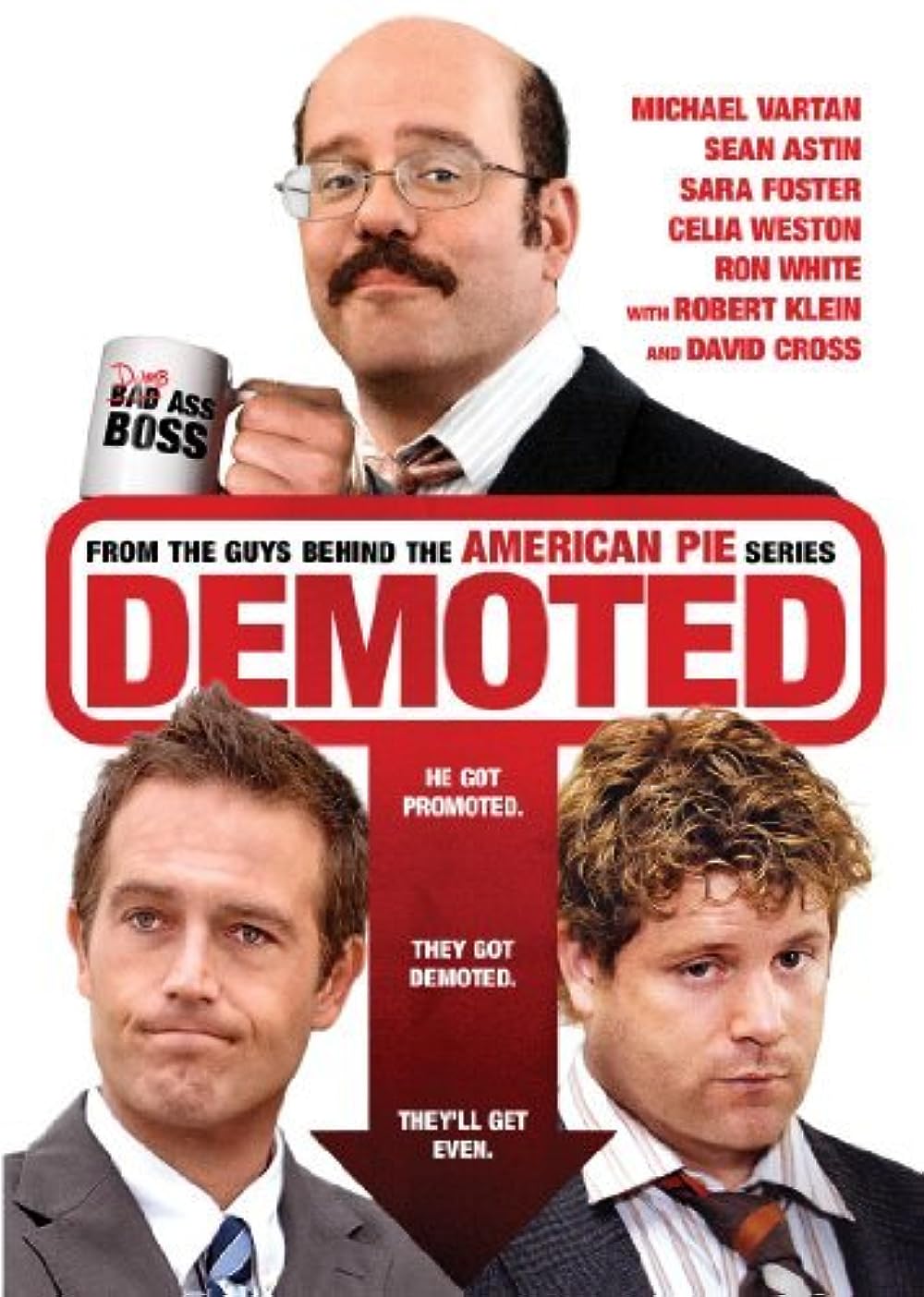
DEMOTED -- DVD review by Porfle


Watching DEMOTED (2011) labor overtime to be like an irreverent combination of OFFICE SPACE, ANIMAL HOUSE, M*A*S*H, and 9-TO-5 is almost as tiring as putting in a full day's work yourself.  Especially since this lame comedy has none of the wit and imagination of the films it's emulating.

Seeing David Cross' big head on the DVD box had me anticipating a lot more from this one, being a devoted fan of the great HBO series "Mr. Show with Bob [Odenkirk] and David."  Indeed, Cross gets to play one of his nerdy-yet-overbearing characters to the hilt here, giving DEMOTED just about its only entertainment value.  But even Dave can't overcome a script that doesn't actually give him much to do or say that's actually funny. 

He plays office drone Ken Castro, a salesman for Treadline Tire Company who is forever being mocked and belittled by bully boys Rodney (Michael Vartan) and Mike (Sean Astin).  Rodney and Mike are the company's best salesmen, but when head honcho Bob Farrell (Robert Klein) kicks the bucket and a gloating Ken lands his position as boss, the two hotshots are demoted from salesmen to secretaries. 

I liked and identified with Ken right away, but we're not supposed to--we're meant to hate him and side with Rodney and Mike, the "cool" guys (think Hawkeye and Trapper vs. Frank Burns), instead of the other way around.  So as the story trudges along, Ken's character gets progressively more irritating, inept, and bigoted while Rodney and Mike develop a new Ghandi-like empathy and respect for their fellow secretaries whom they once treated like chattel.  (I still liked Ken better.)

When Ken has their modest breakroom-slash-storage closet demolished (during which a scene straight out of ANIMAL HOUSE is reenacted), it's last-straw time with the former bully boys leading their new female comrades in a revolt that includes a scene straight out of M*A*S*H in which Ken's trip to the bathroom results in public humiliation.  The trouble is, the bland direction achieves no build-up and payoff to elicit M*A*S*H-level laughs--it just happens, and Cross is forced to flop around on a wet floor with his pants down while we're expected to finally give up and laugh.  And that's the film's comedy highlight.

The dialogue is equally unfunny, as when Rodney reels off this one-liner to Ken:  "Good morning, Kenny.  How's your ass?  Was your boyfriend gentle on you last night?"  Michael Vartan's lack of appeal as the lead doesn't help, including a lengthy subplot concerning his impending marriage to Jennifer (Sara Foster), who doesn't know he's been demoted, and his abrasive relationship with her overbearing father, J.R. (Patrick St. Esprit), who, in another comedy highlight, forces Michael to gaze at his pecker in the men's room to prove he's the alpha male of the two. 

Sean Astin can be likably funny with the right material, but he doesn't get it here.  Not even when he's advising a fellow secretary that a blowjob is the perfect anniversary gift for her boyfriend.  As Bob Farrell, Robert Klein proves once again that whatever appeal he has as a stand-up comedian doesn't carry over well to movie roles, particularly when he's pole-dancing drunk in his underwear.  Celia Weston does her best as head secretary Jane, who exists mainly to appreciate how wonderful Rodney and Mike are when they acknowledge the other secretaries as human beings.

A series of boring song montages clutter the already thin plot and seem to be trying to make the story heartwarming at times, which, needless to say, doesn't work.  An equally fruitless attempt at "cute" comes when Mike starts scoring romantic points with a female executive (Constance Zimmer) that leads to a bowling date and lots of smiling.  Direction and editing often appear to be done by people who have never seen a comedy before but have had one described to them. 

The DVD from Anchor Bay is in 1.78:1 anamorphic widescreen with Dolby 5.1 sound and subtitles in English and Spanish.  There are no extras.

It's hard to screw up a comedy in which David Cross plays a major role as an egotistical dweeb, but DEMOTED tries its best to do so and succeeds.  The most suitable tagline I can think of for this failed effort would be: "If you liked OFFICE SPACE...just watch it again." 


Share/Save/Bookmark

Monday, August 28, 2023

DEAD END -- Movie Review by Porfle


Originally posted on 1/19/16


Director William Wyler's 1937 drama DEAD END opens with a beautiful model vista of the city and its tenements and then dissolves to a vast soundstage set in which most of the story will unfold.  It takes place on the edge of the East River, where (as the opening text tells us) every street in New York ends, and where the rich live in lofty apartments whose terraces overlook the poverty and hopelessness of the slum dwellers below.

These include the famed "Dead End Kids", led by Billy Halop, Leo Gorcey, and Huntz Hall when they were barely in their teens but already first-rate actors.  They would go on to various incarnations as the East Side Kids and the Bowery Boys, but here, they're just a bunch of impressionable neighborhood punks who think they want to be big-time thugs like "Baby Face" Martin (Humphrey Bogart), a former Dead-Ender on the lam who has returned to see his mother and former girlfriend. 

The kids are pretty much the main attraction here as they strut and act tough, huddled around a fire in an old barrel or swimming in the filthy water of the East River.  They come from broken homes, often bragging about their stints in reform school or the beatings they got from the old man the night before.  They're funny--especially Gorcey as "Spit" and Hall as "Dippy"--but are vicious when they prey on the pampered rich kid who must pass by them every day with his fine clothes and superior air.


Their leader, Tommy (Halop), lives with his older sister Drina (a luminous Sylvia Sidney) who struggles to support them even as she and her coworkers strike for higher wages.  Drina loves local boy Dave (Joel McCrea), a struggling architect getting by painting signs, but his eyes are drawn to the wealthy playgirl Kay (Wendy Barrie), who likes him while finding his lifestyle distasteful. 

Throughout DEAD END we see the gap between rich and poor as the rich are portrayed as pampered and privileged, the poor as downtrodden and exploited.  Even Drina sports a bruise on her forehead which she got from a cop on the picket line.  The more noble and strong-willed, like Dave (whom we know will eventually realize Drina's true worth in the end), hold on to their scruples while the weak turn to crime. 

Meanwhile, a younger Bogart, still getting "with" billing after McCrae and Sidney, hones his tough-guy persona while also managing to bring some sympathy to his character when he's coldly rejected by his despairing mother (Marjorie Main) and finds that Francey (Claire Trevor), the neighborhood girl he was always sweet on, has fallen into prostitution.  Main is light years from her "Ma Kettle" character here, while Trevor, always stunningly talented, gives a brief but heartbreaking performance.


These various factions naturally clash when forced to inhabit the same concrete jungle day after day, leading to a dramatic finale that sees Bogart and McCrae trading hot lead while Drina tries to keep her brother Tommy from being arrested after one of the gang squeals on him.  The story ends as it began, with the Dead End Kids resolving their own external and internal conflicts the only way they know how, while hopefully learning something positive from it all. 

Wyler's inventive direction explores that awesome soundstage in inventive ways while making the most of his actors' faces in tight, dramatic closeups.  Gregg Toland's lush black-and-white cinematography is shadowy and noirish, especially in the climactic scenes with Bogart and McCrae stalking each other through back alleys and across the rooftops.  The supporting cast includes Allen Jenkins as Martin's crony "Hunk" and Ward Bond as a burly doorman who doesn't get along with the gang.  

While the message may get a bit heavy-handed at times, DEAD END is a treat for lovers of classic film drama and the great actors and filmmakers of yesteryear.  And the Dead End Kids themselves have never been more fascinating, natural, and bursting with energy and talent.


Share/Save/Bookmark

Sunday, August 27, 2023

THE MALTESE FALCON (1941) -- Movie Review by Porfle


Originally posted on 1/30/16


The first great "film noir", 1941's THE MALTESE FALCON, set the standard both storywise and in its impeccably exquisite visuals.  First-time director John Huston does a masterful job orchestrating his actors and crew to create a visual experience which is consistently involving and often dazzling. 

The film, shot mostly on interior sets, was brought in on budget and ahead of schedule despite Huston requesting an extra day of rehearsal for the film's climactic sequence, which takes place entirely within a single hotel room with almost all members of the main cast.  The complex character interactions and the way the tangled plot is meticulously resolved during this scene makes for some of the most breathlessly riveting cinema ever filmed.

Huston uses clever direction and camera movements to keep things from getting claustrophobic, and never once lets the pace drag.  His screenplay follows Dashiell Hammett's novel almost to the letter (the two earlier, inferior adaptations, 1931's "Dangerous Female" and the comedic "Satan Met a Lady" in 1936, didn't), and crackles with scintillating dialogue, intriguing plot twists, and relentlessly building suspense. 


Hammett's celebrated anti-hero Sam Spade is the perfect noir detective--brash, resourceful, self-assured, keenly intelligent, streetwise, tough but not infallible, and opportunistic.  He does have a moral code, one not easily compromised, and a motto that is rigidly enforced: "Never play the sap for anyone." 

The first person to try and use him is quintessential femme fatale Brigid O'Shaughnessy (exquisitely  played by Mary Astor), who hires San Francisco private detective Spade and his partner Miles Archer (Jerome Cowan) to locate her missing sister along with a mystery man named Floyd Thursby.  When both Archer and Thursby turn up dead, it appears there's more to Brigid's story than she's letting on. 

Before long Spade discovers that she's after a priceless treasure known as the Maltese Falcon, for which she's in fierce competition against  "the Fat Man" Kaspar Gutman (Sydney Greenstreet) and the wily, effeminate Joel Cairo (Peter Lorre).  Spade must spar with these conniving characters while fending off police detectives Dundy and Polhaus (Barton MacLane, Ward Bond), who suspect him in the murders although the more genial Polhaus tends to side with Sam.  All in all, these actors comprise one of the finest casts ever assembled for a film.  (Look for John Huston's father Walter in a quick cameo as a fatally wounded ship's captain.)


Huston delights in working with these masterful performers as any artist deftly employs his chosen medium.  The dialogue scenes between Bogart and Greenstreet are a verbal delight (Gutman constantly admits his glowing admiration for the crafty Spade), while the utter dishonesty underlying Spade's love affair with Brigid gives it an air of perversion. 

Lorre's Joel Cairo, both dangerously scheming and amusingly fussy, is always fun to watch.  I love the scene in which Spade disarms and manhandles Cairo, whose main concern is expressed with the heated accusation: "Look what you did to my shirt!"

Even young character actor Elisha Cook, Jr. gets to shine in the plum role of Gutman's "gunsel" Wilmer Cook, a callow trench-coated hood hiding his cowardice behind guns and tough talk.  (Dwight Frye played the part in the 1931 version.)  The ever-sharper Spade delights in yanking Wilmer's chain, and in one incredible closeup we see fat, glistening tears suspended in each of the young killer's eyes as he's overcome with burning frustration and impotent rage (another bravura touch by Huston).


But it's Bogart's show, and his performance is a pure delight.  We know Spade's a stand-up guy, yet the moment his partner's murdered he has the signs around the office changed from "Spade and Archer" to "Samuel Spade."  He's even having an affair with Archer's wife, Iva (Gladys George), but loses interest once he meets Miss O'Shaughnessy.  Yet we know he's an okay guy as long as his faithful gal Friday, Effie (Lee Patrick), still secretly loves him. 

In one delightful moment, after storming out of a tense encounter with Gutman and Wilmer in the Fat Man's swanky hotel room, Spade smiles when he realizes that his hand is shaking and his palms sweating.  Spade may be brave, but he still gets scared, a fact which both amuses and excites him.

This vintage detective yarn sizzles with suspense and excitement for viewers who are able to plug themselves into its high-voltage current.  For me, it took several viewings before I finally began to appreciate just what a finely-rendered thing of beauty it truly is.  Others (as some IMDb comments would indicate) seem to take a strange kind of pride in remaining immune to its charms, believing that such classics are revered by many simply because they're "old." 

But if it doesn't hit you right away, just keep watching and remain open to it.  Chances are that sooner or later, THE MALTESE FALCON will weave its magic spell over you.  Like the rare and unique artifact of the title, it's "the stuff dreams are made of.

Read our review of the BEST OF BOGART COLLECTION


Share/Save/Bookmark

Saturday, August 26, 2023

CASABLANCA -- Movie Review by Porfle


Originally posted on 1/22/16


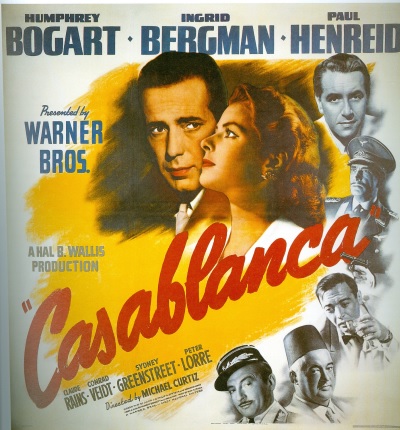
CASABLANCA (1942) is one of those films which we can now look back on as an undisputed classic in which everything seems to come together perfectly.  At the time, however, it was regarded by the studio as just another production, whose script, based on the unproduced play "Everyone Comes to Rick's", was being written on the fly and didn't even have a proper ending worked out until shortly before it was shot.

 The story takes place in 1942 in the Vichy-controlled Moroccan city of Casablanca, which overflows with refugees desperately struggling to gain passage to America and elsewhere in the free world to escape Nazi encroachment in Europe .  Exiled American (and ex-freedom fighter) Rick Blaine, played to perfection by Bogart , runs a nightclub called "Rick's Café Américain" in which many of these people meet to buy and sell the hope for freedom. 

 Also on hand is Rick's friend, Captain Louis Renault (THE INVISIBLE MAN's Claude Rains in one of his best performances), the head of the local police and an opportunist of the first order whose greatest pleasure is accepting bribes both monetary and sexual.  Renault openly admires Rick's similarly self-serving qualities and even displays a platonic crush on him ("If I were a woman, and I were not around, I should be in love with Rick," he admits). 


We wonder how Renault would react if Rick started reverting back to his old, noble self, especially in the presence of the vile German officer Major Heinrich Strasser (Conrad Veidt, THE CABINET OF DR. CALIGARI,  THE MAN WHO LAUGHS), newly-arrived and on the trail of famed Czech resistance leader Victor Laszlo (Paul Henried). 

 While Rick starts out as an anti-hero, he gradually and without really meaning to becomes more heroic as the story progresses.  Early on, Peter Lorre's oily Ugarte--who recently killed some German soldiers to attain two letters of transit to sell in Casablanca--begs Rick for help before he's captured ("Hide me, Rick!  Hide me!").  Rick's terse response: "I stick my neck out for nobody." 

And indeed, Rick seems grudgingly content to sit out the current world war as manager of his bustling nightclub until one night, when an old flame named Ilsa (the utterly radiant Ingrid Bergman) comes through the front door with her husband, none other than Victor Laszlo.  Rick, once an idealistic crusader himself but now cynical and disillusioned, has never forgiven Ilsa for inexplicably running out on him during the fall of Paris, at the height of their love affair--not knowing that Laszlo, whom they both thought dead, had turned up alive.


 When Rick obtains the two letters of transit from Ugarte, he has the means of whisking Ilsa back to America with him and resuming their love affair while leaving Laszlo behind to carry on alone and devastated.  But will he do something so selfish and immoral?  Or regain his soul and commit the supreme act of sacrifice for the sake not only of Ilsa and her husband but of the free world itself?

 This is the dilemma which gives CASABLANCA much of its power to effect us emotionally while simmering with a growing suspense.  As a film, everything clicks-- Michael Curtiz' sharp direction, the gorgeous black-and-white photography, great performances by a stellar cast, a powerful musical score by Max Steiner, and a story that's always totally engaging. 

 Action and romance are perfectly balanced and compliment each other, while comedic touches abound, especially from the delightfully corruptible Renault,  the antics of Rick's eccentric staff (including S.Z. Sakall), and a fez-topped Sydney Greenstreet (again) as a competing club owner who wants to acquire Rick's place along with his loyal piano-playing band leader Sam (Dooley Wilson, who croons the classic "As Time Goes By").


But when Laszlo exhorts Sam and his band to strike up a stirring rendition of "La Marseillaise" in response to Strasser and his fellow German officers belting out "Die Wacht am Rhein", the move (which Rick okays with a subtle nod of his head) not only stirs the patriotic fervor of everyone else in the club but may bring the viewer to tears as well.  (Steiner uses this same anthem as a fanfare for his own musical credit during the main titles.)

The climax of the film takes place at the airport, a focal point for dreams of freedom throughout the story.  Rick now literally holds the ticket to a new life with Ilsa, who will join him if he asks her to.  Yet his newly reawakened sense of duty to humanity now fights for precedence.  Meanwhile Renault, his own duty to Strasser  putting him at odds with his friend, awaits Rick's decision. 

 When the plane fires up its engines, Steiner's music swells, and there comes a stunning, perfectly-edited series of  closeups of Bogart,  Bergman, and Henried which generate a dramatic tension few films could ever attain.  It's pure, undiluted Hollywood magic at its most sublime, and the resolution which follows couldn't be more perfect.  CASABLANCA is an intricate jigsaw puzzle of seemingly disparate pieces which fit together to form a beautiful picture.

Read our review of THE BEST OF BOGART COLLECTION


Share/Save/Bookmark