HK and Cult Film News's Fan Box

Showing posts with label Horror. Show all posts

Thursday, August 6, 2026

CHROMESKULL: LAID TO REST 2 -- DVD review by porfle


(NOTE: This review is based on the unrated director's cut. Originally posted on 9/11/11.)


The tall, skinny, bald guy with the chrome skull-mask, the wicked knife, and the video camera perched on his shoulder like a parrot is back in CHROMESKULL: LAID TO REST 2 (2011) and this time, he's got back-up. 

The last we saw of Ol' Chrome-Dome (Nick Principe) back in the first LAID TO REST (2009), he was lying on the floor of a rural convenience store with his face ripped off and his skull smashed in.  Well, you can't keep a good monster down, so when this sequel picks up right where the last one left off, we see his crew sweep in, dispatch the investigating police, clean up the crime scene, and whisk their boss to an operating room where surgeons labor to save his life and what's left of his face.

It turns out that he's one of those multi-millionaires who can afford to do whatever the heck he pleases and pay people to willingly help him do it, even if that includes setting up an elaborate torture chamber for him (in his chrome-plating factory, naturally) and stocking it with kidnapped young girls.  His right-hand woman, Spann (the ever-popular Danielle Harris) even seems to enjoy her job, as does his main fixer, Preston, who is very well played by Brian Austin Greene. 


Green seems to revel in the Preston role, portraying a borderline psycho who wants to follow in his boss' footsteps by adopting the chromeskull mask and performing his first kills with an almost sexual ardor.  Not only do we get a shocking pre-titles sequence that harkens back to FRIDAY THE 13TH PART 2, but we get a little of PART 5 as well with an imitator going around making like the main man.  This not only gives Green a chance to stretch his acting muscles but also gives gore fans a double dose of carnage.

Like a cross between Jason Voorhees and Mason Verger of HANNIBAL, Chromeskull, now sporting a hideous patchwork face, spends his recovery time stalking a new girl to obsess on now that Princess, his previous object of interest, is out of the picture.  Her replacement is Jess (Mimi Michaels), who has an eye disease that's slowly making her go blind.  In one of the film's first startling kill scenes, Jess' best friend is dispatched in imaginatively gruesome fashion and Jess is abucted, waking up in a casket while being taunted by Preston.  Mimi Michaels plays the role to the hilt, screaming very convincingly and emoting her buns off.

Thomas Dekker returns as Tommy (last seen driving away with Princess in the last film) and gets caught up in the whole mess again, this time coming to the aid of Jess.  They both end up in Chromeskull's factory where they witness some of the film's more elaborate kills, including a virtuoso decapitation and a thing with a spring-loaded blade cluster (a chrome-plated custom job designed by Preston) giving another character a really big smile. 

Other death scenes of interest include a nasty disembowelment (with the victim being portrayed by twins in order to achieve a tricky single take), a head sliced vertically in half like a cantelope, the impromptu chrome-plating of somebody else's head, and another impressive single take in which Chromeskull wipes out a number of cops one after the other in gruesome ways.  The gore effects are achieved, as in the previous film, by combining excellent practical effects with some subtle CGI enhancements. 


Speaking of cops, they're a pretty ineffectual bunch here.  Owain Yeoman plays Detective King, who looks a little young to be heading the precinct, and Christopher Allen Nelson (Beatrix' almost-husband Tommy in KILL BILL) is Max, his best detective.  "Best" being a relative term, since the whole squad amounts to little more than kill fodder for Chromeskull.  When they bust into the chrome-plating factory to rescue Jess and Detective King yells, "You're safe now!", I thought, "Yeah, right."  Hot female detective Holland (Angelina Armani) fares no better.

Gail O'Grady appears as Jess' mother and a grown-up Eric Lloyd (of the SANTA CLAUSE series) is billed as "Geeky Lackey."  The actress who played Princess in the first LAID TO REST, Bobbi Sue Luther, is neither seen here (her flashback scenes were reshot with Allison Kyler replacing her) nor mentioned by name (unless I missed it).  

The DVD from Image Entertainment is in 1.78:1 widescreen with Dolby 5.1 surround sound.  Subtitles are in English and Spanish.  Extras include a commentary with director Robert Hall, co-writer Kevin Bocarde, and actor Brian Austin Green, along with a making-of featurette, deleted scenes, bloopers, and a trailer.  There's also a feature which allows viewers to jump to any one of the various kill scenes.  (Stick around through the closing credits for a two-minute epilogue.)

While the film is pretty fast-paced and the additions to the Chromeskull mythology fairly interesting, I prefer the first film with its creepier settings, more enigmatic killer, more likable characters, and more involving story.  This one has none of its dry humor (Sean Whalen and Kevin Gage are especially missed) and the main girl, Jess, is winsome but not really all that interesting.  Still, CHROMESKULL: LAID TO REST 2 is head and shoulders above most of the cheap slasher flicks being churned out lately, continuing the first film's "cavalcade of cool kills" approach with a little style and a lot of enthusiasm.  And Chromeskull is definitely one of the major movie monsters of the last few decades.


Share/Save/Bookmark

Wednesday, August 5, 2026

LAID TO REST -- DVD Review by Porfle


Originally posted in 2009


"A guy in a mask chasing a girl...that usually works," thought writer/director Robert Hall while thinking up ideas for a follow-up to his '04 debut feature, LIGHTNING BUG. And what a mask--a grinning chrome skull, which fits over the face of tall, lanky, cueball-bald actor Nick Principe. With his imposing stature and graceful, deliberate movements, in addition to being nattily-dressed in a tastefully tailored black outfit, Chrome Skull is one of the most interesting slasher anti-heroes since the 80s. And LAID TO REST (2009) is a glossy, blood-drenched, pedal-to-the-metal throwback to that era.

The chilling titles sequence gives us jagged glimpses of Chrome Skull nastily doing away with several young women. Then we meet our heroine, The Girl (Hall's wife Bobbi Sue Luther in a lively performance), as she wakes up in a closed casket in a funeral home, with no memory of who she is or how she got there. After witnessing the gruesome death of an old mortician (the venerable Richard Lynch) at the hands of Chrome Skull, she flees down the highway until she's picked up by a kindly redneck named Tucker (Kevin Gage, best-known by me as the vile "Waingro" in Michael Mann's HEAT), who takes her home. Tucker's wife Cindy (Lena Headey, "Terminator: The Sarah Connor Chronicles", 300) isn't too pleased at first, but soon warms up to the poor frightened woman. Then Chrome Skull shows up and pins Cindy's head to a wall with his knife.

We should probably talk about Chrome Skull's knife for a minute. It's a real doozy--in fact, it makes those things carried by guys like Jim Bowie and Crocodile Dundee look like toothpicks. Razor-sharp on one side, with jagged spikes on the other, the massive chrome blade is perfect not only for slicing and jabbing but also for sawing people's heads off. Which seems to be one of the many hobbies that keep Chrome Skull occupied. We never learn much about what happened to screw this guy up, but with a phallic extension like this, he definitely has a sexual hang-up or two rattling around in his shiny skull.

Anyway, Tucker is now on the run with Princess (his nickname for the mysterious girl) and along the way they pick up a geeky nerd named Stephen, who's played by the very familiar and funny Sean Whalen (THE PEOPLE UNDER THE STAIRS, TWISTER). They take refuge in the funeral home, which is troublesome for Stephen since his mother just died, and even more troublesome when he sees her head floating toward him in the dark. After a lot of running around from place to place, and a lot of doing stupid stuff that people in slasher movies always do, the three finally end up barricaded in a small grocery store with a couple of rave-bound party boys named Tommy and Johnny (Thomas Dekker, Johnathon Schaech). But they can't keep Chrome Skull out for long, and before you know it he's in there making mincemeat out of anything with a heartbeat.

This is the kind of eye-popping, knuckle-baring slasher flick I was looking for back in the old days whenever I'd trudge to the latest FRIDAY THE 13TH crapfest or rent yet another piece of dreck like THE BURNING or THE PROWLER, ever hopeful that the next one would actually turn out to be worth watching. With LAID TO REST, Robert Hall has taken the old formula and done it up with all the bells and whistles--state-of-the-art gore effects from his own renowned makeup studio Almost Human, a sharp script that lovingly reprises all the old cliches while giving us a few new twists, a top-notch cast, and a cool monster who videotapes his kills with a shoulder-mounted camera (an element which will later provide clues to Princess' mysterious origins). Hall proves himself a very capable director, and the cinematography, done with a Panasonic HPX-3000 high-definition 1080p camera in the AVC Intra Mode (I don't know what any of that means, but it sounds awesome), makes this one of the best-looking indy slasher flicks you'll ever see. Hall's own band Deadbox contributes to the exciting heavy metal musical score.

Extras include an enthusiastic audio commentary from husband-wife team Hall and Luther and the half-hour "Postmortem: The Making of Laid to Rest", a very entertaining and well-produced documentary. There's also a look at "The SFX of Laid to Rest", a few deleted scenes, some funny bloopers, and a trailer.

This isn't "torture porn" as much as an homage to the classic stalker-slasher era with suspense sequences punctuated by sudden, flabbergasting death scenes. It's the kind of gore effects that you used to see featured in big full-color spreads in Fangoria magazine, but when you went to see the movie you'd find they'd all been snipped into almost subliminal split-second flashes to avoid an "X" rating. Not in this unrated director's cut, however--everything's as horribly graphic as the most avid gorehound could hope for. Almost Human studios specializes in realistic-looking dead bodies, which are abundant in the aftermath of Chrome Skull's homicidal activities, and they also give us some of the most shocking kill scenes ever created. These are done with good old-fashioned makeup FX (one death scene even uses bladders) which are augmented by CGI to create some pretty convincing carnage. The most jaw-dropping (literally!) effect comes fairly early as one guy gets Chrome Skull's blade right through his cheeks, which our whimsical hero removes by taking the top of the guy's head off. Yikes! If that sounds intriguing to you, then you really should check out LAID TO REST. If not, then I would advise you to stay as far away from this movie as possible.


Share/Save/Bookmark

Saturday, August 1, 2026

THE LAST HOUSE -- DVD Review by Porfle


Originally posted on 11/23/15


Described as a "psycho-sexual thriller", THE LAST HOUSE, a.k.a. "Breath of Hate" (2015) wants to be deep and maybe even a little avant-garde--in addition to being violent and perversely sexy--but doesn't quite have the finesse to pull it off.

CLERKS' Jason Mewes (ZOMBIE HAMLET, SILENT BUT DEADLY) is Ned, a lovesick schlub trying to convince his hooker heartthrob Love (Lauren Walsh, MEET THE SPARTANS) to quit the business and be his one-guy gal.  But when Love finally goes to her pimp to serve notice, Sonny (Jack Forcinito, SILENT NIGHT, ZOMBIE NIGHT) strongly insists that she go on one final job with two other hookers to a swanky mansion where a wild sex party is to be held.  Reluctantly, Love agrees.

Bad idea, since we've already seen the three psychotic squatters occupying the mansion do away with a lady realtor (SLEEPAWAY CAMP's Felissa Rose in a brief, thankless cameo), and it's obvious their idea of "party" will prove unpleasant for the three unsuspecting working girls.


There's Cleb (Ricardo Gray), an excitable young black dude whose "crazy happy" mood, we're told, must be seen to be believed; Selma (Monique Parent, THE PERFECT HOUSE), a wickedly dominant sex bomb; and "Hate" (Ezra Buzzington), the oily, enigmatic, and endlessly verbose ringleader of the tawdry trio.  Once this dubious situation gets into full swing, THE LAST HOUSE becomes a round-robin series of sexual trainwrecks. 

Cleb, we discover, likes cheerleaders.  In fact, he thinks they look good enough to eat--literally.  He's also partial to heating up half a canteloupe in the microwave and then making love to it AMERICAN PIE-style, and when these two scenarios are edited together the confusion is compounded when Love suddenly shows up and starts hacking away at him with a butcher knife.  Or does she?

Meanwhile, some of the film's kinkier deeds are performed in the upstairs bedroom when Selma has her way with the other hooker in a mistress-slave scenario that includes spanking, toe-sucking, and other sleazy sex stuff that skirts the boundaries of "softcore" before turning baseball-bat violent and, for me anyway, baffling.


But the most perplexing part comes when we watch our heroine Love in an increasingly troublesome tryst with "Hate", which starts out creepy and just gets worse, until he starts to live up to his name and she finds herself in grave peril. 

Which sounds straightforward enough, but is anything but because this film, remember, wants to be some kind of sleazy art film with its jumbled timelines and rambling monologues. 

Despite his on-the-nose moniker, Hate reminds me mainly of an evil David Spade--not very menacing, even when his true nature starts to bleed through.  The story gets progressively strange as characters die, live again, kill, get killed, etc. and we see a variety of flashbacks, flash-forwards, dreams that foretell the future, alternate outcomes, and other timeline-fiddling. While all this is going on, Ned is busy trying to track down Love by haunting the strip club where she works and going head to head with Sonny.


Jason Mewes handles his role well enough but it's Lauren Walsh as Love who's the real standout here.  Monique Parent is meant to be wickedly sexy, which is something she could do without breaking a sweat.  As Hate, Ezra Buzzington gets an "A" for effort although I never found the character as intriguing or mysterious as intended.  Jack Forcinito is sleaze personified as the pimp Sonny, whose main concern is his miniature pet turtle. 

The DVD from WildEye Releasing is widescreen with Dolby Digital sound.  No subtitles.  Bonus features consist of a writer and director commentary, deleted scenes, a Cinemayhem Film Festival director interview, and the film's London premiere at the Gorezone Film Festival.

While some members of the cast double as prolific porn stars, THE LAST HOUSE is more thriller and less sleaze than the synopsis might lead you to believe. I didn't find it all that thrilling, either, but I must give the filmmakers credit for trying something different. 


Share/Save/Bookmark

Tuesday, July 28, 2026

GHOSTS OF GOLDFIELD -- DVD Review by Porfle


Originally posted on 4/10/09


I didn't like the film version of THE SHINING, so any horror movie about ghosts in a big old hotel is going to have to outdo Kubrick in order to win me over. (Okay, that may be a slight exaggeration.) And like the little engine that could, GHOSTS OF GOLDFIELD (2009) huffs and puffs its little heart out trying to do just that. But despite the best efforts of all involved, it never really builds up much steam.

Julie (Marnette Patterson of "Charmed") is a psych major who's doing a thesis on ghosts, so she rounds up some college friends to help her shoot a film inside the haunted Goldfield Hotel, situated in a ghost town in the middle of the Nevada desert. The main reason the place is haunted is because long ago, the rich bastard who built it tortured his mistress Elizabeth (Ashly Rae) to death in one of the rooms after finding out she was cheating on him with the hotel's bartender. He also tossed the couple's illegitimate baby down a mine shaft (what a sweet guy!), so now Elizabeth's ghost roams the corridors wailing "Where's my baby?" (And no, dingos are not involved.)

There's some other stuff mentioned about the hotel being a portal between the worlds of the living and the dead, but nothing much ever comes of this. And the fact that Elizabeth (who resembles Juliette Lewis after a bad weekend) seems to be the only ghost in the whole place for much of the movie really cuts down on the haunt factor. First-time director Ed Winfield displays little skill at building suspense or putting together effective scare sequences, while the cast seem unable to convincingly convey extreme emotions when necessary. Even their casual banter often seems awkwardly improvised, though much of the blame for this is probably due to the writers not giving them much to work with.

Besides Julie, there's her straitlaced boyfriend Dean (Scott Whyte), nice-guy cameraman Chad (TWILIGHT's Kellan Lutz), obligatory jackass Mike (Richie Chance), who stays drunk most of the time and likes to jump out and scare people, and Keri (Mandy Amano), the whiner who's constantly griping about being hungry or tired when she isn't swiping stuff from the hotel to sell on eBay. You know your cast isn't too impressive when the best performance comes from "Rowdy" Roddy Piper, who plays Elizabeth's secret lover Jackson Smith (in flashback) with something resembling two strips of beef jerky glued to his jowls to represent old-timey sideburns.


As expected, members of the group begin to wander off by themselves down dark, spooky corridors as soon as they enter the hotel. Director Winfield relies heavily on shots of mysterious figures flitting past the camera, clutching hands, and other familiar stuff to keep us on edge. The ghostly image of Elizabeth wandering around with her blazing red eyes, flowing white gown, and crazed expression are somewhat effective at times. Late in the story we begin to get a few gory kill scenes, but nothing very elaborate. Also as expected, nobody is able to get a signal on their cell phones! It's inevitable nowadays that horror movies must deal with this issue, and lately it seems more and more as though scriptwriters are simply saying "Screw it--the cell phones don't work."

The DVD is in 16x9 widescreen with 2.0 stereo sound. Direction and photography are average at best, and at times not very good. I viewed a screener with the movie only, but the release version promises a director's commentary, stills gallery, and trailers.

During the story, Julie begins to have visions of herself in the hotel during a past life, and her possible connection with Elizabeth's tragic demise leads to a downbeat and somewhat surprising finale that sends the movie off on a high note. GHOSTS OF GOLDFIELD is an okay time-waster if you're not in a very demanding mood; otherwise, chances are you'll find it more tame and tedious than scary.


Share/Save/Bookmark

Monday, July 27, 2026

B.T.K. -- DVD Review by Porfle


Originally posted on 4/12/09


The same tall, imposing figure, dressed in coveralls, relentlessly stalking his next hapless victim--Kane Hodder remains as intimidating a screen presence now as he did as Jason Voorhees in the FRIDAY THE 13TH films. But there's no hockey mask here, only the face of a normal, everyday guy. Yet there's something about it that isn't quite right, something a little off...just enough to give you the creeps. Because this isn't the face of a mindless killing machine. It's the guy next door.

Which is one of the reasons B.T.K. (2008) is so effective. Hodder plays Dennis L. Rader, a devoted husband and father of two grown daughters, a man active in his church, a man with a fairly responsible position--he's what's called a "compliance officer", which means he gets to wear an official-looking uniform and drive around his sleepy Kansas town in a white van, looking for infractions of various city ordinances. Rader takes this job seriously, perhaps a bit too seriously, to the point of being anally obsessive and at times downright hostile toward people who let their poodles run loose or don't keep their lawns trimmed (he actually measures the grass). Not only does this feed his voracious ego and help bolster his feelings of inadequacy, but it also gives him an opportunity to scope out potential victims--the women who will be his next targets for home invasion and brutal murder.

B.T.K. isn't your usual colorfully-inane slasher flick for teenagers to hoot and throw popcorn at. It's closer to the somber, uncomfortably realistic feel of HENRY: PORTRAIT OF A SERIAL KILLER, although Dennis isn't quite the remote, solitary cold fish that Henry was. He revels in his family life and his community and church activities, as long as he has brutal murder as a release valve for his pent-up rage and an outlet for his sexual frustrations. Hodder is great at portraying the two sides of Dennis--he's all smiles and banal cordiality until the little psycho-dial in his head inches into the red and he starts turning into a monster. And with his hulking physique, bull neck, and big, powerful hands, he's someone you wouldn't want coming after you.

Writer-director Michael Feifer doesn't go in for the flashy, elaborate kills that require the services of guys like Tom Savini or the inventiveness of Rube Goldberg. The real thing is scary enough when presented in a realistic way, as he does here. The performances in B.T.K. are generally good (Hodder himself is excellent) and natural enough that we feel for these everyday people whom Dennis strangles, stomps to death, smothers with plastic bags, or simply shoots in the head. The fear we all feel of having a vicious killer stalking us in our own homes is vividly portrayed. Feifer uses a hand-held camera to good effect and deftly stages the terror sequences so that they're both unnerving and emotionally disturbing. Direction and editing are above average throughout. Not every scene works, of course, and some of the later ones with Rader's family discovering the truth about him as police investigators move in are less than successful.

As the film goes on, we're taken deeper and deeper into Dennis' whacked-out mind while also getting disquieting glimpses from the victims' POV as well. One rather shocking scene shows him tracking down and getting revenge on a hooker who ran out on him earlier in the film--he decorates the wall with her husband's brains and begins to strangle her, which we see through her eyes as her vision dims, then returns, over and over again as Dennis sadistically brings her to the point of death several times before the kill. Then, he suddenly sees his own daughter in her place and freaks out. His mental state becomes even more unstable later on until ultimately we're just as unsure as he is of what's real and what isn't. Which leads to one of the film's most disturbing moments--a final twist that ends the story on a disorienting, dispiriting note.

Picture and sound quality are good--the DVD image is 16 x 9 widescreen with 5.1 surround audio. My screener contained no extras but the final release should boast a commentary track featuring director Feifer and Kane Hodder, a stills gallery, trailers, and Spanish subtitles.

B.T.K. (the title stands for "bind, torture, kill" after the infamous B.T.K. Killer, who inspired this fictional account) isn't a "fun" movie by any means. But it is often harrowing, disturbing, and effective. Mainly because the killer isn't a faceless automaton in a mask, or a grossly disfigured monster, but just some guy you might pass by on the street. Or glimpse out of the corner of your eye while sitting at home alone at night, right before he whips the plastic bag over your head.


Share/Save/Bookmark

Sunday, July 26, 2026

NIGHT STALKER -- DVD Review by Porfle


Originally posted on 7/28/09


A specialist in serial killer films as of late, prolific director Ulli Lommel adds to his screen bios of Son of Sam, the D.C. Sniper, the B.T.K. Killer, the Zodiac Killer, and others with 2007's NIGHTSTALKER, which is being given a new DVD release on Sept. 8 by North American Motion Pictures (under the slightly different title NIGHT STALKER). This weak and ponderous effort makes the recent serial killer films of director Michael Feifer look like "Masterpiece Theater" by comparison.

After a brief flashback of Richard Ramirez as a child witnessing his crazy war-veteran uncle shooting his crabby aunt in the head, the film is virtually plotless. Just about the only other thing that doesn't involve Ramirez skulking around the streets of Los Angeles looking for his next victim is the part where he follows an attractive young woman to a party and is introduced to drugs and Satan worshipping. Her supposed influence on him is manifested by several flashbacks during the murder scenes, consisting of quick closeups of her eyes as she chants "Hail Satan!"

Ramirez hates women, we're told early on, and is intent on putting them in their place. Thus, several of his victims in the movie are bitchy women in the process of bawling out some mousey guy, which seems to set off his "stalker sense" and lead him straight to the scene where he starts blasting away. This is repeated several times ad nauseum during the movie--scenes of couples arguing intercut with shots of Ramirez shuffling down the sidewalk sucking on his ever-present Charms Blow Pop until he arrives on the scene. Bad acting ensues, squibs go off, and star Adolph Cortez is directed to play around with the fake blood that's all over the place while director Lommel fiddles with artsy camera angles and editing.

I've always considered Richard Ramirez to be one of the scariest and most menacing of the famous serial killers, but Cortez plays him like a weaselly high-school dropout looking to score some weed for the big Phish concert. He does a voiceover with a lot of talk about evil and "darkness" and all that stuff, and keeps telling us "God is dead", etc., but there's no real connection between these ominous words and the smirking Richard Grieco wannabe who skulks around endlessly sucking on Blow Pops. Cortez goes through so many bags of Blow Pops during the course of this movie that his stomach lining must have developed an impenetrable candy shell.

Unfortunately, this is just about the only unique trait the character has, so Cortez works those damn things like he was doing a softcore porn tease. Besides that, all the script gives him to do is one walking-around sequence after another topped by yet another splattery bang-bang. After awhile the film becomes mainly a showcase for some decent head-shot squib effects.

NIGHT STALKER has that shot-on-video look and a wildly-inappropriate synth score that often works against the desired effect. The DVD image is 16 x 9 anamorphic widescreen with 2.0 stereo sound. I watched a screener with no extras, but the DVD release is supposed to include a stills gallery and closed captioning.

The film rambles along until the boredom finally ends with Ramirez' capture, which is depicted in a cursory but somewhat accurate manner. Then we're shown the following actual quote: "You don't understand me. You are not expected to. You are not capable of it. I am beyond your experience. I am beyond good and evil." These words are more chilling than anything depicted in NIGHT STALKER. Painting a convincing portrait of Richard Ramirez and giving us an inkling of what it must have been like to live in Los Angeles during his reign of terror or to experience one of his attacks are beyond this film.


Share/Save/Bookmark

Saturday, July 25, 2026

DRIFTER: HENRY LEE LUCAS -- DVD Review by Porfle


Originally posted in 2009


Director Michael Feifer seems intent on chronicling the lives of every vile, lowlife bastard who comes to mind when you think of the term "serial killer." Now, in addition to "B.T.K.", "Boston Strangler: The Untold Story", "Bundy: A Legacy of Evil", "Chicago Massacre: Richard Speck", and "Ed Gein: The Butcher of Plainfield", comes DRIFTER: HENRY LEE LUCAS (2009), a well-made and fairly engaging account of one of the most notorious killers who ever stalked the countryside.

Most of us know at least the basics of Lucas' story--abused physically and mentally by a sadistic mother, he grew up to be a prolific serial killer who traveled with his equally-demented buddy Ottis Toole and Toole's 12-year-old niece Becky, with whom Henry had a romantic affair. After his capture, he confessed to hundreds of murders but later recanted, making it unclear just how many he was actually guilty of.

The screenplay by Feifer and Wood Dickinson generally sticks pretty closely to the facts. The story of Henry's nightmarish childhood proves most affecting, with Ezra Averill as an 8-year-old Henry and Caia Coley giving a frightening performance as his prostitute mother Viola. In addition to making him watch as she has sex with strange men, the monstrous Viola beats Henry brutally, once putting him into a coma with a wooden board, and also abuses her legless husband. When a teenaged Henry (Nicolas Canel) finally kills Viola in what he claims was self-defense, it's pretty much a fist-in-the-air moment.

We see the adult Henry (Antonio Sabato Jr., "The Bold & The Beautiful") commit the first of his serial murders and his fateful meeting with fellow drifter Ottis Toole, played artlessly but with a lot of energy by "Deuce Bigalow: European Gigolo"'s Kostas Sommer. (The fact that grungy, homely Lucas and Toole are portrayed by a couple of relatively hunky actors is a little disconcerting.) Kelly Curran is good in her debut role as Becky, whose eventual murder by Henry is shown near the beginning of the film and revisited later.

The very familiar John Diehl of such films as "Jurassic Park III" and "Pearl Harbor" plays Sheriff Larabie, a fictionalized version of the actual sheriff who was accused of using Lucas as a "confession machine" in order to clear up hundreds of unsolved murders. Farino, the skeptical D.A. is portrayed by John Burke, whom I know mainly as the co-host of "Personal FX: The Collectibles Show." While there really isn't much of an ending to Lucas' story, the final scenes with him being interviewed by Farino do tie things up rather well and bring the film to a satisfactory conclusion.

Despite several opportunites to do so, director Feifer refrains from filling the screen with excessive blood and gore. One of the more lurid death scenes has Henry forcing his way into a woman's kitchen, knifing her in the back, and then strangling her from behind as she crawls away. Another sequence features the strangulation of a hitchhiker and Henry's subsequent necrophilic violation of her body. A movie theater patron gets his throat cut for daring to "shush" Henry and Ottis, and there are several knifings.

For the most part, however, the violence is quick and Feifer doesn't linger over it, preferring to concentrate on the story. The only drawback to this is that the sheer horror of Lucas' crimes is rarely adequately conveyed by this matter-of-fact approach. Direction and photography are consistently good, displaying a fair amount of style and imagination that helps keep things interesting even though there's not really that much of a plot.

The film is presented in 16 x 9 anamorphic widescreen with 5.1 surround and 2.0 stereo audio. My screener contained no bonus features, but the DVD should include a commentary with Feifer and Sabato, stills gallery, and Spanish subtitles.

DRIFTER: HENRY LEE LUCAS does a pretty good job of showing us, in effect, "How to Make a Monster." The scenes of Lucas' childhood are harrowing and sad, yet Antonio Sabato Jr. manages to convey the idea that there's just something inherently evil about Henry (albeit an infinitely banal evil) regardless of his upbringing. While "Henry: Portrait of a Serial Killer" and the lesser-known gem "Confessions of a Serial Killer" remain the last word on the subject as far as I'm concerned, Michael Feifer's version of the story is both visually interesting and perhaps somewhat closer to the real facts than its predecessors.


Share/Save/Bookmark

Friday, July 24, 2026

BUNDY: A LEGACY OF EVIL -- DVD Review by Porfle


Originally posted in 2009


Back in 1990, Corin Nemec starred in a "Ferris Bueller"-inspired TV series called "Parker Lewis Can't Lose." Later, he went against type to play the repellent Harold Lauder in the ABC miniseries "The Stand", based on Stephen King's book. Now, with BUNDY: A LEGACY OF EVIL (2008), Nemec seems intent on exorcising all traces of his nice-guy image by portraying one of the most cold-blooded serial killers of all time, Ted Bundy.

It's hard to say how successful he is at this because at times I couldn't tell if I was supposed to think his Ted Bundy was scary or funny. This is especially true of the scene in which Ted, after murdering a young woman in some isolated location, gets down on all fours and starts howling like a coyote. Sometimes he seems to be still playing perennial loser Harold Lauder, striking out romantically while trying to pass himself off as a normal, dynamic guy. Nemec's theatrical portrayal is occasionally interesting, but rarely convincing.

Some effort is made by writer-director Michael Feifer to show some of the possible reasons for Bundy's warped personality. He had a troubled childhood during which he thought his grandparents were his parents and his mother was his sister (his father's identity being the subject of some dubious speculation). He grew up reading violent horror comics. And he was devastated when his college sweetheart dumped him after she realized that the socially-stunted young man would never grow up. Immediately after this, however, we're shown a montage of brutal abduction-murders with the now totally bonkers Ted having suddenly morphed into a savage, bloodthirsty animal. None of it really comes together to show the evolution of Bundy from troubled youth to psycho.

I read Wikipedia's page on Ted Bundy and found that much of the film's story is fairly accurate, although we still don't get an idea of the sheer number of victims he managed to do away with. The murder sequences themselves are disturbing mainly because the actresses are so convincing--their screams and pleas for mercy are heartrending. Nemec does his best to convey the unhinged monstrousness required, yet his emoting seems overly calculated. He's at his best in the quieter scenes, such as the ones between Bundy and the warden (Kane Hodder) who's about to lead him to the electric chair in the film's bookending segments, or the gripping courtroom sequence in which Bundy serves as his own defense lawyer and makes a mockery of the proceedings.

Michael Feifer, who directed Hodder that same year in B.T.K. and has made a number of other fact-based serial killer films, gives this one the look of an above-average made-for-TV movie. Interestingly, he shoots the early 70s stuff in a way that makes it seem to actually have come from that era, right down to the film stock and cheesy soundtrack songs. This segment of the movie looks as though it could've come right out of a Joe Sarno flick. Artistically, that's the most noteworthy thing about BUNDY: A LEGACY OF EVIL--otherwise, it's capably done but relatively unremarkable.

Other details of Bundy's story are sketched in, including an impromptu jailbreak, a brush with political activism, a stint manning a suicide hotline (where the real Bundy would meet future true-crime author Ann Rule), and a reunion with his college flame Stephanie (the very cute Jen Nikolaisen) which, though fictionalized, results in one of the film's most effective moments. Bundy's infamous rampage through a girls' dormitory is documented in predictably bloody fashion. The final act, of course, consists of Bundy's execution in the electric chair. Feifer, I suspect, was trying for some of the impact of the last minutes of IN COLD BLOOD here. The results are much less effective, yet the sequence does come off pretty well.

How much of Bundy's behavior was simply a deliberate choice to do evil as opposed to the actions of someone incapable of controlling his warped impulses? In the film, a Ted Bundy still hoping for a reprieve puts much of the blame on pornography and other outside influences. Hodder's warden doesn't buy it: "You're not mental. You're not deranged. You're the most normal, intelligent man I've ever had on death row." I think Corin Nemec's performance would have been more effective if he'd played Bundy more like that instead of always trying to make it obvious to us that the guy's a total loon, because we already know that.


Share/Save/Bookmark

Tuesday, July 21, 2026

ALL THE COLORS OF THE DARK -- Blu-ray/CD Review by Porfle


Originally posted on 1/27/19


I'm not all that familiar with the Italian "Giallo" genre (save for some Dario Argento classics such as TENEBRE) which consists of warped, horror-tinged murder stories with lots of bloody violence and other lurid elements. 

So it's always nice to catch a really good one like the Italian/Spanish co-production ALL THE COLORS OF THE DARK, aka "Tutti i colori del buio" (Severin Films, 1972) from Sergio Martino, the director who also gave us TORSO, SLAVE OF THE CANNIBAL GOD, and SCREAMERS.

This one is nowhere near as formally-shot and polished-looking as the usual Argento effort, but Martino has a loose, imaginative style that fits the "anything goes" nature of the material, as well as a talent for staging suspense scenes in interesting ways. 


Our heroine, Jane (cult star Edwige Fenech), has been plagued by horrible nightmares ever since the traumatic loss of her unborn baby following a car crash.  Her lover, Richard (George Hilton), is devoted but unable to help, especially since his job keeps him away for days at a time. 

Jane's sister Barbara (Susan Scott) advises her to visit Dr. Burton, the seemingly kindly psychiatrist she works for.  But Jane finds more solace with a new friend, Mary (Marina Malfatti), a mysterious woman who inducts her into a black magic cult filled with arcane rituals that take place in a creepy old castle in the country.

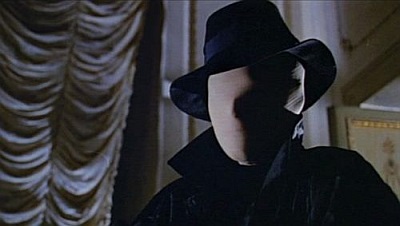
While the mentally and emotionally frazzled Jane may be a bit slow on the uptake, we can tell right away that being forced to drink fresh dog blood and then getting gang-banged by a bunch of stabby, whacked-out weirdos in a cult from which there is no escape probably isn't going to help her as much as a few quiet sessions with Dr. Burton.  Especially since one of the cult members is a creepy trench-coated stalker with neon blue eyes (Ivan Rassimov) who keeps following her everywhere and trying to kill her.


We're never quite sure if we're seeing something real or just one of Jane's waking nightmares, but this lively film keeps us on our toes by constantly alternating the talkier scenes with sudden bursts of action and sometimes shocking violence. 

Much of the suspense is effectively staged around the creaky, open elevator and winding staircase in Jane's shadowy apartment building, and there's a terrific sequence inside Dr. Burton's country estate where Jane discovers a grisly scene involving the elderly caretakers who've been charged with watching over her.

I noticed a few similarities here and there with ROSEMARY'S BABY, which had me suspecting Jane's lover Richard, her sister Barbara, her friend Mary, her shrink Dr. Burton--oh heck, practically everybody--of secretly being part of the cult and their sinister plans for Jane.  Director Martino does like to keep us guessing, all the way up to a nifty fake-out ending in which fantasy and reality clash with deadly results.


The 2-disc Blu-ray from Severin Films is widescreen 1080p full HD resolution with a new 4k scan from the original negative.  Audio is 2.0 English and Italian with English subtitles.  Bonus features include a very learned and thoughtful commentary with Kat Ellinger (author of "All the Colors of Sergio Martino"), interviews with Sergio Martino, screenwriter Ernesto Gastaldi, actor George Hilton & horror expert Antonio Tentori, trailers, and the unrestored alternate US cut of the film entitled "They're Coming to Get You." Also included is a CD of the film's musical score by Bruno Nicolai.

With a fine cast (Edwige Fenech fans will be extra happy), great use of scenic London locations, and a scintillating story full of colorful characters and sinister goings-on, ALL THE COLORS OF THE DARK is pure nerve-wracking fun all the way.


Special Features:
They’re Coming To Get You: Alternate US Cut (88 mins.)
Color My Nightmare: Interview with Director Sergio Martino
Last Of The Mohicans: Interview with Screenwriter Ernesto Gastaldi
Giallo is the Color: Interviews with Actor George Hilton & Italian Horror Expert Antonio Tentori
Audio Commentary with Kat Ellinger, Author of All The Colors of Sergio Martino
Trailers
BONUS Disc: CD Soundtrack 


Share/Save/Bookmark

Friday, July 17, 2026

CHILDREN OF THE CORN -- DVD Review by Porfle


Originally posted on 10/8/09


I've heard the original 1984 version of this movie described as a "classic", but the only things I remember from when I saw it back in the 80s are Linda Hamilton (lookin' good) and Courtney Gains (lookin', unfortunately, like Courtney Gains). And also the fact that, for me, it seems to have been pretty unmemorable. How, then, would I react to a made-for-TV remake of this Stephen King story? Why am I asking you?

Having just watched it, I can now state unequivocally that the 2009 TV-remake of CHILDREN OF THE CORN is...okay. Looking very much like a TV-movie with extra gore and nudity added for the DVD, it begins in 1975 with Burt Stanton (David Anders) and his wife Vicki (Kandyse McClure) driving through Nebraska farm country and trying to find their way out of it. These people hate each other and are constantly arguing, which distracts Burt long enough for him to accidentally run over a little kid who darts out from the tall corn. Shocked and horrified, they discover that the boy's throat has been cut.

Burt decides to take the body to the nearest town and report the incident, but the small village of Gatlin seems deserted. Suddenly, Burt and Vicki are surrounded and attacked by hordes of creepy children who are devoted members of a religious cult led by the diminutive Isaac (Preston Bailey), whom they believe is in direct contact with the wrathful God of the Old Testament. Isaac preaches that all adults over the age of 19 are sinful and must be killed, which is why there aren't any grownups around. Burt and Vicki, naturally, become the next targets of this twisted cult and potential sacrifices to their unusually corn-centric God.

Probably the most noticeable thing about this movie at first is that Kandyse McClure's "Vicki" is one of the most insufferable characters in film history. Crabby, vindictive, self-centered, whiny, verbally sadistic (she berates Burt for being a Viet Nam vet), incessantly bitchy--and these are her good qualities--Vicki is automatically the character we most want to see die horribly.

Others, including perfidious pipsqueak Isaac and his older punk toady Malachai, will join her on that list, along with just about every other brat in the movie, but Vicki tops them all. McClure, who played Sue Snell in another Stephen King TV-remake (the much-superior CARRIE), must be credited for making this character every bit as hateworthy as written.

David Anders' "Burt" thus becomes the only person that we can root for, and the movie is at its best when the former Marine is kicking some serious little-kid butt. His wartime experience comes back to haunt him as he's being chased through the cornfields and has flashbacks in which he imagines himself eluding the Viet Cong, making the protracted chase sequence more interesting. Anders, who I found impressive in the nifty 2006 supernatural flick LEFT IN DARKNESS, does a good job as Burt and gives us just about the only reason we have to care about anything that happens in this movie.

Preston Bailey, who plays Rita's son Cody on "Dexter", tries to be forceful and imposing as cult leader "Isaac" but still looks like he belongs in a Sugar Pops commercial. The kid does manage to spout a heck of a lot of unwieldy dialogue, though, laden with Old Testament-style threats and pronouncements, so you've got to hand it to him. A homicidal fire-and-brimstone wackjob isn't the kind of character that nine-year-old actors are usually asked to portray.

The direction by Donald P. Borchers, who co-produced the original film, is competent but unexceptional. Borchers also wrote the teleplay (inspired by the unused screenplay by King for the first version), which contains some groan-worthy lines such as "Put that in your God and smoke it!" and a whole lot of faux-Biblical blather.

On the sex-and-violence front, some grievous-looking wounds are among the nice gore effects--a broken arm with protruding bone, a spurting throat gash or two, a couple of horribly mutilated victims--and there's a surprising sex scene which takes place on the altar of Isaac's church when he announces that it's time for "fertilization." The score by Jonathan Elias, who also did the music for the original version, is noisy and overbearing. Even the edits make noise.

The DVD from Anchor Bay is 1.78:1 anamorphic widescreen with Dolby Surround 5.1 and English subtitles for the hearing-impaired. The bonus feature is an in-depth, entertaining 45-minute documentary, "Rough Cuts: Remaking 'Children of the Corn'", which is broken into four chapters--"New Directions", "Cast of the Corn", "To Live and Die in Gatlin", and "Fly on the Wall." Included are lots of behind-the-scenes footage and interviews with the cast and filmmakers.

Borchers states that he'd love to hear Stephen King's opinion of the new film, in which the author chose not to participate, since it sticks much closer to his original vision. I've definitely seen worse films that enjoyed King's direct involvement. CHILDREN OF THE CORN redux isn't all that bad for a low-budget TV-movie, although I doubt if very many people will still be talking about it fifteen years from now.


Share/Save/Bookmark

Wednesday, July 15, 2026

ALL THE COLORS OF GIALLO -- Blu-ray/DVD/CD Review by Porfle


Originally posted on 1/31/19


A primer, a history, and a celebration of giallo all rolled into one 3-disc set, Severin Films' ALL THE COLORS OF GIALLO pretty much covers all the bases for new fans wanting to learn more and old ones who just want to revel in it all.

As the publicity states, "‘Giallo’ is Italian for ‘yellow’, the color of the lurid pulp novels that inspired one of the most intense, extreme and influential genres in movie history."

The genesis of all this is the krimi, or German crime novel, which contains elements (shadowy settings, shocking murders, mysterious phantom killers, police procedurals) that would later be adopted by Italian filmmakers but jacked up to new levels of violence and lavish indulgences in cinematic style for its own sake.


Disc One (Blu-ray) starts off with a feature-length documentary by Federico Caddeo entitled "All the Colors of Giallo", an exhaustive history of the genre that takes us from the beginnings of the German krimi books and films, and in particular the works of Edgar Wallace, all the way through the evolution of the giallo thrillers by such directors as Mario Bava, Lucio Fulci, and Dario Argento.

Several of giallo's main figures are interviewed including Fulci and Argento themselves, along with familiar screen talents such as Barbara Bouchet and Susan Scott.

"The Giallo Frames" offers even more on the subject, giving us an in-depth interview with John Martin, editor of "The Giallo Pages." 


But best of all (for me, anyway) is a full four-hour collection of giallo trailers that run the gamut of the entire genre and are accompanied by a commentary track from Kat Ellinger, author of "All the Colors of Sergio Martino."

Kat showed her depth of knowledge on the subject during her commentary for Martino's film "All the Colors of the Dark", but here she is a veritable gold mine of information and unbridled enthusiasm on each and every trailer that we see, keeping a running commentary that never fails to entertain.  Thus, the trailer collection becomes a four-hour documentary unto itself, and perhaps the highlight of the entire collection.

Disc two (DVD) delves deeper into the subject of the krimi, with the informative documentaries  "The Case Of The Krimi" and "The Case Of The Krimi: Interview With Film Historian Marcus Stiglegger."

Then we get yet another hour-and-a-half of trailers, this time mostly in beautiful, atmospheric black-and-white (with very nice picture quality as well) before turning to color for the later ones.


Klaus Kinski fans will be pleased to find that he appears in practically all of these krimi trailers, which are a lively bunch of clips providing much entertainment and amusement.

Disc three is a CD entitled "The Strange Sounds of the Bloodstained Films", containing twenty giallo soundtrack selections from such composers as Ennio Morricone, Riz Ortolani, Bruno Nicolai, Stelvio Cipriani, and others.  It's great stuff, whether you have it on in the background or don your headphones for an intensive listening session.

Experienced giallo fans will enjoy reliving old favorites with this collection of documentaries, interviews, and trailers, and those just getting into such lively, lurid, and lavishly cinematic fare may find their curiosity stoked into an insatiable desire.


Buy it from Severin Films

Special Features:

DISC 1 – Blu-ray
All the Colors of Giallo: A New Feature Length Documentary By Federico Caddeo
The Giallo Frames: Interview With John Martin, Editor Of The Giallo Pages
Audio Commentary with Kat Ellinger, Author of All The Colors Of Sergio Martino


DISC 2 – DVD: The Case of the Krimi
Kriminal!: Trailer Compilation
The Case Of The Krimi: Interview With Film Historian Marcus Stiglegger


DISC 3 – CD
The Strange Sounds Of The Bloodstained Films: Compiled By Alfonso Carillo of Rendezvous! From The Archives Of Beat Records. Remastered By Claudio Fuiano.


Share/Save/Bookmark

Monday, July 13, 2026

WRESTLEMANIAC -- Movie Review by Porfle


(NOTE: This review originally appeared online in 2006 at Bumscorner.com.)


Movies in which a cast of young people gets whittled down "Ten-Little-Indians" style by an unstoppable killer are a dime a dozen these days, and the only things which distinguish any of them from the pack are a good story, competent (at least) execution, and a unique antagonist.  WRESTLEMANIAC (2006) gives us a passably good story which is very well executed by writer-director Jesse Baget and a talented cast. 

As for the antagonist--he's a psychotic Mexican wrestler named El Mascarado who was created by evil scientists (using the bodies of three other Mexican wrestlers) and then abandoned in an isolated ghost town after he went uncontrollably, kill-crazy nuts.  Okay, that's pretty unique.

Adam Huss plays Alphonse, a brash, cocky dude with a pimp goatee and a cowboy hat who's hauling three girls and a couple of other guys down to Mexico in a van to shoot a porn video.  Jeremy Radin is Steve, his pudgy cameraman, and Zack Bennett plays Jimbo, a typical stoner-type who's there mainly because it's his van.  The girls include a couple of blondes--the vivacious Debbie (Margaret Scarborough) and the wasted Daisy (Catherine Wreford)--and a sultry brunette babe named Dallas, played by WWE Raw Diva Leyla Milani (recently seen in THE BOYS AND GIRLS GUIDE TO GETTING DOWN), who should be receiving my marriage proposal in the mail any day now.

On the way to wherever it is they're going, they stop at a gas station that looks like it hasn't seen a drop of gas since 1957 and meet a weird old geezer (familiar character actor Irwin Keyes) who warns them not to stop in the haunted ghost town called La Sangre De Dios.  Whatever you do, he stresses repeatedly, do not stop in the haunted ghost town of La Sangre De Dios.  So what do they do?  They make a beeline for La Sangre De Dios.  Why?  Because, as Alphonse confidently informs everyone, a haunted ghost town would make the perfect location for a porn video.

No sooner do they get there, however, than strange things start happening and members of their group begin to disappear.  They do, of course, find time to start work on their video, which gives us a chance to see a scantily-clad Dallas and Debbie making out on the bar of the saloon.  For those of you who are keeping score at home, Debbie gets topless.  Unfortunately, so does Alphonse.  Daisy, meanwhile, wanders off somewhere to throw up and is never seen again.  Jimbo goes looking for her, and is never seen again.  As darkness begins to fall on the spooky old town, it gradually dawns on the others that something may be amiss.

When the hulking, terrifying Mexican wrestler El Mascarado appears and starts coming after them, they realize that something is definitely amiss.  This is when the fun really starts.  Director Jesse Baget does a good job of keeping the old stalk-and-kill formula interesting, with lots of action and some genuinely suspenseful sequences.  There's also a generous amount of gore, mainly because El Mascarado studiously observes the number one rule of Mexican wrestling: when you defeat an opponent, you rip his mask off.  Our protagonists, of course, don't wear masks, so El Mascarado simply rips their faces off instead.   Yowch!  That's gotta hurt!

I'm not into wrestling myself, but I like to see this sort of horror flick done well, and in this case it's done very well.  If you're into both wrestling and horror, you should really get a kick out of this, especially since El Mascarado is played by none other than Mexican wrestling superstar Rey Misterioso.  He makes a pretty intimidating monster, and when the overweight, out-of-shape Steve squares off with him to try and rip his mask off (which, theoretically, will force him to "retire" and leave them alone), you just know it ain't gonna turn out good.  Forget about the ol' Lone Ranger--Jim Croce should've been a lot more worried about this guy.

Did I mention that every time Dallas or Debbie run away from the killer, the camera zooms in for a closeup of their rear ends?  I didn't notice this myself, of course (ahem) but I believe it's mentioned in the commentary track by Baget, Huss, and director of photography Tabbert Fiiller.  This is just one of the spoofy elements that let you know WRESTLEMANIAC isn't meant to be taken seriously--but, with that in mind, it's still a full-blooded, action-packed horror movie that throws most of the current stalker flicks right out of the ring.


Share/Save/Bookmark

Tuesday, July 7, 2026

BANG BANG BABY -- Movie Review by Porfle


Originally posted on 11/4/15


It's nice to see a low-budget project in which talent and ambition combine to create something impressive.  With BANG BANG BABY (2014), first-time writer and director Jeffrey St. Jules and company have done just that, and it couldn't have been easy to create a candy-coated 60s musical that takes place inside a surreal, sci-fi/horror nightmare.

Our heroine, Stepphy (Jane Levy, EVIL DEAD remake), wonders at one point if she is indeed living in a nightmare, but before that she's a bright, starry-eyed young girl who wants to win a talent contest and become a singing star--preferably, one who sings duets with her heartthrob, rock-and-roll dreamboat Bobby Shore (Justin Chatwin, Tom Cruise's son in WAR OF THE WORLDS).

Stepphy wins an audition in New York, but her widowed, alcoholic dad, George (Peter Stormare, FARGO, ARMAGEDDON) won't let her go because he's sick and lonely, and knows enough about the music business to be extremely pessimistic about her chances.  She's crushed until fate steps in--while out walking one night, Stepphy meets Bobby Shore and his manager, Helmut, whose car has broken down, and invites them back to her house. 


Stepphy and Bobby fall in love.  Bobby cooks up a plan to open up a casino and performance theater in town, so that he and Stepphy can sing together and she won't have to leave George on his own.  Everything seems to be heading toward a storybook perfect, happily-ever-after ending.  

That's the candy-coated part, and up till now BANG BANG BABY seems spun from the same cotton candy machine that John Waters' HAIRSPRAY swirled out of.  Sweet-voiced Jane Levy not only sings like a bird but is wonderfully chipper as Stepphy, while Justin Chatwin does a peppermint-smooth take on the dulcet-voiced, pompadored early-60s rock-and-roll idol.

The film's whimsical art design is like a series of colorful comic book panels, cartoony and artificial, although the perpetually subdued lighting seems to hint at something dark below the surface. 


Indeed, the sci-fi/horror elements have been lurking in the shadows all along, ever since Stepphy's creepy admirer Fabian (David Reale, CHLOE, ONE WEEK) took advantage of her drunken state one night while parked next to the toxic chemical plant that he runs, which, incidentally, is leaking clouds of mutation-inducing gas that will eventually infect the entire town in grotesque ways. (Stepphy herself, it turns out, has been "infected" in more ways than one.)
 
What transpires after that is a dazzling synthesis of clashing sensibilities in which the breezy smalltown musical finds itself veering straight through ERASERHEAD territory, complete with a bleak, joyless marriage and a horrifically strange baby. 

The script flits nimbly between surreal comedy and utter tragedy--there's even a mass suicide when the infected townspeople can't bear what they're turning into any longer--while always maintaining just the right balance to give the film a pleasing fantasy ambience to the very end. 


Even the relatively small budget works to give things more of an unreal feeling.  At night we sense the darkened soundstage, as when Stepphy and Bobby serenade each other in her astro-turfed backyard, and in daytime scenes we notice a fake background scrolling past like something out of "The Flintstones."  The inherent fantasy of the musical form allows the director to lure us into a feverish dream world which will continuously turn bizarre and nightmarish.

But what really makes BANG BANG BABY work, aside from the truly compelling story and quirky visual appeal, are the great songs and music, especially Jane Levy's exquisite opening number and the catchy title tune.  These "Hit Parade"-type songs alternate with rock opera to carry the plot through a world that is wonderfully weird, yet somehow down to earth enough for us to relate to it. 


Official Trailer


Share/Save/Bookmark

Monday, July 6, 2026

VIDEO NASTIES: THE DEFINITIVE GUIDE PART 2 -- DVD Review by Porfle


Originally posted on 1/30/15


One of the oddest episodes in the history of splatter flicks was that whole business about "video nasties" that happened in England back in the 80s and 90s. Back then, Margaret Thatcher and several other government types were popping their corks over any small-screen (i.e. "video") entertainment that involved any kind of graphic gore, and were using all their legal powers to squelch, suppress, censor, and generally pull the plug on the whole bloody shebang.

We know now, of course, that--to paraphrase Allan Carr--you just can't stop the splatter. In "Video Nasties--The Definitive Guide" we learned about Thatcher's infamous banned list, which spelled out which films were not only officially frowned upon but would be forcibly removed from video stores and destroyed, and their offending owners prosecuted.

With its follow-up, the documentary VIDEO NASTIES: THE DEFINITIVE GUIDE PART 2, subtitled "Draconian Days" (Severin Films 3-disc DVD set), we learn that the story continued for many years afterward as censorship and legal action against the offending horror videos grew stricter and more draconian than ever before, while sensationalistic news stories fanned the flames of public condemnation.


The story focuses mainly on the BBFC--British Board of Film Classification--under the strict rule of board director James Ferman. This group of video watchdogs tirelessly scrutinized the seemingly neverending flow of movies containing the sort of violence, gore, and "sick" themes which, they feared, might be accessible by children even if the videos themselves were purchased or rented by "responsible" adults.

Ferman wielded his censor's scissors recklessly and to such extremes that other members of the BBFC, some of whom are interviewed here, began to question him. But for years, a generous number of horror films were either mercilessly edited or banned outright, which, ironically, made them even more sought-after by avid gorehounds who created a vast bootlegging and trading underground.

While the documentary contains numerous film clips, it's composed mainly of talking head segments featuring various politicians, filmmakers, authors, and other interested parties, each offering accounts of their own personal views and experiences during this era of extreme censorship and artistic persecution.


At one point even David Cronenberg shows up to posit that the censors were just as delusional as the psychos supposedly getting all their ideas and inspiration from horror films. This doesn't seem at all unlikely when the documentary details the time in which the infamous murder of toddler James Bulger by two young boys was blamed in large part on the film CHILD'S PLAY 3.

As with the previous installment, director Jake West does a meticulous job of putting it all together to create an engrossing and informative narrative. Those who enjoy documentaries should have little problem getting into this. Those who don't, however, will probably be bored stiff.

For them, discs two and three are just the thing, for they contain trailers for all the blood 'n' guts classics once deemed too sick, horrific, depraved, and just plain evil for sensitive British subjects to handle. The discs offer 82 trailers in all, namely those titles chosen under Section 3 of the Obscene Publications Act which could be seized and destroyed, either from places of business or from citizens' private homes as well.

A great feature of these discs is the choice to watch the trailers one after another, uninterrupted, or to view detailed, informative introductory reviews of each title by a very knowledgeable bunch of filmmakers, authors, and critics.


Some of the 82 titles include BLOOD LUST, BRUTES AND SAVAGES, CANNIBALS, DEAD KIDS, DEEP RED, DEATH WEEKEND, DEMENTED, EATEN ALIVE, HEADLESS EYES, HELL PRISON, LOVE BUTCHER, MARK OF THE DEVIL, MASSACRE MANSION, SAVAGE TERROR, SCREAM FOR VENGEANCE, SUICIDE CULT, THE TEXAS CHAINSAW MASSACRE, XTRO, and ZOMBIE HOLOCAUST.

In addition to these, bonus features also include two galleries--the first, covers from dozens of gore fanzines from the era, and the second, covers from all the videos which were either successfully prosecuted under the Obscene Publications Act or deemed liable for seizure but not prosecution. Discs are in anamorphic widescreen with Dolby Digital mono sound. No subtitles.

As before, this DVD set's design presentation itself, with its simulated videotape imperfections and "adjust tracking" prompts, is fun for the nostalgic VHS fan. But that's just icing on the cake for VIDEO NASTIES: THE DEFINITIVE GUIDE PART 2, which is rewarding not only for its intensive history of the subject but also for a wealth of trailers that should have gorehounds barking at the bloody moon.


Read our review of Part One


Share/Save/Bookmark

Sunday, July 5, 2026

VIDEO NASTIES: THE DEFINITIVE GUIDE -- DVD Review by Porfle


  Originally posted 6/25/2014


For those unfamiliar with the story, Severin Home Video's new 3-disc DVD set VIDEO NASTIES: THE DEFINITIVE GUIDE should serve as a more than adequate recap of one of the strangest cultural battles ever to take place on English soil. And even if you already know all the information imparted by the collection's first disc documentary, "Video Nasties: Moral Panic, Censorship, and Videotape" (2010), the barrage of trailers on discs 2 and 3 should keep you entertained for hours.

The 2010 documentary, directed by Jake West, begins as the home video craze is heating up in the early 80s. One of the hottest attractions is what would become known as the "video nasty", namely those cheap but extremely gory horror flicks that had many of us haunting our local mom 'n' pop video stores looking for anything with some of that good ol' shock value.

But when societal watchdogs in England such as aging activist Mary Whitehouse noticed that these gruesome films were bypassing theatrical age restrictions and being watched on home VCRs by little kids, something was bound to hit the fan.


With something new to censor, various members of Parliament joined Ms. Whitehouse and an indignant press in stirring up public outrage against the "sadist videos" (which Whitehouse admitted to never having watched) along with some heavy legal backlash. The first step was a widespread confiscation, with 32,000 tapes such as DRILLER KILLER and DEATH TRAP being seized and burned in London's Metropolitan area alone.

As righteous anger over these videos grew, so did the penalties for distributing and renting them, with several offenders paying large fines and even going to jail. Newspapers and police began using the films to conveniently explain all sorts of criminal behavior, accusing them of potentially "corrupting and depraving" anyone who watched them.

It wasn't long before Prime Minister Margaret Thatcher jumped on the bandwagon in order to attain some much-needed moral cred, coming up with a list of 72 banned titles that could get you into big trouble if caught renting or distributing them. This list, of course, became a "must-see" menu for fans of the genre although the films were becoming increasingly difficult to find.


The documentary describes how the banned video nasties got copied and passed around by fans, and how these multi-generation tapes had a fuzziness which helped obscure bad FX and make the images seem more mysterious and realistic. One of my favorite things about "Video Nasties: Moral Panic, Censorship, and Videotape", in fact, is how it delves into the nostalgia those of us from the VCR era still have for those big, clunky machines and often battered tapes that we ran through them.

The documentary--and, in fact, the DVD packaging and menus themselves--display an almost fetishistic regard for VCRs, VHS, videotape imperfections, and other quirks of the medium with which I could strongly identify. There's also a fond remembrance of those hole-in-the-wall video stores that seemed to pop up just about everywhere in the 80s, each of which had its own individual ambience and unique variety of titles both familiar and obscure.

What I didn't like so much about the documentary--and it's a small gripe--is that it leans rather heavily on talking heads (politicians, filmmakers, critics, and other interested parties from the era) and not enough film clips. However, since discs 2 and 3 more than make up for this, then disc 1 can be forgiven for being more of a history lesson than anything else.


Disc 2 features trailers for "The Final 39", or the films that were successfully prosecuted in UK courts and "deemed liable to deprave and corrupt." Retailers and distributors could be heavily fined and even imprisoned for handling these hot-button horrors. The trailers range all the way from something called ABSURD to ZOMBIE FLESH-EATERS, with some of the titles in-between including: THE BEAST, CANNIBAL HOLOCAUST, THE DRILLER KILLER, I SPIT ON YOUR GRAVE, NIGHTMARES IN A DAMAGED BRAIN (I think I rented this under the shortened title NIGHTMARES), and the infamous fake-out SNUFF.

Disc 3 contains trailers for the 33 films that were initially banned but later removed from the "leper list" (as I just now decided to call it). Are they truly milder than the notorious 39 and less likely to turn viewers into gibbering sadists? It's your call as the line-up includes such blood-soaked fare as THE BOGEY MAN, DEATH TRAP, DEEP RIVER SAVAGES, THE EVIL DEAD (that one definitely warped MY mind), THE FUNHOUSE, HUMAN EXPERIMENTS, THE TOOLBOX MURDERS, and ZOMBIE CREEPING FLESH.

The trailers on Discs 2 and 3 can be viewed in all their uninterrupted glory, or with introductions and reviews (some pretty in-depth) from some of the talking heads seen in Disc 1's feature documentary. Cult horror presenter Emily Booth greets us at the start of each disc. Other extras include VHS box art and video logo galleries. The discs are in anamorphic widescreen with Dolby digital sound. No subtitles.

"Video Nasties: Moral Panic, Censorship, and Videotape" is an interesting but slow-moving and occasionally dull account of a fascinating time in British history. Lots of yakkity-yak and not enough video clips slow things down to a creep even though this is a valuable historical document that should be seen by anyone interested in the subject. But it's that collection of "must-see list" trailers that really rates VIDEO NASTIES: THE DEFINITIVE GUIDE a nasty niche in your own video library.


Read our review of Part Two

 
Share/Save/Bookmark

Thursday, July 2, 2026

"CAT PEOPLE" (1983) Leopard Tree Dream Sequence With Alternate Album Track (video)


Giorgio Moroder's soundtrack album for 1983's "Cat People"...

...contains some music that is considerably different from that in the film.

A notable example is the music for the memorable "Leopard Tree Dream" sequence.

Here is the scene from the movie, accompanied by the music from the album.


Music by Giorgio Moroder

Starring
Nastassia Kinski
Malcolm McDowell

Directed by
Paul Schrader

Written by
DeWitt Bodeen, Alan Ormsby, Paul Schrader

Video by Porfle Popnecker
I neither own nor claim any rights to this material.  Just having some fun with it. 
Thanks for watching!


Share/Save/Bookmark